Ukraine · The Entente
Symon Petliura
General Secretary for Military Affairs of the Central Rada (1917), member of the Directorate and Chief Otaman of the UPR forces (from November 1918)
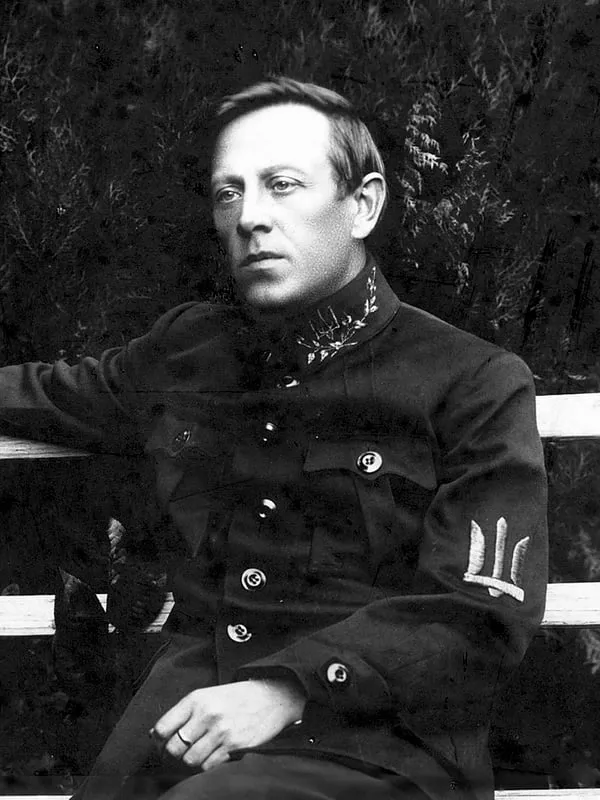
- Born:
- 22 May 1879, Poltava (Ukraine)
- Died:
- 25 May 1926, Paris
- Author:
- Natalia
- Photo:
- autor nieznany, domena publiczna, Wikimedia Commons

Symon Petliura was a journalist who within a few revolutionary months became a military leader. Until 1917 he had never worn a uniform, and he spent the war as an official of the zemstvo organisations behind the Russian front. After the fall of tsarism he headed the Ukrainian military movement, organised the first units of the Ukrainian People’s Republic and defended Kyiv against the Bolsheviks. In November 1918, when the Central Powers had lost the war, he led the uprising against Hetman Skoropadskyi and as Chief Otaman restored the republic. He was never an ally of the Central Powers: he fought the Bolsheviks, opposed the German occupation, and after the war sought support from the victorious Allies and from Poland. In 1920 he concluded an alliance with Józef Piłsudski. For Ukrainians he is a symbol of the struggle for independence; for many Jews, a symbol of the pogroms that were committed in 1919–1920 by, among others, his troops.
Before the war
He was born on 22 May 1879 (10 May Old Style) in a suburb of Poltava, into a townsman’s family of Cossack roots. His father ran a cab business, the family was very devout, and the son was meant to become a priest. In 1895–1901 he studied at the Poltava seminary, from which he was expelled when it emerged that he belonged to a secret Ukrainian hromada. In 1900 he joined the Revolutionary Ukrainian Party. Fearing arrest, in 1902 he left for the Kuban, where he taught at a school and put in order the archives of the Kuban Cossack Host. At the end of 1903 he was imprisoned for party activity, and after being released on bail he made his way to Austrian Lviv.
He returned to Russia after the amnesty of 1905. He was active in the Ukrainian Social Democratic Labour Party, which grew out of the RUP, and worked as a journalist in St Petersburg and Kyiv. It was then that his quarrel with Volodymyr Vynnychenko began, which lasted more than a decade and at the turn of 1918 and 1919 divided the leadership of the Ukrainian revolution. Around the turn of the decade, after several years in St Petersburg, Petliura moved to Moscow. He worked as an accountant in an insurance company, and from 1912, together with Oleksandr Salikovsky, edited the Russian-language monthly Ukrainskaya Zhizn, which brought the Ukrainian cause closer to Russian public opinion.
The war, 1914–1917
The outbreak of war put the Ukrainian movement in Russia in a difficult position. In Lviv émigrés from Russia founded the Union for the Liberation of Ukraine, which counted on the defeat of tsarism and co-operated with Austria-Hungary and Germany. The Russian authorities suspected the whole Ukrainian movement of Austrophilia, closed its newspapers and exiled its activists. Petliura chose a different path. In the pages of Ukrainskaya Zhizn he published an article, “The War and the Ukrainians”, in which he gave assurances that Ukrainians, as subjects of the empire, would loyally do their duty, and expressed the hope that after the war the authorities would change their attitude to the Ukrainian question. Thanks to this the journal survived until 1917, but Vynnychenko later reproached it for having preached “war to a victorious end”, and opponents accused Petliura of Russophilia.
In 1916 he joined the All-Russian Union of Zemstvos, which organised supplies and medical aid for the army. As deputy plenipotentiary of its committee on the Western Front he settled with his family in Minsk, where the front’s headquarters was located. This work gave him a knowledge of the army and of the people whom he was to gather around him after the revolution.
1917: military secretary
After the February Revolution Petliura organised in Minsk a Ukrainian congress of soldiers of the Western Front and became chairman of its council. In May he went as a delegate to the First All-Ukrainian Military Congress in Kyiv. The congress backed the demand for Ukrainian autonomy and the Ukrainisation of the army, and Petliura became head of the Ukrainian General Military Committee elected there and joined the Ukrainian Central Rada, chaired by Mykhailo Hrushevsky. When the General Secretariat, the Rada’s government, was formed at the end of June, he took charge of military affairs in it. He was the only member of the cabinet who treated building an army as a matter of the first importance. Vynnychenko and some of the socialists in the Rada wanted to replace a standing army with a people’s militia, while the Provisional Government viewed Ukrainisation with growing mistrust.
After the Bolshevik coup in Petrograd Petliura was the man of action in Kyiv. In November Ukrainian units took over the offices in the city, and then disarmed and sent off to Russia the regiments and Red Guards sympathetic to the Bolsheviks. On his orders Pavlo Skoropadskyi, commander of the 1st Ukrainian Corps, halted the Bolshevised 2nd Guards Corps, which was marching on Kyiv. The Council of People’s Commissars regarded the disarming of its units as a hostile act, and Joseph Stalin, the commissar for nationalities, pointed to Petliura as the main culprit of the conflict. Vynnychenko, who still hoped for an agreement with Petrograd, brought about his departure from the government at the end of December. Some sources speak of dismissal for exceeding his powers, others of resignation in protest.
The Haidamaks and the Arsenal
Petliura did not leave the army. On the left bank of the Dnieper he organised the Haidamaka Kish of Sloboda Ukraine, a volunteer unit which as early as January 1918 fought the Bolshevik troops advancing from Russia. When at the end of January a Bolshevik uprising of the workers of the Arsenal plant broke out in Kyiv, the Haidamaks returned to the city, and it was Petliura who directed the assault on the factory that ended the fighting on 4 February. A few days later, however, Kyiv was taken by the troops of Mikhail Muravyov, and the Rada fled to Zhytomyr. In Brest its delegates meanwhile signed a peace with the Central Powers and asked the Germans for help.
On 1 March Petliura’s Haidamaks entered Kyiv as one of the first Ukrainian units, ahead of the Germans, and the next day their commander took a parade on St Sophia Square. The socialist ministers, however, again suspected him of dictatorial ambitions and in mid-March took his command away from him. For a time Petliura then became a civilian.
Against the Hetman
After Skoropadskyi’s coup Petliura found himself in opposition. He headed the Kyiv provincial zemstvo and the All-Ukrainian Union of Zemstvos, which under the Hetmanate were one of the few legal footholds of the Ukrainian socialists. The network of zemstvos and their money helped him prepare the ground for a future uprising. On the night of 26/27 July 1918 the Hetman’s police, in agreement with the Germans, arrested several dozen left-wing Ukrainian politicians. Petliura spent almost four months in a Kyiv prison without trial.
He was released only around 12 November, when the collapse of Germany had already sealed the fate of the Hetmanate. Skoropadskyi later wrote that he had done so under German pressure. On the night of 13/14 November the opposition elected a five-member Directorate headed by Vynnychenko, and Petliura took command of its army as Chief Otaman. When the Hetman proclaimed a federation with Russia, Petliura issued his own universal in Bila Tserkva calling for an uprising. The main force was the Sich Riflemen of Yevhen Konovalets, former Austrian soldiers from Galicia, but the uprising quickly spread to the countryside, embittered by the return of the landowners and by German requisitions. The Hetman’s units went over to the insurgents, and the German soldiers’ councils agreed to remain neutral.
On 14 December the Hetmanate fell, and on 19 December the members of the Directorate made a ceremonial entry into Kyiv. A few days earlier Petliura had had to choose between war and submission to the Entente. When the French landed in Odessa and demanded the withdrawal of his troops from the city, he ordered the fighting to stop and the troops to move north. He hoped for recognition from the victorious powers and did not want a war with them.
After the war
From its first days the reborn republic fought on many fronts. In February 1919, under pressure from the Red Army, the Directorate left Kyiv, Vynnychenko went abroad, and Petliura became chairman of the Directorate and the de facto leader of the state. Throughout 1919 his troops, from the summer together with the Ukrainian Galician Army, fought the Bolsheviks and the Whites of Anton Denikin. In December, surrounded by his enemies, Petliura left for Warsaw. In April 1920 he concluded an agreement with Józef Piłsudski: he recognised the Polish border on the Zbruch, giving up Eastern Galicia, in return for military aid. Polish and Ukrainian troops took Kyiv on 7 May during the Kiev offensive, but after the Red Army’s counter-offensive they had to withdraw. The Peace of Riga of 1921 wrecked Petliura’s plans, and his soldiers were interned in Poland.
From 1924 Petliura lived in Paris and headed the government in exile of the Ukrainian People’s Republic. On 25 May 1926 he was shot dead in the street in the Latin Quarter by Sholem Schwarzbard, a Jewish watchmaker and anarchist, who claimed he was taking revenge for the pogroms in which his family had died. In October 1927 a Paris jury acquitted him. The trial turned into a trial of Petliura and remains a matter of dispute to this day. Petliura is buried in the Montparnasse Cemetery.
Assessment
For Ukrainian historians Petliura is above all the man who in 1917 began to build a Ukrainian army and for three years, in a hopeless position, never stopped fighting for an independent state. It is pointed out that he was one of the few politicians in the leadership of the revolution ready to act decisively while his colleagues still believed in an agreement with the Bolsheviks or in replacing the army with a militia. Critics, including some in the Ukrainian camp, reproached him for being self-taught as a commander, for relying on undisciplined otamans, and for an alliance with Poland that cost the Ukrainians of Galicia their cause.
The gravest dispute concerns the pogroms. In 1918–1921, according to various estimates, between 50,000 and more than 100,000 Jews were killed in Ukraine, and some researchers give as many as 200,000. All the warring sides committed murders, according to many historians most of all Denikin’s Whites, but a significant share of the pogroms was committed by units subordinate to the Directorate, especially in 1919. Most researchers believe that Petliura did not order the pogroms, and that in 1919 he issued orders forbidding them and threatening the perpetrators with severe punishment. Critics point out, however, that he reacted late, that the guilty were rarely punished, and that as commander-in-chief he bore responsibility for his soldiers. This dispute, inflamed by the Paris trial, makes him one of the most divisively remembered figures in the history of Eastern Europe.
Sources
Spotted a mistake?Report an error
Often appears with
People who appear in the same events.