Ukraine · The Central Powers
Mykhailo Hrushevsky
Chairman of the Ukrainian Central Rada (1917–1918)
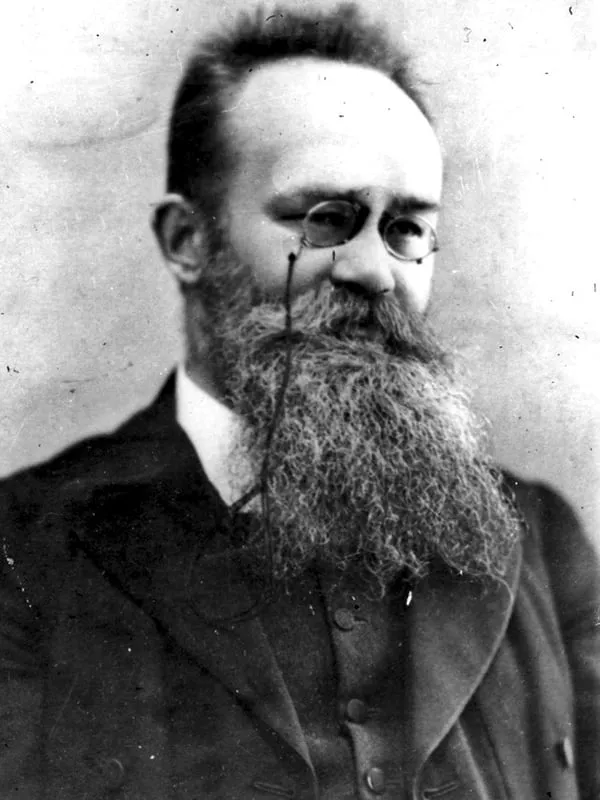
- Born:
- 29 September 1866, Chełm (Poland)
- Died:
- 24 November 1934, Kislovodsk (Russia)
- Author:
- Łukasz Skowroń
- Photo:
- autor nieznany, domena publiczna, Wikimedia Commons

Mykhailo Hrushevsky was a historian who wrote the history of Ukraine as the history of a separate nation, and then for a year stood at the head of the Ukrainian revolution. During the war the Russian authorities considered him an Austrian agent and exiled him to the Russian interior. After the February Revolution he returned to Kyiv as the unquestioned authority of the national movement and chairman of the Ukrainian Central Rada. For most of 1917 he wanted autonomy for Ukraine within a federal, democratic Russia. In January 1918, as Bolshevik troops marched on Kyiv, it was he who read out the universal that proclaimed independence. The Rada made peace with the Central Powers and returned to Kyiv under the protection of their troops, but the Germans soon got rid of it. He was not, however, Berlin’s man: he was a socialist and a federalist, and he turned to the Germans for help out of necessity, when the republic was losing the country.
Before the war
He was born on 29 September 1866 (17 September Old Style) in Chełm, where his father, a teacher and author of Church Slavonic textbooks, taught at the gymnasium. He spent his childhood and youth in the Caucasus and passed his school-leaving examinations in Tiflis. He studied history at the University of Kyiv under Volodymyr Antonovych, founder of the Kyiv school of history. In 1894, on his recommendation, he took up the newly created chair of East European history, in fact of Ukrainian history, at the University of Lviv in Austrian Galicia.
Lviv became the base for his great work. In 1897–1913 he presided over the Shevchenko Scientific Society, which he turned into something like a Ukrainian academy of sciences, and with Ivan Franko he published the most important literary and political journal of the Ukraine of the time. In 1898 the first volume of his History of Ukraine-Rus’ appeared, a monumental synthesis on which he worked for the rest of his life. In an article of 1904 he challenged the Russian scheme of history, in which Kyivan Rus’ passes directly into the Muscovite state, and described the Ukrainians as a separate nation with an unbroken history of its own. After the revolution of 1905 he spent more and more time in Kyiv. There he founded the Ukrainian Scientific Society and co-founded the secret Society of Ukrainian Progressives (PL), a moderate organisation that demanded a constitution and autonomy for Ukraine. Before 1914 he was the generally recognised leader of the Ukrainian movement in both empires.
War and exile
The outbreak of war found him on holiday in Kryvorivnia in the Carpathians, on the Austrian side of the border. He was a Russian subject and did not want to remain in an enemy country. He returned to Kyiv by a roundabout route, through Hungary, Vienna and neutral Romania, in November 1914. The authorities were waiting for him with an arrest warrant ready. He was accused of Austrophilia, contacts with the enemy and involvement in creating the Legion of Ukrainian Sich Riflemen, a volunteer formation of Galician Ukrainians in the Austro-Hungarian army. After nearly three months in prison, in February 1915, he was exiled to Simbirsk on the Volga.
Thanks to the intercession of the Russian Academy of Sciences he was allowed in the autumn of 1915 to move to Kazan, where he could work in libraries, although he was not permitted to lecture. In 1916 he moved, under police supervision, to Moscow. Meanwhile in Lviv, occupied by the Russians and then retaken by the Austrians, the university deprived him of his chair in 1916. In Moscow Hrushevsky again worked in the archives, wrote further volumes of the History and contributed to the journal Ukrainskaya Zhizn, edited by Symon Petliura. War and repression convinced him that the Ukrainian cause in Russia depended on a change of the whole state.
Chairman of the Central Rada
After the February Revolution the Central Rada was formed in Kyiv. On 20 March 1917 (7 March Old Style) it elected Hrushevsky chairman in his absence, and a few days later he arrived from Moscow and took over its leadership. He joined the party of the Ukrainian Socialist Revolutionaries, the strongest in the Rada. His programme was broad territorial autonomy for Ukraine within a federal Russian republic. As long as Russia was democratic, Hrushevsky saw no need to break with it, and he was reluctant to think about creating a strong army. In the following months the Rada under his chairmanship proclaimed autonomy in the First Universal in June, forced the Provisional Government to recognise the General Secretariat as the country’s government, and after the Bolshevik coup, on 20 November, proclaimed the Ukrainian People’s Republic in the Third Universal, still as part of a future federation.
There was no one left to form the federation with. The Rada did not recognise the Bolshevik Council of People’s Commissars, which in December declared war on Kyiv. The Rada sent its own delegation to Brest, and on the night of 24/25 January 1918 Hrushevsky opened the session at which the Fourth Universal, dated 22 January, was adopted. He himself read out the sentence declaring that the Ukrainian People’s Republic was becoming an independent, free and sovereign state. Two weeks later the Rada fled Kyiv before the troops of Mikhail Muravyov, and during the shelling of the city Hrushevsky’s house burned down together with his library and collections. In Zhytomyr and Korosten the chairman supported the ratification of the Treaty of Brest-Litovsk and the summoning of German troops. On his motion the Little Rada then adopted the tryzub, the emblem of the princes of Kyiv, as the republic’s coat of arms.
Under German bayonets
The Rada returned to Kyiv in March 1918. It presented the Germans and Austrians as allies rather than occupiers, and Hrushevsky argued in his articles of the time that Ukraine must turn away from Moscow towards the West and the Black Sea. In April he protested when Bessarabia joined Romania without Kyiv’s participation. The socialist government, however, was unable to deliver grain to the Germans, and its land reform alarmed their commanders. On 29 April, the day of Skoropadskyi’s coup, the Rada met for the last time and adopted the republic’s constitution. According to a tradition that later became widespread, it then elected Hrushevsky president. Historians point out that the constitution provided for no such office, and that in the Rada’s documents Hrushevsky always appears as its chairman. Under the rule of Hetman Pavlo Skoropadskyi he went into hiding, wrote historical works and refused to join the Ukrainian Academy of Sciences founded by the Hetman.
After the war
After the fall of the Hetmanate he did not regain his former position. In 1919 he went abroad and in Prague and Vienna was active in the émigré leadership of the Ukrainian Socialist Revolutionaries, inclining more and more towards an accommodation with the Soviet government. In 1924, during the policy of Ukrainisation, he returned to Kyiv as a member of the All-Ukrainian Academy of Sciences and for several years directed research there on the history of Ukraine. From 1929 he was attacked as a nationalist; in 1931 he was arrested and forced to live in Moscow. He died on 24 November 1934 in Kislovodsk after an operation. The circumstances of his death aroused suspicion from the start. Some sources give the date as 25 November. He was buried in Kyiv.
Assessment
As a historian Hrushevsky has no rival among Ukrainians. His History of Ukraine-Rus’ created the framework in which the history of Ukraine is thought about to this day, and in independent Ukraine he is a national hero whose portrait appears on a banknote. As a politician he is often judged far more harshly. Critics, from Petliura and the Hetman’s monarchists to many later historians, reproached him for believing too long in federation with Russia, neglecting the building of an army and allowing the republic, at the moment of trial, to have nothing to defend itself with. His defenders reply that in 1917 autonomy was the programme of almost the entire Ukrainian movement, and that Hrushevsky did more than anyone to make statehood grow out of a cultural movement. To Poles he was associated with Ukrainian claims to the Chełm Land, which under the Treaty of Brest fell to Ukraine, making the historian’s native town a symbol of the dispute.
Sources
Spotted a mistake?Report an error
Often appears with
People who appear in the same events.