Ukraine · The Entente
Volodymyr Vynnychenko
Chairman of the General Secretariat of the Central Rada (1917–1918), Chairman of the Directorate of the Ukrainian People's Republic (1918–1919)
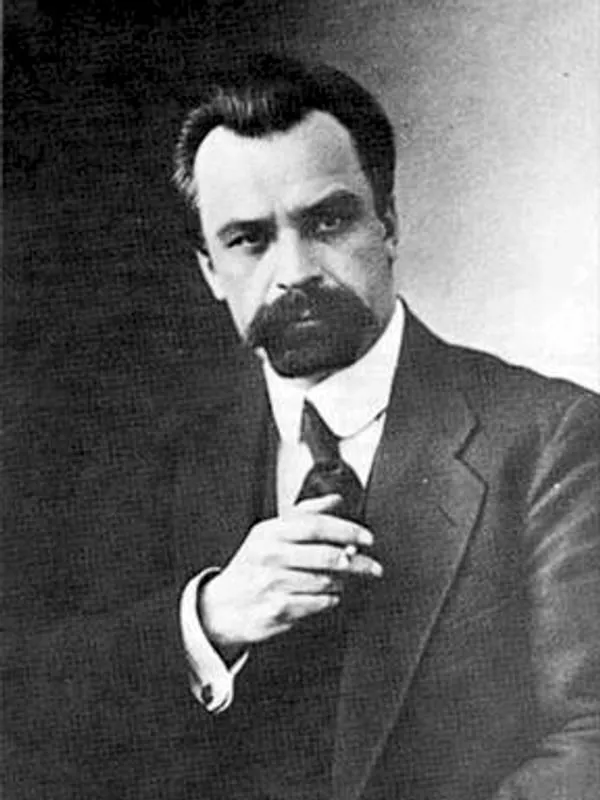
- Born:
- 28 July 1880, Yelisavetgrad (now Kropyvnytskyi, Ukraine)
- Died:
- 6 March 1951, Mougins (France)
- Author:
- Natalia
- Photo:
- autor nieznany, domena publiczna, Wikimedia Commons

Volodymyr Vynnychenko was the most popular Ukrainian writer of his generation and one of the three men who led the Ukrainian revolution. In 1917, as the first head of the Central Rada’s government, he negotiated autonomy for Ukraine with Petrograd. In the winter of 1917–1918, when Kyiv found itself at war with the Bolsheviks, he headed the cabinet that sent a delegation to the peace negotiations at Brest. In November 1918 he became head of the Directorate that overthrew Hetman Skoropadskyi. He tied himself neither to the Central Powers nor to the Entente. He was a socialist, an opponent of a standing army and an advocate of agreement with the Russian revolution, and in 1918 he fought the hetmanate that rested on German bayonets. His quarrel with Symon Petliura split the leadership of the reborn republic.
Before the war
He was born on 28 July 1880 (16 July Old Style) in Yelisavetgrad, now Kropyvnytskyi, into a poor family. His father was a former farmhand who had moved to the town. Some sources give the suburban village of Velykyi Kut as his birthplace. He was expelled from grammar school for a revolutionary poem, but passed his school-leaving examinations as an external candidate. In 1901 he began studying law in Kyiv and joined the Revolutionary Ukrainian Party. For agitation among workers and peasants he was expelled from the university and imprisoned. Drafted into a disciplinary battalion, he deserted and from then on for over a decade lived illegally or in exile, crossing the border several times with party literature.
He won fame with his first short story, “Krasa i syla” (“Beauty and Strength”), of 1902. In the following years he wrote stories, novels and plays, which were also staged in theatres abroad. He scandalised the traditional public with his treatment of morals and his merciless portrait of revolutionaries, and his slogan of “honesty with oneself” provoked a long controversy in the Ukrainian press. He was at the same time one of the leaders of the Ukrainian Social Democratic Labour Party. In his years of exile he lived in Lviv, Switzerland, France and Italy. As early as 1905 he alienated the young Symon Petliura, who persuaded a party congress not to entrust him with the editorship of a paper. Their mutual dislike lasted to the end.
The war, 1914–1917
The outbreak of war found him abroad. He returned secretly to Russia and until 1917 lived under an assumed name, mainly in Moscow, devoting himself to literature. As a Social Democrat he regarded the war as imperialist, and later sharply criticised the loyalist line of some Ukrainian activists in Russia, including Petliura’s Moscow journal “Ukrainskaya Zhizn”. Nor did he join the Galician-based Union for the Liberation of Ukraine, which was counting on a victory of the Central Powers. In these years he wrote the novel “Notes of a Snub-Nosed Mephistopheles”, published in 1917.
1917: head of government
After the February Revolution he returned to Kyiv and joined the Ukrainian Central Rada, where he became one of the two deputies of its chairman, Mykhailo Hrushevsky. He was the author or co-author of most of its declarations. In May he led a delegation to Petrograd demanding autonomy, but the Provisional Government refused. On 23 June (10 June Old Style) it was Vynnychenko who read out to a military congress the First Universal, which proclaimed that Ukraine would order its own life. A few days later he became head of the General Secretariat, the first Ukrainian government, and took charge of internal affairs in it.
In July he negotiated in Kyiv with ministers of the Provisional Government, among them Alexander Kerensky and Irakli Tsereteli. The agreement, under which Petrograd recognised the Secretariat as its organ in Ukraine, was announced in the Second Universal, and the concessions to Kyiv set off a government crisis in Petrograd. Vynnychenko, however, regarded a standing army as obsolete and wanted to replace it with a people’s militia, which led to sharp clashes with Petliura, the secretary for military affairs.
After the Bolshevik coup the Rada proclaimed the Ukrainian People’s Republic, and Vynnychenko’s cabinet took power in nine governorates. The head of government long hoped for an agreement with the Bolsheviks, who also called themselves socialists. But when on 17 December the Council of People’s Commissars presented Kyiv with an ultimatum, demanding among other things that it stop disarming Soviet units and letting Cossacks through to the Don, the cabinet rejected it. Vynnychenko then blamed Petliura as the chief culprit of the conflict and brought about his departure from the government. On 24 December his cabinet announced that Ukraine would conduct its own foreign policy, and sent a delegation to Brest-Litovsk. A note signed by Vynnychenko and the secretary for international affairs, Oleksandr Shulhyn, was read out there on 10 January, and Leon Trotsky did not object to the Ukrainians taking part in the negotiations.
After the proclamation of the Fourth Universal, which declared independence, the cabinet was called the Council of People’s Ministers. At the end of January 1918, amid party quarrels and defeats at the front, Vynnychenko resigned, and the government was taken over by Vsevolod Holubovych. A few days later the Bolsheviks took Kyiv. Vynnychenko left with his wife for the south and withdrew from politics.
The Directorate
Under the rule of Hetman Pavlo Skoropadskyi he lived in the countryside near Kaniv and wrote, but soon returned to opposition. He described the coup that brought the hetman to power as the work of impoverished landowners, factory owners, a bribe-taking bureaucracy and the officer corps. From August 1918 he chaired the Ukrainian National Union, which brought together the Ukrainian parties and organisations opposed to the hetman. As Germany was losing the war, the Union prepared an uprising. According to his later accounts, Vynnychenko was then in contact with the Soviet negotiators in Kyiv, Christian Rakovsky and Dmitry Manuilsky, counting on the Bolsheviks’ neutrality.
During the night of 13–14 November 1918 he became chairman of the five-member Directorate, which the next day called for an uprising. The main force was the Sich Riflemen, whose commander Yevhen Konovalets Vynnychenko had himself persuaded to take action, but the uprising quickly spread across the whole countryside. On 14 December the hetmanate fell, and on 19 December Vynnychenko, as chairman of the Directorate, made a ceremonial entry into Kyiv. On 26 December the Directorate announced its programme: abolition of the hetman’s laws, handing over the landowners’ land to the peasants and the convening of a Labour Congress (PL), elected by peasants, workers and the working intelligentsia.
After the war
The victory soon dissolved into conflict. Vynnychenko wanted councils and social reforms that would deprive the Bolsheviks of the countryside’s support, and an agreement with Moscow. Petliura relied on the army and its otamans and sought support from the Entente. In February 1919, when the Red Army occupied Kyiv, Vynnychenko stepped down from the Directorate and went abroad. In Vienna he wrote the three-volume “The Rebirth of a Nation”, a history of the revolution of 1917–1919, and announced his conversion to communist positions. In 1920 he went to Moscow and Kharkiv, where he was offered the post of deputy prime minister of Soviet Ukraine. When he was refused a place in the party leadership, he returned to exile. He settled in France, from 1934 in Mougins near Cannes, where he wrote, painted and preached his own moral philosophy, which he called concordism. He died there on 6 March 1951.
Assessment
As a writer Vynnychenko is one of the classics of Ukrainian literature, although in the Soviet Union his books were banned for decades. As a politician he is often judged harshly, and from different sides. Petliura’s supporters and Ukrainian conservatives accused him of weakening the building of an army in the critical year 1917, of trusting the Bolsheviks for too long and of sidelining Petliura when the republic most needed him. The left valued him for the consistency with which he combined the national cause with social reform. Many historians point out that his “The Rebirth of a Nation” and his extensive diary are among the most important, though highly partisan, sources for the history of the Ukrainian revolution, and that his fate illustrates well the dilemma of Ukrainian socialists torn between a national state and social revolution.
Sources
Spotted a mistake?Report an error
Often appears with
People who appear in the same events.