Poland · The Polish cause
Roman Dmowski
President of the Polish National Committee in Paris (1917–1919), Polish delegate to the Paris Peace Conference
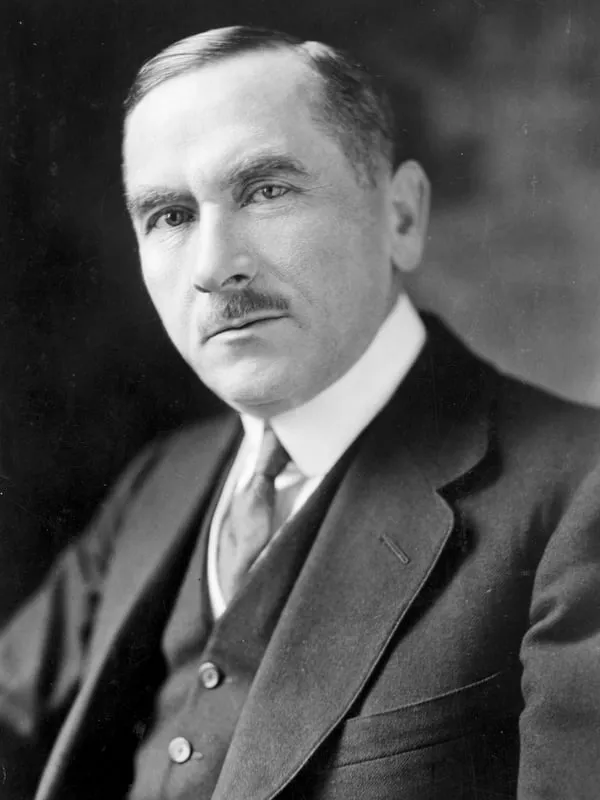
- Born:
- 9 August 1864, Kamionek near Warsaw (Russian Empire)
- Died:
- 2 January 1939, Drozdowo near Łomża
- Author:
- Łukasz Skowroń
- Photo:
- Harris & Ewing, domena publiczna, Wikimedia Commons

During the Great War Roman Dmowski was the chief opponent of Józef Piłsudski and his mirror image. In 1914 Piłsudski staked everything on Austria against Russia; Dmowski staked it on Russia and her Western allies against Germany, in which he saw Poland’s mortal enemy. For the first year of the war he worked in Warsaw and Petrograd, hoping for the unification of the Polish lands under the Tsar’s sceptre. When Russia proved weak, he moved to the West and for three years tried to convince London, Paris and Washington that they needed an independent Poland. The Polish National Committee he founded in 1917 became the Entente’s recognised representative of the Poles; it had its own army in France and in 1919 provided the core of the Polish delegation to the peace conference. Dmowski signed the Treaty of Versailles. He was at the same time a nationalist politician and an avowed antisemite, which already then harmed him in the eyes of his Western partners and still weighs on how he is judged today.
Before the war
He was born on 9 August 1864 in Kamionek near Warsaw, into a poor family of craftsmen of noble descent. He studied natural sciences at the Imperial University of Warsaw and was already active in the patriotic underground as a student. In 1893 he took over the leadership of the secret National League, from which grew the camp of National Democracy, known as the Endecja. For taking part in a demonstration on the centenary of the Constitution of 3 May he was sent to the Citadel and then into exile in Mitau, from where in 1895 he escaped to Lviv. In his book Thoughts of a Modern Pole (PL), published in 1903, he set out a programme of “national egoism”: the nation is the highest value, and politics is a struggle for its existence against other nations.
What mattered most for the war was his reading of Poland’s position. He believed that the main threat was Germany, which denationalised Poles more effectively than Russia did and for which the existence of Poland was a matter of life and death. Russia was weaker and less dangerous, and in alliance with France it could become the instrument for uniting the Polish lands. He set this out in his 1908 book Germany, Russia and the Polish Question. In 1907–1909 he was a deputy to the State Duma and chaired its Polish caucus. During the Revolution of 1905 he fought the socialists and plans for an uprising, and his conciliatory course towards St Petersburg cost him the departure of some of the younger activists. In 1912 he lost the election to the Fourth Duma in Warsaw to a candidate backed by Jewish voters, and responded with a call to boycott Jewish trade. In the autumn of that year, at a secret congress in Pieniaki in Eastern Galicia, the leaders of the Endecja from all three partitions decided that in a future war the Poles should stand against Germany.
1914–1915: the Russian card
Dmowski took the outbreak of war as confirmation of his conception. He welcomed the declaration of loyalty made by the Polish deputies in the Duma on 8 August 1914, and regarded the proclamation of Grand Duke Nicholas of 14 August, which promised the unification of Poland under the Tsar’s sceptre, as the foundation of Polish policy. On 25 November 1914 the Polish National Committee was formed in Warsaw, bringing together the National Democrats and conservatives of the Kingdom. It was chaired by Count Zygmunt Wielopolski, while Dmowski headed its Executive Committee. The committee fought the Legions and the Supreme National Committee in Kraków, and patronised the Puławy Legion being formed on the Russian side.
This policy had its achievements. In the view of many historians it was largely thanks to it that the Kingdom did not follow Piłsudski and that its inhabitants received the legionnaires coolly. Dmowski, however, failed to obtain anything concrete from Russia. The Tsarist government did not want to bind itself with promises, and plans for autonomy for the Kingdom got bogged down in commissions. In June 1915 Dmowski went to Petrograd, and after the Germans took Warsaw he concluded that further efforts in Russia were pointless. At the beginning of November 1915 he left Russia and travelled via Scandinavia to London.
1915–1917: in the West
In the West Dmowski had to start from scratch. As long as the alliance with the Tsar lasted, the governments of France and Britain treated the Polish question as an internal Russian affair and avoided any declarations on it. Dmowski therefore built influence indirectly: through journalists, scholars and officials. He became friends with Henry Wickham Steed of The Times, gave lectures, and in August 1916 received an honorary doctorate from the University of Cambridge. He visited Paris, Rome and Lausanne, where his associates ran a Polish press bureau. In February 1916 he submitted a memorandum to the Russian ambassador in Paris, Alexander Izvolsky, in which, according to his later accounts, he presented Polish independence for the first time as a realistic political aim. The Russians received it unwillingly.
After the Act of 5 November Dmowski argued to the Allies that if the Entente did not counter the German promise of a Polish state, Berlin would gain Polish soldiers. The breakthrough, however, came only with the fall of Tsarism. In March 1917, even before the proclamation of the Russian Provisional Government, he submitted to the Foreign Office a memorandum on the rebuilding of a strong Poland from all three partitions as a barrier against Germany, and in April the Western powers backed Polish independence. He had long advocated a Polish army on the side of the Entente, and in June France agreed to the creation of an autonomous Polish army. In July he circulated to Western politicians the memorandum “Problems of Central and Eastern Europe”, in which he outlined the borders of a future Poland: with Greater Poland, Pomerania and Danzig, Upper Silesia and the southern part of East Prussia, and in the east with the lands where the Polish element predominated. At the same time he demanded the break-up of Austria-Hungary into nation states.
The Polish National Committee
On 15 August 1917 in Lausanne Dmowski founded the Polish National Committee and became its president. The committee soon moved to Paris and within three months won recognition from France, Britain, Italy and the United States as the official Polish organisation. Ignacy Jan Paderewski became the committee’s representative in America. The KNP’s membership was balanced geographically but not politically: it included National Democrats and conservatives, but no one from the left and none of Piłsudski’s people. According to some historians Dmowski also refused, despite Paderewski’s urging, to admit a representative of the Polish Jews to the committee. He saw its purpose not only as representing the Poles but also, as the historian Janusz Pajewski wrote, as turning the committee into a government at the right moment.
Recognition of the committee was only the beginning. Dmowski fought for political authority over the army in France, which the French wanted to keep in their own hands. In February 1918 the committee obtained political direction of it, and an agreement of 28 September recognised it as the supreme authority of the Polish Army, “autonomous, allied and co-belligerent”. Earlier, on 22 June, Dmowski had spoken in Champagne at the presentation of colours to the first regiments. On 4 October the committee appointed as commander-in-chief Józef Haller, who had made his way from Russia to France in the summer. Dmowski later wrote that the army was “our only title to the status of an allied state”.
He regarded the Versailles declaration of 3 June 1918, in which the prime ministers of France, Britain and Italy recognised a united and independent Poland with access to the sea as a condition of a just peace, as the greatest success of his diplomacy. In August 1918 he went to the United States. According to Polish biographers he twice spoke with President Woodrow Wilson, in September and November, presented memoranda on Poland’s borders and lobbied for American recognition of the army, which came on 1 November. Wilson later recalled that when he asked Dmowski and Paderewski to define what Poland was, they presented him with a map on which they claimed “a large part of the earth”.
November 1918 and the peace conference
For Dmowski the war ended in a paradox. Poland came into being, but power in Warsaw was taken by Piłsudski, his oldest opponent, who appointed a socialist government. The committee recognised neither Jędrzej Moraczewski’s government nor Piłsudski’s notification, while the Allies continued to see the KNP as Poland’s representation. This threatened a dual authority and even a clash between Haller’s Army and the army at home. A compromise was reached at the turn of 1918 and 1919, largely thanks to Paderewski, who came home as a man trusted by the Allies. Paderewski became head of the government, the committee co-opted representatives of the Chief of State and recognised the new cabinet, and Dmowski became Poland’s first delegate to the Paris Peace Conference.
On 29 January 1919 he spent about five hours presenting Poland’s demands to the Council of Ten, translating his own speech into French and English. The speech was judged masterly. He did not carry his programme in full. Danzig became a free city, plebiscites were to decide Upper Silesia, Warmia and Masuria, and Poland was obliged to sign a minorities protection treaty, against which Dmowski protested vehemently. His relations with David Lloyd George, who opposed the far-reaching Polish claims in the west, were particularly bad. On 28 June 1919 Dmowski and Paderewski signed the Treaty of Versailles on behalf of Poland.
After the war
After returning home Dmowski remained the leader of the national camp but seldom held office. In the autumn of 1923 he was foreign minister in Wincenty Witos’s government for less than two months. After the May Coup he founded the Camp of Great Poland in 1926 and the National Party in 1928. In the 1930s his views were increasingly coloured by antisemitism and admiration for Fascist Italy, and under his influence the national camp grew more radical. After a stroke in 1937 he went to live with friends at Drozdowo near Łomża, where he died in the night of 1–2 January 1939. His funeral in Warsaw drew enormous crowds.
Assessment
In Poland Dmowski is written about above all in comparison with Piłsudski. His associates, such as Stanisław Kozicki, and later many historians saw in him the architect of a diplomatic victory: it was he who made the Western Allies adopt the Polish cause as their own, who ensured that Poland had an army on the side of the victors, and whose programme the western border of the reborn state, with Greater Poland and Pomerania, largely matched. Biographers, among them Roman Wapiński and Krzysztof Kawalec, stress that his calculation of 1914, based on an Entente victory and German defeat, ultimately proved correct, even though Russia, on which he had originally relied, fell apart along the way.
Critics point out that the first years of his policy were a game for autonomy under the Tsar’s sceptre and that he came round to independence only when Russia was weakening. They also note that the Allies’ recognition of the KNP decided nothing until the defeat of all three partitioning powers came. Western historians recall that in London and Washington his antisemitism and sweeping territorial claims aroused distrust. Lewis Namier, the Foreign Office’s expert on Polish affairs, was his determined opponent, and one British diplomat wrote of him that he was a man too intelligent and too consistent to be trusted. Today it is generally accepted that both great wartime rivals contributed to independence. Piłsudski built the army and the authority at home; Dmowski won Poland a place at the victors’ table. The dispute over whose contribution weighed more, and the judgement of his nationalism, still divide Poles today.
Sources
Spotted a mistake?Report an error
Often appears with
People who appear in the same events.