Poland · The Polish cause
Zygmunt Zieliński
Commander of the 2nd Infantry Regiment of the Legions (1914–1915) and of the Third Brigade of the Legions (1916–1917), commandant of the Legions and of the Polish Auxiliary Corps (1917–1918)
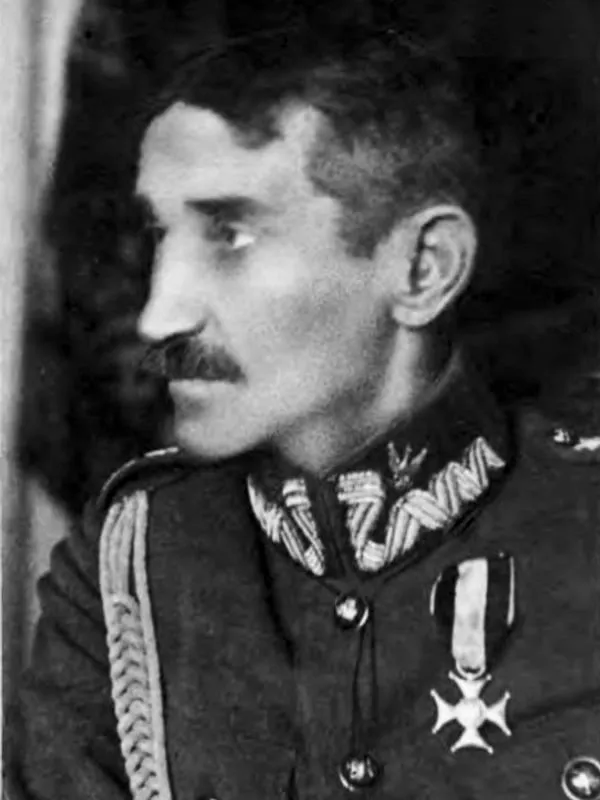
- Born:
- 1 August 1858, Rzeszotary near Kraków (Austrian Empire)
- Died:
- 11 April 1925, Kraków
- Author:
- Łukasz Skowroń
- Photo:
- autor nieznany, domena publiczna, Wikimedia Commons

Zygmunt Zieliński was one of the oldest officers of the Polish Legions. In August 1914 he was 56 and had been retired for three years with the rank of colonel of the Austro-Hungarian army, yet he volunteered for the Legions and went through the whole war with them. He commanded the 2nd Infantry Regiment in the Carpathians and Bukovina, then the Third Brigade, and from 1917 the remnants of the Legions, which as the Polish Auxiliary Corps returned under Austrian authority. His soldiers called him “Grandad” and valued him for his integrity and courage. In the politics of the Legions he sided with those who wanted to preserve a Polish army at any price, which is why he did not support the refusal of the oath in 1917, and in February 1918 he opposed the breakthrough across the front at Rarańcza. Even so, the Austrians interned him together with his soldiers.
Before the war
He was born on 1 August 1858 at Rzeszotary near Kraków, into an impoverished noble family. His father Paweł had fought in the January Uprising. He spent his childhood in the Nowy Sącz region and attended the gymnasium in Nowy Sącz. In 1875 he joined the 20th Galician Infantry Regiment in Kraków as a volunteer, and in 1878 he completed the infantry cadet school in Vienna. For more than thirty years he served in the infantry of the imperial and royal army, in Kraków, Nowy Sącz, Prague and Königgrätz, and with a battalion of the 13th Infantry Regiment also in Mostar. In November 1910 he took command of the 13th Regiment, and in December he became a colonel. He was a solid officer, but without a brilliant career, and on 1 July 1911 he retired. He settled in Kraków and was active in the field squads of the “Sokół”.
1914–1915: the Second Brigade in the Carpathians
After the outbreak of war Zieliński, together with his fellow member Władysław Turski, mobilised the Kraków “Sokół”. Called up into the Austro-Hungarian army, he immediately asked to be transferred to the Polish Legions and on 11 September 1914 took command of the 2nd Infantry Regiment then being formed. To the disappointment of the legionnaires, who wanted to fight in the Kingdom, the regiment was sent to Hungary, where together with the 3rd Regiment of Józef Haller it helped in October to drive the Cossacks out of Máramaros. The legionnaires then crossed the Carpathians into Eastern Galicia and approached Stanislau. On 29 October the 2nd Regiment fought the Battle of Mołotków, one of the bloodiest in the history of the Legions, after which the Poles had to withdraw into the mountains.
In the winter the legionnaires fought in the Eastern Carpathians during the Austro-Hungarian winter offensive. In the Battle of Kirlibaba in January 1915 Zieliński led the legionnaires along the main road to Kirlibaba, and according to dzieje.pl he in practice commanded the whole Legion group of General Karol Trzaska-Durski. The decisive attack came on 21 January, and on 22 January the legionnaires took Kirlibaba, which opened the way to the recapture of Czernowitz. On 18 February Zieliński’s units took Śniatyn. The 2nd and 3rd Regiments formed the Second Brigade, known as the Carpathian or Iron Brigade. In June 1915 it fought in Bukovina, on the Prut and at Rarańcza, and on 13 June its squadron of uhlans carried out the famous charge at Rokitna. A surviving photograph shows Colonel Zieliński decorating the uhlans after the charge.
1916–1917: the Third Brigade and the Legions Command
Valued by superiors and subordinates alike, he was quickly promoted to higher posts. At the turn of 1915 and 1916, on 2 January 1916 in Kozienice according to the Polish Wikipedia, he took over the Legions Group Command, which organised the recruiting and training base of the Legions in the Kingdom. At the end of 1916, in December according to most sources, he took command of the Third Brigade.
Zieliński respected Józef Piłsudski, but was far from his politics. What mattered most to him was building a Polish army. On 24 April 1917, when the Austrians handed the Legions over to the Germans as the nucleus of the army of the Kingdom of Poland, he became commandant of the Legions. In July, during the oath crisis, he did not support the refusal of the oath. He felt bound by the oath he had sworn earlier to the emperor and wanted to preserve a Polish army at any price. Together with General Tadeusz Rozwadowski he drew up a plan for a future Polish army. When the soldiers of the First and Third Brigades were interned, he was the author of the project to return the rest of the Legions to Austrian command. Thus the Polish Auxiliary Corps was created, built around Colonel Haller’s Second Brigade. Zieliński took command of it, on 9 October 1917 according to Radio Kraków, and in November was promoted to major general. At the end of October the corps was moved to Bukovina.
Rarańcza and internment
At the beginning of January 1918 the Austrians withdrew the corps from the front and quartered it around Czernowitz. On 9 February the Central Powers signed the peace with Ukraine, promising it the Chełm region. The legionnaires saw this as a new partition, and their commanders debated what to do. Zieliński advised laying down arms, which he considered the honourable course, and opposed the plan to cross the front to the Russian side. The proposal of the younger officers, accepted by Haller, nevertheless prevailed. On the night of 15–16 February part of the corps broke through the Austrian lines at Rarańcza. According to the IPN’s Przystanek Historia portal, the legionnaires themselves then detained their respected commander “with tears in their eyes”. The Austrians surrounded and arrested the remaining units, the trains and the corps staff with the general.
The Austrians disbanded the corps and interned its soldiers in Hungary. Zieliński spent several months in the camp at Chust (Huszt). When more than a hundred legionnaires accused of mutiny and treason were tried at Máramarossziget, he defended his subordinates before the court. The trial was ended in the autumn of 1918 by an amnesty proclaimed by Emperor Charles I.
After the war
On 8 November 1918 Zieliński joined the Polish Army as a general. He took command in Kraków and fought the Ukrainians for Przemyśl and Lviv. From April 1919 he commanded the 3rd Legions Infantry Division, which in May took Borysław with its oilfields and in June halted the Ukrainian offensive near Brzeżany. From August 1919 he was commander of the Poznań General District, and in the Polish-Soviet War he commanded the 3rd Army, which fought Budyonny’s cavalry and in August 1920 covered the strike group on the Wieprz. Piłsudski wrote of him that he covered “with remarkably small forces the flank and rear of the counter-attack group”, showing “great strength of will, decision and calm”. He then commanded the district in Toruń. On 1 January 1923 he retired at his own request as a general of arms. He died on 11 April 1925 in Kraków and, in accordance with his wishes, was buried in Rakowicki Cemetery next to the uhlans who fell at Rokitna.
Assessment
Zieliński is today an almost forgotten figure, known mainly to historians of the Legions. His contemporaries rated him highly. The commandant of the Legions, General Karol Trzaska-Durski, called him “an excellent commander, a brave soldier, a worthy man”, and his former subordinate Stanisław Rostworowski called him a “hero-commander” and wrote that when he led them “we knew we were not going in vain”. His hardest choices were those of 1917–1918. In the dispute between Piłsudski and the loyalist Legions Command, Zieliński kept away from politics, and what mattered most to him was building a Polish army, even in Austria’s service. That is why he followed neither Piłsudski in July 1917 nor Haller in February 1918, but neither did he abandon his soldiers when they stood before an Austrian court. His biographer Maciej Zakrzewski writes that his life was a record of glory, but also of the difficult choices and winding roads to independence taken by many Polish officers of the partitioning powers’ armies, who in 1918 became the cadre of the reborn Polish Army.
Sources
Spotted a mistake?Report an error