Italy · The Entente
Giovanni Giolitti
Prime Minister of Italy (1892–1893, 1903–1905, 1906–1909, 1911–1914, 1920–1921), in 1914–1915 leader of the supporters of neutrality
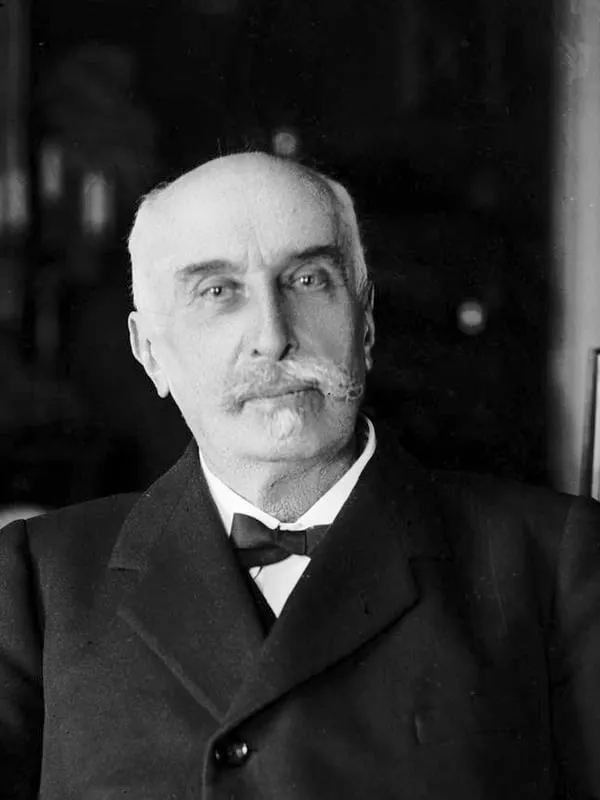
- Born:
- 27 October 1842, Mondovì (Piedmont, Kingdom of Sardinia)
- Died:
- 17 July 1928, Cavour (Piedmont)
- Author:
- Łukasz Skowroń
- Photo:
- autor nieznany, domena publiczna, Wikimedia Commons

Giovanni Giolitti was the most important politician of liberal Italy. He headed the government five times, and the years from the start of the twentieth century to 1914 went down in history as the “Giolittian era” (età giolittiana). When the Great War broke out he was already out of office, but he still had a majority of the Chamber of Deputies behind him. He believed that Italy was not ready for war, that it would be long and costly, and that “quite a lot” could be obtained from Austria-Hungary through negotiation. In May 1915 his supporters briefly brought down the government of Antonio Salandra, but Giolitti did not dare to take power, and Italy entered the war against his will. Through three years of fighting he stayed on the sidelines, accused by the supporters of the war of something close to treason. He returned as prime minister in 1920 and put an end to D’Annunzio’s adventure in Fiume, but he could not stop fascism.
Before the war
He was born on 27 October 1842 in Mondovì (PL) in Piedmont. In 1861 he graduated in law in Turin, and for twenty years he worked in the state administration: in the Ministry of Justice, in the Ministry of Finance and as secretary general of the Court of Audit. In 1882 he became deputy for the Cuneo constituency and represented it to the end of his career.
In 1889–1890 he was Treasury minister in the government of Francesco Crispi (PL). In May 1892 he became prime minister for the first time, but his cabinet fell at the end of 1893 in the shadow of the scandal surrounding the Banca Romana. Giolitti went to Germany for a time to avoid a threatened arrest. The case was eventually dropped. In 1901–1903 he was interior minister in the government of Giuseppe Zanardelli (PL), and then prime minister three times: in 1903–1905, 1906–1909 and 1911–1914. Even when he was not in office, the make-up of cabinets was decided to a large extent by the majority he controlled.
His policy was liberal and, for its time, modern. The state was not to crush strikes by force but to stay neutral in disputes between workers and employers. Giolitti courted the moderate socialists and the Catholics, prepared the nationalisation of the railways, nationalised life insurance, and in 1912 carried out a reform that came close to universal male suffrage and raised the number of voters from about 3 to 8.5 million. At the same time, in 1911, without the consent of parliament, he started the war with Turkey over Libya, which ended in October 1912 with the Peace of Ouchy. In December 1912 his government renewed the Triple Alliance with Germany and Austria-Hungary ahead of time. Giolitti won the elections of autumn 1913, the first under the new electoral law, thanks to an agreement between liberal candidates and the Catholic Electoral Union of Count Ottorino Gentiloni. This so-called Gentiloni Pact, however, weakened his position. When the Radicals withdrew from the coalition, he resigned in March 1914 and recommended Salandra to King Victor Emmanuel III as his successor. He was believed to be counting on a return to power after a few months.
Neutralist (1914–1915)
After the outbreak of war he supported the decision of the government, which declared neutrality on 3 August 1914. He also had his own arguments on the matter. On 5 December 1914 he revealed in the Chamber of Deputies that as early as the summer of 1913, during the Balkan Wars, Vienna had informed Rome and Berlin of its intention to act against Serbia and had presented the action as defensive. Giolitti, then prime minister, replied that since no one intended to attack Austria, there could be no question of a casus foederis, that is, of an obligation to give allied assistance. For the supporters of neutrality the speech was proof that the Triple Alliance did not oblige Italy to go to war on Austria’s side, and for the Entente proof that Austria-Hungary had long been looking for an opportunity to settle accounts with Serbia.
Giolitti was neither a pacifist nor a friend of Austria. He believed, however, that war was not necessary to obtain the Trentino and the other lands inhabited by Italians. On 24 January 1915 he wrote a letter to the deputy Camillo Peano, which the Rome daily “La Tribuna” soon published. In it he stated that in the present situation of Europe Italy could obtain “quite a lot” (parecchio) without war. From then on the supporters of armed intervention repeated the word with derision as a symbol of the neutralists’ pettiness.
Meanwhile the government of Salandra and the foreign minister Sidney Sonnino was negotiating with both sides. On 26 April 1915 Italy signed a secret agreement with the Entente in London, and at the beginning of May it denounced the Triple Alliance. Giolitti knew nothing of the agreement. On 9 May he arrived in Rome, greeted by hostile shouts from nationalists, and on 10 May he argued to the King and to Salandra that the war would be long and the army was not ready for it. Vienna, pressed by Berlin and its ambassador Bernhard von Bülow, was making ever more far-reaching offers of concessions. In the following days about 300 deputies, 320 according to some sources, and about a hundred senators left visiting cards at his Rome flat as a sign of support. It was a clear majority of the Chamber.
On 13 May Salandra resigned. Supporters of the war took over the streets of the big cities, and the poet Gabriele D’Annunzio called Giolitti “the intriguer of Dronero” and incited the crowds against him. Troops and police had to guard his flat. The King turned first to Giolitti, but he refused. He knew by then that the agreement with the Entente had been signed with the monarch’s consent, and he did not want to take on himself the breaking of the Crown’s commitments or to divide the country at a moment when the streets were seething. On 16 May Victor Emmanuel III refused Salandra’s resignation. On 18 May Giolitti left for Cavour in Piedmont and did not attend the sitting of the Chamber, which on 20 May granted the government war powers by 407 votes to 74. Most of the same deputies who a week earlier had been leaving cards at his door now voted for the government. On 23 May Italy declared war on Austria-Hungary.
During the war
Throughout the war Giolitti lived in Cavour and kept away from high politics. He spoke mainly at the sittings of the provincial council of Cuneo, over which he presided. For the interventionists he remained the symbol of neutralism and almost a traitor, and his name came up in every crisis. His supporters in the Chamber, however, were still numerous. In June 1916, after the Austrian offensive in the Trentino, they voted against Salandra and helped bring about the fall of his government. His successor, Paolo Boselli, even considered giving the Ministry of Justice to Luigi Facta, an associate of Giolitti, but abandoned the idea in the face of opposition from the supporters of the war. In October 1917 the Giolittians joined the attack that brought Boselli down.
In the summer of 1917 Giolitti spoke more sharply than at any time since Italy entered the war. He criticised the profiteers who had grown rich on army supplies, pointed out that the war had concentrated great wealth in the hands of a few, and announced that after it ended deep changes would be needed in domestic and foreign policy. After the defeat at Caporetto in October 1917, when the Austrians and Germans occupied a large part of Venetia, he did not, however, use the crisis against the government. The cabinet of Vittorio Emanuele Orlando, a former minister in his governments, led the country to victory at Vittorio Veneto without Giolitti’s involvement.
After the war
On 12 October 1919 at Dronero (PL) Giolitti made a speech in which he defended his neutrality, condemned the way in which Italy had been drawn into the war, and demanded that parliament, not the King and a few ministers, should decide on war and treaties. His opponents called him a “Bolshevik” for it. In June 1920, after the fall of the government of Francesco Saverio Nitti, he became prime minister for the fifth time. In September he refused to use force against the workers occupying factories in the north and waited for the movement to die out on its own. Carlo Sforza became foreign minister. On 12 November 1920 Italy and the Kingdom of Serbs, Croats and Slovenes signed a treaty at Rapallo that fixed the border and made Fiume a free city. D’Annunzio, who had held the city since September 1919, refused to submit. At Christmas 1920 Giolitti sent the army and the navy against him, and on 31 December the poet capitulated. In the dispute over Upper Silesia, Giolitti’s government stood closer to the British, who wanted to leave the industrial district to Germany, than to the French, who backed Poland.
In the elections of May 1921 Giolitti formed the national blocs, which also included the fascists of Benito Mussolini. He hoped to absorb them into the parliamentary system, as he had earlier done with the moderate socialists. The results disappointed him, and on 4 July 1921 he resigned. After the March on Rome he supported Mussolini’s government and the new electoral law, but after the murder of the socialist Giacomo Matteotti in 1924 he went into opposition. In December 1925, when the provincial council of Cuneo called on him to join fascism, he resigned his seat. On 16 March 1928 he voted in the Chamber for the last time, against the electoral law that finally ended parliamentary government. He died on 17 July 1928 in Cavour.
Assessment
Giolitti is one of the most controversial figures in Italian history. In 1909 the historian Gaetano Salvemini called him “the minister of the underworld”, accusing him of winning elections in the south through corruption, pressure from officials and the support of criminals. Critics on the right accused him of giving in to the socialists, liberal economists of abandoning the free market. He was supported by the court, the reformist socialists, much of the middle class and the philosopher Benedetto Croce (PL). His American biographer Alexander De Grand regards him as the most outstanding Italian prime minister since Camillo Cavour. Many historians admit, however, that his system, based on skilful management of parliament, was already beginning to run out of steam before 1914.
On the war, events largely proved him right. The war turned out long and costly, cost Italy, depending on the method of counting, between 460,000 and 651,000 soldiers killed and dead, and did not bring all the gains promised in London, which the nationalists called the “mutilated victory”. Some historians reproach him, however, for having given way to the court and the street in May 1915 when he had a majority in the Chamber. The way in which the will of parliament was overridden then is seen as a foretaste of the crisis that a few years later opened the way to power for the fascists. Giolitti, who for decades had taught Italians parliamentary government, himself contributed to that crisis when in 1921 he took the fascists onto his lists.
Sources
Spotted a mistake?Report an error
Often appears with
People who appear in the same events.