Italy · The Entente
Vittorio Emanuele Orlando
Minister of Justice (1914–1916) and of the Interior (1916–1919), Prime Minister of Italy (1917–1919)
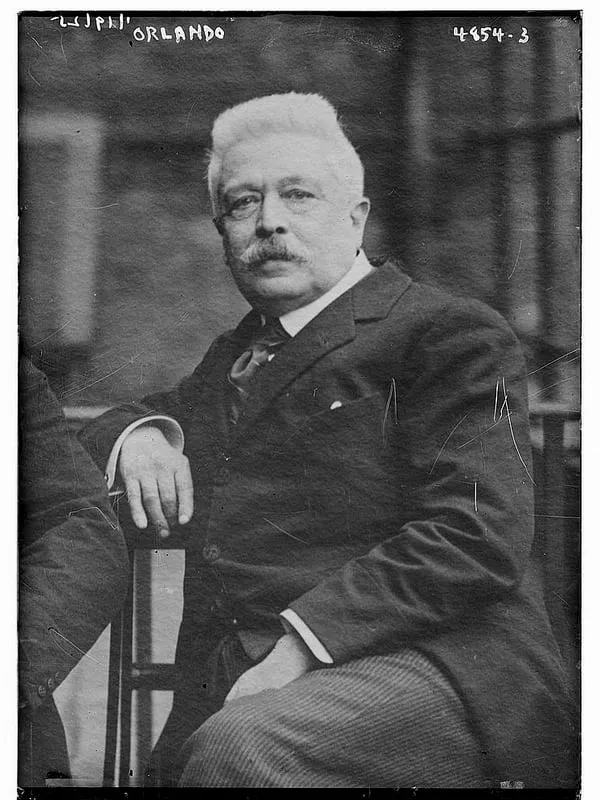
- Born:
- 19 May 1860, Palermo (Italy)
- Died:
- 1 December 1952, Rome
- Author:
- Łukasz Skowroń
- Photo:
- Bain News Service, domena publiczna, Wikimedia Commons

Vittorio Emanuele Orlando took over the government of Italy at the worst moment of its war, in the last days of October 1917, when the army was retreating in disorder from Caporetto. An eminent professor of public law from Palermo, until then Minister of the Interior accused by the Supreme Command of leniency towards opponents of the war, he proved to be the prime minister the country needed at that time. He changed the commander-in-chief, united parliament and public opinion around the defence on the Piave, and in October 1918 pressed the army to deal Austria-Hungary the final blow at Vittorio Veneto. As the “premier of victory” he sat in Paris in the “Big Four” alongside Wilson, Clemenceau and Lloyd George, but there he lost the dispute over Fiume and the Adriatic coast, and disappointment at the “mutilated victory” contributed to the crisis from which fascism grew.
Before the war
He was born on 19 May 1860 in Palermo into a family of lawyers. He studied law at the university there and made a very rapid academic career: in his twenties he was a professor, and in the 1880s and 1890s he became one of the founders of the modern Italian science of constitutional and administrative law. He modelled himself on the German school of law, translated the works of Georg Jellinek, and his great multi-volume treatise on administrative law trained a generation of Italian lawyers. From 1903 he lectured at the University of Rome.
He became a deputy in 1897 for the Sicilian constituency of Partinico and represented it until 1925. He drew close to the liberal Giovanni Giolitti, in whose governments he was Minister of Education in 1903–1905, when he extended compulsory schooling to the age of twelve, and Minister of Justice in 1907–1909, when among other things he created the Superior Council of the Judiciary. At the end of 1914 he again took over the Ministry of Justice, this time in the cabinet of Antonio Salandra.
Minister of the home front
After Italy entered the war in May 1915 he drafted the law on the government’s emergency powers and all the wartime legislation. He also made sure that the war with Austria did not infringe the privileges of the Holy See guaranteed to it by the Italian state. In June 1916, in Paolo Boselli’s broad cabinet, he took over the Ministry of the Interior, that is, responsibility for public order on the “home front”.
In this post he tried to respect constitutional liberties, including towards the socialists, who opposed the war, and the Catholics, whom Pope Benedict XV was calling for peace. This brought down on him the anger of the commander-in-chief, Luigi Cadorna. In June 1917 the general, in three letters to the prime minister, accused the government of weakening the spirit of the army by tolerating subversive propaganda, and the nationalists demanded Orlando’s dismissal. The minister did not change course, however, although he was not naive about the socialists: his government decided not to issue passports for the planned conference in Stockholm of socialists from both sides of the front as early as the end of June 1917. After the bread riots in Turin in August 1917 criticism of his “leniency” grew still further.
Prime minister after Caporetto
On 24 October 1917 the Germans and Austrians broke through the front at Caporetto. A day later Boselli’s government fell, and King Victor Emmanuel III entrusted Orlando with forming a cabinet. The government took office on 29 October, and according to some sources the ministers were sworn in a day later. Orlando kept the Ministry of the Interior for himself, and Sidney Sonnino remained Foreign Minister. There were differences between the two politicians from the start: Sonnino was the guardian of the Treaty of London, while Orlando was more flexible.
From his first days the prime minister intended to change the commander-in-chief, although for appearances’ sake he assured Cadorna of his confidence by telegram. The Allies settled the matter. At the Rapallo conference on 5–7 November David Lloyd George and Paul Painlevé made the dispatch of their divisions to Italy conditional on Cadorna’s removal, and at the same conference the Allied Supreme War Council was set up. On 8 November the King dismissed Cadorna, and his place was taken by General Armando Diaz, with whom Orlando worked much better.
The army halted on the Piave and Monte Grappa, where in the First Battle of the Piave it repulsed the enemy’s attack. Orlando did a great deal to keep the defeat from shattering the home front. On 22 December 1917 he ended a speech in parliament with the words “Resistere! resistere! resistere!” (Hold out! hold out! hold out!), and on 23 February 1918 he cried out in the Chamber: “Monte Grappa, you are my homeland!” Both slogans passed into the legend of the Piave. His government and the new command also saw to propaganda among the soldiers, care for their families and promises of land for the peasants fighting at the front.
The year of victory
In 1918 Orlando represented Italy at all the sessions of the Supreme War Council at Versailles. He guarded the independence of the Italian army: in May 1918 at Abbeville he agreed that Foch’s coordination should extend to the Italian front, but he did not give him command over the Italian troops. He also changed his attitude towards the nations of the Habsburg monarchy. In April 1918 he received the leaders of the Congress of Oppressed Nationalities in Rome and associated himself with its resolutions, and on 21 April he signed with Milan Štefánik a convention on the formation of a Czechoslovak army in Italy. On 3 June, together with Clemenceau and Lloyd George, he agreed the Versailles declaration on an independent Poland, but he would not agree to promise the Yugoslavs anything more than sympathy in it. The dispute over the eastern shore of the Adriatic still hung over Italian policy.
After the last Austrian offensive was repulsed in the June battle on the Piave, Orlando, like Ferdinand Foch, pressed Diaz to go over to the offensive. He wanted Italy to enter the peace conference as a victor, not as a country for which others had won its gains, and he feared that Austria-Hungary would leave the war before the Italian army had won a great victory. On 3 October he informed Foch that the Italians would strike with all their strength. The offensive began on 24 October, the anniversary of Caporetto, and ended with the disintegration of the Austro-Hungarian army at Vittorio Veneto. On 31 October at Versailles Orlando took part in approving the terms of the armistice with Austria-Hungary and during the night passed them by telephone to Italian headquarters. The armistice was signed at Villa Giusti on 3 November.
The peace conference
At the Paris Peace Conference Orlando and Sonnino demanded everything the Treaty of London had promised, and in addition the port city of Fiume, which the treaty had not granted to Italy. Orlando was ready to give up most of Dalmatia in exchange for Fiume, Sonnino insisted on Dalmatia, and in the end Italy demanded both and received neither. In the way stood President Woodrow Wilson, who invoked the principle of nationality and supported the emerging State of Serbs, Croats and Slovenes. On 23 April 1919 Wilson issued a message to the Italian people, over the prime minister’s head. The next day the Italian delegation left the conference. In Rome crowds greeted it and parliament gave the government a vote of confidence, but in Paris the deliberations went on without the Italians, and on 7 May Orlando and Sonnino had to return there without any concessions. The failure weighed on the prime minister. On 19 June 1919 his government fell in parliament, and Italian nationalists began to speak of a “mutilated victory”.
After the war
In 1919–1920 Orlando was President of the Chamber of Deputies. Like many liberals, he at first saw fascism as a necessary reaction to the crisis of the state: in 1924 he helped prepare the fascist electoral law and stood on the government list of Benito Mussolini. After the murder of the socialist deputy Giacomo Matteotti he went over to the opposition in November 1924, and in 1925 he resigned his seat. In 1931 he left the university so as not to swear an oath of loyalty to the regime. After the fall of fascism he returned to politics as the “last survivor” of liberal Italy: he sat in the Constituent Assembly, sharply opposed the peace treaty of 1947, and as a former prime minister became a senator of the republic by right. He died in Rome on 1 December 1952.
Assessment
Italians remember Orlando above all as the “premier of victory”. Historians stress that after Caporetto he was able to give the country the leadership it had lacked under Boselli: he separated politics from military command, chose Diaz wisely and supported him, maintained the unity of parliament and did not let himself be pushed onto the path of police rule that Cadorna demanded. His oratory was an important weapon in the winter of 1917/1918.
He is judged less favourably as a diplomat. The author of his entry in the Treccani Biographical Dictionary, Giulio Cianferotti, points out that the failure in Paris was attributed to the indecision and weakness of Orlando’s line, torn between loyalty to the Treaty of London and efforts to obtain Fiume. Critics also reproach him for having, in 1922–1924, together with many liberals, made it easier for Mussolini to consolidate his power. His defenders reply that no Italian prime minister could have overcome Wilson’s resistance in Paris, and that Orlando had the courage to break with fascism when he understood what it really was.
Sources
Spotted a mistake?Report an error
Mentioned in battles
(02)Often appears with
People who appear in the same events.