Key event
United States declares war on Austria-Hungary
- Category:
- Diplomacy
- Date:
- 7 December 1917
- Author:
- Łukasz Skowroń
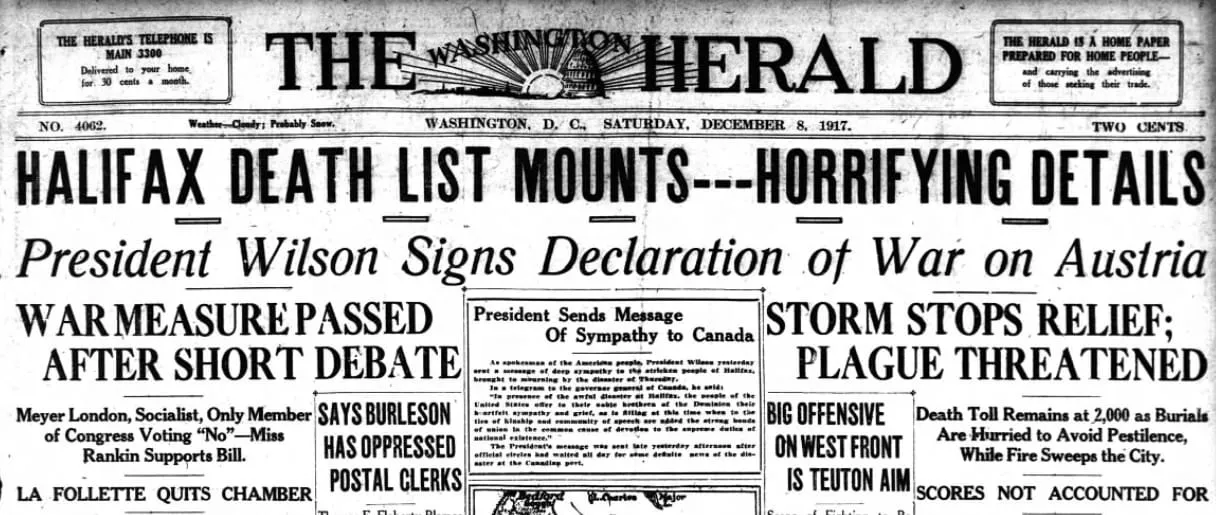
On 7 December 1917, eight months after entering the war against Germany, the United States found itself at war with Austria-Hungary as well. That day both houses of Congress passed a joint resolution, and President Woodrow Wilson signed it the same day. The Senate voted unanimously, 74 to nothing, and in the House of Representatives only one member voted against, the socialist Meyer London of New York. According to the House’s website 365 members voted for the resolution, while the New York Times Current History gave 363. Unlike the April debate on war with Germany, this time nobody in Congress doubted the outcome. The most that was disputed was why the war covered only the Habsburg monarchy and not Germany’s other allies.
The message of 4 December
The proposal came from the president. On 4 December Wilson delivered his annual message to both houses in joint session, devoted entirely to the war. He said that Americans wanted peace, but not a compromise peace. The war would be regarded as won only when the German people, through trustworthy spokesmen, agreed to a peace based on justice and on reparation of the wrongs their rulers had done. He conceded that the formula “no annexations, no contributions, no punitive indemnities” expressed the right instincts of ordinary people, but warned that German agents had used it to lead the people of Russia astray. In Petrograd less than a month had passed since the October Revolution, and the Bolsheviks were just beginning armistice negotiations with the Central Powers.
Then he turned to specifics. “We must clear away with a thorough hand all impediments to success,” he said. One of them was that the United States was at war with Germany but not with her allies. “I therefore very earnestly recommend that the Congress immediately declare the United States in a state of war with Austria-Hungary.” The monarchy was, in his words, “for the time being not her own mistress but simply the vassal of the German Government”, acting neither on its own initiative nor in accordance with the wishes of its peoples, but as the instrument of another state. The Central Powers therefore had to be treated as a single whole.
The same logic, he admitted, would lead to war with Turkey and Bulgaria, but “they are mere tools and do not yet stand in the direct path of our necessary action”. Government spokesmen later explained that no Turkish diplomats were left in the United States and that there were few Turkish subjects. In the Ottoman Empire, on the other hand, there were many American missionaries, who had invested more than 20 million dollars there, and their property would be at risk of confiscation. It was also hoped that Turkey, increasingly weary of German tutelage, would make a separate peace. Bulgaria, according to Washington, was fighting only in territories it regarded as Bulgarian, and had refused Germany’s demand to break off relations with the United States. Its minister was still at his post in Washington.
At the same time Wilson gave assurances that America had no intention of impairing or rearranging the Habsburg monarchy. “It is no affair of ours what they do with their own life, either industrially or politically,” he said. He wanted only that the peoples of Austria-Hungary, the Balkans and Turkey should be freed from “the impudent and alien dominion of the Prussian military and commercial autocracy” and should decide their own affairs.
The resolution
On 4 December the Democrat Henry D. Flood of Virginia, chairman of the House Committee on Foreign Affairs, introduced a draft resolution. Its text repeated almost word for word the April resolution against Germany. The preamble stated that the Imperial and Royal Austro-Hungarian Government had committed repeated acts of war against the Government and people of the United States. Congress declared that a state of war existed between the two countries, authorised and directed the president to employ the entire naval and military forces and the resources of the government to carry it on, and pledged all the resources of the country to bring it to a successful termination.
The committee unanimously recommended the resolution and listed Austro-Hungarian offences in its report. It recalled the affair of Ambassador Konstantin Dumba, who in 1915 had to leave the United States for inciting strikes in munitions factories. It accused Vienna of adopting the German policy of unrestricted submarine warfare despite the undertakings it had given after the sinking of the Ancona. As an example it cited the American schooner Marguerite, sunk on 4 April off Sardinia by a submarine flying no flag, whose officer was said to have spoken “Austrian”. In fact, as later records show, the schooner was sunk by the German U-35. The committee admitted, moreover, that the damage done by the Austro-Hungarian navy was small compared with the German, and that a state of war had “in fact existed for many months”.
It gave the most important reason last. After the Italian defeat on the Isonzo, when the Central Powers had reached the Piave, the United States was sending its allies ships, money and supplies, and might soon send troops who would face Austro-Hungarian soldiers. Before that, war had to be declared. The committee added that such a step would hearten the Italians, who were being misled by German propaganda, and strengthen the whole Allied cause.
The votes
On 7 December the resolution was moved in the Senate by the chairman of the Foreign Relations Committee, William J. Stone of Missouri, the same man who in April had voted against war with Germany. Now he argued that a state of war with Austria already existed and that the United States could not afford to play an ambiguous game with the nations of the world. The Republican Henry Cabot Lodge agreed with the president for the time being on Turkey and Bulgaria, but believed that sooner or later they too would have to be counted among the enemies. Philander C. Knox of Pennsylvania asked about the fate of the monarchy’s subjects, tens of thousands of whom worked in the coal mines and other industries, and expressed the hope that if they remained loyal nobody would trouble them. Robert La Follette left the chamber to prepare an amendment and missed the vote. On his return he declared that he would have voted for the resolution if the United States had undertaken not to take part in enforcing Allied agreements to take from Austria-Hungary territory she had held on 1 August 1914. Otherwise he would have voted against.
In the House of Representatives Flood said that Austria had forbidden Americans to sail parts of the seas and, when they did not obey, had sunk their ships and killed their citizens, which was as much an act of war as if she had landed an army on the American coast. He called for the resolution to be passed unanimously, so as “to unite in common defeat the two medieval governments that have plunged the world into war”. Unanimity failed because of one man. Meyer London of the New York Socialist Party of America, who in April had also voted against war with Germany, explained in a quarter-hour speech that as a socialist he was bound to vote against every declaration of war. “In matters of war I am a teetotaller. I refuse to take the first intoxicating glass,” he said. Other members attacked him sharply.
Jeannette Rankin, who in April had not voted for war with Germany, acted differently. Though ill, she came to the chamber before the vote and declared that she still regarded war as a stupid and futile way of settling international disputes. This time, however, she said, the vote was not on a declaration of war but on “a mere technicality in the prosecution of a war already declared”, and she supported the resolution, just as she had earlier voted for money and men for the army. The resolution was signed by the Speaker of the House, Champ Clark, and the Vice-President, Thomas Marshall, and Wilson approved it the same day.
The monarchy’s subjects in America
Several million immigrants from Austria-Hungary lived in the United States: Poles from Galicia, Czechs, Slovaks, Slovenes, Croats, Hungarians, Ruthenians and Austrian Germans. Many did not have American citizenship and from 7 December formally became enemy aliens. Wilson’s proclamation of 11 December, published the next day, treated them more leniently than the Germans, however. Male subjects of the monarchy aged 14 and over could not leave or enter the country without permission, and those suspected of aiding the enemy could be arrested. As long as they obeyed the law they were to live and work “undisturbed”, and citizens were to treat them with the kindliness that loyalty to the United States allowed. For many of them, especially the Poles, Czechs and Slovaks, who hoped for the break-up of the monarchy, the war with Vienna was in any case their own cause.
Significance
The declaration of war changed little in the military situation at once. Diplomatic relations had been broken off in April by Austria-Hungary itself, and the American forces in Europe still numbered only a few divisions and were in France. The decision had political significance, however, especially for Italy. When the message became known in Rome, demonstrations were held in front of the American embassy and at the consulates in other cities, and the prime minister, Vittorio Emanuele Orlando, sent Wilson warm congratulations. The United States could now send its soldiers to the Italian front, which it did in 1918, and take full part in Allied councils on the war against the monarchy.
Wilson did not, however, give up hope of an understanding with Vienna. For several more months he hoped that the war-weary monarchy could be detached from Germany. In the Fourteen Points, announced in January 1918, he promised the peoples of Austria-Hungary only “the freest opportunity of autonomous development”, not independence. Only in September 1918 did Washington recognise the Czechoslovaks as a belligerent, and in October it replied to Vienna that autonomy was no longer enough. Formally the state of war outlasted the monarchy itself. The Senate did not ratify the peace treaties with Austria and Hungary concluded at Saint-Germain and Trianon, so the United States signed separate treaties with the two countries only in August 1921.
Remember the articles you have read? Only in this browser; nothing is sent anywhere.How it works
Read ·
Spotted a mistake?Report an error
Meanwhile
(04)Elsewhere in the same days.
- 7 December 1917 · War at seaAmerican battleships join the Grand FleetOn 7 December 1917 Rear Admiral Rodman's four American dreadnoughts entered Scapa Flow. They joined the Grand Fleet as the 6th Battle Squadron.
- 9 December 1917 · Middle EastSurrender of JerusalemOn 9 December 1917, after the Turks fled overnight, Jerusalem's mayor went out to the British with a white flag. The city surrendered without a fight or damage.
- 5 December 1917 · Eastern FrontTemporary armistice on the Eastern FrontOn 5 December 1917 at Brest-Litovsk Russia and the Central Powers signed a ten-day ceasefire, from 7 to 17 December. Talks were suspended for a week.
- 9 December 1917 · War at seaSinking of the battleship WienOn the night of 9/10 December 1917 two Italian torpedo boats broke into Trieste harbour. Luigi Rizzo's MAS 9 sank the Austro-Hungarian battleship Wien.
Related events
(04)The same battle, people or subject.
- 16 December 1917 · DiplomacyCuba declares war on Austria-HungaryOn 16 December 1917 Cuba proclaimed a state of war with Austria-Hungary. President Menocal's request passed both houses of Congress in a few days.
- 23 May 1918 · DiplomacyCosta Rica declares war on GermanyOn 23 May 1918 Federico Tinoco's government, unrecognised by Washington, declared war on Germany. Congress gave way only under threat of dissolution.
- 8 May 1918 · DiplomacyNicaragua declares war on GermanyOn 8 May 1918 Nicaragua announced that Congress had declared war on Germany and Austria-Hungary. President Chamorro openly sided with the United States.
- 26 October 1917 · DiplomacyBrazil declares war on GermanyOn 26 October 1917 the Brazilian Congress recognised that Germany had imposed a state of war on Brazil. The immediate cause was the sinking of the Macau.