1918: The Italian front
Battle of Vittorio Veneto
- Dates:
- 24 October – 4 November 1918
- Front:
- Italian Front
- Location:
- The front from the Monte Grappa massif between the Brenta and the Piave across the middle Piave (the Grave di Papadopoli island, the Montello hill, Valdobbiadene and Sernaglia) to Vittorio, Conegliano, the Livenza and the Tagliamento, and in the last days also the Asiago plateau and Trento, Veneto and Friuli (Italy) and South Tyrol (Austria-Hungary, now Italy)On the battle map →
- Sides:
- Italy, United Kingdom, France, Czechoslovaks and United StatesArmando Diaz, Pietro Badoglio, Gaetano Giardino, Enrico Caviglia, Lord Cavan, Jean-César Graziani, Prince Emanuele Filiberto, Duke of AostaAustria-HungaryEmperor Charles I, Arthur Arz von Straußenburg, Svetozar Boroević, Alexander von Krobatin, Alois Schönburg-Hartenstein, Wenzel von Wurm
- Result:
- Decisive victory for Italy and its allies. After the front on the Piave was broken, the Austro-Hungarian army disintegrated, and the Armistice of Villa Giusti ended the war on the Italian front on 4 November at 3 p.m. Between about 400,000 and more than 430,000 of the monarchy's soldiers were taken prisoner.
- Author:
- Natalia
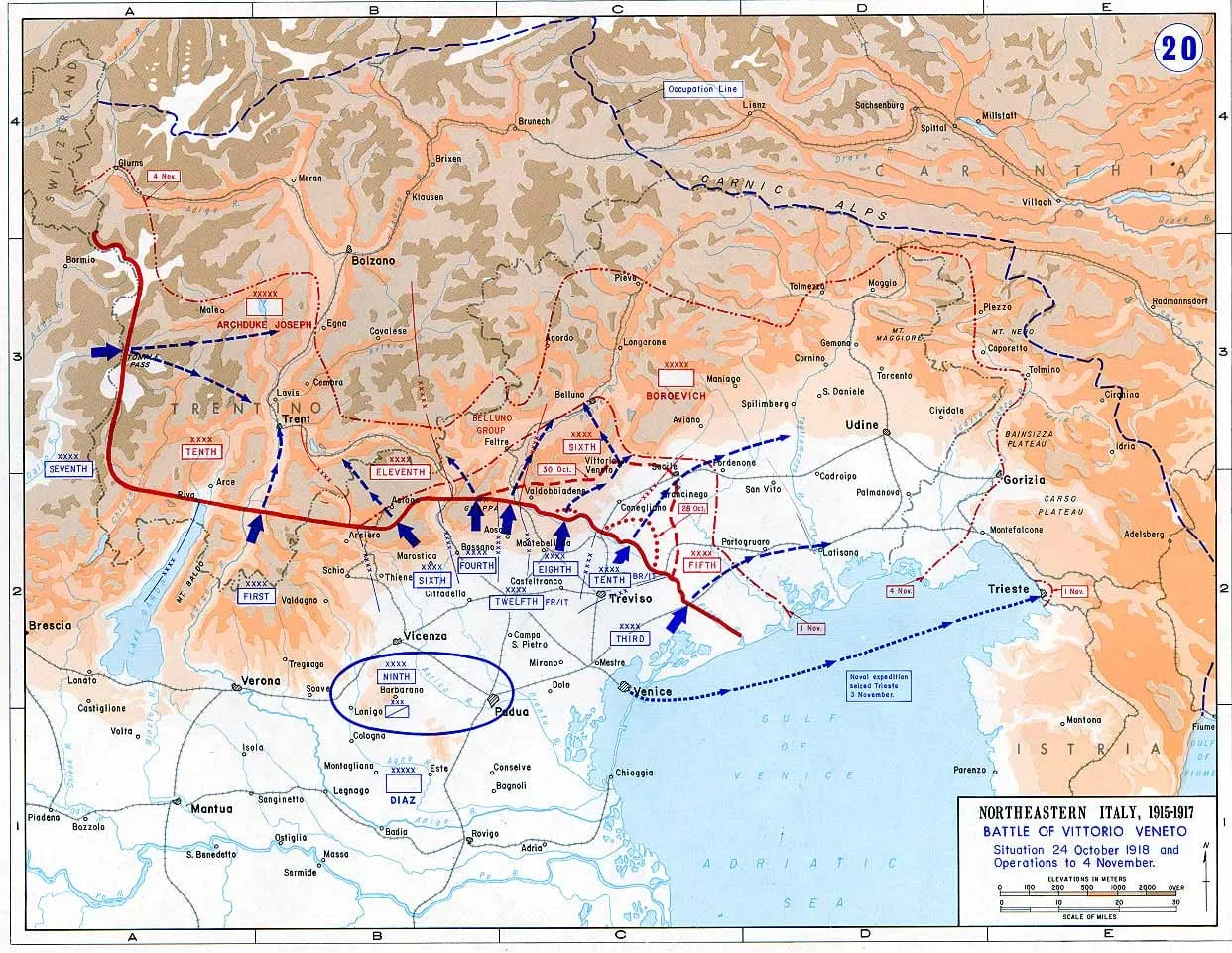
The Battle of Vittorio Veneto was the last battle of the war on the Italian front and the last battle of the Austro-Hungarian army. On 24 October 1918, exactly a year after the breakthrough at Caporetto, General Armando Diaz opened the offensive with an attack in the Monte Grappa massif. There the Austrians held off the assaults for three more days, inflicting heavy losses on the Italians. The main blow across the swollen Piave, twice postponed because of downpours, went in only on the night of 26/27 October. The British, French and Italians seized three bridgeheads on the left bank, and at the same time mutinies began in the Austro-Hungarian army: first Hungarian regiments, then Czech, Croatian, Polish and others refused to go to the front and demanded to be sent home. On 28 October the army began to withdraw, on 30 October the Italians entered the small town of Vittorio, and the retreat turned into disintegration. The armistice signed on 3 November at Villa Giusti near Padua came into force on 4 November at 3 p.m. In the last day and a half of the war hundreds of thousands of soldiers of the monarchy, which in those same days ceased to exist, were taken prisoner.
Name and dates
The Italians call the battle the battaglia di Vittorio Veneto, and sometimes, counting the fighting of November 1917 and June 1918, the Third Battle of the Piave. The small town from which it took its name was then called simply Vittorio (after King Victor Emmanuel II). The epithet Veneto, already in use earlier, became part of the official name of Vittorio Veneto only in 1923, partly in memory of the victory. The Austrian official history (Österreich-Ungarns letzter Krieg) speaks of the last battle on the South-Western Front and singles out from it “the defensive battle in the Grappa mountains” of 24–28 October. The British official history describes the whole as the Battle of Vittorio Veneto, 24 October – 4 November.
We adopt the dates 24 October – 4 November 1918. On 24 October the Italian Fourth Army began its attack on the Grappa (the British had already taken part of the Grave di Papadopoli island in the Piave on the night of 23/24 October, as a preparation for the battle). On 4 November at 3 p.m. the armistice came into force. The Austrians stopped fighting earlier: on the night of 2/3 November their high command, believing that the armistice applied from the moment its terms were accepted, ordered the troops to cease hostilities.
Background
After the defeat in the Second Battle of the Piave in June 1918 the Austro-Hungarian army was no longer capable of attacking. The soldiers were underfed, influenza and malaria decimated them, desertions multiplied, and in July the emperor dismissed Conrad. Even so, the front on the Piave and in the mountains held firm, and in October 1918, as the British official history notes, the military situation on this front was far better for the Austrians than that of the Germans in France. Politics was decisive. After Bulgaria’s capitulation at the end of September the monarchy, together with Germany, asked President Wilson for an armistice on the basis of his Fourteen Points, and on 16 October Emperor Charles I issued a manifesto on transforming Austria into a federal state. Instead of calming the nations of the monarchy, it hastened its break-up. In Budapest there were demands for the Hungarian regiments to return home.
Diaz long delayed the offensive. He feared a blow from the Grappa against the flank of his armies and believed he did not have enough forces. He was pressed by Marshal Ferdinand Foch, who had long accused the Italians of passivity, by Lord Cavan, commander of the British divisions in Italy, and above all by the government of Prime Minister Vittorio Emanuele Orlando. The Italians wanted to enter the peace conference as victors and feared that Austria-Hungary would leave the war before the Italian army had won a great victory. At the end of September Diaz decided to attack, and on 3 October Orlando informed Foch that the Italian army would strike with all its strength.
The plan, prepared at the Comando Supremo, provided for breaking the front where the Austro-Hungarian Sixth Army and the Isonzo Army met, that is on the middle Piave between the Montello hill and the Grave di Papadopoli island. From there General Enrico Caviglia’s Eighth Army was to strike towards Vittorio, through which ran the roads and railway supplying the Sixth Army, and separate the Austrian troops on the plain from those in the mountains. Beforehand, to tie down the Austrian reserves, General Gaetano Giardino’s Fourth Army was to attack on the Grappa. Two new armies were formed for the breakthrough: Lord Cavan’s Tenth Army, made up of the British XIV Corps (7th and 23rd Divisions) and the Italian XI Corps, opposite the Papadopoli island, and the Twelfth Army of the French General Graziani, with the French 23rd Division, at the mouth of the Piave valley near Pederobba. Among the reserves stood the Czechoslovak division, and the American 332nd Infantry Regiment fought alongside the Italian 31st Division.
The forces of the two sides along the whole front were similar in number: according to the British official history 56 Allied divisions and 4 cavalry divisions faced 55 Austro-Hungarian divisions and 6 cavalry divisions. Diaz, however, had more than 7,700 guns against about 6,000 Austrian ones, superiority in the air and shorter railway lines. On the sector of the main attack between Pederobba and Ponte di Piave 22 Allied divisions faced 19 Austro-Hungarian ones, and, according to the Austrian official history, more than 3,200 guns faced about 1,350. The Austrians in the mountains, in Army Group Tyrol, were under Field Marshal Alexander von Krobatin, and those on the Piave and the Grappa, including Army Group Belluno, under Field Marshal Svetozar Boroević.
The offensive was to begin on 16 October, but downpours swelled the Piave and the attack was postponed. Diaz used the delay to move another 400 guns to the Grappa and to change the Fourth Army’s role from a supporting one to an independent attack. According to the British official history, since the transfer of the artillery was to be completed on 23 October, 24 October was set as the opening day. The first anniversary of Caporetto thus fell on the day of the attack, and from the outset the Italians gave it a symbolic meaning.
Course
Papadopoli, night of 23/24 October. Lord Cavan proposed taking the Grave di Papadopoli island before the battle itself, a gravel island about six kilometres long in the middle of the Piave, held by Hungarians of the 7th Division. On the evening of 23 October Italian pontoneers ferried the men of the British 22nd Brigade, from the Honourable Artillery Company battalion and the Royal Welch Fusiliers, seven at a time in flat-bottomed boats punted with poles through the rushing current. They were commanded by Lieutenant-Colonel Richard O’Connor, in the Second World War one of the British commanders in North Africa. In rain and fog the British struck the flank of the surprised Hungarians and by five in the morning had taken the northern part of the island, capturing about 330 prisoners. The Italian 37th Division on the neighbouring islets failed to cross the river.
Grappa, 24–26 October. At dawn on 24 October, after a bombardment of several hours, in cloud and fog, six divisions of the Italian Fourth Army and two from the right wing of the Twelfth Army attacked the Grappa: Monte Asolone, Monte Pertica, Prassolan, Solarolo, Spinoncia and Valderoa. The Austrians, exhausted by hunger and expecting an armistice rather than a battle, defended their positions cut into the rock with a determination that the Austrian official history called a “miracle”. Regiments of almost all the nations of the monarchy retook lost positions in counter-attacks. By evening the Italians had taken only Valderoa and the approaches to a few peaks, and according to Italian sources they had lost more than 3,000 men by 3 p.m. alone. Because the Piave had risen and the attack across the river had to be postponed, Diaz ordered Giardino to keep attacking. On 25 and 26 October the Fourth Army, led by the assault troops (arditi) of Major Giovanni Messe, stormed Asolone and Pertica again and again. It took the summit of Pertica, but the Austrians retook almost all its other gains. After three days Giardino halted the attack. The Austrian official history estimates Italian losses in those three days at nearly 35,000 men. According to Italian studies the Fourth Army as a whole lost more than 25,000 in the battle, the great majority of them in those very days. The Austrians regarded the Grappa as their defensive victory, and for a moment Boroević believed that they might hold out until an armistice on tolerable terms.
First mutinies, 24–27 October. At the same time obedience was cracking in the rear. As early as 24 October the II Battalion of the Hungarian 25th Infantry Regiment, in reserve behind the Asiago plateau, refused to take part in a counter-attack: the soldiers declared that, since the ties between Austria and Hungary were loosening, they would no longer fight for Austria, and demanded to return to Hungary to defend its borders. Other battalions of the 27th Division and regiments of the 38th Honvéd Division joined them. Archduke Joseph August tried to persuade them, but the mutineers fired on anyone who approached the camp. On 26 October the high command, faced with the Hungarian government’s refusal, promised both divisions transport home. The news that the mutiny had been not punished but rewarded spread along the whole front.
Crossing the Piave, 26–28 October. On 26 October the water began to fall and Diaz ordered the crossing for the coming night. By the morning of 26 October the British had taken the rest of the Papadopoli island, beating off Hungarian counter-attacks. Late in the evening the bombardment began, and during the night troops started crossing the river in boats and over pontoon bridges. Of eleven bridges only six could be built, and the rushing current and Austrian artillery soon broke most of them. On the left wing the French of the 23rd Division and Italian Alpini seized a bridgehead below Valdobbiadene. The Eighth Army managed to get only parts of two corps across the river near Falzè and Sernaglia, where the Hungarian Honvéd cavalry mostly fled or surrendered without a fight. Cut off from its bridges, the bridgehead was in a critical position for a day, and ammunition and food were dropped to it from aircraft. The Tenth Army did best. On 27 October at 6.45 a.m. the British and Italians attacked from the Papadopoli island, forded the remaining channels of the river and broke the Hungarian 7th Division, part of which refused to fight. By noon they had pushed four kilometres deep on a front twelve kilometres wide.
On 28 October the bridgeheads grew, and above all it became clear that the Austrians no longer had anything with which to eliminate them. The reserve divisions that were to counter-attack refused to march: the Croatian 116th Infantry Regiment stopped at Vittorio, the Czech 21st Regiment turned back from Sacile to Pordenone, and the 57th Regiment from Tarnów declared that, since Poland had proclaimed its independence, it would no longer fight for the monarchy. At nine in the morning Boroević reported that the troops’ capacity for resistance was dwindling “with terrifying speed”. In the afternoon the Sixth Army command ordered a retreat to the second line of defence, and on the night of 28/29 October the high command at Baden near Vienna instructed both army groups to save the army from destruction “by withdrawing in time”. That same day the emperor sent General Viktor Weber von Webenau’s armistice commission to the Italians.
Pursuit, 29 October – 2 November. On 29 October the Eighth Army at last built bridges at Ponte della Priula, the troops from the three bridgeheads joined up, and the British and Italians forced the small river Monticano. In the evening the command of the Austrian Sixth Army left Vittorio, and during the night retreating columns poured through the town in disorder and plundered it. Early on the morning of 30 October a light detachment of lancers and cyclist Bersaglieri from the Italian VIII Corps entered it without a fight. The Austrian front was cut in two. On the night of 30/31 October the Austrians abandoned the Grappa, and on 31 October and 1 November Boroević’s troops fell back behind the Livenza, pursued by Italian cavalry and aircraft. On 1 November the Italian Sixth Army, with a British and a French division, attacked on the Asiago plateau, and the collapsing armies in the Tyrol began to retreat towards Trento. On 2 November the new Hungarian minister of war ordered Hungarian soldiers to stop fighting.
The armistice and the last hours, 3–4 November. Weber’s commission reached Villa Giusti near Padua only on the evening of 31 October, because Diaz was playing for time: he did not want an armistice while enemy troops stood on Italian soil. General Badoglio read out to the Austrians on 1 November the terms laid down at Versailles by the Supreme War Council. They were very harsh: besides an end to the fighting and the demobilisation of the army, they provided among other things for the evacuation of South Tyrol up to the Brenner, of Istria with Trieste and of part of Dalmatia, and for the free passage of Allied troops across the monarchy’s territory. On the night of 2/3 November it was decided in Vienna to accept them, and the high command, taking the first point (“the immediate cessation of hostilities”) literally, ordered the troops to stop fighting at about two in the morning. The Italians, meanwhile, stipulated that operations would cease only 24 hours after the terms were accepted. On 3 November at 3 p.m. Weber accepted the terms, and in the evening the Armistice of Villa Giusti was signed. For the Allies it was signed by the deputy chief of staff, General Pietro Badoglio. The war on the Italian front was to end on 4 November at 3 p.m.
During that day and a half the Austro-Hungarian army, convinced that the war was over, hardly defended itself, while the Italians pressed forward to take as much ground and as many prisoners as possible. On 3 November Italian cavalry, Alpini and arditi entered Trento, and troops carried by warships landed at Trieste, which the Austrian garrison had left a few days earlier. On 4 November the British and the Americans of the 332nd Regiment forded the Tagliamento, and Italian cavalry reached Udine, Cividale and Palmanova. Whole Austrian divisions laid down their arms, protesting that the armistice was just coming into force. At noon on 4 November Diaz announced in a famous communiqué (the Bollettino della Vittoria) that the Austro-Hungarian army had been annihilated.
Losses
According to Italian figures the Italian army lost between about 36,500 and 37,500 killed, wounded and missing in the battle, more than 25,000 of them in the Fourth Army on the Grappa. British losses, according to the British official history, came to just over 1,600 men (about 1,800 according to Italian tables), and French losses to a few hundred. Austro-Hungarian losses in killed and wounded are unknown: Italian estimates speak of about 30,000, others of as many as 90,000. The number of prisoners was enormous. At noon on 4 November the Italian command gave about 300,000, and on 11 November 436,674. Various sources give from about 400,000 to 480,000 prisoners and from 5,000 to more than 7,000 guns. According to the Austrian official history more than 300,000 men were taken prisoner in the last 36 hours of the war, largely from rear-echelon units, since by the end of the war the 56 divisions of the Italian front had only about 260,000 front-line soldiers. Among the prisoners were 24 generals. In a captivity that dragged on for many months, about 30,000 weakened soldiers died, according to Austrian estimates. Lord Cavan’s Tenth Army took more than 35,000 prisoners, about 28,600 of them by the British XIV Corps.
Significance
For the Italians Vittorio Veneto became the answer to Caporetto and the symbol of victory in the war. In Italy 4 November is the Day of National Unity and the Armed Forces. The Austrians and some historians, however, stressed that the Italians had defeated an army that was disintegrating together with its state, and that the outcome was decided by mutinies and refusals to fight, not by the battle itself. The truth lies in between: for the first days the Austro-Hungarian army defended itself effectively on the Grappa and on the Piave, but the Italian offensive, with a substantial British and French contribution, turned the monarchy’s decay into the defeat of its army. The Duke of Aosta is said to have told Lord Cavan that without the British there would have been no Vittorio Veneto.
The battle ended the war on the Italian front a week before the Armistice of Compiègne. It opened the way for the Allies towards Germany’s southern borders, which the German high command feared, and gave the Italians Trento and Trieste before the peace conference met. The dispute over whether the prisoners taken after the order to stop fighting had been captured fairly went on in Austria for years. Austria-Hungary, which had entered the battle as one state, came out of it as several new states, and soldiers returning from the front dispersed to homes where new authorities were already in power.
Spotted a mistake?Report an error