Key event
Battle of Vittorio Veneto begins
- Category:
- Military operations
- Front:
- Italian Front
- Date:
- 24 October 1918
- Author:
- Natalia
- Battle:
- Battle of Vittorio Veneto
- Tags:
- Italy, Austria-Hungary, Armando Diaz, Great Britain
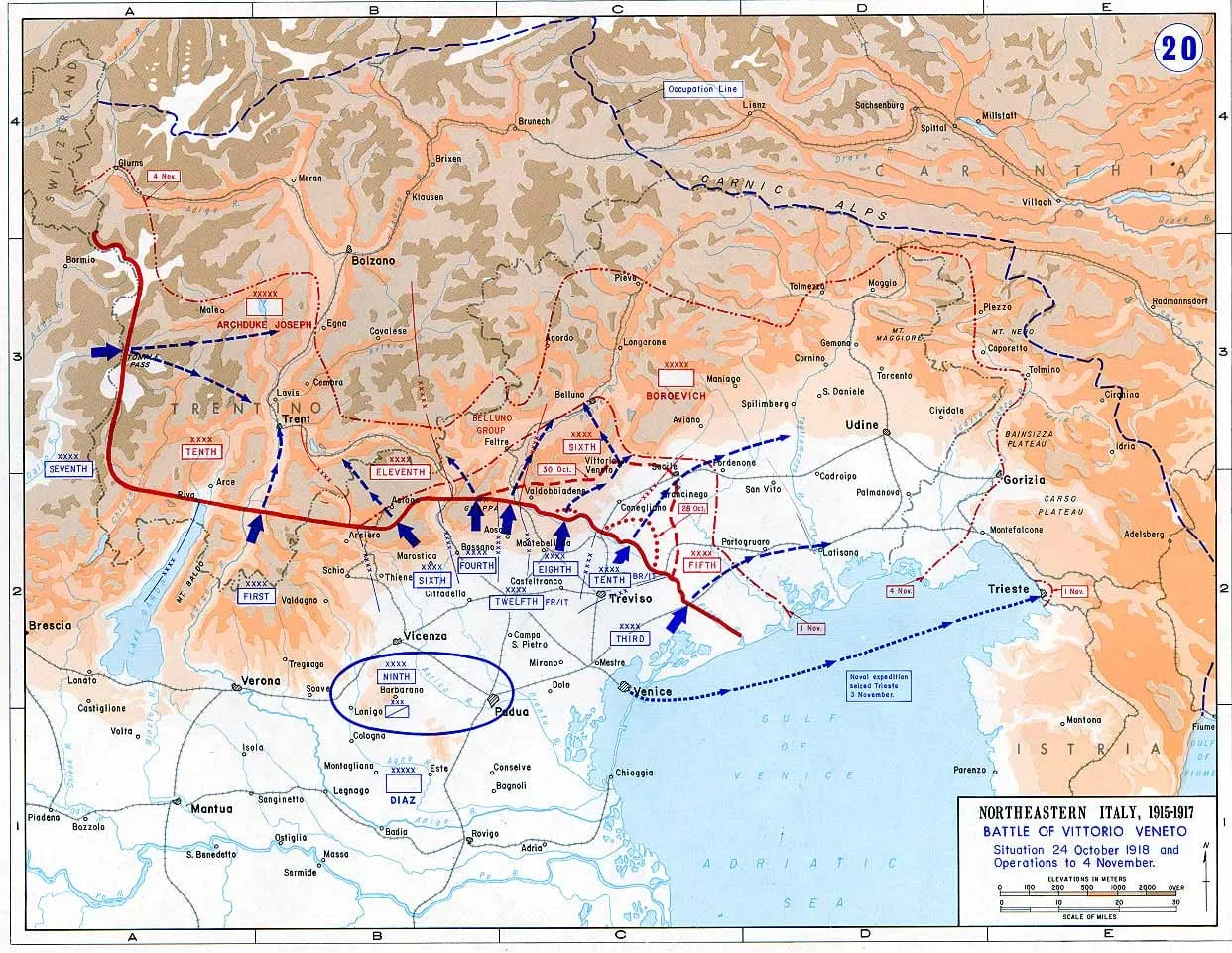
On 24 October 1918, exactly a year after the Germans and Austrians had broken through the Isonzo front at Caporetto, the Italian army began its last offensive. Before dawn thousands of guns opened fire on the Austro-Hungarian positions in the Monte Grappa massif, between the Brenta and the Piave, and in the morning the Italian infantry went in to storm the rocky summits. The first day brought no victory. In cloud and fog, the Dual Monarchy’s soldiers, weakened by hunger, beat off almost all the attacks, and the Piave, swollen by downpours, prevented the main thrust from crossing the river. The only success of the day was the British capture of part of the island of Grave di Papadopoli in the middle of the Piave. At the same time, behind the front on the Asiago plateau, the first Hungarian battalion refused to fight for Austria.
The anniversary and the plan
General Armando Diaz, chief of staff of the Italian army since November 1917, had long resisted pressure from the Allies and from his own government. In the end he prepared a plan in which the main blow was to fall on the middle Piave, between the Montello hill and the island of Papadopoli. From there General Enrico Caviglia’s 8th Army was to strike towards the small town of Vittorio (today Vittorio Veneto) and cut the supply routes of the Austrian 6th Army. Its flanks were to be covered by two new armies: the 10th Army under the British general Lord Cavan, with the British XIV Corps and the Italian XI Corps, and the 12th Army under the French general Graziani. The attack of General Gaetano Giardino’s 4th Army on the Grappa was originally meant only to support its neighbours and pin down the Austrian reserves.
The offensive was due to begin on 16 October, but it had been raining for several days and the Piave had risen. During the delay Diaz moved another 400 guns to the Grappa from other sectors and ordered Giardino to make an independent, determined attack. According to the British official history, the date was decided by the timetable: the transfer of artillery was to be completed on 23 October, so 24 October was chosen as the day of the attack. That it fell on the first anniversary of Caporetto was nevertheless of enormous significance for the Italians. The Austrian official history also stresses that the offensive began “exactly a year after the breakthrough at Flitsch and Tolmein”.
Diaz’s final order of 21 October provided that on the morning of 24 October the 4th Army and the left wing of the 12th Army would attack on the Grappa, and that on the evening of the same day the 12th, 8th and 10th Armies would begin crossing the Piave. The 6th Army on the Asiago plateau, with a British and a French division, was to pin the enemy down with fire and raids.
Papadopoli
The battle had in fact begun the previous evening. Lord Cavan obtained permission to seize Grave di Papadopoli before the main attack: a flat island of gravel and sand about six kilometres long, which split the bed of the Piave into several fast-flowing channels. The island was held by Hungarians of the 7th Division. The British, who had taken over the sector opposite the island from the Italians a few days earlier, wore Italian greatcoats and helmets so as not to betray their presence.
At dusk on 23 October Italian pontoniers of the 18th Company began ferrying soldiers of the British 22nd Brigade of the 7th Division across in flat-bottomed boats, poled against the current: first the Honourable Artillery Company battalion, then the Royal Welch Fusiliers. Each boat took seven men and there were only twelve boats, so the crossing took hours. On the island the commander was Lieutenant-Colonel Richard O’Connor, in the Second World War one of the ablest British commanders in North Africa. The Austrians quickly realised what was happening: they sent up flares, began shelling the bank with artillery and machine guns and lighting it with a searchlight, and the moon came out from behind the clouds. The British nevertheless got across, and the sappers put up two footbridges on boats alongside. In pouring rain and thick fog the soldiers attacked along the Austrian trenches, into the flank of the surprised Hungarians. By five in the morning of 24 October they had taken the northern part of the island and about 330 prisoners.
The Italians were unable to follow them. The neighbouring Italian 37th Division ferried six battalions onto the islet of Caserta, but fire and deep water prevented them from reaching the island of Maggiore. Throughout 24 October the British sat on Papadopoli under fire, in shallow holes dug with entrenching tools. The commander of the Austrian Isonzo Army took their landing for a local raid meant to divert attention from the Grappa and did not counter-attack.
The Grappa
On the Grappa the Italian artillery began firing at about three in the morning, and according to Italian sources the main bombardment began at five; according to the Austrian official history it reached its greatest intensity at about seven. The Austrians had replied earlier with counter-preparation fire. The massif was wrapped in cloud and fog, and the artillery fire partly lost its effectiveness because of it. Six divisions of the 4th Army, and on the right wing two divisions of I Corps of the 12th Army, advanced on the positions of the Austrian Army Group Belluno: from Col Caprile above the Brenta through Monte Asolone, Monte Pertica, Prassolan and the Solarolo ridge to Monte Spinoncia and the Alano valley on the Piave.
The Austrians were waiting for the end of the war and no longer expected a great battle. The Austrian official history writes that even so the “abandoned soldiers” defended themselves with determination, and regiments made up of Germans, Hungarians, Poles, Czechs, Croats, Serbs, Romanians, Slovenes and Slovaks stood shoulder to shoulder once more. On Monte Asolone a brigade of the 18th Division (according to Italian sources the Bari Brigade) of the IX Corps of General Emilio De Bono, later one of the Fascist leaders, broke into the first lines, but a counter-attack by the 9th Infantry Regiment, made up of Poles and Ukrainians, and the Moravian 99th Regiment threw it back to its starting positions. At Monte Pertica the Pesaro Brigade twice reached the summit and was twice thrown off it, while the Cremona Brigade, which had broken through onto the Prassolan ridge, was cut off by artillery fire, attacked by the 73rd Regiment from the Egerland (today the area around Cheb in the Czech Republic) and thrown back with nearly a thousand killed, wounded and missing. On the Solarolo ridge the attack broke down, and at Monte Spinoncia a regiment made up of Germans, Hungarians, Serbs and Romanians beat off every assault. In the Alano valley a Hungarian Honvéd regiment sealed off a penetration by Italian brigades of the 12th Army.
The Italians’ only lasting success was the capture of Monte Valderoa by the Aosta Brigade, which approached the summit in the dark and in a second attack, at about half past twelve, drove the defenders off it. At 3 p.m. Giardino halted the attacks. According to Italian sources his army lost more than three thousand men that day and took about 1,800 prisoners. The Austrian official history states that by evening the 4th Army’s attack had been “completely shattered” on the still strong front of the Belluno group.
The Piave will not let them cross
On the Piave the 8th, 10th and 12th Armies were to begin crossing and building bridges in the evening. In the morning the Italian artillery shelled the Austrian positions along the river, and during the night soldiers of the British 7th and 23rd Divisions began crossing to the island of Papadopoli, to attack from it in the morning. But it rained all day, the river was rising again, and the current was so strong that crossing by boat took much longer than the previous night, and the building of footbridges had to be abandoned. Instead of the attack planned for 6.45 a.m. on 25 October came an order to halt. Diaz postponed the main blow until the water fell. The British who had already crossed to the island stayed there, soaked and under fire.
On the evening of 24 October the Comando Supremo ordered Giardino to attack on the Grappa the next day as well. Since the attack across the river was delayed, the 4th Army had to go on pinning down the Austrian reserves, although its attacks were costing ever more blood. Over the next two days Giardino’s regiments, led by the assault troops of Major Giovanni Messe, stormed Asolone and Pertica, suffering heavy losses.
The first mutiny
That same day the Austrian army received the first sign that its disintegration was no longer just a matter of morale. On the Asiago plateau the II Battalion of the Hungarian 25th Infantry Regiment from Losoncz (today Lučenec in Slovakia), held in reserve, was to take part in a counter-attack. The soldiers refused. They declared that they would no longer fight for Austria and demanded to be sent back to Hungary. The regiment’s other battalions soon joined them, and the divisional commander, who tried to drive to the camp, had to turn back because the mutineers were throwing grenades onto the road. The regiment’s delegates explained that since the ties between Austria and Hungary were loosening, they as Hungarians were no longer obliged to fight for Austria and wanted to defend Hungary’s borders against the Serbs. Soon the Hungarian 22nd Honvéd Infantry Regiment, held in reserve in the Sugana valley, behaved in the same way.
For the Austrian command, 24 October thus ended with mixed news. On the Grappa the troops had won a defensive victory that raised their spirits, and the British on Papadopoli were judged to be a raid of no great importance. The mutiny of the Hungarians near Asiago, however, was a portent of what was to happen a few days later, when the main attack finally moved across the swollen Piave.
Remember the articles you have read? Only in this browser; nothing is sent anywhere.How it works
Read ·
Spotted a mistake?Report an error
Meanwhile
(04)Elsewhere in the same days.
- 24 October 1918 · DiplomacyAndrássy becomes foreign ministerOn 24 October 1918 Count Gyula Andrássy the Younger, son of the author of the alliance with Germany, replaced Burián as the last joint foreign minister.
- 24 October 1918 · SocietySpanish flu in the Polish landsOn 24 October 1918 it was decided to close Kraków's schools because of the Spanish flu and a lack of coal. The epidemic raged in Galicia, the Kingdom and Posen.
- 23 October 1918 · Middle EastStart of the march on MosulOn 23 October 1918 Cobbe's I Corps faced the Turkish position at Fat-ha on the Tigris. That night the Turks left it, and the British set off for Mosul.
- 25 October 1918 · Western FrontEnd of the Battle of the SelleOn 25 October 1918 the Battle of the Selle ended. The British reached the Sambre–Oise Canal and the Forest of Mormal, taking about 20,000 prisoners.
Related events
(04)The same battle, people or subject.
- 4 November 1918 · Italian FrontEnd of the Battle of Vittorio VenetoAt 3 p.m. on 4 November 1918 the guns fell silent on the Italian front. Before that the Allies crossed the Tagliamento and whole enemy divisions surrendered.
- 3 November 1918 · Italian FrontArmistice of Villa GiustiOn 3 November 1918 near Padua Austria-Hungary signed an armistice with the Allies. Fighting ceased at 3 p.m. on 4 November; the Habsburg monarchy left the war.
- 14 October 1918 · Balkan FrontItalians take DurrësOn the morning of 14 October 1918 Italian infantry entered Durrës, abandoned by the Austrians. The same day the Italians took Tirana.
- 3 October 1918 · Balkan FrontItalians retake BeratOn 3 October 1918 the Italians, pursuing the retreating Austrians, again took Berat in Albania. The enemy fled north, burning his depots.