Austria-Hungary · The Central Powers
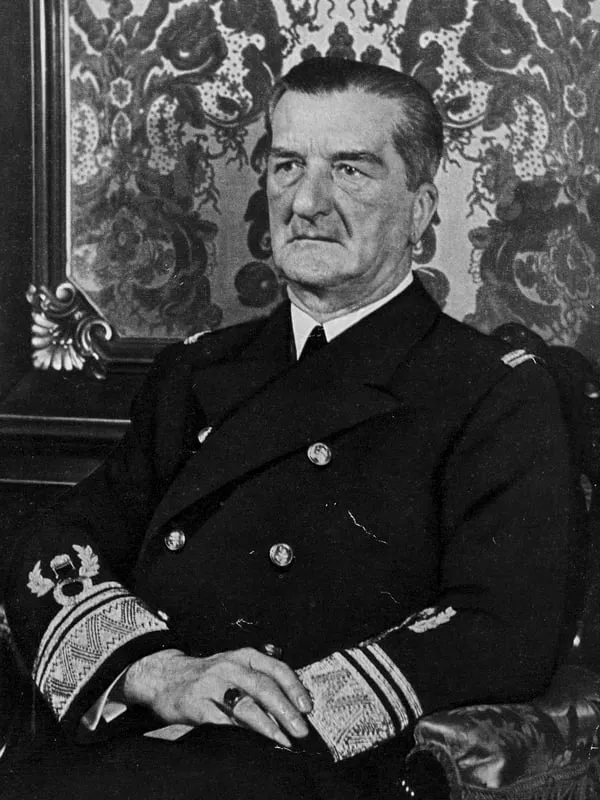
Miklós Horthy
Commander of the cruiser Novara (1915–1918), last commander of the Austro-Hungarian fleet (1918), rear admiral, regent of Hungary (1920–1944)
- Born:
- 18 June 1868, Kenderes (Hungary)
- Died:
- 9 February 1957, Estoril (Portugal)
- Author:
- Łukasz Skowroń
- Photo:
- autor nieznany, domena publiczna, Wikimedia Commons

Miklós Horthy is known above all as regent of Hungary from 1920 to 1944, but his career began on the Adriatic. During the First World War he was one of the most enterprising officers of the Austro-Hungarian Navy, which spent most of the war in harbour. As commander of the fast cruiser Novara he led raids on the Italian and Albanian coasts and on the barrage in the Strait of Otranto, and in May 1917, badly wounded, he emerged from the largest surface battle in the Adriatic a hero. After the Cattaro mutiny Emperor Charles I passed over many more senior admirals and gave him command of the whole fleet. Horthy tried to restore its fighting spirit, but his only major operation ended in the sinking of the dreadnought Szent István, and half a year later it was he who had to hand the ships over to the Yugoslav state. The fame of the “hero of the Novara” helped him in 1919 to take the lead of the Hungarian counter-revolution.
Before the war
He was born on 18 June 1868 in Kenderes on the Great Hungarian Plain, into a Calvinist family of the middle nobility. His father was a landowner and a member of the Hungarian House of Magnates. According to the French historian Catherine Horel, Miklós chose the navy although nothing in the family’s traditions pointed that way. At the age of fourteen he entered the Naval Academy in Fiume, where teaching was in German. To the end of his life he spoke Hungarian with a slight Austrian accent; he also knew Italian, Croatian, English and French. As an officer he sailed the Mediterranean and far beyond, and in 1908, during the Bosnian crisis, he commanded the embassy station ship in Constantinople. In 1901 he married Magdolna Purgly, with whom he had four children.
In 1909 he became one of the aides-de-camp of Emperor Franz Joseph. Horel points out that this was an unusual promotion: Horthy was a sailor, a Hungarian and a Protestant in a circle dominated by Catholic army officers. At court he won the trust of the old emperor and the goodwill of his entourage, including the future Emperor Charles. He remained an aide-de-camp until 1914, when he returned to sea service as a captain.
1914–1916: the Novara
At the start of the war Horthy commanded the old battleship Habsburg. The Austro-Hungarian fleet under Admiral Anton Haus, however, faced superior French and British forces at the mouth of the Adriatic, and later the Italian fleet as well, so Haus husbanded his battleships and relied on raids by light ships, mines and submarines. Horthy was ideally suited to that kind of war. When the new light cruiser Novara, one of the fastest ships in the fleet, entered service in January 1915, Horthy became her captain.
At the beginning of May 1915 the Novara tried to tow the German submarine UB-8 out of the Adriatic into the Mediterranean, towards the Dardanelles. After a few days the group was spotted by the French and the Novara had to cast off the tow, and the submarine went on alone. When on 23 May Italy declared war on the monarchy, the whole Austro-Hungarian fleet bombarded the Italian coast the next day. The Novara, with a destroyer and torpedo boats, attacked Porto Corsini near Ravenna, and fire from the coastal batteries killed six men on board.
In the autumn of 1915, after the defeat of Serbia, the fleet began to raid the ships carrying Allied supplies to Albania. Horthy moved to Cattaro. On 5 December the Novara, with four destroyers and three torpedo boats, sank ships at the mouth of the Bojana and in the harbour of San Giovanni di Medua, and on the way her group destroyed the French submarine Fresnel, which had run aground, and took her crew prisoner. At the end of December the Novara went out to help a group which in the First Battle of Durrës had run onto mines and was fleeing from pursuit. In 1916 Horthy several times took his ship out against the barrage the Allies had built in the Strait of Otranto to shut the submarines’ exit from the Adriatic. The barrage consisted of nets guarded by dozens of armed fishing boats, the so-called drifters. In July 1916 the Novara sank two of them.
1917: Otranto
After the death of Haus in February 1917 command of the fleet passed to Admiral Maximilian Njegovan. Horthy had already been preparing a much larger raid for several months. On the night of 14/15 May 1917 the Novara, Helgoland and Saida, with their masts cut down so that in the dark they would resemble British destroyers, burst in among the drifters and in less than two hours sank fourteen of them. The Austrians often first called on the crews to abandon their boats, and they took 72 British sailors prisoner. On the way back the cruisers were intercepted by a force of British and Italian ships from Brindisi under the Italian Rear Admiral Alfredo Acton. The British cruiser Dartmouth had heavier guns and hit the Novara several times. A shell that exploded by the bridge badly wounded Horthy. He went on commanding for a while until he lost consciousness, and the gunnery officer Stanislaus Witkowski took over the ship. At about 11 a.m. the crippled Novara came to a stop. She was saved by the arrival from Cattaro of the armoured cruiser Sankt Georg with destroyers: Acton drew off for a moment, the Saida took the Novara in tow, and the Italian, unwilling to be drawn under the guns and mines off Cattaro, broke off the pursuit.
The Austrians lost no ship and sank fourteen drifters, an Italian destroyer and an ammunition ship. A dozen or more sailors were killed on the Novara. The Battle of the Strait of Otranto was the largest surface engagement in the Adriatic during the war and one of the few tactical victories of the Austro-Hungarian Navy. Strategically it changed little: the nets were quickly rebuilt, and the submarines got through the strait anyway. For a monarchy that had little good news at the time, however, the wounded commander proved an invaluable hero. According to Horel, it was then that Horthy’s name first became known to the wider public in Hungary.
1918: fleet commander
After recovering from his wounds Horthy took command of the dreadnought Prinz Eugen at Pola at the beginning of February 1918. In those same days the sailors of several dozen ships in the Bay of Cattaro mutinied, demanding peace and better treatment. The mutiny was put down and four of its leaders were shot, but it cost Njegovan his post. On 27 February Emperor Charles promoted Horthy to rear admiral and appointed him commander of the fleet. In doing so he passed over many admirals and captains senior to him in rank and service. Horel sees in this proof of the emperor’s personal trust, but also recognition of Horthy’s abilities. The new commander was to restore discipline in the fleet and convince the sailors that their service had a purpose.
Horthy also broke with the cautious strategy of his predecessors. He decided to strike the barrage in the Strait of Otranto with almost the whole fleet. Light cruisers with destroyers were to attack the drifters, while four dreadnoughts and older battleships waited in reserve for the Allied cruisers that would give chase. The operation was also meant to make it easier for German and Austro-Hungarian submarines to get out into the Mediterranean. On 8 June Horthy sailed from Pola in the Viribus Unitis. At dawn on 10 June, near the island of Premuda, Luigi Rizzo’s Italian motor torpedo boat MAS 15 hit the dreadnought Szent István with two torpedoes, and she sank a few hours later. Horthy concluded that the Italians knew his plan and called off the whole operation. In fact the boats had come upon the Austrian force by chance. The monarchy’s battle fleet did not go out on any major action again before the end of the war.
In October 1918 the monarchy was falling apart, and on the ships the sailors were forming councils and hoisting national colours. On 30 October the emperor signed the order handing the fleet over to the National Council in Zagreb, which the day before had proclaimed the State of Slovenes, Croats and Serbs. He hoped that the new, neutral state would not give the ships to Italy. On the afternoon of 31 October, aboard the Viribus Unitis at Pola, Horthy had the ensign of the Imperial and Royal Navy lowered and handed the fleet over to the delegates from Zagreb. Command was taken by the Croat Janko Vuković, proposed, according to most accounts, by Horthy himself. Horthy left Pola by train that same day. The next morning Italian saboteurs sank the Viribus Unitis, and Vuković died with her. Horthy took his leave of the emperor and went home to Kenderes. Hungary, soon reduced to a landlocked state, no longer needed an admiral.
After the war
In Hungary power soon passed to Mihály Károlyi, and in March 1919 to Béla Kun’s communists. In June 1919 Horthy accepted the offer of the counter-revolutionary government formed in Szeged under the protection of French troops and, as the highest-ranking officer in the country, took command of its National Army. In the autumn, after the fall of the Soviet Republic and the withdrawal of the Romanians from Budapest, he rode into the capital on a white horse on 16 November. Units of his army were responsible for the White Terror, whose victims were communists, Social Democrats and Jews. Horthy did not take part in it personally, but he tolerated it. On 1 March 1920 parliament elected him regent of Hungary, a state that remained a kingdom without a king. In June 1920 Hungary signed the Treaty of Trianon, which took away two-thirds of its territory. In 1921 Horthy twice prevented Charles from returning to the throne.
He ruled Hungary for nearly a quarter of a century as a conservative, authoritarian regent. Hoping to recover the lost lands, he drew the country closer to Italy and Germany and in 1941 took it into the war against the USSR. Anti-Jewish laws were passed under his rule. After the German occupation of Hungary in March 1944 the Hungarian authorities handed over more than 430,000 Jews to the Germans in less than two months, most of whom were murdered in Auschwitz. At the beginning of July Horthy halted the deportations. In October 1944 he announced an armistice with the USSR, but the Germans overthrew and interned him and handed power to the Arrow Cross. After the war he settled in Portugal. He died on 9 February 1957 in Estoril. In 1993 his remains were buried in Kenderes.
Assessment
As a naval officer Horthy is judged fairly uniformly. Historians of the war in the Adriatic describe him as a brave and enterprising commander who sought battle in a passive fleet and knew how to prepare a bold raid. The Battle of the Strait of Otranto showed his tactical ability and personal courage. As fleet commander, however, he had little time and limited means. The blow of June 1918 was bold but risky, and calling it off after the loss of the Szent István is regarded by some as sensible caution and by others as proof that the fleet was no longer capable of major operations. Horel points out that after the war the legend of the “hero of the Novara” became the basis of his image, and the admiral’s wartime record helped him win the leadership of a country that no longer had a navy.
His rule as regent arouses much sharper controversy. To some he was a patriot who rebuilt the state after defeat and revolution, long resisted the radical right and in July 1944 saved the Jews of Budapest. To others, including many historians, he was an authoritarian leader who tolerated the White Terror, put his name to discrimination against Jews, tied Hungary to Hitler and shares responsibility for the deportations of 1944. The American historian Thomas Sakmyster called his biography Hungary’s Admiral on Horseback, and the dispute over his place in history continues in Hungary to this day.
Sources
Spotted a mistake?Report an error