Hungary · The Central Powers
Mihály Károlyi
Leader of the anti-war Károlyi Party of Independence (from 1916), chairman of the Hungarian National Council, prime minister (1918–1919) and president of Hungary (1919)
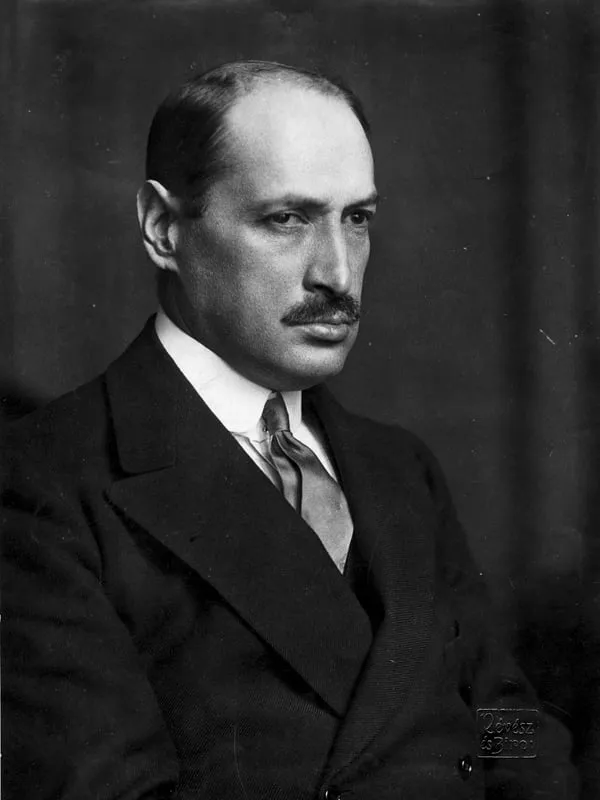
- Born:
- 4 March 1875, Budapest (Hungary)
- Died:
- 19 March 1955, Vence (France)
- Author:
- Łukasz Skowroń
- Photo:
- Révész és Bíró, domena publiczna, Wikimedia Commons

Count Mihály Károlyi, one of the richest men in Hungary, was during the war the chief opponent of István Tisza’s policy and the best-known Hungarian advocate of peace and of an understanding with the Entente. For the first years of the war he was a second-rank politician, but once the country had grown weary of the war, his slogans of a separate peace, a break with the German alliance and democratic reform brought him great popularity. In the last days of October 1918 the Aster Revolution carried him to power. As prime minister he broke the union with Austria, took Hungary out of the war and in November became head of the Hungarian People’s Republic. Formally, then, he belonged to the camp of the Central Powers, but in 1918 it was he who broke Hungary away from them. He hoped that the victors would treat a democratic Hungary leniently. He was disappointed, and after less than five months in power he had to step down. He remains to this day one of the most controversial figures in Hungarian history.
Before the war
He was born on 4 March 1875 in the Károlyi palace in Pest, into an old magnate family with great estates in eastern Hungary. Some sources, including the Polish Wikipedia, give Fót, where he grew up, as his birthplace. He was born with a cleft lip and palate, which meant that as a child he could hardly speak. He lost his mother early and was brought up by his grandmother at Fót, and only an operation in Vienna at the age of fourteen allowed him to learn to speak. He studied law, and then for years led the life of a wealthy rake: he travelled, played cards and raced cars. His opponents often reproached him for this later. Family tradition also inclined him to dislike the Habsburgs and the Germans. He knew France and England well.
He entered politics as a conservative, but soon moved to the left. In 1905 he became a member of parliament and soon joined the opposition Party of Independence, which demanded greater autonomy for Hungary from Vienna. From 1909 to 1912 he presided over the influential Hungarian National Agricultural Association. His chief adversary was Tisza, whose heavy-handed rule in parliament Károlyi fought together with Oszkár Jászi’s radicals and the Social Democrats. The quarrel was so personal that in January 1913 the two counts fought a sabre duel, which was stopped after an hour when Tisza wounded Károlyi in the arm.
In 1914 Károlyi, by then one of the leaders of the opposition, was on a lecture tour of the United States. It was there that the news of the Sarajevo assassination reached him. In dispatches for the Budapest press he warned that by throwing itself into Germany’s arms the monarchy had put itself in a hopeless position, and of the ultimatum to Serbia he wrote that it looked as though the monarchy wanted war.
1914–1916: a second-rank politician
Returning to Europe, Károlyi arrived at Le Havre on 5 August. The French arrested him as an enemy national, even though France and Austria-Hungary were not yet at war. He spent several weeks interned at Bordeaux. He was released in September after giving his word of honour that he would not fight against France, and returned home via Spain and still-neutral Italy. In November 1914 he married Countess Katinka Andrássy, stepdaughter of Gyula Andrássy, one of the leading figures of Hungarian politics.
In the first years of the war Károlyi did not swim against the tide. His party, like the whole Hungarian opposition, proclaimed a “political truce” and supported the government. He himself, as he later regretted in his memoirs, even read out on the party’s behalf, for the sake of peace and quiet, a declaration supporting the war. In 1915 he volunteered for the 1st Honvéd Hussar Regiment and, according to his memoirs, served for some time at the front as a junior officer. Hungarian historians note that until 1916 the public heard more about his car accidents and card losses than about his speeches in parliament.
The turning point came in July 1916. When the Party of Independence declared for continued support of the government’s war policy, Károlyi left it with a group of about twenty deputies and founded his own party, known simply as the Károlyi Party. It demanded a peace without annexations, a loosening of the ties with Austria, a break with the German alliance, universal and secret suffrage, and land reform. Károlyi also spoke of equal rights for Hungary’s nationalities, although he assumed that the integrity of the state would be preserved.
1917–1918: leader of the peace camp
After the death of Franz Joseph the young King Charles IV, as the Emperor Charles I was called in Hungary, sought an understanding with the opposition. Károlyi supported his efforts for peace and electoral reform, which in May 1917 led to Tisza’s resignation. On 6 June he became head of the Electoral Bloc, an alliance of his party with the Social Democrats, the Radicals and the Democrats, which demanded universal suffrage and a peace without annexations. Two leaders of the Bloc entered the government of Móric Esterházy, but the electoral reform stalled, also under Sándor Wekerle, who inherited it. In autumn 1917 Károlyi set out his views in neutral Switzerland, where, according to some authors, he also sought contacts with Entente diplomats. In January 1918 he publicly declared his support for President Woodrow Wilson’s Fourteen Points. To the right he was from then on almost a traitor; to the war-weary workers, peasants and soldiers he was a hope. When in February 1918 the sailors at Cattaro mutinied, it was to him that they tried to send a telegram.
In autumn 1918 events gathered pace. On 16 October Károlyi declared in parliament that the war was lost, and the next day Tisza admitted that he was right. After the fall of Wekerle’s government on 25 October, his party, Jászi’s Radicals and the Social Democrats formed the Hungarian National Council with Károlyi at its head, which regarded itself as an opposition government and demanded immediate peace, a break with the German alliance and full independence. The same day the king spoke with him and was inclined to entrust him with the government, but changed his mind, partly on the advice of Andrássy. The king’s plenipotentiary, Archduke Joseph August, gave the task of forming a government to a conservative, Count János Hadik. During the night of 30–31 October soldiers and workers took control of Budapest, and in the morning Károlyi became prime minister.
Prime minister and president
That same evening soldiers shot Tisza dead in his villa. Because the perpetrators had links with the circle of the National Council, the right accused Károlyi for years of complicity. A court later convicted several of his associates in absentia, but neither the judges nor historians found evidence that Károlyi himself was involved. Károlyi condemned the killing and sent a wreath for the coffin inscribed “To my greatest political opponent, as a sign of human reconciliation”.
Károlyi’s government broke the union with Austria and called on Hungarian soldiers to return from the front. On 2 November the minister of war, Béla Linder, announced that he “no longer wished to see soldiers” and ordered Hungarian soldiers to lay down their arms. This hastened the disintegration of the Austro-Hungarian army in Italy, but left Hungary without an army. Károlyi refused to accept that he was bound by the Armistice of Villa Giusti, concluded on 3 November still in the emperor’s name. On 7 November he went to Belgrade for talks with General Louis Franchet d’Espèrey, hoping that his anti-war past would earn him lenient treatment. The Frenchman, however, treated the delegation as representatives of a defeated state. The Armistice of Belgrade, signed on 13 November, placed the Banat, the Bačka and part of Transylvania under Allied occupation. At the Entente’s request Károlyi’s government also interned Field Marshal Mackensen and his troops withdrawing from Romania.
On 13 November Charles renounced any part in the affairs of Hungary, and on 16 November an independent republic was proclaimed. Károlyi became provisional head of state, and on 11 January 1919 the National Council elected him president. His rule brought laws on freedom of the press and of assembly, a new electoral law giving women the vote, and a land reform act. In February 1919 he himself began distributing land from his estate at Kápolna to the peasants. The minister for nationalities, Jászi, offered the Slovaks, Romanians and Serbs broad autonomy in an “Eastern Switzerland”, but Hungary’s nationalities no longer wanted such a state. Czechoslovak, Serbian and Romanian troops, backed by France, occupied more and more territory, often beyond the Belgrade line. When on 20 March 1919 the French Lieutenant-Colonel Fernand Vix delivered a demand for a further withdrawal of Hungarian troops, the government resigned. The next day power was taken by the Social Democrats and Communists, who proclaimed the Hungarian Soviet Republic of Béla Kun. This was announced in a proclamation bearing Károlyi’s name, which he later claimed he had not signed. It remains disputed whether he handed over power voluntarily or merely gave way to a fait accompli.
After the war
In July 1919 Károlyi left Hungary and never again returned to live there permanently during his lifetime. Under the rule of Miklós Horthy he was convicted of high treason in absentia and his property was confiscated. In exile in Czechoslovakia, Yugoslavia, France and Britain he drew closer to the Communists, which earned him the name “the Red Count”. In 1946 he returned home; from 1947 to 1949 he was Hungarian minister in Paris, and in 1949 he resigned in protest against the show trial of László Rajk. He died on 19 March 1955 at Vence on the Riviera. In the early 1960s his ashes were brought back to Budapest.
Assessment
Few Hungarian politicians provoke such conflicting judgements. For the right of the Horthy era, and in part even today, Károlyi was the man who disarmed the country at the moment of greatest danger, handed it to its neighbours without a fight and opened the way to the Communists, and so shares responsibility for the Treaty of Trianon. The Communist authorities, with whom he had broken in 1949, rehabilitated him after his death as a progressive patriot. Liberal and left-wing historians see him above all as the first Hungarian democrat, who during the war had the courage to swim against the tide and believed in Wilson’s principles.
Even authors sympathetic to him admit that he lacked political experience and firmness. The Austro-Hungarian-born journalist Paul Lendvai called him “a sincere idealist without the abilities of a statesman”, and the British diplomat and writer Harold Nicolson wrote that he had many virtues, but not those for which serious people take someone seriously. Many historians point out, however, that Hungary’s fate in 1918–1919 was decided above all by the defeat of the monarchy, the disintegration of the army, the attitude of the nationalities and French policy, and not by the weakness of one man. Recent Hungarian research questions whether the army returning from the front, exhausted and largely non-Hungarian, could have been used at all at that time to defend the old borders.
Sources
Spotted a mistake?Report an error
Often appears with
People who appear in the same events.
On the timeline
(12)1917
1918
February
October
- 24
- Wekerle resigns for goodOn 23 October 1918 Hungarian Prime Minister Sándor Wekerle announced his government's resignation after news of a Croatian regiment's mutiny in Fiume.
- Andrássy becomes foreign ministerOn 24 October 1918 Count Gyula Andrássy the Younger, son of the author of the alliance with Germany, replaced Burián as the last joint foreign minister.