Austria-Hungary · The Central Powers
Heinrich Lammasch
Member of the House of Lords, advocate of a compromise peace, last prime minister of Austria (27 October – 11 November 1918)
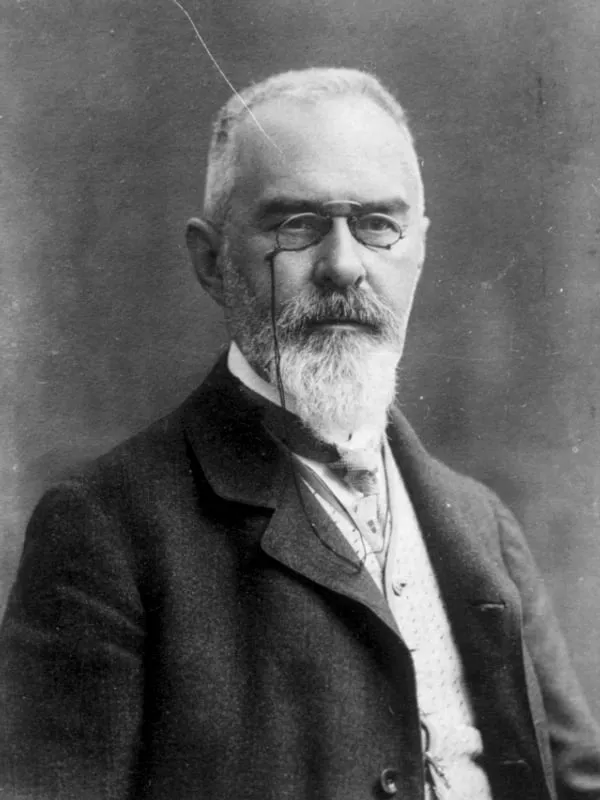
- Born:
- 21 May 1853, Seitenstetten (Austria)
- Died:
- 6 January 1920, Salzburg
- Author:
- Natalia
- Photo:
- Isidor Harkányi, domena publiczna, Wikimedia Commons

Heinrich Lammasch was one of the most eminent jurists of the Habsburg monarchy and one of the few members of its elite who throughout the war loudly demanded a peace without victors and vanquished. A professor of criminal and international law, a participant in the Hague peace conferences and several times an arbitrator in disputes between states, he had warned even before 1914 against Austria-Hungary’s close bond with Germany. During the war he drew the suspicion of the general staff and the hostility of the press, and in the House of Lords he was shouted down as the “advocate of the Entente”. Emperor Charles I, however, valued him and twice offered him the premiership. The first time, in the summer of 1917, Lammasch declined. The second time, in October 1918, he accepted office when there was nothing left to save, and as the last prime minister of imperial Austria he brought about the peaceful transfer of power to the republic.
Before the war
He was born on 21 May 1853 in Seitenstetten in Lower Austria, into a notary’s family. After his father’s early death he was educated at the Schottengymnasium in Vienna, and he studied law at the University of Vienna, where he took his doctorate in 1876. He qualified as a university lecturer in criminal law, became a full professor at Innsbruck in 1885 and returned to Vienna in 1889. He worked especially on extradition and the law of asylum and had a great influence on the 1912 draft reform of the Austrian criminal code.
It was international law, however, that made him famous. In 1899 and 1907 he advised the Austro-Hungarian delegation at the Hague peace conferences and contributed to the creation of the Permanent Court of Arbitration. As one of its members he served as arbitrator in several celebrated disputes, among them the Venezuelan case of 1904 and the Anglo-American dispute over the fisheries off Newfoundland in 1910. In 1899 Franz Joseph appointed him to the House of Lords, where he did not attach himself to any of the major parties. He was a Catholic and a moderate conservative, for a time advised the heir to the throne, Franz Ferdinand, on legal matters, and at the same time for years nominated Bertha von Suttner for the Nobel Peace Prize, which she received in 1905. In foreign policy he made no secret of regarding the alliance with Germany as dangerous and advised rapprochement with the Western powers. In 1914, owing to poor health, he asked to retire, which the emperor granted in November, and he moved from Vienna to Salzburg.
A pacifist in wartime
After the assassination in Sarajevo Lammasch did not oppose a firm stance towards Serbia, but he did not want war. On 28 July 1914, the day Austria-Hungary declared war on Serbia, he published an article in the Neues Wiener Tagblatt under the questioning title “War?”, in which he proposed coercive measures short of open war. At first he regarded the war as defensive, but from the outset he rejected plans for annexations. According to his biographer Dieter Köberl, as early as the autumn of 1914 he was convinced that the war would last for years. In November 1914, in a German legal journal, he called for an impartial investigation, with the participation of neutral states, into charges of violations of the laws of war by all sides, including the Austro-Hungarian army. The military regarded this as treason, and some sources state that the general staff demanded his arrest.
Since the Austrian parliament had not sat since the spring of 1914, Lammasch spoke through his pen. He wrote in the domestic and foreign press against “hatred between nations”. In 1917 he published the book The Law of Nations after the War, in which he sketched an international organisation similar to the later League of Nations. Between 1915 and 1918 he was nominated several times for the Nobel Peace Prize.
After the death of Franz Joseph in November 1916 the pacifists gained access to the court. Lammasch belonged to the so-called Meinl group, a circle gathered around the Viennese merchant Julius Meinl, which also included the jurist and politician Josef Redlich. The group sought ways to a compromise peace and to the transformation of the monarchy into a federal state of nations, and the young emperor willingly listened to its advice.
Refusal in 1917
When the government of Heinrich Clam-Martinic fell in June 1917, Charles wanted to entrust Lammasch with forming a cabinet. He declined, pleading his lack of parliamentary experience and a heart condition. According to the Austrian historian Manfried Rauchensteiner, in those days he advised the foreign minister, Ottokar Czernin, to give the Germans an ultimatum: either they agree within 48 hours to cede Alsace-Lorraine to France, or Vienna would conclude a separate peace. Czernin passed this advice on to the German ambassador, adding that he did not do such “swinish things”. From then on Lammasch was regarded in Berlin as a dangerous man. Charles also considered a Redlich government, but in the end kept the civil-service cabinet of Ernst Seidler.
When the emperor reconvened the Imperial Council in 1917, Lammasch gave several speeches in the House of Lords in favour of a negotiated peace based on the principles of no annexations, equal rights for nations and the peaceful settlement of disputes. The most famous he gave in February 1918, during the negotiations at Brest-Litovsk, when Vienna once again believed in victory. He warned that a so-called victorious peace would be a “rotten peace”, merely a truce before an even mightier and more terrible war. He was interrupted by heckling, called the “advocate of the Entente”, and at the end someone shouted: “We want war and victory!” After the attacks of his colleagues he left the Centre Party, the moderate group in the House of Lords to which he had belonged. Almost the only person to come publicly to his defence was the satirist Karl Kraus, who in March 1918 gave a lecture in Vienna entitled “For Lammasch”.
Lammasch also tried unofficial diplomacy. At the emperor’s wish, on 3 February 1918 he met the American George Herron in Switzerland, who had contacts with the circle of President Woodrow Wilson. They discussed peace and the reconstruction of the monarchy in the spirit of the Fourteen Points. Czernin learned of the talks and informed Berlin, and the matter fizzled out. Herron later regarded its failure as one of the great lost opportunities and blamed Czernin above all. After Charles’s letters to Prince Sixtus were revealed in the spring of 1918, the emperor could no longer afford contacts with pacifists and sidelined Lammasch for several months.
Prime minister in the monarchy’s last days
By the summer of 1918 Lammasch was convinced that the monarchy could not be saved, but to the end he looked for solutions that would preserve some form of union of the nations on the Danube. In September he wrote a draft federal constitution. After the emperor’s manifesto of 16 October he was asked, through the jurist Hans Kelsen of the war ministry, to head a commission that was to carry out the dissolution of the monarchy peacefully in agreement with the national councils and to examine the possibility of a union of states. According to Kelsen’s memoirs, around 20 October Lammasch judged the mission a failure, because the Czechs had refused to take part in it.
On 25 October Lammasch agreed to become prime minister of Austria, after which his appointment was announced. On 27 October his cabinet replaced the government of Max Hussarek. The Viennese Neue Freie Presse heralded him as “the liquidator of old Austria” and his cabinet as a “liquidation ministry”. He accepted office in order to prevent bloodshed and, through his contacts abroad, to obtain milder peace terms. The government included, among others, Josef Redlich as finance minister and the priest Ignaz Seipel as minister of social welfare. Lammasch took part in drafting the note in which, on 27 October, Vienna asked for an armistice and a separate peace. A few days earlier, as American diplomats in Switzerland noted, he had judged Wilson’s reply of 18 October more leniently than most politicians in Vienna.
Lammasch’s government no longer had any real power. The Czechs, Poles and Yugoslavs were taking over the administration of their lands, and on 31 October the government of German-Austria headed by Karl Renner was sworn in in Vienna. The imperial cabinet handed over one matter after another to it and made no attempt to compete with it. For Renner, Victor Adler and Karl Seitz it was an acceptable intermediary between the emperor and the revolution. As a result, as Austrian historians stress, the transition from monarchy to republic in Vienna took place almost without bloodshed. The government did not negotiate the Armistice of Villa Giusti of 3 November; the armistice commission was sent by the high command.
After the overthrow of the monarchy in Germany on 9 November, the council of ministers under Lammasch’s chairmanship took up the future of the monarchy in Austria. Renner and Seitz also took part in the deliberations. A text of a declaration by the emperor was drawn up, to which Renner, Seipel, Redlich and Lammasch himself contributed ideas and wording. The key formula that the emperor “renounces all participation in affairs of state” came, according to German studies, from Seipel. On 11 November Lammasch went with the interior minister to Schönbrunn and persuaded the hesitant Charles to sign. The declaration was countersigned by Lammasch. According to accounts cited by Köberl, when Charles demanded in addition a written confirmation that this was not an abdication, Lammasch refused. That same afternoon the emperor dismissed his government, thanking him for his tireless work for peace among nations. The next day the Republic of German-Austria was proclaimed.
After the war
Lammasch served the new republic loyally, although he opposed the union of Austria with Germany sought by Renner and the Social Democrats. He drew up a draft covenant of the League of Nations, which the government in Vienna adopted. In the spring of 1919 he went to Saint-Germain, though not as a delegate but as an expert attached to the delegation. He advocated an independent and neutral republic on the Swiss model, which he called “Noric”, and proposed a referendum on the matter. His article on the subject was confiscated within the delegation on Renner’s orders. On 10 June, embittered by the peace terms and the loss of South Tyrol, he left Saint-Germain before the end of the negotiations. He died of a stroke in Salzburg on 6 January 1920. Stefan Zweig wrote to Romain Rolland that only five people stood at the grave of the former prime minister of “a state of thirty million”, because nobody wanted to be taken for a monarchist. In 1957 his remains were moved to the family grave in Bad Ischl.
Assessment
Contemporaries judged Lammasch in sharply different ways. To the supporters of a “victorious peace” he was a defeatist and almost a traitor; to Karl Kraus and the Social Democratic Arbeiter-Zeitung he was one of the few who during the war had “passed the test of character”. Legal historians see in him one of the pioneers of international arbitration and of the idea of the League of Nations, and Austrian authors such as Stephan Verosta also a forerunner of Austrian neutrality.
As a politician, however, he is judged in a more complex way. He had neither an appetite for power nor experience of government, and poor health sapped his strength. Some historians, following Köberl, wonder whether in 1917, when the Allies were not yet thinking of breaking up the monarchy, his government might have achieved a separate peace. Most, however, consider this unlikely: Austria-Hungary was too dependent on Germany, and Lammasch would not have overcome the resistance of the high command, the Hungarian government and Czernin. Kelsen, for his part, suggested that in the autumn of 1918 Lammasch was too attached to preserving the dynasty. Few, however, dispute his achievement in the monarchy’s last days: as its last prime minister he helped to carry out Austria’s parting from the Habsburgs calmly and without civil war.
Sources
Spotted a mistake?Report an error
Often appears with
People who appear in the same events.