Germany · The Central Powers
Wilhelm Groener
Chief of Field Railways (1914–1916), head of the War Office (1916–1917), chief of staff of Army Group Kiev (1918), First Quartermaster General (1918–1919), lieutenant-general
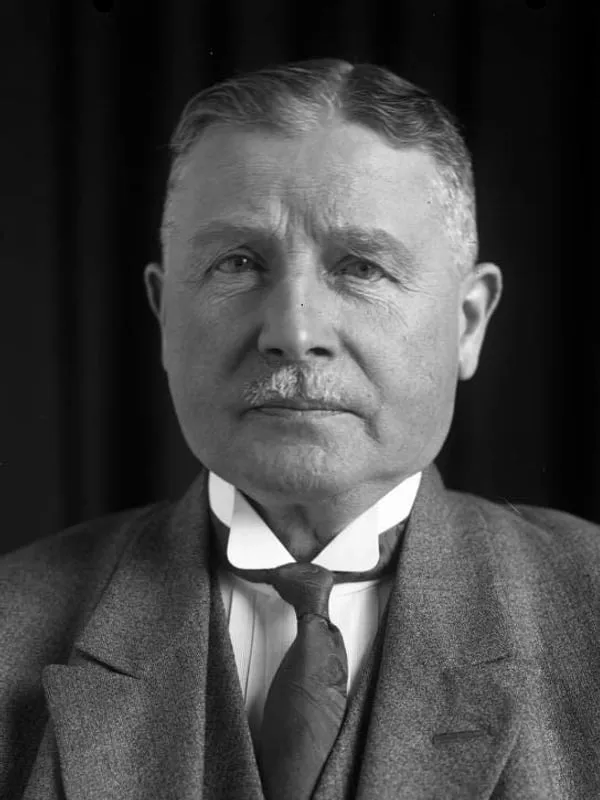
- Born:
- 22 November 1867, Ludwigsburg (Württemberg)
- Died:
- 3 May 1939, Potsdam-Bornstedt
- Author:
- Natalia
- Photo:
- Bundesarchiv, Bild 102-01049 / Georg Pahl, CC BY-SA 3.0 DE, Wikimedia Commons

Wilhelm Groener was one of the most able organisers of the Imperial Army and one of the few of its generals who understood that wars are fought not only by armies but by whole societies. In 1914 his railwaymen carried millions of soldiers to the frontiers. In 1916–1917 he directed the entire German war economy, and in 1918 the German occupation of Ukraine. In the last weeks of the war he replaced General Erich Ludendorff, and it was he who on 9 November 1918 told Wilhelm II that the army no longer stood behind him. A day later he made an agreement with Friedrich Ebert under which the army recognised the revolutionary government and the government relied on the army. The monarchists never forgave him for it, and the left still sees the pact as the original sin of the Weimar Republic.
Before the war
He was born on 22 November 1867 in Ludwigsburg, the son of a paymaster in a Württemberg regiment. He was not of noble birth, which was rare in the German army among men who rose so high. In 1884 he joined a Württemberg infantry regiment, graduated top of his year from the War Academy in Berlin and in 1899 was posted to the Great General Staff. Over the next dozen or so years, with breaks for regimental service, he worked in its railway department, and in 1912, as a lieutenant-colonel, he became its head. He considered himself a disciple of Alfred von Schlieffen and subordinated the whole railway network and transport plans to Schlieffen’s concept of a rapid blow against France through Belgium.
1914–1916: the railways
In August 1914 Groener became Chief of Field Railways at General Headquarters. He was responsible for carrying the armies to the frontiers, for bringing up supplies and for repairing and extending the lines, especially in Belgium. The mobilisation and concentration of an army of several million went smoothly, and the credit was given above all to him. All the more painfully did he take the defeat on the Marne. After the war he judged the Chief of the General Staff, Helmuth von Moltke, to have been a “commander against his own will” who had failed to carry out Schlieffen’s idea. He was also critical of Moltke’s successor, Erich von Falkenhayn, but as head of the railways he could only propose, not decide.
The railways proved the key to a war on two fronts. Groener’s trains shifted divisions from west to east and back, and their capacity set the limits of operations. In September 1915, during the Battle of Vilna, he noted that the great “sack” with which Hindenburg and Ludendorff wanted to encircle the Russians looked fine on the map, but there was no strength behind it to pull it shut. In June 1915 he was promoted major-general out of turn, and in September he received the Pour le Mérite. At the end of 1915 he was also put in charge of grain imports from still-neutral Romania, and in May 1916 he joined the leadership of the newly created War Food Office. This was the start of his second career: as an organiser of the economy.
1916–1917: the War Office
When in August 1916 Hindenburg and Ludendorff took over the Supreme Army Command, they demanded a drastic increase in the output of weapons and munitions, the so-called Hindenburg Programme. On 1 November 1916 the War Office (Kriegsamt) was set up within the Prussian Ministry of War, and Groener, with the rank of lieutenant-general, became its head. The office was to control the raw materials, armaments and manpower of the whole country. In the Reichstag Groener defended the Auxiliary Service Law (Hilfsdienstgesetz) of December 1916, which introduced compulsory labour for men aged 17 to 60. In return for parliament’s support, however, the law gave the trade unions the right to take part in arbitration boards and in workers’ committees in the factories.
Groener treated the trade unionists as partners, which the industrialists regarded as weakness. At the same time, in the spring of 1917, when strikes broke out in Germany after the revolution in Russia, he issued an appeal to the workers in which he called anyone who struck while the armies faced the enemy a scoundrel. The left did not forget it for a long time. His work at the War Office convinced him that Germany’s economic resources were limited, and undermined his belief in victory. In the summer of 1917 he proposed that the state should curb both employers’ war profits and the rise in wages. The industrialists, some officials and soldiers, including, it is believed, Ludendorff himself, found this unacceptable. On 16 August 1917 Groener was dismissed and his place was taken by General Heinrich Scheuch. The public read it as punishment for his social views.
1918: Ukraine
For half a year Groener commanded on the Western Front, first the 33rd Division and then the XXV Reserve Corps. At the turn of February and March 1918 he took over the I Army Corps, which was entering Ukraine after the Central Powers had concluded peace with the Ukrainian People’s Republic, and on 28 March he became chief of staff of the army group headed by Field Marshal Hermann von Eichhorn. His staff in Kiev, occupied by the Germans at the beginning of March, in practice directed the whole of German policy in Ukraine. The main aim was grain and raw materials for starving Germany and Austria, which led to constant disputes with the Austro-Hungarian ally.
The Ukrainian Central Rada, left-wing and hostile to requisitioning, did not meet German expectations. In April Eichhorn’s order on compulsory sowing of the fields led to open conflict. On 26 April Groener discussed with General Pavlo Skoropadskyi the terms of German support, and on 29 April Skoropadskyi proclaimed himself Hetman. Groener also took part in assembling the Hetman’s government and rejected the demands of the Ukrainian socialist parties. In conversations with officers he warned against the Jews, whom he regarded as enemies of the German “power of order”. After Eichhorn’s assassination on 30 July 1918 he remained in his post until October.
Ludendorff’s successor
After Ludendorff’s dismissal on 26 October the Kaiser appointed Groener First Quartermaster General. The appointment is dated to 29 or 30 October. He was chosen for his administrative experience and his reputation as a general the Social Democrats could talk to. He found an army retreating along the whole front and allies asking for an armistice. On 3 November he ordered a retreat to the Antwerp–Meuse line, hoping to hold it for several weeks, but on 6 November, after the news from Kiel and another defeat at the front, he demanded that an armistice delegation be sent at once.
For a long time he would not hear of the Kaiser’s abdication, fearing for the cohesion of the army. On 6 November he rejected Ebert’s request to persuade Wilhelm II to abdicate. In private, however, he considered that the Kaiser ought to seek death at the front. On 9 November at Spa, when Wilhelm II spoke of marching on Berlin, Groener, relying on a poll of front-line officers, told him that the army would march home in good order under its own commanders, but not under the Kaiser’s command. According to some historians, the same day he also let Berlin know by telephone that full abdication was a matter of moments, which prompted Chancellor Max von Baden to announce it. On leaving headquarters, the Kaiser refused to shake his hand.
The pact with Ebert
On the evening of 10 November Groener telephoned Friedrich Ebert, head of the new government. The army recognised the government and promised to bring the troops home in good order, and the government was to support the officers in maintaining discipline and supplies and in fighting Bolshevism. Groener acted on his own initiative, and Hindenburg approved it after the fact. In his memoirs he wrote that, in defiance of the revolution, he had wanted to carry over into the new Germany the best of the old Prussia. In the following weeks he directed the return of several million soldiers from beyond the Rhine within the deadlines imposed by the armistice, which went surprisingly smoothly. He forced Ebert to water down the resolutions of the Congress of Councils on democratising the army, and in December urged him to act decisively against the mutinous sailors during the Christmas fighting. Headquarters moved from Spa to Wilhelmshöhe Palace in Kassel, and in February 1919 to Kolberg, today Kołobrzeg, from where the defence of the eastern borders was directed.
After the war
In June 1919, when the government asked whether the army could defend itself if the Treaty of Versailles were rejected, Groener judged resistance hopeless. Hindenburg agreed with him but left it to Groener to pass the message on to the politicians, which in the eyes of the right made Groener the guilty one. In September 1919 he left the army. In 1920–1923 he was Minister of Transport and rebuilt the railways, and in 1928–1932 Minister of the Reichswehr, from 1931 also of the Interior. In April 1932 he banned the Nazi SA and SS. His former protégé, General Kurt von Schleicher, then brought about his dismissal. He died in Potsdam on 3 May 1939. The Wehrmacht command forbade officers to attend his funeral.
Assessment
German historians see Groener above all as the man who in 1918–1919 helped preserve the unity of the state and build the first German republic. His biographer in the Neue Deutsche Biographie, Friedrich Hiller von Gaertringen, stressed the sober realism and organising talent of a general who, thanks to his work at the War Office, understood what modern industrial war was and won the trust of Social Democratic workers. Critics point out that the pact with Ebert also served to save the old officer corps and its influence, and that the army whose survival Groener secured never became loyal to the republic. His antisemitic remarks of 1918 are also noted. To the monarchists he was the man who betrayed the Kaiser; to the radical left, the general who helped crush the revolution. He himself believed he had been guided only by a sober grasp of reality.
Sources
Spotted a mistake?Report an error
Commanded in battles
(01)Mentioned in battles
(01)Often appears with
People who appear in the same events.