1918: Palestine, Syria and Persia
Battle of Sharqat
- Dates:
- 23–30 October 1918
- Front:
- Middle East
- Location:
- The Tigris valley from the river's gorge through the Jebel Hamrin hills at Fatha, about 55 kilometres north of Tikrit, past the mouth of the Little Zab to the area of Qalat Sharqat (the ruins of Ashur) and Huwaish, about 100 kilometres south of Mosul, northern Mesopotamia (present-day Iraq)On the battle map →
- Sides:
- United Kingdom and British IndiaWilliam Marshall, Alexander Cobbe, Hew Fanshawe, Robert CasselsOttoman EmpireAli Ihsan Pasha, Ismail Hakki Bey
- Result:
- British victory. The Turkish Tigris Group of the Sixth Army, trapped between cavalry and infantry, surrendered on the morning of 30 October. In the operation as a whole the British took over 11,000 prisoners and 51 guns.
- Author:
- Łukasz Skowroń
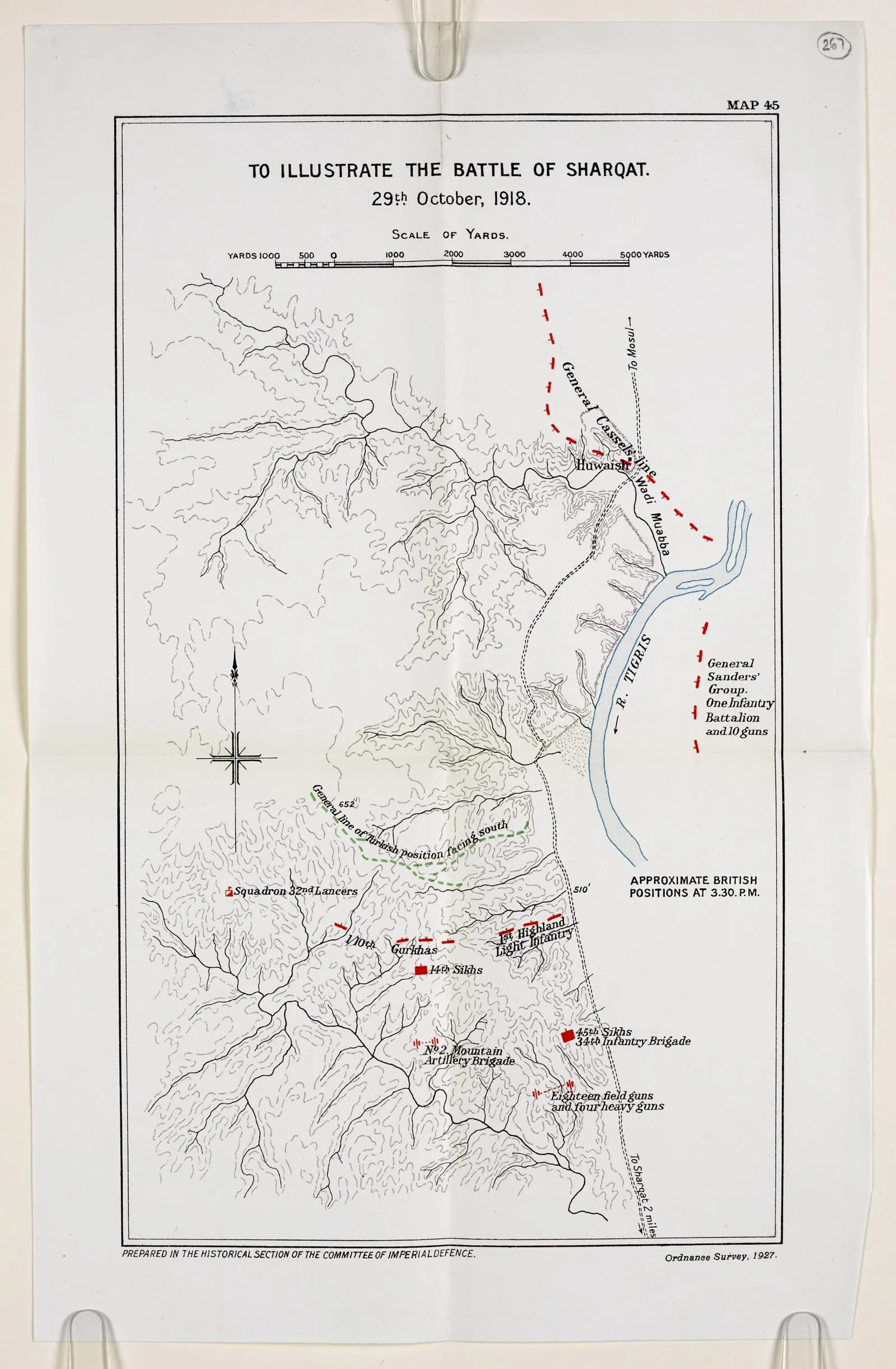
The Battle of Sharqat was the last battle of the Mesopotamian campaign and one of the last battles of the entire British–Turkish war. In the last week of October 1918, when the Ottoman government was already seeking an armistice, the British-Indian I Corps of Lieutenant-General Alexander Cobbe advanced from Tikrit up the Tigris against the positions covering Mosul. The Turks gave up their fortifications at Fatha without a fight, but defended themselves stubbornly in the hills on the right bank of the river. Meanwhile two cavalry brigades outflanked them from the east, crossed the Little Zab and the Tigris and closed the road to Mosul behind the Turkish Tigris Group. For three days the Turks tried to break through to the north, squeezed between the cavalry and the 17th Division attacking from the south. On the morning of 30 October, the day the Armistice of Mudros was signed, their commander Ismail Hakki Bey surrendered with his entire force.
Name and dates
The British chronology of the war (Principal Events) records under 23 October 1918 the “beginning of the British advance on Mosul”, and the “Battle of Sharqat” under 28–30 October, with the note that on 30 October the Turkish army on the Tigris surrendered. The British official history of the campaign (F.J. Moberly, The Campaign in Mesopotamia, vol. IV) describes the fighting at Fatha and on the Little Zab (23–26 October) in a separate chapter and counts the Battle of Sharqat from the pursuit of 27 October. All these days, however, made up a single operation, planned by Cobbe from the outset as an encirclement of the Turkish forces covering Mosul. This page therefore covers the whole of it, from the advance on 23 October to the surrender on 30 October, and describes the subsequent occupation of Mosul as its consequence.
Sharqat (today the town of Al-Shirqat) is in period sources Qalat Sharqat, a mound on the west bank of the Tigris with the ruins of Ashur, the ancient capital of Assyria, which German archaeologists excavated before the war, in 1903–1914. The battle itself was fought mainly a few to a dozen or so kilometres north of it, at Huwaish and Hadraniya. The main source is Moberly’s official history, supplemented by the British air history (H.A. Jones, The War in the Air, vol. VI) and by General William Marshall’s summary quoted by the war correspondent Edmund Candler. The figures come from these British sources.
Background
After the defeat of the Turks at Megiddo and Bulgaria’s capitulation at Salonika, London expected Turkey to sue for peace soon. On 2 October the War Office telegraphed the commander in Mesopotamia, General William Marshall, that in these circumstances as much ground as possible should be occupied up the Tigris. Moberly explains this by the wish to exploit Allenby’s victories and to remove Turkish influence south of the Taurus Mountains. Historians add that the government wanted to hold the Mosul vilayet, with its oil deposits, before the peace talks. Marshall replied on 4 October that all his transport was serving the road through Persia and that he could assemble at most about 200 Ford vans and a column of mule carts. He therefore ruled out a cavalry raid up the Euphrates to help Allenby and proposed a blow solely along the Tigris, with the line of the Little Zab as the first objective. On 6 October London agreed.
The main Turkish position lay about 55 kilometres north of the railhead at Tikrit, which the British had taken in November 1917. At Fatha the Tigris breaks through a range of hills, called Jebel Makhul on the right bank and Jebel Hamrin on the left, rising about 300 metres above the plain. The Turks had been fortifying themselves there for a year and a half. About 25 kilometres further on they had a second line, from Ain Dibs through the hills on the right bank to the Tigris at Mushak and then along the steep northern bank of the Little Zab, with a bridge over the Tigris at Humr. On 21 October the British estimated that about 2,600 Turkish soldiers with 28 guns stood at Fatha and about 2,900 with 14 guns on the second line. On the Tigris stood the Turkish 14th Division with additional regiments, and at Kirkuk the 2nd Division, roughly 2,200 rifles and 30 guns. The 5th Division was coming to help from Persia. The whole Sixth Army was commanded by Ali Ihsan Pasha, who according to British intelligence had improved its discipline and morale and sent away the unpopular German staff officers. The Turks had, however, sent their heavy guns to Aleppo.
Cobbe judged that a frontal assault on Fatha would be costly and indecisive, and that outflanking the Turkish right through the desert was impossible for lack of water. He decided to outflank the Turks from the east, through the passes in the Jebel Hamrin, force the Little Zab, push the enemy onto the right bank of the Tigris and cut him off there. On the left bank operated the 18th Division of Major-General Hew Fanshawe (about 1,400 sabres, 7,700 rifles and 48 guns, including the 7th Cavalry Brigade of General C.E.G. Norton), on the right the 17th Division of Major-General G.A.J. Leslie (about 200 sabres, 7,700 rifles and 82 guns). Secret tasks were given to the 11th Cavalry Brigade of General R.A. Cassels, which was to go far to the east and force the Little Zab, and to the Light Armoured Motor Brigade, which was to cross the desert near the ruins of Hatra and come out on the Mosul road beyond Sharqat. On the right flank a column of General A.C. Lewin from III Corps was to advance on Kirkuk and Altun Köprü and prevent the Turkish 2nd Division from coming down the Little Zab. Both divisions of I Corps were new formations, with few battle-experienced units, weakened by the dispatch of Indian battalions to Salonika and by the influenza epidemic.
Course
Fatha and the Little Zab (23–25 October)
By the morning of 23 October the concentration was complete. The British artillery spent the whole day ranging on the Turkish batteries, and in the afternoon an infantry brigade with mountain guns set off along the crest of the Jebel Hamrin. During the night the Turks abandoned the entire position. At one in the morning patrols of the 55th Brigade found the trenches on the left bank empty, and before five in the morning of 24 October it turned out that those on the right bank had been vacated as well. The withdrawal, a day earlier than expected, took the British by surprise. The Turks blew up the road through the gorge on the right bank so effectively that not even pack animals could pass, and their rearguard got away, harassed only by aircraft of No. 63 Squadron RAF.
Meanwhile Cassels’s 11th Cavalry Brigade, after a march of about 125 kilometres in 39 hours, reached the Zarariya ford on the Little Zab on the afternoon of 24 October. On the far bank it ran into two Turkish battalions with four guns marching to the Tigris. The 7th Hussars crossed the river by a ford one and a half metres deep and forced the Turks to retreat. On 25 October the 7th Cavalry Brigade and the 53rd Infantry Brigade also crossed the Little Zab, and the Turks were pushed off the whole left bank of the Tigris. On the right bank the 17th Division forced its way through the gorge along the wrecked road, hauling its guns almost by hand, and reached the Turkish position in front of Mushak. In the evening two companies of the 1st Battalion, Highland Light Infantry, took a Turkish trench behind a double wire obstacle in a night attack, losing over a hundred men. That same evening Lewin’s column occupied Kirkuk, which the Turks had abandoned.
Mushak and the crossing of the Tigris (26–27 October)
On the morning of 26 October the 14th Sikhs attacked the Turkish position at Mushak along the river. The Turks had hidden machine guns on the slopes firing into the flank of the attack, and that day the Sikhs lost 323 men, mostly within the first hour of the attack, including six of their eight British officers. The 17th Division was stuck in the hills, and its 51st Brigade lost 618 men on 25 and 26 October. Yet the same day sealed the fate of the Turks. At dawn the 11th Cavalry Brigade set off north from the Little Zab, screened from the enemy by the 7th Brigade, and in the afternoon found a ford across the Tigris at Hadraniya, about 21 kilometres above Sharqat. The crossing of the river’s three channels, the last of them along a narrow underwater ledge in water one and a half metres deep, was dangerous, but by 4.30 p.m. the Guides Cavalry were on the right bank, and after 5 p.m. Cassels had taken up a position at Huwaish across the road to Mosul. That morning the armoured cars had already reached this road and cut the Turkish telegraph cable.
During the night of 26–27 October the Turks abandoned the position at Mushak and fell back to a line of trenches a few kilometres south of Sharqat. Their commander, Ismail Hakki Bey, had orders not to withdraw north of Sharqat before 31 October and was waiting for the 5th Division, which was to join him. On 27 October the 23rd Cavalry attacked a Turkish detachment south of Huwaish to force the Turks to reveal their strength and to conceal its own weakness. It lost 49 men, and the commander of the armoured car brigade, Major T. Thompson, was taken prisoner when a shell wrecked his car. The 17th Division pursued slowly, across trackless country and without water, whereas a column of General G.A.F. Sanders from the 18th Division marched about 53 kilometres overnight along the left bank of the Tigris and at dawn on 28 October stood opposite Huwaish.
The fight at Huwaish (28–29 October)
On the morning of 28 October the Turks moved against Cassels from the south and west. About 2,500–3,000 infantry tried to outflank the brigade’s right, and a detachment of the 5th Division was approaching from the north. The 7th Hussars threw back the attackers’ left with a dismounted counter-attack from a ravine, the 1/7th Gurkhas crossed the Tigris by ferry, and Sanders’s guns shelled the Turks from the left bank. In the afternoon, after a march of about 72 kilometres, Norton’s 7th Cavalry Brigade arrived and began crossing the ford at Hadraniya, losing several men and horses in the current. The firing went on until late at night, but the Turks did not break the ring. Cassels’s brigade lost over a hundred men that day, and according to Moberly it owed its successful defence above all to the accurate fire of its horse battery and its sixty machine guns. At the same time in the south the 2nd Battalion, Royal West Kent, down to only about 430 men, stormed a line of trenches less than 6 kilometres south of Sharqat, taking about 200 prisoners and 11 machine guns. This cost the 17th Division about 140 killed and wounded.
In the evening Cobbe judged that the Turks were ready to surrender and, despite the objections of Leslie, who feared a march by exhausted soldiers across unreconnoitred ground, ordered the 17th Division to move off during the night, at 1.45 a.m., to come to the cavalry’s aid as quickly as possible. On 29 October, on the northern flank, the 13th Hussars, 239 sabres, galloped across the open plain to the foot of a steep spur held by the Turks, dismounted in dead ground and stormed the summit with the bayonet, losing only seven men. Together with the lancers, who had taken the Turkish flank, they captured 985 prisoners, the entire Turkish 13th Regiment of the 5th Division. In the south the 17th Division reached the main Turkish position about 5 kilometres south of Huwaish only in the afternoon. The attack at 4 p.m. ended in confusion: about a thousand Turks left their trenches and drove back the 45th Sikhs, although Mahrattas and Gurkhas stopped the counter-attack and the 112th Infantry took part of the trenches. The division lost about 500 of its 3,000 men, but pinned the Turks in place.
Surrender (30 October)
At dawn on 30 October white flags appeared over the whole Turkish line facing the 17th Division. At 7.30 a.m. Ismail Hakki Bey gave himself up to Lieutenant-Colonel Shoubridge of the 112th Infantry. He later explained that he had intended to withdraw into the desert by night and reach the Tigris at Qaiyara, but until the last moment had hoped that the 5th Division would break through the British cavalry. He no longer had any communications: the German wireless station had left for Mosul, and his last two aircraft were unfit to fly. That same day the 7th Cavalry Brigade and the armoured cars moved north, captured about 200 Turks with a gun and a steamer at Qaiyara, and then caught up with and rounded up about a thousand soldiers of the Turkish 14th Regiment.
Losses
According to Moberly, from 18 to 30 October Cobbe’s forces took 11,322 prisoners, 51 guns and 130 machine guns, as well as three steamers and much ammunition. British and Indian losses in this period amounted to 1,886 men, 1,504 of them in the 17th Division, which attacked through the hills on the right bank. Marshall wrote that the whole Turkish 14th Division, most of the 2nd Division and parts of two regiments of the 5th Division had surrendered, with all their artillery, transport and services. These figures cover the whole operation. Candler states that Ismail Hakki Bey himself surrendered with about 8,000 men. British sources do not give Turkish losses in killed and wounded.
Significance
Moberly writes that after Sharqat the Turkish Sixth Army “had almost ceased to exist” and without the armistice would not have been able to hold Mosul. The Armistice of Mudros came into force at noon on 31 October. On 1 November Cassels’s advanced troops at Hammam Ali, about 20 kilometres south of Mosul, met Ali Ihsan’s envoys with a letter about the armistice, and the commander of the Turkish 5th Division demanded that the British return to Qaiyara, where they had stood when the armistice came into force. Marshall, however, citing Article 7 of the armistice, which allowed the Allies to occupy strategic points, ordered the advance to continue. On 3 November Cassels entered the city with his staff, and his troops occupied the surrounding hills and roads. Ali Ihsan protested and awaited orders from Constantinople. When they arrived, the British took over the whole city on 10 November, and by 15 November the Turkish troops had left the vilayet. Turkey regarded the occupation of Mosul after the armistice as unlawful, and the dispute over this oil-rich region dragged on until 1926, when Mosul was finally awarded to Iraq under the British mandate.
Sharqat closed a four-year campaign that had begun in November 1914 with a landing at the mouth of the Shatt al-Arab. The battle showed what the British in Mesopotamia had mastered in 1917–1918: outflanking the enemy with cavalry and armoured cars instead of frontal assaults. At the same time the price was paid above all by the infantry of the 17th Division, sent through the hills against fortifications that the Turks defended, as Marshall admitted, “with the greatest obstinacy”.
Spotted a mistake?Report an error