United Kingdom · The Entente
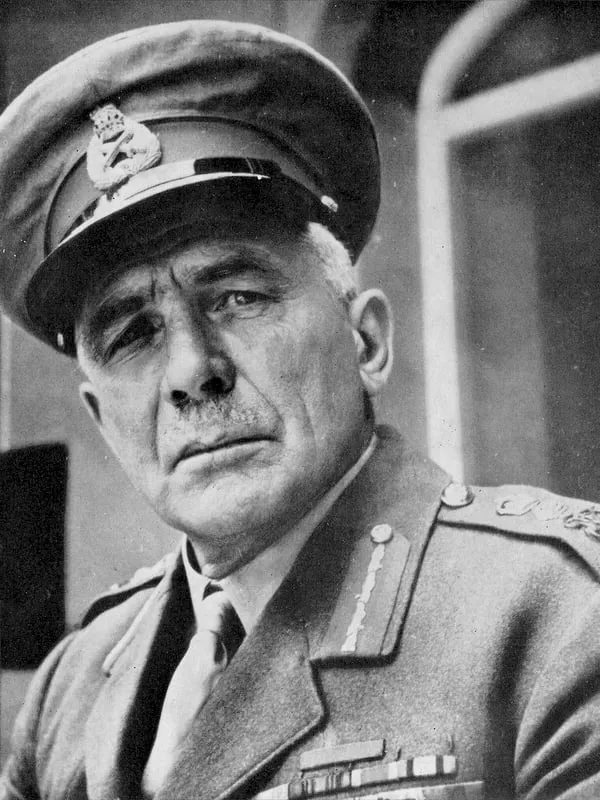
Edmund Ironside
Chief of staff of the 4th Canadian Division (1916–1917), commander of the Allied forces at Archangel (1918–1919), later field marshal
- Born:
- 6 May 1880, Edinburgh (Scotland)
- Died:
- 22 September 1959, London
- Author:
- Natalia
- Photo:
- War Office, domena publiczna, Wikimedia Commons

William Edmund Ironside, known to his fellow officers ironically as “Tiny”, because he stood over 190 centimetres tall and weighed over a hundred kilograms, was one of the most colourful British officers of his generation. He spoke several languages fluently, including Russian. In the Great War he served for four years on staffs on the Western Front, longest as chief of staff of the 4th Canadian Division, with which he fought at Vimy and Passchendaele. In the autumn of 1918, aged 38, he took command of the Allied forces at Archangel and for a year waged a war against the Bolsheviks in the far north of Russia, which went on long after the armistice in the west. Later he commanded in Persia, and in 1939 he became Chief of the Imperial General Staff. When he was made a baron, he took the title Ironside of Archangel.
Before the war
He was born on 6 May 1880 in Edinburgh into the family of an army surgeon, who died when his son was an infant. His mother, living on a modest pension, travelled with him around the Continent, because life was cheaper there. This was the beginning of his knowledge of languages: as an adult he passed official interpreter’s examinations in seven. He was educated at St Andrews and at Tonbridge, and in 1898 entered the Royal Military Academy, Woolwich. In June 1899 he was commissioned into the field artillery.
In the Boer War he was wounded three times. Towards the end of the war he was part of the escort that took General Jan Smuts to the peace negotiations. Afterwards, by his own account, he disguised himself as a Boer wagon driver and worked as a spy with the transport of the German forces in German South West Africa until he was recognised. This adventure, whose details and date biographers give differently, gave rise to the legend that he was the model for Richard Hannay, the hero of John Buchan’s spy novels. He later served in India and in South Africa, and in 1912 began his studies at the Staff College, Camberley.
On the Western Front
The war interrupted his studies. In August 1914, as a staff captain, he went to Boulogne and Saint-Nazaire, the supply bases of the British Expeditionary Force. At the end of October he moved to the staff of the 6th Division, which was fighting near Armentières, and was promoted to major. In March 1916, as a lieutenant-colonel, he became chief of staff of the newly formed 4th Canadian Division. Its commander, General David Watson, was a volunteer without professional training, so Ironside, as he himself recalled, often in effect ran the division while Watson signed his orders. He imposed a hard training programme on it so that it would reach the front as soon as possible and not be broken up to provide reinforcements for other divisions.
In October 1916 the division went into action in the final phase of the Battle of the Somme, on the Ancre Heights, where in November it took Regina Trench. In the spring of 1917 it prepared for the assault on Vimy Ridge. The 4th Division had the hardest task: Hill 145, the highest point of the ridge. According to Ironside’s memoirs, when the attack broke down and Watson passed on an unclear order to halt it, he himself, on his own responsibility, sent further battalions into the fight. In the autumn the division fought in the Second Battle of Passchendaele.
In January 1918 Ironside became commandant of a small arms school, but at the end of March, in the days of the German offensive, he returned to the front as a brigadier-general and commander of the 99th Brigade of the 2nd Division. He commanded it for less than half a year.
Archangel
At the beginning of September 1918 he was urgently summoned to the War Office. The Chief of the Imperial General Staff, General Henry Wilson, told him that his task in northern Russia would be “to hold the fort until the local Russians took up the fight” and ordered him to prepare for a winter campaign. Ironside sailed with Canadian gunners and on 1 October arrived at Archangel, where for two weeks he was chief of staff to General Frederick Poole. When Poole sailed for England on 14 October, Ironside took over command, formally confirmed in November. Murmansk received its own commander, General Charles Maynard.
Ironside toured the fronts and concluded that with a few thousand soldiers of various nationalities there was no question of reaching Kotlas or Vologda. He ordered the troops to dig in and prepare for the winter, when the frozen White Sea cut Archangel off from reinforcements. Unlike Poole he did not stay at headquarters: he travelled by sledge to outposts hundreds of kilometres away on the Dvina and the Vaga. His most important task, as he saw it, was to create a Russian army that could one day defend the north on its own, and for this reason he supported bringing General Vladimir Marushevsky to Archangel. Progress was slow. On 11 December a newly formed regiment in Archangel mutinied. Ironside had the barracks shelled with mortars and the mutiny collapsed. In his book he wrote that he pardoned the ringleaders sentenced to death, but witnesses reported that more than ten of them were shot by their own comrades.
The armistice with Germany removed the original purpose of the intervention, but the troops could not leave before the spring. The Bolsheviks attacked in the winter. In January 1919 they forced the Americans and Canadians to abandon Shenkursk on the Vaga, which threatened the whole front. Ironside asked for reinforcements, but received only two battalions taken from Murmansk. In the spring and summer further mutinies broke out in the Russian units trained by the British, in which officers were murdered, and in July a mutinous garrison handed Onega over to the Bolsheviks. Ironside had the ringleaders shot.
In the summer of 1919 the British government decided to withdraw. The Americans and Canadians sailed in June, and in their place came two brigades of volunteers who were to cover the evacuation. In August Ironside carried out a last attack on the Dvina, meant to throw the Bolsheviks back before the withdrawal. Among other things, a new chemical weapon dropped from aircraft was used in it. On 9 August General Henry Rawlinson arrived and took overall command of the evacuation. The Russians who had trusted the Allies felt betrayed. Ironside recalled a Russian colonel who threw his British decoration onto his desk, but he also admitted that he found it hard to sympathise with people who had done so little to help themselves. At the end of September 1919 the last British left Archangel. For this campaign Ironside received a knighthood and the rank of major-general, as one of the youngest in the army.
After the war
In 1920 he supervised the withdrawal of Romanian troops from Hungary, and then commanded the British forces in northern Persia. At that time he helped to raise Colonel Reza Khan, the future Shah Reza Pahlavi, to the command of the Persian Cossack Division, and according to most historians at least advised the participants in the coup of February 1921. In 1922–1926 he was commandant of the Staff College at Camberley and wrote a book on the Battle of Tannenberg. He supported the mechanisation of the army. In 1939, to his own surprise, he became Chief of the Imperial General Staff. He did not cope with the role and in May 1940 moved to the post of Commander-in-Chief, Home Forces, and in July he left it. He was made a field marshal, and in 1941 Baron Ironside of Archangel. He spent the rest of his life in Norfolk, where he wrote, among other things, a book on the Archangel expedition published in 1953. He died in London on 22 September 1959.
Assessment
Ironside is remembered above all as the unsuccessful Chief of the Imperial General Staff of 1940, which has overshadowed his earlier achievements. His role in the 4th Canadian Division and the story of Vimy rest largely on his own memoirs. At Archangel he kept calm, held together through the winter a scattered, multinational army that was less and less willing to fight, and the evacuation was carried out efficiently. Critics point out that in his book he left out inconvenient facts, such as the executions of mutineers, and that he was unable, like everyone before him, to create in the north a Russian army capable of fighting on its own.
Sources
Spotted a mistake?Report an error
Often appears with
People who appear in the same events.