1918: The Allied counter-offensive
Meuse–Argonne offensive
- Dates:
- 26 September – 11 November 1918
- Front:
- Western Front
- Location:
- The ground between the Meuse and the Argonne Forest north-west of Verdun, from Forges, Hill 304 and Vauquois north to the heights above Sedan, and Champagne between the Suippe and the Argonne; departments of Meuse, Marne and Ardennes (France)On the battle map →
- Sides:
- United States and FranceFerdinand Foch, Philippe Pétain, John Pershing, Hunter Liggett, Paul Maistre, Henri GouraudGerman EmpireErich Ludendorff, Max von Gallwitz, Georg von der Marwitz, Crown Prince Wilhelm, Karl von Einem
- Result:
- Allied victory. In 47 days the Americans broke through successive German positions, cleared the Argonne and reached the heights above Sedan, while the French reached the Aisne and the Meuse. The offensive tied down dozens of German divisions but cost the First Army about 117,000 killed and wounded.
- Author:
- Łukasz Skowroń
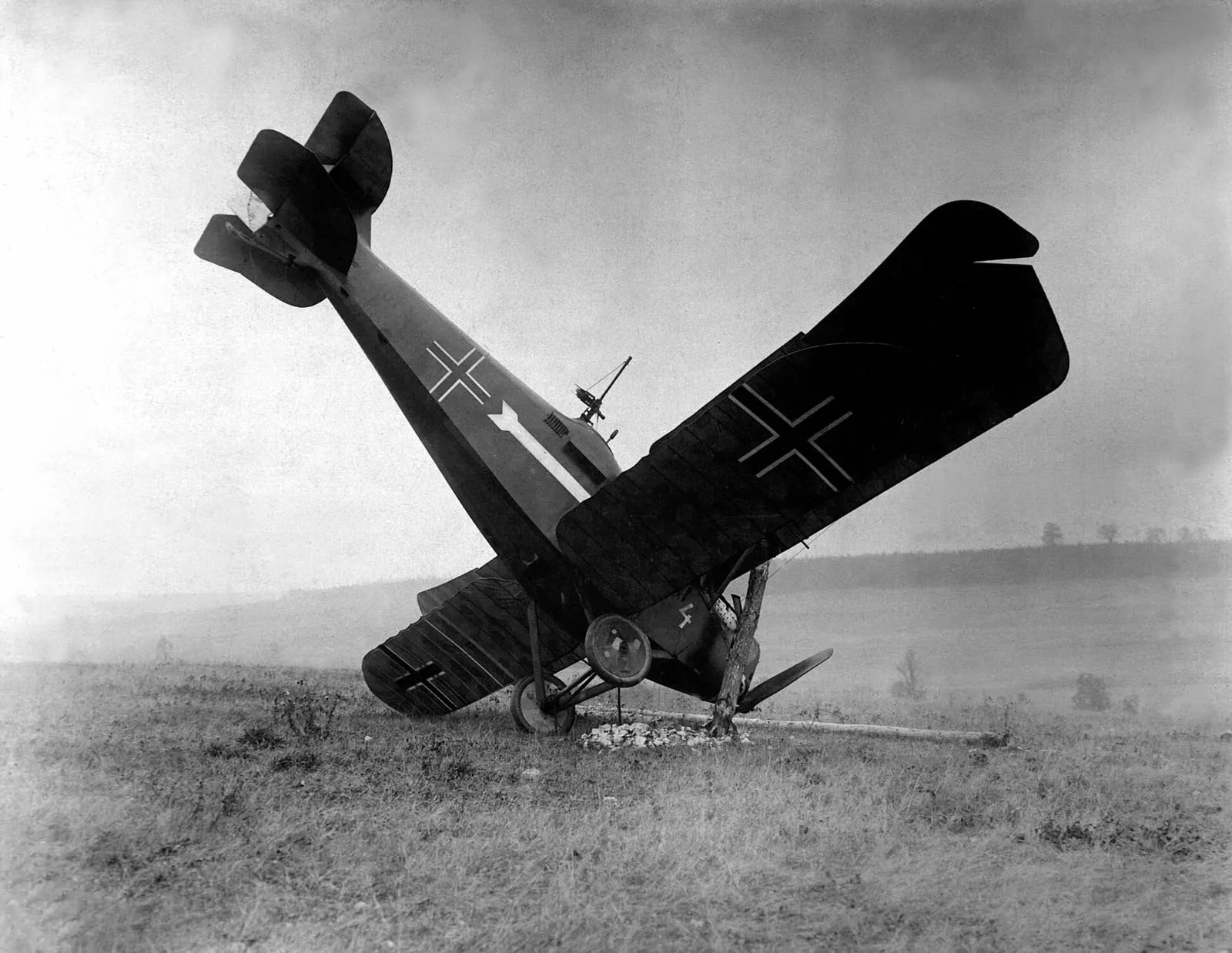
The Meuse–Argonne offensive was the last and largest battle fought by the Americans in the First World War. On 26 September 1918 the American First Army of General John Pershing struck northwards in a narrow corridor between the river Meuse and the wooded ridge of the Argonne, and beside it, west of the Argonne, in Champagne, the French Fourth Army of General Henri Gouraud moved off. The objective was the German railway lines running through Sedan and Mézières, on which the supply of most of the German forces in France depended. On the first day the Americans, helped by surprise, passed through the first German position, but they failed to take the hill of Montfaucon and soon stuck fast in traffic jams on ruined roads and under fire from both flanks. Throughout October they bled themselves white in frontal attacks on successive belts of fortifications, until in mid-month they broke through the main German position, the so-called Kriemhilde position. On 1 November the attack was resumed and this time shattered the German defence. When the armistice came into force on 11 November, the Americans stood on the Meuse and on the heights above Sedan.
Name and dates
The Americans call the whole operation the Meuse–Argonne offensive and date it 26 September – 11 November 1918. In Polish works the names “ofensywa Meuse-Argonne” and “bitwa w Argonnach” are also found. The French gave the fighting of both armies, American and French, the common name of the battle of Champagne and the Argonne (bataille de Champagne et d’Argonne). The British official chronology of the war dates it 26 September – 15 October and divides the later fighting into further battles. According to that chronology, the American share of the fighting up to 15 October appears on the French list of battles as the battle of Montfaucon. In his final report Pershing divided the offensive into three phases: 26 September – 3 October, 4–31 October and 1–11 November. We follow that division below. Facts and figures are given chiefly after Pershing’s final report of 1919, the guide of the American Battle Monuments Commission American Armies and Battlefields in Europe (1938) and the memoirs of Marshal Foch.
Background
In the summer of 1918 the initiative on the Western Front passed into Allied hands. After the Second Battle of the Marne and the British victory at Amiens, General Ferdinand Foch, since the spring the supreme commander of the Allied armies, decided to give the Germans no respite. At the turn of August and September he prepared a great converging offensive in which the Allied armies were to strike one after another along the whole front from Flanders to the Meuse. The Americans were to attack northwards between the Meuse and the Argonne, the French in Champagne and on the Aisne, the British towards Cambrai and Saint-Quentin, and an army group under the King of the Belgians in Flanders.
From the German point of view the American sector was the most sensitive. Behind the front here ran two railway lines linking the Metz area with northern France, the only lateral connections between the German forces east and west of the Meuse. At and south-east of Sedan they came within less than 60 kilometres of the front. Further north lay the difficult Ardennes, and the only other supply route led through the bottleneck near Liège. Cutting the railway at Sedan threatened to split the German armies. The Germans had therefore fortified this sector with exceptional care. The front had stood here almost unchanged since the autumn of 1914, apart from the fighting for Hill 304 and the Mort-Homme during the Battle of Verdun. Pershing wrote that behind no man’s land stretched an almost continuous belt of fortifications about 20 kilometres deep. In the east it was protected by the high bank of the Meuse, from which German artillery fired into the valley from the flank; in the west by the dense forests of the Argonne, where since 1914 bitter fighting had gone on; and in the centre by the hill of Montfaucon, from which the Germans could see everything for a dozen or more kilometres. Behind it lay further positions, the strongest of which, the Kriemhilde position (Kriemhild-Stellung), part of the system the Allies called the Hindenburg Line, ran across the heights near Romagne and Cunel.
Ever since arriving in France Pershing had fought for American divisions to fight together, in their own army. On 30 August 1918 the American First Army took over its first sector of the front, and on 2 September Pershing agreed a plan of action with Foch and General Philippe Pétain. First the First Army was to eliminate the Saint-Mihiel salient, but only up to a limited line, and then, by 25 September at the latest, strike between the Meuse and the Argonne. Pershing wrote that it was he who chose this more difficult sector, because he believed that only his fresh troops had enough spirit to break through it. The French high command did not expect the Americans to get much beyond Montfaucon in the autumn.
Preparations
There were only 14 days between the two great operations. The Battle of Saint-Mihiel began on 12 September, and the very next day reserves and army artillery began moving to the Argonne. According to the Monuments Commission, in less than two weeks about 220,000 Allied soldiers, mostly French, were withdrawn from the sector between the Meuse and the Argonne and about 600,000 Americans brought in. All movements took place at night, along three or four roads, and by day the soldiers hid in the woods. The transfer was planned by the operations section of the First Army staff, in which Colonel George Marshall worked. Until the last moment French soldiers held the front line so that the Germans would not spot the Americans, and further east preparations for an attack on Metz were simulated. Pershing wrote that the Germans rather expected a blow in that direction and that the attack was a tactical surprise.
On the evening of 25 September nine assault divisions in three corps stood between the Meuse and the western edge of the Argonne. On the right, by the Meuse, was General Robert Bullard’s III Corps with the 33rd, 80th and 4th Divisions. In the centre was General George Cameron’s V Corps with the 79th, 37th and 91st Divisions. On the left, in the valley of the river Aire and in the Argonne, was General Hunter Liggett’s I Corps with the 35th, 28th and 77th Divisions. Each corps had one division in reserve, and the army had three. Only five of the nine assault divisions had already fought in an attack, and four had been assigned artillery with which they had never worked, because their own batteries had stayed at Saint-Mihiel. The attack was supported by about 2,700 guns, 189 Renault FT light tanks, 142 of them with American crews, and 821 aircraft, 604 of them American. The Germans had no tanks here. According to Pershing, on the whole front from Fresnes-en-Woëvre to the Argonne they had 10 divisions in the line and 10 in reserve. Between the Meuse and the Argonne stood the Fifth Army of General Georg von der Marwitz, part of the army group of General Max von Gallwitz, and further west the Third Army of General Karl von Einem, part of the army group of Crown Prince Wilhelm. Many German divisions were well below strength.
The plan called for the deepest thrust in the centre, along the axis Montfaucon–Romagne–Buzancy. Montfaucon was to be outflanked on both sides: V Corps was to advance west of the hill, and III Corps was to support it by passing round the hill to the east. I Corps was to advance up the Aire valley, along the eastern edge of the Argonne, so that the Germans, threatened from the flank by the Americans and from the west by the French, would abandon the forest of their own accord. The first objective was a line about 16 kilometres from the starting positions, beyond the third German position. In a note of 25 September Foch demanded that the Americans not stop at any limited objectives but push as far as possible towards Buzancy.
Course: the first phase (26 September – 3 October)
26 September. At 2.30 a.m. about 2,700 guns opened fire. Among the batteries firing that night was Battery D of the 129th Field Artillery Regiment of the 35th Division, commanded by Captain Harry Truman. At 5.30 a.m. the infantry advanced behind a creeping barrage, and five minutes earlier, at 5.25 a.m., the French Fourth Army had gone into the attack between the Suippe and the Argonne. Thick fog, wire entanglements, a field of shell craters after four years of bombardment, deep ravines and woods broke up the formations, but on most of the sector the surprised Germans were unable to defend themselves. III Corps passed east of Montfaucon and by early afternoon its left wing was a kilometre and a half beyond the hill, while its right wing had wheeled towards the Meuse and taken its high bank. I Corps drove deep up the Aire valley, taking Varennes, but in the Argonne itself advanced only a kilometre and a half. Before noon, near Cheppy, Lieutenant-Colonel George Patton, commander of the tank brigade supporting the 35th Division, was wounded.
Things went worst in the centre. Montfaucon lay in the zone of attack of the 79th Division, made up of draftees, which had arrived in France only in July and had never yet attacked. The division took Malancourt but bogged down in the woods and in the valley in front of the hill. Only at about 6 p.m. did its units, together with the 37th Division and tanks but without artillery support, reach the slopes of Montfaucon. At dusk the attack was broken off. Historians still argue whether the 4th Division of III Corps, which halted east of the hill, should have turned west and outflanked it from the rear, as the plan foresaw. Even so, the day brought more than had been expected. On both flanks of Montfaucon the Americans advanced about 8 kilometres and took the whole first German position.
27–29 September. Montfaucon fell at about noon on 27 September, taken by the 79th Division in the rain. The brief resistance on the hill, however, gave the Germans time to bring up reserves behind it. Now all the weaknesses of the young army came to light. Only four roads, almost destroyed, led across the churned-up no man’s land; they had to be rebuilt under fire, and over them had to pass artillery, ammunition, food, ambulances and reserves. Traffic jams many kilometres long formed on the roads, and much of the artillery failed to arrive in time to support the infantry. Divisions sent into battle without experience lost contact and scattered in the woods. Fire from the Argonne and from the heights on the eastern bank of the Meuse, from which the Germans could see the whole valley, took a bloody toll. On 28 September the Americans advanced about another two kilometres, reaching at the furthest point 11 kilometres from their starting positions. By 29 September the Germans had thrown six fresh divisions against them, and their counter-attacks hit the 28th and 35th Divisions particularly hard. On 29 September the First Army was ordered to consolidate and prepare to resume the attack, and over the following days the most exhausted divisions were replaced by experienced ones: the 1st, 3rd and 32nd.
The French Fourth Army also quickly lost momentum. According to Foch, on 26 September both armies took the first German line along the whole front, advancing an average of 3–5 kilometres. In the following days the French ran into fortifications in the valley of the river Py and on 29 September pushed the Germans back to the next position between Sommepy and Monthois, but halted in front of the Blanc Mont ridge. On the right of the Fourth Army, within French divisions, fought the black regiments of the American 93rd Division, among them the 369th Infantry Regiment from New York, which took Ripont on 26 September.
Foch and Pétain were dissatisfied. At the end of September they proposed moving some American divisions to the eastern bank of the Meuse and west of the Argonne, and giving command of the troops on both sides of the Argonne to a new French army. Pershing agreed to most of the changes but refused to hand over part of his front to the French. Foch gave way, on condition that the Americans resumed the attack and kept it going without pause. By then, according to the Monuments Commission, the First Army had lost more than 23,000 men and taken 9,000 prisoners and 100 guns. The great Allied offensive along the whole front, including American pressure on the Meuse, contributed to the German supreme command’s demand on 29 September that the government immediately seek an armistice.
Course: the second phase (4–31 October)
On 4 October the First Army attacked again. The Germans now had 16 divisions in the line on its front, including some of their best. Progress was slight, except for the 1st Division, which drove deep east of the Aire. From the night of 2–3 October nine companies of the 77th Division under Major Charles Whittlesey, later called the “Lost Battalion”, were surrounded in the Argonne, in the Charlevaux ravine. For five days the unit of more than 500 men, without food and almost without water, beat off attacks, including some with flamethrowers, while being shelled by its own artillery, and rejected a German summons to surrender. Headquarters reportedly learned of the friendly fire from a message carried by the carrier pigeon Cher Ami. On 7 October the 28th and 82nd Divisions struck from the flank at Châtel-Chéhéry, into the rear of the German positions in the Argonne, and that evening the 77th Division reached the encircled men. 194 men walked out of the ravine on their own feet. On 8 October, in the further fighting of the 82nd Division, Corporal Alvin York took 132 Germans prisoner, for which he received the Medal of Honor. The same day the French XVII Corps, with two American divisions, attacked on the eastern bank of the Meuse, and on 9 October the Germans began withdrawing from the Argonne. West of the forest the American 2nd Division, fighting as part of the French Fourth Army, took the Blanc Mont ridge on 3–4 October, which soon forced the Germans to fall back to the Aisne.
In October the First Army grew to about a million men and more than 120 kilometres of front, and commanding it was beyond the capacity of a single staff. On 12 October General Bullard’s Second Army was formed from its right wing, and on 16 October General Liggett took command of the First Army. Pershing, as commander of the group of American armies and commander-in-chief of the American forces in France, retained direction of the whole. On 14–17 October the Americans broke through the Kriemhilde position in costly attacks. The 32nd Division took the Côte Dame Marie; the 42nd Division, in which General Douglas MacArthur served, the Côte de Châtillon; and the 3rd and 5th Divisions the Bois de la Pultière. Romagne and Cunel were taken, and in the following days Grandpré (PL) and the rest of the heights. The setbacks at the turn of September and October so exasperated the French prime minister Georges Clemenceau that on 21 October, in a letter to Foch, he demanded a change of commander of the American army. Foch did not support this demand. In this fighting the depleted divisions were also decimated by the Spanish flu pandemic, and according to American reports it rained almost every day.
Course: the third phase (1–11 November)
At the end of October Liggett gave the troops a few days for rest, replacements and the rebuilding of roads. At the request of the French the date of the great attack was moved from 28 October to 1 November, so as to strike together with the Fourth Army. This time the American army prepared in normal conditions, on a sector it knew, with its own artillery and air service. On 1 November, after a two-hour artillery preparation, V Corps in the centre advanced about 9 kilometres and took the heights of Barricourt, the last strong German position before the Meuse. During the night the German command ordered a retreat along the whole front west of the Meuse. In the following days the Americans pursued the Germans, part of the infantry riding in lorries. On 4 November the 5th Division crossed the Meuse south of Dun-sur-Meuse, and by 7 November the left wing of the First Army stood on the heights above Sedan. American heavy guns could now shell the Carignan–Sedan–Mézières railway. The ambition that the Americans should be the ones to enter the town where Napoleon III had capitulated in 1870 led on 6–7 November to a chaotic march by the 1st Division across the attack zones of neighbouring divisions. On 7 November Foch finally shifted the boundary between the armies so that Sedan fell to the French. The French Fourth Army, which had also moved forward on 1 November, reached the Meuse. On 9 November Foch called on all armies to attack without pause. Fighting on the eastern bank of the Meuse went on until the morning of 11 November, when word came that the armistice would come into force at 11 a.m.
Losses
According to Pershing, over the 47 days 22 American and 4 French divisions fought on this front. They faced 47 German divisions, drawn in also from the French and British sectors. The First Army lost about 117,000 killed and wounded. The figures most often given are that about 26,000 Americans were killed and nearly 96,000 wounded. It was the bloodiest battle in the history of the American army. The Americans took 26,000 prisoners, 847 guns (the Monuments Commission gives 874) and about 3,000 machine guns. The Commission estimated German losses at about 100,000 men. The losses of the French Fourth Army cannot be separated out precisely. In the war cemetery at Romagne-sous-Montfaucon, the largest American cemetery in Europe, lie more than 14,000 soldiers, most of them killed in this offensive.
Significance
The Meuse–Argonne offensive was a test of whether the United States could wage a great war on the Western Front. The first two weeks went badly: inexperienced divisions, jams on the roads and shortages of supplies meant that after a brilliant first day the attack stalled, and the French openly doubted the abilities of Pershing and his staff. The Americans paid a high price for their education, but they learned. By November the First Army was an efficient machine that broke the German front with a single blow. The main role in the victorious autumn of 1918 fell to the British and French armies, which took far more prisoners and gained more ground. The offensive on the Meuse nevertheless drew dozens of German divisions to the place where the Germans could least afford to lose ground, and threatened the railway on which their whole rear depended. On the hill of Montfaucon there stands today a 55-metre column, the American monument to the offensive.
Spotted a mistake?Report an error