Canada · The Entente
Robert Borden
Prime Minister of Canada (1911–1920), member of the Imperial War Cabinet (1917–1918)
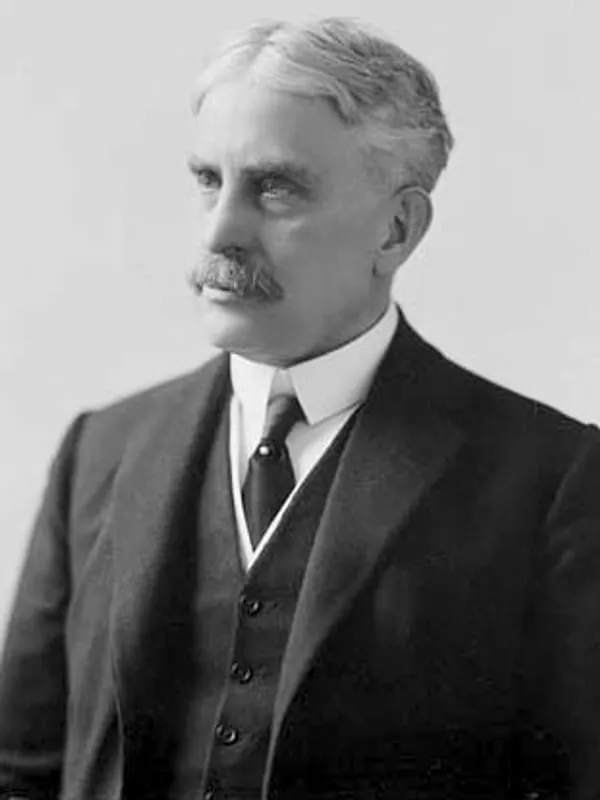
- Born:
- 26 June 1854, Grand-Pré (Nova Scotia)
- Died:
- 10 June 1937, Ottawa
- Author:
- Łukasz Skowroń
- Photo:
- William James Topley, domena publiczna, Wikimedia Commons

Sir Robert Laird Borden was Prime Minister of Canada throughout the Great War. A country that in 1914 had little more than 3,000 regular soldiers sent over 400,000 men overseas, and the Canadian Corps became one of the best formations on the Western Front. Borden led Canada through this effort, but paid a high price for it: the introduction of conscription in 1917 divided the country along the language line for decades. At the same time this cautious, cool lawyer from Nova Scotia, who began the war as a loyal subject of the Empire, ended it as one of the chief architects of the dominions’ independence. It was largely thanks to him that Canada had a separate delegation at the peace conference, signed the Treaty of Versailles in its own name and joined the League of Nations.
Before the war
He was born on 26 June 1854 at Grand-Pré in Nova Scotia, into a farming family descended from New England settlers. He did not go to university, but at fourteen he was already teaching Latin and Greek at the local academy. He studied law in a Halifax law office and in 1878 passed the bar examination with the top mark. He quickly became one of the most respected lawyers in the province. From a Liberal he turned Conservative and in 1896 entered the House of Commons of Canada for Halifax. In 1901 he became leader of the Conservative Party, and in September 1911 he defeated Wilfrid Laurier’s Liberals at the polls, winning a campaign against the trade agreement with the United States.
As prime minister he tried to pass a bill allocating 35 million dollars to build three battleships for the Royal Navy, but in 1913 it was blocked by the Liberal-dominated Senate. In June 1914 the King knighted him. He was conscientious, hard-working and reserved, an administrator rather than a tribune. His biographers stress that he was not a good judge of people.
Volunteers
Britain’s declaration of war on 4 August 1914 automatically covered Canada, but the scale of its participation was for the government in Ottawa to decide. Borden’s government at once offered military assistance, and in August Parliament passed the War Measures Act, which gave the government wide powers, from censorship to internment. Under it several thousand immigrants from enemy countries were held in camps, many of them Ukrainians from Galicia and Bukovina, subjects of Austria-Hungary.
Borden left the organisation of the army to the Minister of Militia, Sam Hughes, energetic but chaotic and given to cronyism. The first contingent, over 30,000 men, sailed for England as early as the beginning of October 1914. Borden made one pledge after another: in July 1915 150,000 soldiers, in October 250,000, and on New Year’s Day 1916 he announced that Canada would raise half a million, an enormous number for a population of under eight million. In December 1914 he gave assurances that there would be no conscription.
In the summer of 1915 Borden went to England and on 14 July attended a meeting of the British Cabinet, which the press presented as a precedent. Behind the scenes, however, he found that Asquith’s government had no intention of sharing decisions or information with the dominions. In January 1916 he wrote bitterly that Canada, which was raising hundreds of thousands of soldiers, would not accept being treated as “toy automata”. At home, meanwhile, he had to put out scandals over munitions contracts: in 1915 the discredited Shell Committee was replaced by the Imperial Munitions Board under the industrialist Joseph Flavelle. In November 1916 Borden finally forced Hughes to resign and handed the affairs of the troops overseas to a new ministry in London headed by George Perley.
The Imperial War Cabinet and conscription
The breakthrough in relations with London came with the new prime minister David Lloyd George, who invited the dominion leaders to the Imperial War Cabinet. Borden sat in it from 20 March 1917, as a member and not a guest. Together with General Jan Smuts he was the principal author of Resolution IX of the Imperial War Conference, which announced that after the war relations within the Empire would be settled on the basis of “a full recognition of the Dominions as autonomous nations of an Imperial Commonwealth”, with a right to a voice in foreign policy.
At the same time the Canadian Corps captured Vimy Ridge, but it was suffering heavy losses and volunteers were running short. Borden visited the wounded in hospitals and returned home convinced that the corps could not be maintained without compulsion. On 18 May 1917 he announced conscription in the House of Commons. Laurier refused to join a coalition that would introduce it. On 11 June Borden introduced the Military Service Act, which passed the House of Commons in July and came into force at the end of August. In the autumn the government pushed through two electoral acts: one gave the vote to all soldiers and military nurses, the other took it away from naturalised immigrants from enemy countries and granted it to soldiers’ relatives. Critics called this manipulating the franchise. In October Borden formed a Union Government, a coalition of Conservatives with pro-conscription Liberals, mainly from Ontario and the western provinces.
In December two blows came at once. On 6 December the explosion of a munitions ship destroyed the northern part of Halifax, the prime minister’s own constituency. Eleven days later came the election, the most bitter in the country’s history. The Unionists won 153 seats out of 235, but in Quebec they won in only three constituencies. In the spring of 1918, when the government abolished some exemptions, including those for farmers’ sons, anti-conscription riots broke out in Quebec City. The army opened fire and four civilians were killed. Of over 400,000 registered men, about 125,000 were eventually called up, and about 24,000 reached the front. Borden’s supporters stress that these men kept the corps up to strength in the last, victorious months of the war; his critics, that the political price was out of proportion to the benefit.
The last year of the war
In 1918 Borden’s government introduced votes for women in federal elections, and earlier, in 1917, the first federal income tax, conceived as temporary. In the summer of 1918 Borden returned to London for the meetings of the Imperial War Cabinet. He was shaken by the spring defeats and by what he heard from Canadian officers. In June he sharply criticised the British command and reportedly told Lloyd George that if there were a repetition of Passchendaele, not a Canadian soldier would leave the shores of Canada so long as the Canadian people entrusted the government to him. The Canadian Corps under Arthur Currie was by then fighting as a cohesive formation commanded by a Canadian, and in the last hundred days of the war it played one of the leading roles, from Amiens to Mons. Borden’s government also sent soldiers to the Russian north and to Vladivostok.
The peace conference
After the armistice Borden, convinced that Canada had earned its place among the nations on the battlefields, demanded separate representation for it. Britain and the United States, fearing additional British votes, at first objected. In the end the dominions and India received their own seats at the conference while also sitting in the British Empire delegation. Borden chaired this delegation several times in Lloyd George’s absence. He secured the right of the dominions to sign the Treaty of Versailles in their own name and to become members of the League of Nations, eligible for election to its Council. He himself left Paris in May 1919, and the treaty was signed on Canada’s behalf by his ministers.
After the war
Tired and ill, Borden stepped down in July 1920, handing over office to Arthur Meighen. He went on to represent Canada at the Washington Conference in 1921–1922, then was Chancellor of Queen’s University and president of financial institutions, and wrote on the constitutional history of the Empire. He died on 10 June 1937 in Ottawa.
Assessment
Canadian historians generally see Borden as a statesman who brought Canada to maturity as a state. His persistence over the dominions’ voice, from Resolution IX to the signature on the Treaty of Versailles, paved the way for the decisions of the 1926 Imperial Conference and the 1931 Statute of Westminster, which recognised the full independence of the dominions. The war effort he organised was enormous, and the Canadian Corps became a source of national pride.
The other side of the balance sheet is equally clear. Conscription and the way it was carried out, with the manipulation of the franchise and a campaign portraying French Canadians as shirkers, deepened the gulf between English and French Canada and cut the Conservatives off from Quebec for generations. Critics also accuse Borden of indifference to the grievances of francophones, including the restrictions on French-language teaching in Ontario, and of harshness towards the interned immigrants. Many historians consider that he was a better leader on the imperial stage than at home.
Sources
Spotted a mistake?Report an error
Mentioned in battles
(01)Often appears with
People who appear in the same events.