1916: The Western Front beyond Verdun
Battle of Fromelles
- Dates:
- 19–20 July 1916
- Front:
- Western Front
- Location:
- Marshy plain at the foot of Aubers Ridge, between the Fauquissart–Trivelet road and Cordonnerie Farm, opposite the village of Fromelles, about 16 km west of Lille, on the border of the Nord and Pas-de-Calais departments (France)On the battle map →
- Sides:
- United Kingdom and AustraliaDouglas Haig, Charles Monro, Richard Haking, James McCay, Colin MackenzieGerman EmpireRupprecht, Crown Prince of Bavaria, Gustav Scanzoni von Lichtenfels
- Result:
- German victory. The attackers held on to none of the trenches they had taken and lost over 7,000 men, including 5,533 Australians. German losses are estimated at 1,500–2,000.
- Author:
- Natalia
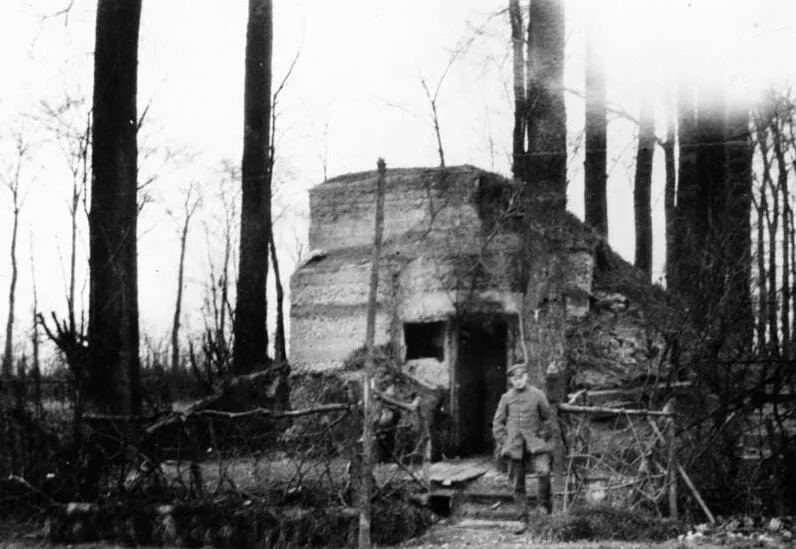
The Battle of Fromelles was a subsidiary attack that the British command carried out in French Flanders in the third week of the Battle of the Somme. On the evening of 19 July 1916 two fresh, inexperienced divisions, the British 61st and the 5th Australian Division, attacked in broad daylight the German positions opposite the village of Fromelles, about 80 kilometres north of the Somme battlefield. They were to show the Germans that they could not take troops from here to the south with impunity. The British were stopped in front of the German trenches; the Australians broke into the enemy line on two sectors, but towards morning on 20 July Bavarian counter-attacks drove them back. A single night cost the 5th Australian Division 5,533 killed, wounded and captured, and the British 61st Division more than 1,500. For Australia it was the blackest twenty-four hours in its military history.
Name and dates
The British official history calls the fighting “the subsidiary attack at Fromelles” and dates it to 19–20 July 1916. In 1922 the British Battles Nomenclature Committee adopted the name “Attack at Fromelles”, because it regarded it as an operation subordinate to the Battle of the Somme rather than a separate battle. The Australian official history, written by Charles Bean, speaks of the “Battle of Fromelles”, and that is what it is called in Australia, in Germany (Schlacht von Fromelles) and in most studies. The name “Battle of Fleurbaix”, after a village on the British side of the front, is also found.
The infantry went over the top on 19 July between 5.30 and 6 p.m., and the last Australians withdrew from the German trenches on the morning of 20 July, at about nine. We date the battle to these two days. The attack was originally to take place on 17 July, but because of rain and mist it was postponed by two days. The British chronology of the war on which our timeline is based records it under 19 July.
Background
Since 1 July the British Fourth Army had been waging a great offensive on the Somme which, after its disastrous first day, was advancing slowly and at great cost. On 5 July the headquarters of General Douglas Haig instructed the commanders of the First and Second Armies, Generals Charles Monro and Herbert Plumer, to choose sectors where, in the event of success on the Somme, the weakened German front could be broken. Plumer pointed to his extreme right flank, at the junction with the First Army. On 8 July Monro instructed the commander of XI Corps, General Richard Haking, to prepare a plan. Haking, who in May 1915 had commanded the 1st Division at the Battle of Aubers Ridge, wanted to take the ridge itself together with the villages of Aubers and Fromelles, but was told that so large an operation was not contemplated.
On 13 July the situation changed. Intelligence reported that the Germans had taken about nine battalions from around Lille to the Somme. Haig’s deputy chief of staff, General Richard Butler, told Monro that the commander-in-chief now wanted a local attack at the junction of the two armies: it was to pin the Germans in place and teach them that they could not weaken this sector with impunity. The bombardment was to give the impression of preparations for a great offensive, and the infantry’s objective was limited to the first line of German defences. There were only a few days left for everything.
Two divisions were assigned to the attack. The British 61st Division of General Colin Mackenzie was a second-line Territorial division from the South Midland counties, which had arrived in France at the end of May and first entered the trenches on 13 June. Its battalions in the front line averaged about 550 men each. The 5th Australian Division of General James McCay, formed in Egypt after the evacuation of Gallipoli, reached France at the end of June and only on 10–12 July relieved the 4th Australian Division on this sector, which was leaving for the Somme with the whole of I ANZAC Corps. Its battalions were at full strength, but neither the infantry nor the artillery knew the conditions of the Western Front. Many of the soldiers were recruits who had never been in battle.
The ground favoured the defenders. The front here had run almost unchanged since the autumn of 1914 across a flat, marshy plain where the water table lay so close to the surface that instead of trenches both sides built high breastworks of sandbags. The Germans looked down on everything from the low Aubers Ridge. For fourteen months there had been no major fighting on this sector, so the defenders had built dozens of concrete shelters and machine-gun posts into their breastworks. The strongest point was a salient, called the Sugarloaf by the British, at the junction of the two attacking divisions. From it machine-gun fire could sweep no man’s land on both sides. On the front of the attack no man’s land was between about 90 and 370 metres wide, and it was widest precisely in front of the Sugarloaf.
The positions were held by the 6th Bavarian Reserve Division of Lieutenant-General Gustav Scanzoni von Lichtenfels, part of the German Sixth Army of Rupprecht of Bavaria. Its four regiments (from the south the 17th, 16th, 21st and 20th Bavarian Reserve Infantry Regiments) stood in the same place as in the spring of 1915. At that time the British 8th Division had attacked the same ground and the same enemy at Aubers.
Plan and preparations
Haking initially intended to attack with three divisions, but decided that there was too little artillery and shortened the front of the attack to about 3.7 kilometres, from the Fauquissart–Trivelet road to Delangre Farm. Each of the two divisions was to attack with three brigades in line, and each brigade with only two battalions, so that half the infantry would remain in reserve. In all, twelve battalions were to go into the assault, no more than at Aubers in 1915, but the artillery was much stronger: 296 field guns and howitzers and 78 heavier guns, including 9.2- and 12-inch howitzers. According to the British official history there were more heavy guns per metre of front than on 1 July on the Somme. Yet some of the batteries had only just arrived from England and had never fired in France, and the Australian gunners had no experience of the Western Front. The bombardment was to last seven hours, with four feint lifts of fire, during which the infantry was to show bayonets and dummies above the breastwork to lure the Germans to their posts.
The plan raised doubts from the start. The chief of staff of I ANZAC Corps, General Brudenell White, said that he “hated these unprepared little shows”, because after two days the Germans would realise that it was only a feint, and the captured trenches would be hard to hold. On 14 July Major Howard of Haig’s headquarters, together with the commander of the 15th Australian Brigade, General Harold Elliott, looked over the meadow in front of the Sugarloaf and, according to Bean, concluded that the attack would almost certainly end in disaster. On 16 July General Butler came to First Army headquarters at Chocques and passed on that Haig did not want the attack unless the commanders were sure they had enough guns and ammunition, and that the operation was no longer urgent. Haking assured him that he was “quite confident of success”, and Monro and Plumer spoke against cancelling it. When Haking asked whether, in the event of great success, he could push on to Aubers Ridge, he was told no.
Rain and mist on 16 and 17 July prevented the artillery from registering on its targets. Haking himself proposed a postponement, and Monro then wanted to cancel the whole operation. Headquarters, however, replied that the commander-in-chief wished it to be carried out “as soon as possible, weather permitting”, and left the decision to Monro. On the evening of 17 July a new date was set: 19 July.
Course
19 July, afternoon. The day was fine and the visibility good. At eleven the artillery began its seven-hour bombardment, and at noon the German batteries replied with heavy fire on the British and Australian trenches, communication trenches and ammunition dumps. The feint lifts of fire did not lure the Germans onto their breastworks. British shells destroyed many stretches of the German defences, but most of the concrete shelters survived, and the machine guns in the Sugarloaf remained untouched.
The attack. At about 5.30 p.m. the infantry began to move out into no man’s land, earliest where it had the longest distance to cover. On the right flank of the British 61st Division the 2/7th Battalion, Royal Warwickshire Regiment broke into the German trenches, but the rest of the division was stopped by machine-gun fire as soon as it left its own lines or in front of uncut wire. In front of the Sugarloaf most of two battalions were killed, including the commanding officer of the 2/4th Royal Berkshire. On the left flank of the Australians, Elliott’s 15th Brigade, which had to cross the widest part of no man’s land, was mown down by fire from the Sugarloaf before it reached the German wire. In the centre and on the left the 14th and 8th Brigades crossed the German breastworks almost without loss, but behind them, instead of a second line of trenches, they found water-filled ditches and fields. The Germans had long kept their reserves here in fortified farmsteads, several hundred metres behind the front line. The Australians dug in in the ditches, and sappers and pioneers began to dig a communication trench across no man’s land.
Evening and night. Haking ordered a renewed assault by the 61st Division on the Sugarloaf for 9 p.m., but at 8.20 p.m. he cancelled it. The message did not reach the 15th Australian Brigade in time, and its 58th Battalion went in alone and was shattered. During the night Bavarian reserves counter-attacked the forward Australians. The most dangerous attacks fell on the exposed right flank of the 14th Brigade, where the Germans worked along their former front line, and on the left flank of the 8th Brigade near Delangre Farm and the Kastenweg communication trench.
20 July, morning. At dawn the Bavarians attacked from the front and from both flanks. The 8th Brigade had to fight its way back across no man’s land. At 5 a.m. Monro, Haking and the divisional commanders conferred at Sailly about a new attack by the 61st Division, but when news came of the 8th Brigade’s retreat, Monro stopped the operation and ordered the 14th Brigade to withdraw. The artillery put a “box” of fire around its sector, and the survivors came back under fire, mostly along the newly dug communication trench. By about nine it was all over. Some groups did not receive the order and were taken prisoner.
After the battle
On the afternoon of 20 July Major A.W. Murdoch of the 29th Battalion crossed no man’s land with an improvised Red Cross flag and agreed an informal truce with a Bavarian officer to collect the wounded. General McCay, obeying a ban on any dealings with the enemy, ordered it to be broken off. For three days and nights Australian soldiers went out on their own initiative to bring in the wounded, and on the night of 20–21 July alone they brought in about three hundred. The Germans collected the dead on their side and buried them in mass graves on the edge of the Fasanenwäldchen (Pheasant Wood) near Fromelles. About 400 captured Australians were paraded through Lille.
The next day the British war communiqué spoke of “some important raids” south of Armentières, “in which Australian troops took part”, and of 140 prisoners. When the truth reached Australia, it undermined trust in British communiqués. Public opinion blamed McCay, although Bean considered him blameless. Several officers left their commands: the exhausted Lt-Col W.E.H. Cass, who had commanded in the German trenches for more than a dozen hours, was sent home, and the commander of the 14th Brigade, Col. Harold Pope, was sent back to Australia “for disciplinary reasons” unconnected with his command in the battle.
Casualties
According to the Australian and British official histories the 5th Australian Division lost 5,533 officers and men and the 61st Division 1,547, together more than 7,000 (some studies give 5,513 for the Australians). Of the 887 soldiers of the Australian 60th Battalion, one officer and 106 other ranks answered the roll call. According to the Commonwealth War Graves Commission, 1,780 Australians and 503 British soldiers were killed or died of wounds in the battle. The Germans took 481 prisoners, including about 400 Australians. Bavarian losses were estimated at fewer than 1,500 (Bean) or at 1,600–2,000 (the British official history, based on the histories of the Bavarian regiments). About 140–150 Germans were taken prisoner.
Significance
The attack achieved nothing. On a dead Australian or a prisoner the Germans found Haking’s order and learned that it had been only a feint. On 20 July Rupprecht’s chief of staff reassured the chief of the German General Staff, Erich von Falkenhayn, who the previous evening had believed that the expected great offensive against the Sixth Army had begun. That same day the Supreme Army Command demanded another corps from the Sixth Army for the Somme front. The British official history writes that the greatest harm was that the battle “need never have been fought”, because the First Army could have called it off. Bean concluded that it was hard to imagine how an operation in that form could have succeeded. Some modern historians, among them Haking’s biographer Michael Senior, argue, however, on the basis of German records, that the attack delayed the transfer of divisions from around Lille to the south.
Fromelles weighed on relations between the Australians and the British command for years. Among Australian soldiers it entrenched the belief that the British “Tommies” could not be relied on in hard fighting. The 5th Australian Division needed months to rebuild. A few days later the 1st Australian Division began the fight for Pozières on the Somme, which brought the Australians even heavier losses.
In the trenches opposite the Sugarloaf stood the Bavarian 16th Reserve Infantry Regiment, the same one in which Adolf Hitler had served since 1914. According to his biographers, among them Thomas Weber, he was then a runner at regimental headquarters, located in Fournes-en-Weppes, and there is nothing to suggest that he took part in hand-to-hand fighting.
Remembrance
After the war the remains of hundreds of the fallen were buried in V.C. Corner Cemetery near Fromelles, the only cemetery of its size in France containing only Australian graves. It holds 410 unidentified soldiers, and a memorial wall names 1,299 Australians killed at Fromelles whose graves were never found. Opposite the cemetery, in the Australian Memorial Park opened in 1998, stands Peter Corlett’s sculpture “Cobbers”, depicting Sergeant Simon Fraser of the 57th Battalion carrying a wounded comrade out of no man’s land. Fraser described in a letter how one of the wounded called out to him: “Don’t forget me, cobber.”
For decades no one knew where several hundred of the missing lay. In 2002 the Australian teacher Lambis Englezos, comparing the lists of the missing with the number of those buried and with German aerial photographs, pointed to German mass graves by Pheasant Wood. In May 2008 archaeologists from Glasgow confirmed that the graves were undisturbed. In 2009 the remains of 250 soldiers were recovered and DNA samples were taken from them. The War Graves Commission built a new cemetery next to the site, the first in more than half a century. The first burial took place on 30 January 2010, and on 19 July 2010, the 94th anniversary of the battle, the last, unidentified soldier was buried in the presence of the heir to the British throne, Prince Charles. Thanks to DNA comparison with samples from relatives, by 2024 about 180 of the 250 soldiers buried there had been identified. A museum of the battle has stood beside the cemetery since 2014.
Spotted a mistake?Report an error