1915: The spring offensive in Artois
Battle of Aubers Ridge
- Dates:
- 9 May 1915
- Front:
- Western Front
- Location:
- The plain west of Aubers Ridge, from the Rue du Bois south of Neuve-Chapelle to Rouges Bancs near Fromelles, French Flanders (Pas-de-Calais and Nord), FranceOn the battle map →
- Sides:
- United Kingdom and British IndiaJohn French, Douglas Haig, Charles Monro, Henry Rawlinson, James WillcocksGerman EmpireRupprecht, Crown Prince of Bavaria, Eberhard von Claer
- Result:
- German victory. The British and Indians held on to no part of the German trenches, and in a single day lost more than 11,600 killed, wounded and missing.
- Author:
- Łukasz Skowroń
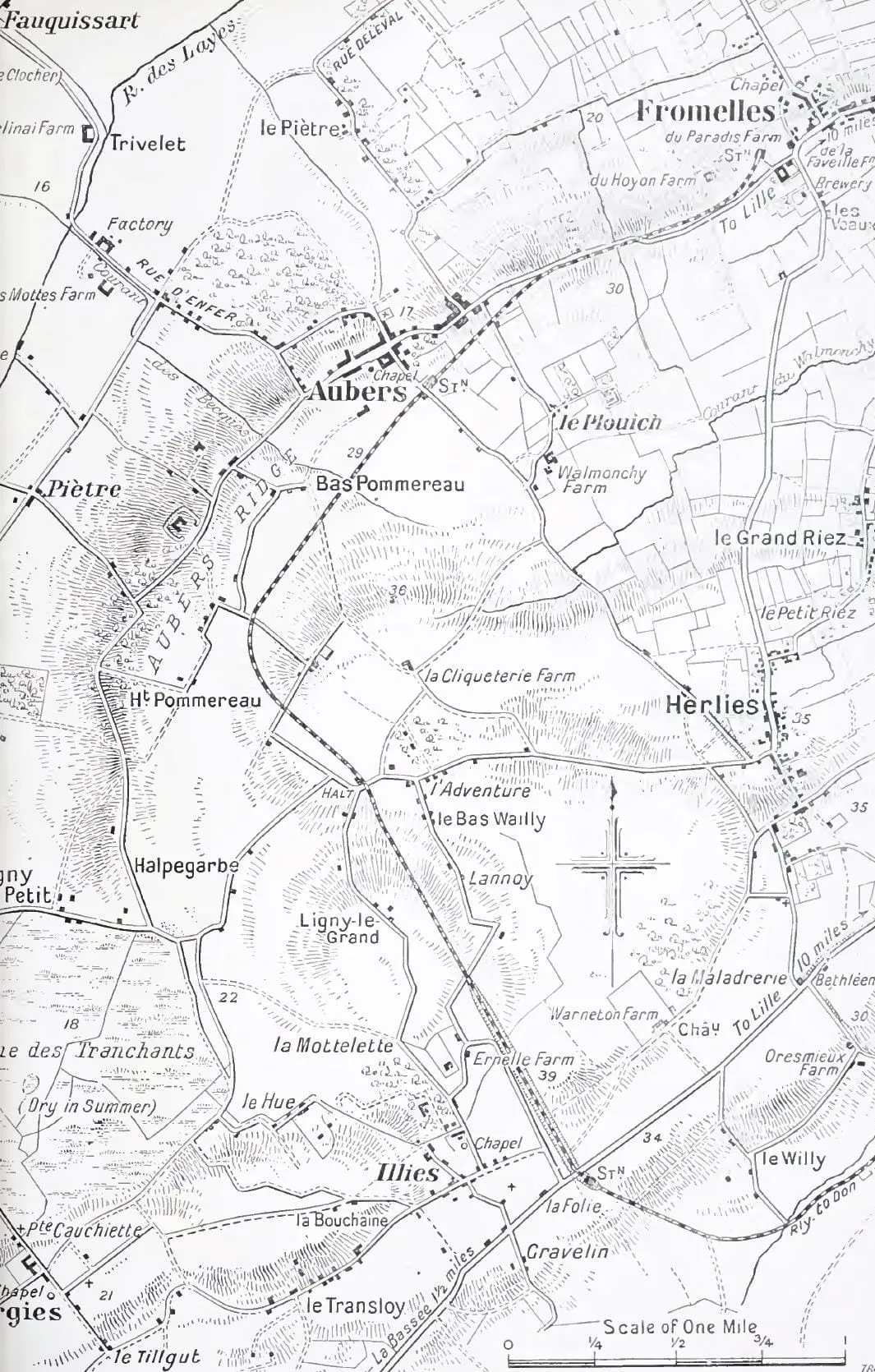
The Battle of Aubers Ridge was a British attack which on 9 May 1915 was meant to support the great French offensive in Artois known as the Second Battle of Artois. General Douglas Haig’s First Army attacked with two groups on the flat plain west of the low Aubers Ridge, roughly where it had fought two months earlier at Neuve-Chapelle. This time the Germans were ready. After a forty-minute bombardment that barely damaged their defences, machine-gun fire stopped the attackers in no man’s land. In the north a few units broke into the German lines, but had to withdraw by the following morning. The battle lasted one day and cost the British and Indians more than 11,000 men. It exposed the lack of high-explosive shells, which soon became a political issue in Britain.
Name and dates
The British Battles Nomenclature Committee and the British official history call this fighting the Battle of Aubers Ridge and date it to a single day, 9 May 1915. The British chronology of the war on which our timeline is based dates it the same way. Some accounts, among them The Long, Long Trail website, speak of fighting on 9 and 10 May, because the last soldiers returned from the German trenches only in the early hours of 10 May, and Haig decided to call off further attacks before noon that day. English-language literature also uses the shorter name “Battle of Aubers”.
Aubers Ridge itself is a low rise a few kilometres long, running north-east from the area of La Bassée, behind the villages of Aubers and Fromelles. It rises barely a dozen or so metres above the surrounding plain, but from its slopes the Germans could see the whole British rear area, and behind it lay the road to Lille.
Background
In the spring of 1915 the Germans were moving more and more divisions to the east, where on 1 May they began a great offensive at Gorlice. The commander-in-chief of the French army, General Joseph Joffre, judged it a good moment to strike in the west. The main role was to be played by the French Tenth Army, which was to take Vimy Ridge north of Arras. The British were to attack at the same time north of the La Bassée Canal, widen the breach and prevent the Germans from moving reserves from there against the French. On 6 April Joffre sent Field Marshal Sir John French the details of the plan.
The preparations were disrupted by the Second Battle of Ypres. From 22 April part of the forces earmarked for the attack, among them the Indian Lahore Division, was fighting in the Ypres salient, and French was worried about the fate of his Second Army. Even so, the offensive was not cancelled. The French set the start of the attack for 7 May and then for 8 May, but rain and mist led them, on the afternoon of 7 May, to postpone it to 9 May. It was then agreed that the French and British would attack on the same day, and not one after the other as had been planned earlier.
Plan
Haig wanted to repeat the Neuve-Chapelle method, but on a larger scale. Two groups were to attack on the flat, waterlogged plain, about 5.5 kilometres apart. In the south, by the road known as the Rue du Bois, on a frontage about 2.2 kilometres wide, the 1st Division of General Charles Monro’s I Corps and the Indian Meerut Division of General James Willcocks’s Indian Corps were to advance. In the north, astride the road from Sailly to Fromelles, towards the hamlet of Rouges Bancs, the 8th Division of General Henry Rawlinson’s IV Corps was to attack, followed by the 7th Division. The two groups were to meet on the ridge near La Cliqueterie Farm, cut off the German troops around Aubers and push on towards the road from La Bassée to Lille.
The British chose a short, violent bombardment intended to ensure surprise. It lasted only 40 minutes, the last ten of which were the heaviest. This came partly from the belief that the method had worked at Neuve-Chapelle and partly from a lack of heavy guns and ammunition. According to the official history the First Army had 516 field and light guns and 121 heavy ones, but many of them were obsolete, and most of the field-gun ammunition was shrapnel, of little use against defences. On the 1st Division’s front fewer howitzers per metre of front were assigned to destroying the German breastworks than at Neuve-Chapelle. The French, meanwhile, had been shelling the German positions in Artois for several days.
German defences
The Germans had learned from their defeat in March. Opposite the First Army they placed three divisions instead of two: the 13th and 14th Divisions of General Eberhard von Claer’s Westphalian VII Corps and the 6th Bavarian Reserve Division. Each regiment now defended a narrower sector. The high water table prevented the digging of deep trenches, so the Germans built sandbag breastworks 4.5–6 metres thick and nearly 2 metres high, proof against everything but the heaviest shells. Roughly every 20 metres they set into them machine-gun posts firing just above the ground, widened and strengthened the wire, and prepared a second line behind the first. The British knew of these changes only in part.
Course of the battle
The southern attack. Sunday 9 May was sunny and cloudless. At 5 a.m. some six hundred British guns opened fire. At 5.30 a.m. the bombardment entered its heaviest phase, and the first waves of infantry of the 2nd and 3rd Brigades of the 1st Division and of the Dehra Dun Brigade of the Meerut Division left their trenches to get as close as possible to the German line. The Germans, who had been looking out over the breastworks even during the bombardment, opened fire at once. At 5.40 a.m. the artillery lifted onto targets further back and the infantry went in to the assault. The wire was mostly uncut and the breastworks intact. Machine guns swept the front with crossfire. Only a handful of men of the Northamptonshire Regiment and the Royal Munster Fusiliers got into the German trench. None of them returned. The rest were pinned down in front of the wire or halfway across. A renewed attack after a further bombardment ended the same way. By 7.20 a.m. the six battalions of the 1st Division that had gone over the parapet had lost about 2,300 men, and the Dehra Dun Brigade nearly 900.
Haig, however, had no intention of giving up. He knew that the French in Artois were advancing, and he wanted to pin down the German reserves. He ordered the attack to be renewed in the afternoon. After a fresh bombardment, at about 4 p.m., the 1st (Guards) Brigade, including the 1st Battalion of the Black Watch and the 1st Battalion of the Cameron Highlanders, went in, together with the Indian Bareilly Brigade. The leading companies of the Black Watch broke into the German trenches, and about fifty men even got towards the second line, but the Germans surrounded them and killed almost all of them. The support companies could not get through to help them. The Bareilly Brigade lost more than a thousand men within a few minutes. Corporal John Ripley and Lance-Corporal David Finlay of the Black Watch were awarded the Victoria Cross for that day. Haig also planned an evening bayonet attack, but the trenches were so choked with wounded and with men of different units that it was cancelled.
The northern attack. At Fromelles the start looked better. At 5.40 a.m. sappers of the 173rd Tunnelling Company fired two mines under the German line, and the fire of guns brought up just behind the line smashed the breastwork in several places. Men of the 2nd Battalion of the Rifle Brigade and the 1st Battalion of the Royal Irish Rifles of the 25th Brigade broke into the German trenches, and a Territorial London battalion known as the Kensingtons occupied the mine craters and the neighbouring trenches. To their right the 24th Brigade was stopped in front of uncut wire. Corporal James Upton of the Sherwood Foresters, who under fire carried wounded men in from the ground in front, and Corporal Charles Sharpe of the Lincolnshire Regiment, who cleared a stretch of German trench with grenades, were awarded the Victoria Cross. Among the defenders of this sector was the Bavarian 16th Reserve Infantry Regiment, the same regiment in which Adolf Hitler was then serving as a runner.
The three small lodgements had no contact with one another, and support could not reach them across no man’s land, which was swept by machine-gun and artillery fire. During the confusion in the British trenches the commander of the 25th Brigade, General Arthur Lowry Cole, stood up on the parapet to stop retreating men and was mortally wounded. A renewed attack in the afternoon collapsed under fire. All day and evening the Germans counter-attacked, and during the night, at about 3 a.m. on 10 May, the last survivors from the lodgements returned to the British lines.
10 May. In the morning Haig gathered his corps commanders. It turned out that there was ammunition for at most one more attack, and that the shells for the 4.7-inch guns were so defective that the batteries were practically useless. Haig cancelled the attack planned for the afternoon and decided to concentrate his forces south of Neuve-Chapelle, where a few days later the battle of Festubert began.
Losses
According to the British official history, the First Army’s divisions lost 458 officers and 11,161 other ranks on 9 May, a total of 11,619 killed, wounded and missing. Some accounts give the figure of 11,161 alone as the total losses. The heaviest losses were suffered by the 8th Division, about 4,700 men, and the 1st Division, nearly 4,000. The Meerut Division lost more than 2,600. Several battalions lost over 500 men each, and the 2nd Battalion of the Rifle Brigade over 650. Mile for mile, it was one of the British army’s bloodiest days of the whole war.
German losses were many times smaller, but were never precisely compiled. According to German regimental histories, the two regiments of the 13th and 14th Divisions that repulsed the southern attack lost about 900 men between them. The defenders did not even need the help of reserves. As early as the evening of 9 May the command of the German Sixth Army was able to move two divisions held in reserve behind the British front, the 58th and the 115th, against the French at Vimy.
Significance
The Battle of Aubers Ridge brought the British no gains and did not even achieve its secondary aim: it did not hold back the German reserves, which went off against the French. The British official history named three causes of the defeat: strong German defences with skilfully concealed machine guns, a lack of heavy high-explosive shells, and poor-quality ammunition and worn gun barrels, because of which many shells fell short, including on the British trenches, or failed to explode in the sodden ground. One British brigadier summed up the battle by saying that “the sapper had beaten the gunner”. Haig drew from it the conclusion that an attack had to be preceded by a long, methodical bombardment by heavy artillery, like the French one in Artois.
The defeat also had political consequences. On 9 May itself Lord Kitchener ordered about 22,000 artillery shells to be sent from the army’s stocks in France to the Dardanelles. French, embittered by the lack of ammunition, passed information to the war correspondent of “The Times”, Charles Repington. On 14 May the paper published his dispatch on the shortage of shells, and in a leading article wrote that British soldiers had died on Aubers Ridge in vain because there were not enough shells. The resulting Shell Crisis, together with the dispute over the Dardanelles, led at the end of May to the formation of a coalition government under Prime Minister Herbert Henry Asquith and to the creation of the Ministry of Munitions, headed by David Lloyd George.
Spotted a mistake?Report an error