Greece · The Entente
Stefanos Skouloudis
Prime Minister and Minister of Foreign Affairs of Greece (1915–1916)
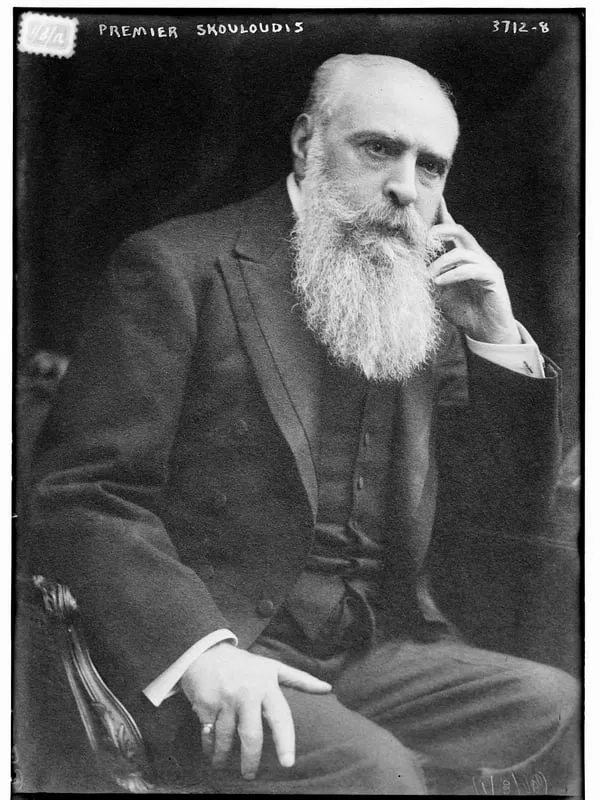
- Born:
- 5 December 1838, Constantinople (Ottoman Empire)
- Died:
- 19 August 1928, Athens
- Author:
- Łukasz Skowroń
- Photo:
- Bain News Service, domena publiczna, Wikimedia Commons

Stefanos Skouloudis was one of the oldest politicians to head a government during the Great War. When in November 1915 King Constantine I entrusted him with the premiership, he was 76 and had behind him a long career as a banker, diplomat and minister. He governed for only seven months, but they were the months in which Greece, formally neutral, became the base of the Entente army at Salonika, and its government had to yield to one Allied demand after another while not wishing to break with Germany. To the Entente and to the supporters of Eleftherios Venizelos he was the embodiment of the court policy that handed Fort Rupel to the Bulgarians. To the royalist camp he was an aged patriot who out of a sense of duty accepted an office nobody wanted.
Before the war
He was born in the Pera district of Constantinople, according to Greek sources on 23 November 1838. The Greeks then used the Julian calendar, and by the Gregorian calendar this was 5 December. His parents came from Crete and his father was a merchant. He finished secondary school in Athens and began studying medicine, but soon returned to Constantinople and in 1859 joined the great Greek trading house of the Rallis. After a few years he was in charge of all its branches in Turkey. In 1871, with Andreas Syngros and other Greek financiers, he founded the Bank of Constantinople. He made a large fortune and in 1876 settled permanently in Athens.
As an expert on Ottoman affairs he soon entered politics and diplomacy. During the Eastern crisis in 1877 he conducted secret talks with Albanian notables about joint action against Turkey, and after the Congress of Berlin he took part in the negotiations that gave Thessaly to Greece. He founded the company that undertook the draining of Lake Copais in Boeotia. In 1881 he became a deputy for Syros, and later for Thebes, in the party of Charilaos Trikoupis. For two years he headed the legation in Madrid; in 1892 he was briefly Minister of Education and then of the Navy. According to some sources he sat on the organising committee of the first modern Olympic Games and left it, warning that the costs would exceed the state’s means. In 1897, as foreign minister in the government of Dimitrios Rallis, he conducted the peace talks after the defeat in the war with Turkey. After the officers’ coup of 1909 he was mentioned as a possible prime minister. In 1912 Venizelos sent him as a plenipotentiary of Greece to the peace conference in London after the First Balkan War.
Prime minister by necessity
The king had offered him the premiership as early as March 1915, after Venizelos’s first resignation. Skouloudis declined and the office went to Dimitrios Gounaris. By the autumn the situation was much more difficult. Venizelos resigned for the second time on the day Entente troops were landing at Salonika, and after a month the government of Alexandros Zaimis lost a vote in the chamber, where the Liberals still had a majority. According to the British writer George F. Abbott, Skouloudis refused three times and agreed only at the king’s insistent urging. On 7 November he became prime minister and foreign minister, keeping almost the whole of his predecessor’s cabinet, with the former prime ministers Gounaris, Georgios Theotokis, Rallis and Stefanos Dragoumis. The Venizelist press called it “the policy of old men”. A few days later the king dissolved the chamber, and the Liberals boycotted the December elections.
Between the Entente and Germany
Skouloudis assured the Allies of an “armed neutrality marked by sincere benevolence”, but as early as 10 November he caused a crisis. He told the Entente ministers that if Serbian or Anglo-French troops, beaten by the Bulgarians, retreated onto Greek soil, Greece would have to disarm and intern them in accordance with the Hague Conventions. Formally this was the right of a neutral state, but Allied soldiers were fighting at that very moment on the Vardar, and Greek army corps stood between them and Salonika. The British official history supposes that the prime minister spoke thus under German pressure. Abbott replied that he was only repeating a formula he had no intention of applying. The Allies held up ships carrying supplies for Greece, assembled a squadron off Milos and on 23 November handed him a joint note. Skouloudis accepted all its demands the next day.
The dispute over Salonika itself ended in a similar way. On 10 December, in a verbal conversation with the ministers of the four powers, Skouloudis agreed that the Greeks would not leave the city but would not oppose by force the building of fortifications, and that the Greek V Corps would move east and leave the Allies a free area up to the frontier. Athens thus did not hand over Salonika, but got out of the Allies’ way, and in return recovered the detained ships. Over the following months the prime minister mainly wrote protests: after the arrest of the consuls of the Central Powers by General Maurice Sarrail, after the occupation of Corfu, whose “perpetual neutrality” had been guaranteed in 1864 by those same powers, and after the arrest of the consuls on Chios. When in April 1916 the Allies wanted to move the Serbian army, rebuilt on Corfu, by rail across Greece, he refused and the Serbs went by sea.
Fort Rupel and resignation
The gravest charge concerned May 1916. From March the German Chief of Staff, Erich von Falkenhayn, pressed for his troops to be allowed onto the Rupel Pass on the Struma. Skouloudis tried to restrain him through the German Foreign Office, warning that the sight of Bulgarians in Macedonia would cause an uproar in Greece. But when on 22 May the German and Bulgarian ministers announced the advance, he replied that he “took note” of their assurances, did not protest and warned no one. On 26 May the fort at first fired on the approaching column, but the War Ministry forbade resistance and the next day it was given up without a fight. The British official history states that Skouloudis’s government knew of the Central Powers’ intentions and concealed this from the Allies, but there is no evidence of collusion in any other sense. In Paris and London, however, it was concluded that Athens had abandoned benevolent neutrality.
The response was a state of siege in Salonika, a blockade of Greek shipping and, on 21 June, a note from the protecting powers demanding the demobilisation of the army, a caretaker government, new elections and the removal of some police officers. Skouloudis resigned the same day, according to some accounts just before the note was handed over, according to others immediately after. His last official act was to deposit at the ministry the May correspondence with the German and Bulgarian ministers about Rupel.
After the war
Skouloudis withdrew from politics. After the king’s removal in June 1917 the French commissioner Charles Jonnart forced the expulsion or internment of opponents of the Entente. Gounaris was exiled to Corsica, while Skouloudis, because of his age, was merely placed under surveillance. Venizelos’s government later had him impeached for high treason, among other things for the surrender of Rupel, and together with members of his cabinet referred the case to a special tribunal. The proceedings dragged on until the elections of November 1920, which the Venizelists lost. The charge collapsed, and in 1921 the National Assembly declared the entire proceedings null and void. Skouloudis died in Athens on 19 August 1928. He bequeathed his collection of paintings to the National Gallery, and his archive went to the Gennadius Library in Athens.
Assessment
How Skouloudis is judged depends on how one judges the king’s policy as a whole. Venizelists and Allied writers saw him as an obedient tool of the court, through which Athens pursued a neutrality benevolent to Germany: it threatened to intern Allied troops, multiplied protests and finally let the Bulgarians into Macedonia without a shot, which led to the loss of Kavala and hastened the split of the state. Writers sympathetic to Constantine, such as Abbott, portrayed him as an experienced diplomat who defended the remnants of the sovereignty of a country being occupied piece by piece by foreign troops, while repeatedly giving way whenever a blockade threatened and never using force against the Allies.
Both sides agree that the old banker was prime minister in a hopeless position. Greece could neither oppose the Entente, which ruled the sea and could starve it, nor provoke the Germans, whose victories over Serbia it was just then witnessing. Skouloudis’s government tried to manoeuvre between them and as a result lost the confidence of both sides, and the Rupel affair became one of the main arguments with which the Entente justified its ever more brutal interference in Greek affairs.
Sources
Spotted a mistake?Report an error
Often appears with
People who appear in the same events.
On the timeline
(31)1915
1916
January
February
April
May
June
- 21
- Entente ultimatum to GreeceOn 21 June 1916 the ministers of France, Britain and Russia demanded that Greece demobilise, form a non-party government and hold elections. Athens gave in.
- Resignation of the Skouloudis governmentOn 21 June 1916, the day the Entente demanded a change of government in Greece, Prime Minister Stefanos Skouloudis resigned after less than eight months.