1915: The conquest of Serbia
Battle of Krivolak
- Dates:
- 24 October – 3 December 1915
- Front:
- Balkan Front
- Location:
- The Vardar valley between Gradec and Krivolak, the Kara Hodjali heights on the east bank of the river and the loop between the Vardar and the Crna Reka (Gradsko, Vozarci, Čičevo), Serbian Macedonia (now North Macedonia)On the battle map →
- Sides:
- FranceMaurice Sarrail, Paul Leblois, Charles de LardemelleBulgariaGeorgi Todorov, Stefan Bogdanov
- Result:
- Bulgarian victory. The French repulsed the attacks on their bridgeheads but failed to break through to the Serbian army, and at the beginning of December withdrew from the Vardar valley towards Greece.
- Author:
- Łukasz Skowroń
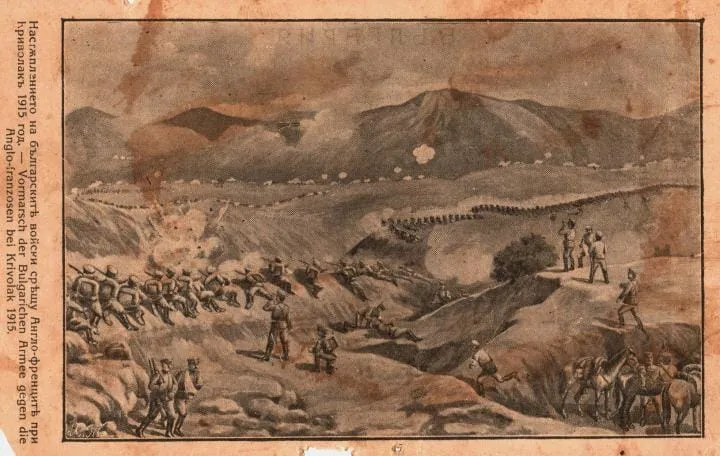
The Battle of Krivolak was the only serious attempt to come to Serbia’s aid by the Entente troops who in October 1915 had landed at Salonika. When Germany and Austria-Hungary attacked Serbia from the north and Bulgaria from the east, General Maurice Sarrail’s French Army of the Orient set off by rail up the valley of the Vardar to join the Serbs in the area of Veles and Skopje. At the end of October its leading division reached Krivolak and dug in on both sides of the river. The Bulgarians, however, had been faster. Their Second Army took Veles and Skopje and cut the main Serbian forces off from the French. Throughout November the French repulsed attacks on their bridgeheads on the Vardar and the Crna Reka and themselves tried to strike towards Veles, but they never reached the Serbs. When the Serbian army began to withdraw through the mountains of Albania and Montenegro, Sarrail ordered a retreat. The fighting at Krivolak was part of the conquest of Serbia by the Central Powers.
Name and dates
Krivolak was a village with a railway station on the Vardar, on the line from Salonika to Serbia, about 13 kilometres east of the confluence of the Crna Reka and the Vardar and about 30 kilometres south-east of Veles. In different traditions the name of the battle covers different fighting. The British chronology of the war, on which our timeline is based, distinguishes a first engagement at Krivolak on 24 October and a second on 30 October, and dates the French abandonment of Krivolak to 2 December. The French official history speaks not of a battle but of fighting at Krivolak and Gradsko in October and November, and separately of fighting at Čičevo in November. The Bulgarians call this fighting the Battle of Krivolak (Krivolashko srazhenie), and some modern studies begin it as early as 21 October, with the first skirmish with the French near Strumica station, and end it on 22 November.
On this page we adopt the dates 24 October – 3 December 1915, that is, from the first engagement at Krivolak to the start of the French retreat from the loop of the Vardar and the Crna Reka. According to the British official history and the American correspondent Richard Harding Davis, who was at the front at the time, the retreat began on 3 December. We do not, however, include here the fighting of the French 156th Division near Strumica station and on the slopes of Belasica, which took place at the same time several dozen kilometres further south-east, nor the later rearguard fighting in the Vardar valley.
Background
General Sarrail arrived by sea at Salonika on 12 October. He was to cover the railway linking Salonika with Serbia and help the Serbs, but he had few forces: General Maurice Bailloud’s French 156th Division from the Dardanelles and the 57th Division, which disembarked in the port between 12 and 23 October. The 122nd Division did not arrive until the beginning of November. General Bryan Mahon’s British 10th (Irish) Division was not permitted to cross the Serbian frontier until the last days of October. The first clash between the French and the Bulgarians took place on 21 October near Strumica station.
After declaring war on Serbia, Bulgaria threw its Second Army under General Georgi Todorov westwards, straight at the railway from Salonika. According to the Austrian official history, Bulgarian cavalry reached Veles as early as 19 October, and on 22 October the Bulgarians took Kumanovo and Skopje. At that time the main Serbian forces were fighting far to the north, falling back before the armies of Field Marshal August von Mackensen. The only route by which they could still join their allies was the Vardar valley.
Course
Krivolak and Kara Hodjali, 24 October – 2 November. After the fighting near Strumica station Sarrail sent the leading brigade of the 57th Division, commanded since 23 October by General Paul Leblois, further north by rail. According to the British official history the Bulgarians were taken by surprise and the road to Veles lay open, but the French were too weak to advance further and had to defend the long railway line behind them. The Austrian official history states that at Krivolak the advance guards of the 57th Division ran into units of a Bulgarian cavalry division moving south from Štip. The road bridge at Krivolak had been destroyed since 1912, so the French crossed the swollen river on an old Turkish ferry. By 27 October the whole division was in the valley and held about 25 kilometres of front from Gradec to Krivolak. On the east bank the French occupied the Kara Hodjali massif, which dominated the valley, and repulsed the first stronger Bulgarian counter-attack, according to the British writer John Buchan after a close-quarters fight with grenades. According to the British history, as early as 24 October the Bulgarian Second Army had completely cut the main Serbian forces off from the French.
At the turn of October and November the fate of the whole expedition hung in the balance. On 29 and 30 October the French commander-in-chief, Joseph Joffre, obtained the agreement of the British in London that they would cover the railway from Salonika to Krivolak, while the French were to secure the section from Krivolak to Veles. On 31 October Vojvoda Radomir Putnik informed Sarrail that the Serbs would try to retake Skopje with two divisions and asked for an attack from the south. Sarrail decided to strike on one side at Belasica, towards Bulgarian Strumica, and on the other across the Crna Reka against the flank of the Bulgarians advancing from Veles.
The attack of 3 November. In the first days of November French and British sappers built two pontoon bridges across the Vardar at Krivolak, and the French developed a semicircular bridgehead on Kara Hodjali. A second one was formed on the Crna Reka at the village of Vozarci, where a bridge had survived. Against them the Bulgarians brought up from Štip two brigades of the 11th Division, formerly known as the Macedonian Legion, which joined a brigade of the 7th Division already in position. Twenty-four battalions now faced the French. On 3 November the 11th Division, fresh and poorly trained, attacked the bridgehead on Kara Hodjali. The French caught it in open ground and decimated it with fire. According to a Spanish observer cited by the British official history, the division lost over 3,000 men in this attack, and the whole first Bulgarian offensive against the French in the loop of the Vardar and the Crna Reka cost the Bulgarians over 4,300 killed, wounded and missing.
The advance on Veles, 5–9 November. General Leblois judged that the tracks leading west of the Crna Reka were impassable for field artillery and, with Sarrail’s consent, struck instead along the Vardar towards Veles, into the Bulgarian rear. On 5 November the French took the villages of Kamen Dol and Debrište on the left bank of the Crna Reka and Gradsko station north of the river’s mouth. On 6 and 7 November they were held up before a strong position on the hill with the Monastery of the Archangel. On 8 November command of the advance passed to General Charles de Lardemelle, whose 122nd Division now provided most of the troops. He returned to Sarrail’s original plan, that is, a blow against the flank of the Bulgarians between the Crna Reka and the Babuna valley, where a Serbian detachment was still holding out on the road from Veles to Prilep. On 9 November the French took the villages of Kruševica and Sirkovo.
Čičevo, 10–13 November. By then, however, it was too late. The Bulgarians lost interest in the Serbs in the Babuna pass and turned against the French. Todorov entrusted the task of stopping them to his artillery commander, Colonel Stefan Bogdanov. On 10 November both sides attacked almost simultaneously. The Bulgarian attack did not develop, but it paralysed the advance of two French battalions on the monastery. The French took only the village of Dolno Čičevo at the foot of the hill, and only late in the evening of 11 November Gorno Čičevo. The monastery, less than a kilometre away, was still holding out. The British official historian believed that this was perhaps the turning point of the fighting, as the Bulgarians were exhausted and demoralised, which the French did not know. During the night de Lardemelle withdrew from both Čičevos. On 12 November Bogdanov threw his regiments into a general attack. The Bulgarians took Gradsko station and Kruševica, and on 13 November advanced further on both wings, after which they were ordered to wait for reinforcements from the 5th Division. In the attack of 13 November, according to the Spanish observer, they lost over 1,500 men.
The loss of Vozarci and preparations for the retreat, 12 November – 3 December. The French government, alarmed by the position of the Serbs and by the hostile attitude of Greece in the rear of the Army of the Orient, warned Sarrail of the danger on 12 November and practically ordered him to break off the offensive. On 17 November Sarrail instructed Generals de Lardemelle and Leblois to prepare a retreat. On 20 November a fresh brigade of the Bulgarian 5th Division occupied the heights above the bridgehead at Vozarci, and de Lardemelle withdrew all his troops behind the Crna Reka, which greatly angered Sarrail. The bridges over the river were blown up. On 22 November Sarrail learned that the Serbian attack on Skopje, the main objective of the whole expedition, had failed. He ordered the immediate removal from the loop of the Vardar and the Crna Reka of the supplies, artillery and transport gathered there, and the fortification of two intermediate positions. Meanwhile the Bulgarians were bringing up reinforcements, and at the beginning of December they had about 80 battalions against the French and British. On 3 December the French began their retreat. They blew up the railway tunnel at Krivolak and the bridges over the Vardar, and the positions in the gorge at Demir Kapija became their new line of defence.
Losses
The exact losses of the fighting at Krivolak alone are not known. According to the British official history, the French lost 143 officers and 4,822 men in the whole expedition to Serbia, including the December retreat. A Spanish staff officer who observed the campaign from the Bulgarian side gave Bulgarian losses for only three engagements, including over 4,300 men in the first offensive against the French in the loop of the Vardar and the Crna Reka and over 1,500 in the attack of 13 November. The British historian noted that these figures alone exceeded the combined French and British losses in the whole expedition. The Soviet historian Nikolai Korsun estimated the losses of Sarrail’s troops in the whole operation at about 6,000 men.
Significance
The French reached the Vardar too late and in too small numbers to save Serbia. When they got to Krivolak, the Bulgarians already held Veles and Skopje, and the Serbian army could not break through to the south. The British official history nevertheless judged that the expedition took a considerable part of the burden off the Serbs. By tying down the Bulgarian Second Army, which had to turn a considerable part of its forces south against the French, it may have saved the Serbian army from complete encirclement and destruction, and it allowed its remnants to escape through the mountains to the Adriatic. The efficient retreat from Krivolak and from the whole Vardar valley, carried out at the beginning of December, saved Sarrail’s troops. In mid-December the French and British returned to Greek territory and began to fortify the entrenched camp around Salonika, from which the Salonika front grew.
Spotted a mistake?Report an error