Russia · The Entente
Viktor Chernov
Leader of the Socialist Revolutionary Party, minister of agriculture of the Provisional Government (May–September 1917), chairman of the Constituent Assembly (1918)
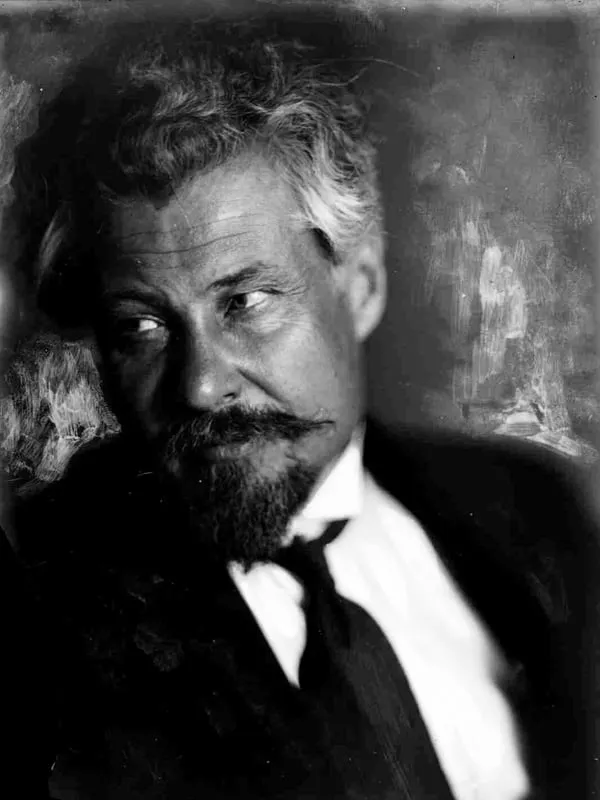
- Born:
- 7 December 1873, Khvalynsk, Saratov Governorate (Russian Empire)
- Died:
- 15 April 1952, New York (United States)
- Author:
- Natalia
- Photo:
- autor nieznany, domena publiczna, Wikimedia Commons

Viktor Mikhailovich Chernov was a co-founder and the chief theorist of the Socialist Revolutionary Party, the SRs, the largest revolutionary party in Russia, which spoke in the name of the peasants. During the war, in emigration, he was one of the leaders of its anti-war wing. In 1917 he returned home and, as minister of agriculture in the Provisional Government, tried to prepare the transfer of land to the peasants, which made him a target of hatred on the right and did not satisfy the left. In January 1918 he presided over the only session of the Constituent Assembly, which the Bolsheviks dispersed. His fate shows how the party that won the most votes in the first free elections in Russian history lost power to the far smaller Bolsheviks.
Before the war
He was born on 7 December 1873 (25 November in the Julian calendar) in Saratov Governorate on the Volga. Older biographies give Kamyshin as his birthplace, but Russian researchers, relying on the parish register, established in the 1990s that it was Khvalynsk. His father, the son of a serf, rose to become a treasury official and attained personal nobility. Chernov studied law at Moscow University and was already involved with the Narodniks as a student. In 1894 he was arrested and then exiled to Saratov Governorate and to Tambov, where he founded the first revolutionary organisations among the peasants.
In 1899 he went abroad. He was one of the founders of the Socialist Revolutionary Party, formed at the turn of 1901 and 1902, editor of its newspaper Revolyutsionnaya Rossiya and author of its programme. His most important idea was the “socialisation of the land”: the abolition of private ownership of land and its transfer for equal use to those who cultivated it themselves. Unlike the Marxists, he believed that in agrarian Russia the force of the revolution would be not only the workers but above all the peasants. The party also used terror against tsarist dignitaries. In 1905 Chernov returned to Russia, and from 1908 he again lived in emigration, shaken by the revelation that the head of the party’s combat organisation, Yevno Azef, had for years been a police agent. He had defended him for years.
War in emigration
The outbreak of war divided the Socialist Revolutionaries just as it divided the Social Democrats. Some of the leaders, such as the “grandmother of the revolution” Yekaterina Breshko-Breshkovskaya and Nikolai Avksentiev, decided that Russia and its Western allies had to be defended against Germany. Chernov headed the internationalist wing. At a meeting of SR émigrés in Switzerland in August 1914 he argued that Russia was waging not a defensive war but a dynastic one, and that its defeat could bring power to the people. From the autumn of 1914 he co-edited anti-war newspapers in Paris, which the French censors constantly cut.
In September 1915 he went to the Zimmerwald Conference. He voted for the manifesto of the opponents of the war but did not sign it, because he felt it said too little about the guilt of tsarism and the plight of the peasants. Much, however, separated him from the Zimmerwald Left of Vladimir Lenin. He wanted a peace without annexations or indemnities, imposed by a “third force”, that is the organised working masses of all the belligerent countries, not a civil war.
Minister of agriculture
After the February Revolution he tried to return to Russia through Britain, but the British, distrustful of opponents of the war, sent him back to France. He finally reached Petrograd on 21 April 1917 (8 April Old Style), a few days after Lenin. He brought the news that in the West no one had noticed the Provisional Government’s declaration renouncing conquests, which contributed to the April Crisis. He joined the leadership of the Petrograd Soviet, and on 18 May entered the first coalition government as minister of agriculture.
He wanted to prepare a land reform for the Constituent Assembly and, until then, to ban the sale of land and place it under the administration of land committees. The peasants would thus be sure that estates would not be broken up and sold before the reform, and at the same time would have less reason to seize them on their own. In June and July he secured the suspension of Stolypin’s agrarian laws, but his most important bills got stuck in the government, blocked by the Kadets, by the prime minister, Prince Georgy Lvov, and later also by Alexander Kerensky. Lvov, on leaving the government in July, openly blamed Chernov’s policy for undermining the people’s sense of law. Chernov was also losing influence in his own party. At the SR congress in May and June 1917 his resolution on the war was defeated by a more moderate one, and he was elected to the Central Committee with a worse result than the leader of the right wing, Abram Gots.
During the July Days sailors from Kronstadt seized him in front of the Tauride Palace and dragged him into a car, shouting that he should take power since it was being given to him. He was freed by Leon Trotsky. The right-wing press unleashed a campaign against him, accusing him of defeatism and contacts with the Germans. In the second coalition government, however, he kept the agriculture ministry as the only true radical in the cabinet. He left it at the beginning of September, in the days of the Kornilov affair.
The Constituent Assembly
The Bolshevik coup found him away from Petrograd. He rejected it, but his centre-left wing preferred to wait until Lenin’s power discredited itself rather than take up arms at once. In November a plan was hatched at Headquarters in Mogilev to form a socialist government headed by Chernov, but it lacked support, including among the right wing of the SRs, and nothing came of it. At the party congress at the turn of November and December, Chernov’s people won a majority in the Central Committee.
In the elections to the Constituent Assembly the Socialist Revolutionaries won the most seats. On 18 January 1918 the assembly elected Chernov as its chairman by 244 votes to 153 cast for the candidate of the Bolsheviks and Left SRs, Maria Spiridonova. In his speech he called for the transfer of land to the peasants, for peace and for a federation of the peoples of Russia, but said not a word about recognising Soviet power. The Bolsheviks left the hall. At about 4.20 a.m. the commander of the guard, the sailor Anatoli Zheleznyakov, told Chernov that everyone had to leave “because the guard is tired”. Chernov still managed to put to the vote a law on the land, an appeal for a general democratic peace and the proclamation of a federal republic, and then closed the session. The next day Lenin’s government dissolved the assembly.
Civil war
In the spring of 1918 Chernov was in hiding in Moscow, and the party resolved to overthrow the Bolshevik dictatorship. When, after the revolt of the Czechoslovak Legion, a group of SR deputies formed Komuch, the Committee of Members of the Constituent Assembly, in Samara in June, Chernov was first sent to Saratov. He reached Samara only in September, when the State Conference at Ufa had already set up the Directory, a compromise government of SRs and Siberian conservatives. Chernov was dissatisfied with this compromise. On 22 October an appeal of the SR Central Committee, written by him, was circulated, calling on party members to arm themselves against the “counter-revolution”. For the officers in Omsk this was proof that the SRs wanted to repeat 1917, and it became one of the pretexts for Admiral Kolchak’s coup on 18 November. A congress of Constituent Assembly deputies in Yekaterinburg, chaired by Chernov, called for a struggle against the “handful of conspirators”, but Kolchak had it broken up. Chernov was briefly arrested and got out with the help of the Czechoslovaks.
He was caught between a rock and a hard place. He preached a struggle on two fronts, against the Bolsheviks and against the White generals, but he no longer had either an army or territory. In March 1919 he returned illegally to Moscow, and in 1920 he left for Estonia on a false passport.
After the war
In emigration he headed the SR party’s foreign delegation and lived in Berlin, Prague and Paris. In Germany he won a libel case against a publisher who had accused him of taking German money during the war. Ahead of the German occupation of France he fled through Portugal to the United States, where in the early 1940s he settled in New York. He published memoirs and a book, The Great Russian Revolution. He died in New York on 15 April 1952.
Assessment
Chernov was an outstanding theorist and writer, but as a politician he was considered weak. Contemporaries, including those well disposed towards him, described him as a man of great erudition and eloquence who wavered at moments of decision. Kerensky and the Kadets saw him as a demagogue who stirred up the peasants, the Bolsheviks as a petty-bourgeois windbag. Historians such as Oliver Radkey, in his classic work on the Socialist Revolutionaries, stress that the party he built won the elections but was too divided to exploit its victory. Its right wing wanted war alongside the Allies, its left wing went over to the Bolsheviks, and Chernov could not hold them together. In the history of the war his name is linked with two symbols: the minister whom sailors told to “take power”, and the chairman of the assembly whom sailors told to leave because “the guard is tired”.
Sources
Spotted a mistake?Report an error
Often appears with
People who appear in the same events.