Russia · The Entente
Mikhail Rodzianko
Chairman of the Third and Fourth State Duma (1911–1917), chairman of the Provisional Committee of the Duma during the February Revolution
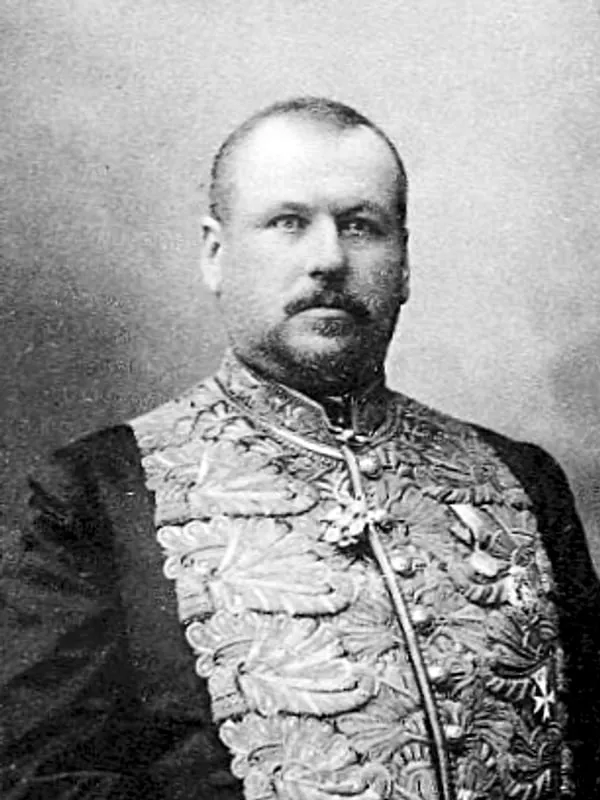
- Born:
- 21 February 1859, Popasnoye, Yekaterinoslav Governorate (Russian Empire)
- Died:
- 24 January 1924, Kingdom of Serbs, Croats and Slovenes
- Author:
- Natalia
- Photo:
- Karl Fischer / Karl Fischer, domena publiczna, Wikimedia Commons

Mikhail Vladimirovich Rodzianko was for six years chairman of the Russian State Duma and its best-known face. A landowner, a former Guards officer and a convinced constitutional monarchist, throughout the war he warned Nicholas II that government by men who lacked the country’s confidence, and the influence of Grigori Rasputin, were leading the monarchy to its ruin. When the Petrograd garrison mutinied in March 1917, he headed the Provisional Committee of the Duma, and his night-time conversation with General Nikolai Ruzsky decided the Tsar’s abdication. He wanted to save the dynasty, but helped to bring about its end. Within a few days the revolution pushed him aside.
Before the war
He was born on 21 February 1859 (9 February in the Julian calendar) on the Popasnoye estate in the Novomoskovsk district of Yekaterinoslav Governorate, into a wealthy noble family of Ukrainian origin. His father was a general. He graduated from the elite Page Corps and served in the Chevalier Guard Regiment, from which he retired to the reserve in 1882 with the rank of lieutenant. He then devoted himself to his estate and to local government: he was marshal of the nobility of Novomoskovsk district and, in 1901–1906, chairman of the board of the Yekaterinoslav provincial zemstvo. He was one of the richest landowners in his province, and thanks to his court offices he held the title of chamberlain.
After the October Manifesto of 1905 he was a co-founder of the Octobrist party, moderate liberals who wanted to cooperate with the monarchy within the new system. From 1907 he sat in the Third Duma, and in March 1911, after the resignation of Alexander Guchkov, he became its chairman. In November 1912 he was re-elected chairman of the Fourth Duma. He was of massive build, spoke in a booming voice and reportedly called himself “the fattest man in Russia”. He was very careful of the dignity of his office. At the service marking the tercentenary of the Romanovs in 1913 in the Kazan Cathedral he ordered Rasputin out of the seats reserved for deputies.
He regarded Rasputin as a sectarian and a charlatan who was discrediting the throne. As early as 1912 he presented the Tsar with material about him, but was told that it was a family matter. From then on Empress Alexandra Feodorovna considered him an enemy. In foreign policy, however, Rodzianko favoured a hard line. According to Orlando Figes, in March 1913 he told the Tsar that the Straits must become Russian and that the country would welcome a war with joy.
The war and the shell question
The outbreak of war found him taking a cure at Bad Nauheim in Germany. After returning he backed the government without reservation. At the one-day session of the Duma on 8 August 1914 (26 July Old Style) the deputies voted war credits and agreed not to be convened until further notice. Rodzianko is said to have told the ministers then that the Duma would only get in their way, so it was better to send it home until the end of hostilities.
He soon learned what the war looked like behind the lines. In the first months of the war, by his own account, he found some 17,000 wounded soldiers at the railway station in Warsaw lying untended in the rain and mud, while the officials of the medical service hid behind regulations. In the spring of 1915 he visited Russian-occupied Galicia. When it came to light that the army was short of shells, Rodzianko persuaded the Tsar to set up a Special Council for army supply with the participation of deputies and industrialists, and at the beginning of June 1915 he came out in favour of removing the Minister of War, Vladimir Sukhomlinov. The dismissal of Sukhomlinov and several other ministers was the Duma’s first victory.
In the summer of 1915 Rodzianko opposed the Tsar’s assumption of the supreme command, because he believed the monarch should not personally take on responsibility for defeats. He supported the formation of the Progressive Bloc, which united the majority of the Duma around the demand for “a government of public confidence”. As chairman of the chamber he was in effect the intermediary between the Duma and the monarch and made regular reports to the Tsar. In the autumn of 1915 he also headed the evacuation commission of the Special Council for State Defence.
Warnings nobody heeded
In 1916 his reports grew ever more alarming. He demanded the departure of ministers who enjoyed the support of the Empress and Rasputin, and in November he opened the Duma session at which the opposition accused the government of incompetence and even treason. Soon afterwards the Tsar dismissed Prime Minister Stürmer. According to some accounts Rodzianko also advised that Alexandra Feodorovna be removed from affairs of state until the end of the war, and in her letters to her husband the Empress called him a scoundrel. In the autumn of 1916 the leaders of the liberal opposition, among them Rodzianko, Guchkov and Pavel Milyukov, were already discussing a palace coup that would give the throne to the heir under the regency of Grand Duke Michael Alexandrovich. Rodzianko was not a conspirator, however. He believed that the Tsar could still be persuaded.
The murder of Rasputin in December 1916 changed nothing. At an audience in January 1917 Rodzianko told the Tsar that all the best men had been removed from the government and only those of ill repute remained. Nicholas received him for the last time on 23 February 1917 (10 February Old Style). According to Rodzianko, he was exceptionally cold towards him.
The February Revolution
When strikes and demonstrations broke out in Petrograd, on 11 March Rodzianko telegraphed the Tsar that anarchy reigned in the capital and begged him to appoint at once a government enjoying the country’s confidence. Nicholas II dismissed the telegram with the words that “that fat Rodzianko” was again writing him nonsense, and responded by proroguing the Duma. The next day the garrison went over to the insurgents. The deputies, not wishing to defy the decree openly, met in a “private conference” and set up the Provisional Committee of the Duma, with Rodzianko as its chairman. To the last he hesitated over whether to take power. On the night of 12–13 March, when Prince Golitsyn’s government had ceased to function, the committee announced that it was taking power into its own hands.
In the following days Rodzianko tried to master the situation from the position of legitimate authority. He called on the soldiers to return to barracks and obey their officers, and when representatives of the garrison demanded recognition of their rights, he refused to negotiate. The Petrograd Soviet responded with Order No. 1. At Rodzianko’s request General Lavr Kornilov took command of the Petrograd Military District. Rodzianko also assured the chief of staff to the Supreme Commander, General Mikhail Alekseyev, that the new government would be formed by the leaders of the Duma and not by the soviets. Alekseyev trusted him, and this was one reason why he halted the expedition of General Nikolai Ivanov’s troops against the capital.
The most important was the conversation on the night of 14–15 March. At about half past three in the morning Ruzsky, who in Pskov had persuaded the Tsar to agree to a government responsible to the Duma, contacted Rodzianko by telegraph. He was told that the concession had come too late and that hatred of the dynasty had reached its utmost limits. The only way out was to be abdication in favour of his son under the regency of Michael. In the morning Alekseyev circulated the record of this conversation to the front commanders, and their replies induced Nicholas to renounce the throne. Rodzianko himself wanted to go to Pskov, but the Soviet would not let him leave the capital. Guchkov and Vasily Shulgin went instead.
When it turned out that the Tsar had abdicated in favour of his brother, Rodzianko asked Headquarters to hold back the publication of the manifesto. On the morning of 16 March, together with most members of the Duma Committee and the new government, he advised Michael to refuse. The Grand Duke asked him for a private conversation and asked whether the Duma would guarantee his safety. Rodzianko replied that he could not do so, and Michael signed an act making his acceptance of power dependent on the will of a Constituent Assembly.
On the margins of the revolution
Rodzianko did not join the Provisional Government, headed by Prince Georgy Lvov. The Duma, which he tried to keep alive as “private conferences” of deputies, quickly lost its importance, and to the soviets and the soldiers the chairman of the chamber was the embodiment of the old propertied classes. In the summer of 1917 Rodzianko was among the politicians who demanded the restoration of discipline in the army and “strong government”. According to Russian sources, he and Guchkov then founded the Liberal Republican Party. He supported Kornilov’s programme, and after the failure of the general’s putsch he dissociated himself from any “counter-revolution”. In October 1917 the Provisional Government formally dissolved the Duma in connection with the elections to the Constituent Assembly. In those same weeks, when after the fall of Riga and the loss of the islands of the Gulf of Riga the Germans seemed to threaten the capital, Rodzianko caused a storm with a press statement that the newspapers summed up in the words “God be with Petrograd”. He suggested that the government could leave the city and that the loss of its revolutionary institutions would be no harm. The Bolsheviks used this as proof that the bourgeoisie was ready to hand the revolutionary capital over to the Germans.
After the war
After the Bolshevik coup he went to the Don, where the White Volunteer Army was forming. In 1918, aged almost sixty, he went with it on the First Kuban Campaign, the so-called Ice March. In January 1918 the Bolsheviks shot his son Georgy, an officer of the Preobrazhensky Regiment, in Kiev. Rodzianko stayed with the Whites to the end, but no longer had any influence on politics. In 1920 he emigrated to the Kingdom of Serbs, Croats and Slovenes. He wrote memoirs, “The Collapse of the Empire”, published in Berlin in the “Archive of the Russian Revolution”, and in English as “The Reign of Rasputin”. For the monarchist émigrés he was one of those to blame for the fall of tsarism. According to Russian biographers, shortly before his death he was beaten up in Belgrade by former officers of Pyotr Wrangel’s army. He died in poverty on 24 January 1924 in the village of Beodra in the Banat, or according to other sources in nearby Vršac. He was buried in the New Cemetery in Belgrade.
Assessment
Rodzianko was not an outstanding politician and is rarely the hero of books about the revolution. His contemporaries, his allies included, stressed his vanity, his verbosity and his conviction of his own importance. Nicholas II and his entourage saw him as a disloyal intriguer, the monarchists in exile as one of the gravediggers of the monarchy. The left regarded him as the embodiment of landowning Russia. Historians such as Orlando Figes and Richard Pipes point out, however, that in 1915–1916 he was one of the few men who openly told the Tsar the truth about the state of the country, the army and the court. In March 1917 it was his authority as chairman of the Duma that convinced the generals that abdication would save the army and allow the war to go on. This calculation proved wrong: Rodzianko wanted to replace the Tsar with a regency and a government of confidence, and instead opened the way to a revolution that he did not understand and could not control. Russian scholars see him above all as the tragic figure of a liberal monarchist who all his life defended the system of 1905 and lived to see its end.
Sources
Spotted a mistake?Report an error
Often appears with
People who appear in the same events.
On the timeline
(10)1915
1916
1917
March
- 15
- Key eventAbdication of Nicholas IILate on 15 March 1917 at Pskov Nicholas II gave up the throne for himself and his son in favour of his brother Michael. The next day Michael declined the crown.
- Formation of the Provisional GovernmentOn 15 March 1917 Milyukov announced the Provisional Government, led by Prince Lvov. It arose from an agreement of the Duma Committee and the Petrograd Soviet.