Key event
Murder of Rasputin
- Category:
- Politics
- Date:
- 30 December 1916
- Author:
- Natalia
- Tags:
- Russia, Nicholas II, Grigori Rasputin
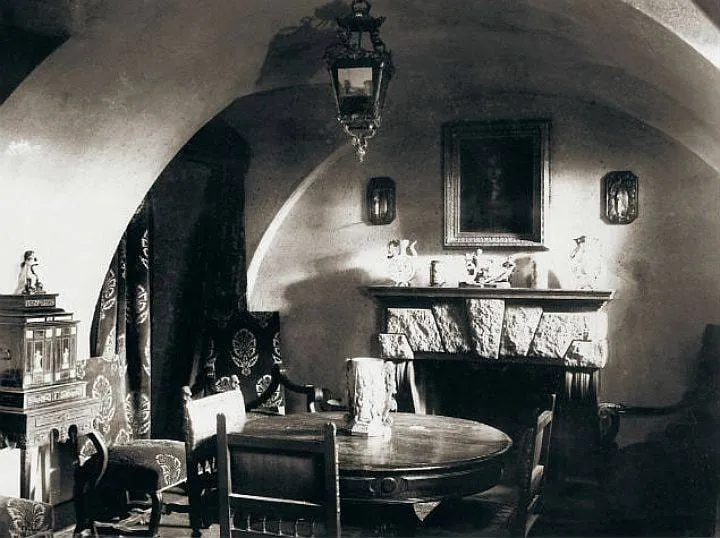
Before dawn on 30 December 1916 (17 December by the Julian calendar), in the Yusupov Palace on the Moika in Petrograd, Grigori Rasputin was murdered: a Siberian peasant and starets (“elder”) who for ten years had enjoyed the boundless trust of Empress Alexandra Feodorovna. The killers were Prince Felix Yusupov, husband of the Tsar’s niece, the Tsar’s cousin Grand Duke Dmitri Pavlovich, the Duma deputy Vladimir Purishkevich, Lieutenant Sergei Sukhotin and the physician Stanislaus Lazovert. Before daybreak they threw the body under the ice of the river, and that same day news of Rasputin’s disappearance spread through the city. The British chronology of the war records the murder a day later, under 31 December.
A Siberian peasant at the imperial court
Rasputin was born in 1869 in the village of Pokrovskoye in the Tobolsk Governorate. After a pilgrimage to a monastery in the late 1890s he became a wandering pilgrim and gained a reputation as a holy man who could heal and foretell the future. Around 1903 he reached St Petersburg, where he was introduced into aristocratic salons. On 1 November 1905 (by the Julian calendar) he met Emperor Nicholas II and his wife. The Tsar noted in his diary that he had met “a man of God, Grigori from the Tobolsk Governorate”.
The source of his power was the illness of the heir to the throne, Tsarevich Alexei, who suffered from haemophilia. Every cut or bruise threatened the boy’s life, and the Empress was convinced that Rasputin’s prayers had several times stopped a haemorrhage. The most famous case occurred in the autumn of 1912 at Spała, the tsars’ hunting estate in Poland: when the doctors were losing hope, Rasputin telegraphed from Siberia that God had heard the mother’s prayers, and the boy soon recovered. From then on he was the indispensable “Friend” to Alexandra Feodorovna. To the rest of the country he was a scandalous enigma. Stories circulated about his drunkenness and his affairs, the Church twice investigated charges that he was spreading the Khlyst heresy, and the press and the Duma asked ever more loudly about his influence at court. In July 1914, on the eve of the war, he was badly wounded with a knife at Pokrovskoye by a follower of his bitter enemy, the former monk Iliodor. Rasputin survived. He opposed the war and is said to have warned the Tsar that it would bring ruin on Russia.
“Dark forces”
Rasputin became a real political force only during the war. When in September 1915 the Tsar took over the supreme command and left for headquarters at Mogilev, domestic affairs in the capital were increasingly handled by the Empress, and she consulted the “Friend”. Her letters to her husband teem with the names of ministers and bishops recommended or opposed by Rasputin. Heads of ministries changed so often that in Russia people spoke of “ministerial leapfrog” (chekharda). Men regarded as Rasputin’s protégés entered the government, among them Prime Minister Boris Stürmer and the Minister of the Interior, Alexander Protopopov. Some historians believe that Rasputin’s real influence on policy was smaller than his contemporaries thought, since the Tsar ignored much of his wife’s advice. For public opinion, however, what counted was what people believed.
In the capital it was said that the peasant and “the German woman”, as the Hesse-born Empress was called, were betraying the country to the enemy and preparing a separate peace with Germany. No proof of this was ever found, but the rumours undermined the dynasty’s authority, in the army as well. In the autumn of 1916 the Duma went over to open attack. On 14 November the Kadet leader Pavel Milyukov, asking “stupidity or treason?”, named Rasputin among the “court party”, which contributed to Stürmer’s dismissal. The new Prime Minister, Alexander Trepov, according to several accounts tried to bribe Rasputin, offering him a large sum of money to return to Siberia and withdraw from politics, but Rasputin refused and told the Empress everything.
The conspiracy
On 2 December 1916 Purishkevich, one of the leaders of the far right and of the Black Hundreds and an ardent monarchist, spoke in the Duma. This time it was not the liberals but a defender of autocracy who called on the ministers to go to headquarters and beg the Tsar to free Russia from Rasputin. In the following days he was approached by Felix Yusupov, the twenty-nine-year-old heir to one of the greatest fortunes in Russia. According to Purishkevich’s diary, Yusupov told him bluntly that the speech would achieve nothing, because the Emperor disliked pressure and the Empress was running the state under Rasputin’s influence, so he had to be got rid of. Yusupov had been looking for accomplices for several weeks. He consulted the lawyer and Duma deputy Vasily Maklakov, who declined to take part, and recruited an officer he knew, Sukhotin, and Grand Duke Dmitri. The participation of a member of the dynasty was meant to show that the attempt was not aimed at the Romanovs. Purishkevich agreed at once and brought into the plot Lazovert, a doctor from his hospital train.
According to his own memoirs, Yusupov had earlier sought Rasputin’s friendship and visited him as a patient. Now he invited him to his palace, luring him with the promise of meeting his wife, Princess Irina, the Tsar’s niece, famed for her beauty. In reality Irina was in the Crimea.
The night on the Moika
Shortly after midnight Yusupov and Lazovert, disguised as a chauffeur, brought Rasputin to the palace. The guest was shown into a newly furnished dining room in the basement, while upstairs, where the other conspirators waited, a gramophone played to give the impression of a party. What happened next is known chiefly from the later memoirs of Yusupov and Purishkevich, which differ in detail. Years later Yusupov described how he offered Rasputin cakes and Madeira laced with cyanide and the poison had no effect. According to Purishkevich’s diary, Rasputin did not touch the food. The post-mortem in any case found no trace of poison.
What is certain is that after more than an hour Yusupov shot Rasputin at close range. The wounded man fell, but after a moment leapt up and ran out through a side door into the snow-covered courtyard. Purishkevich ran after him and fired several shots, at least two of which hit. At about half past two policemen heard the shots. Purishkevich told one of them that he had killed Rasputin and asked him to keep quiet. The fatal shot proved to be one to the forehead, fired from very close range. Who fired it is still unknown. The conspirators wrapped the body in cloth, drove it to the Petrovsky Bridge by Krestovsky Island and dropped it into a hole in the ice of the Malaya Nevka, a branch of the Neva. By six in the morning they were back at the palace. Theories later arose about the involvement of British intelligence, but no documents confirm them.
The day after the crime
The secret could not be kept even for a day. On the afternoon of 30 December the newspaper Birzhevye Vedomosti carried a short report of Rasputin’s death “after a party in one of the most aristocratic houses in the centre of the city”. Maurice Paléologue, the French ambassador, learned of the murder that evening, and at the Yacht Club it was already the talk of everyone. Prime Minister Trepov told one of the grand dukes over the telephone that all he knew was that Rasputin had disappeared and had probably been murdered, and that the head of the Okhrana was conducting the investigation. The police had opened an investigation that morning, and rumour pointed to Yusupov, Grand Duke Dmitri and Purishkevich as the culprits. Purishkevich soon left for the front with his hospital train.
In the following days the affair was quickly cleared up. On 31 December Paléologue noted that the names of the killers had been confirmed, and that the grief-stricken Empress had summoned her husband from Mogilev and had Dmitri placed under house arrest, although she had no right to do so. Workmen found traces of blood and a boot on the ice at the Petrovsky Bridge, and on 1 January 1917 (19 December by the Julian calendar) divers recovered the body from under the ice. According to Paléologue, people in the streets fell into each other’s arms, and in the bread queues they repeated: “A dog’s death for a dog.” Rasputin was buried quietly at the beginning of January in the park at Tsarskoye Selo, in the presence of the imperial family, Protopopov and the Empress’s friend Anna Vyrubova. The killers were never brought to trial: Nicholas II exiled Dmitri to the Russian corps in Persia, at Qazvin, and Yusupov to his estate in the Kursk Governorate. Purishkevich, popular among monarchists, went unpunished.
Significance
The conspirators wanted to save the monarchy from a man who, in their view, was discrediting it. They achieved little. Milyukov later wrote that the murder had confused rather than satisfied public opinion, because once Rasputin was gone everyone understood that the evil did not lie in one man. Moreover, he had been killed by people from the very circles in which “Rasputins” grew up. Protopopov stayed in office, and the Tsar and Empress shut themselves into an even narrower circle of trusted people. On 9 January 1917 (27 December 1916 by the Julian calendar) Trepov lost the premiership, and his successor was the aged Prince Nikolai Golitsyn. The former Prime Minister Vladimir Kokovtsov told Paléologue in the first days of January that he expected either a palace drama or a revolution soon.
The murder showed that even the aristocracy and the extreme monarchists had ceased to believe in lawful ways of influencing the Tsar. Some contemporaries regarded it as the beginning of a second revolution. Ten weeks later the February Revolution broke out and overthrew the dynasty. In March 1917, on the orders of the new authorities, Rasputin’s coffin was dug up and his body burned. The figure of the Siberian starets remains to this day a symbol of the decay of the last years of tsarist Russia.
Remember the articles you have read? Only in this browser; nothing is sent anywhere.How it works
Read ·
A voice from the front
“Rasputin is no more. He has been killed. Fate willed that I, and no one else, should rid the Tsar and Russia of him, that he should fall by my hand. Thank God, I say, thank God that the hand of Grand Duke Dmitri Pavlovich is not stained with this filthy blood: he was only a spectator, nothing more.”
Translated · Original (ru)
Распутина уже нет. Он убит. Судьбе угодно было, чтобы я, а никто иной избавил от него царя и Россию, чтобы он пал от моей руки. Слава богу, говорю я, слава богу, что рука великого князя Дмитрия Павловича не обагрена этой грязной кровью — он был лишь зрителем и только.
Spotted a mistake?Report an error
Meanwhile
(03)Elsewhere in the same days.
- 1 January 1917 · Western FrontHaig becomes field marshalOn 1 January 1917 Douglas Haig, British commander in France, was made a field marshal. The King called it a New Year's gift from himself and the country.
- 27 December 1916 · AfricaAnglo-French agreement on TogolandOn 27 December 1916 London and Paris agreed on the provisional administration of conquered Togoland, dividing it into two separate administrative zones.
- 27 December 1916 · War at seaSinking of the battleship GauloisOn 27 December 1916 the German UB-47 torpedoed the French battleship Gaulois east of Kythira. The ship sank, but only four sailors were killed.
Related events
(04)The same battle, people or subject.
- 24 November 1916 · PoliticsResignation of StürmerOn 24 November 1916 the fall of Russian premier Boris Stürmer, accused of treason in the Duma, was announced. Transport Minister Alexander Trepov succeeded him.
- 9 January 1917 · PoliticsGolitsyn becomes prime minister of RussiaOn 9 January 1917 the Tsar dismissed Prime Minister Trepov. The post went to 66-year-old Prince Nikolai Golitsyn, who had begged to be spared.
- 13 December 1916 · PoliticsPokrovsky becomes Russian foreign ministerOn 13 December 1916 Nicholas II appointed the State Comptroller Nikolai Pokrovsky foreign minister. He was the last head of tsarist diplomacy.
- 20 July 1916 · PoliticsDismissal of SazonovOn 20 July 1916 the Tsar dismissed the foreign minister Sazonov, advocate of Polish autonomy. His post went to Stürmer, favourite of the Tsarina and Rasputin.