Serbia · The Entente
Stepa Stepanović
Commander of the Serbian Second Army (1914–1919), vojvoda
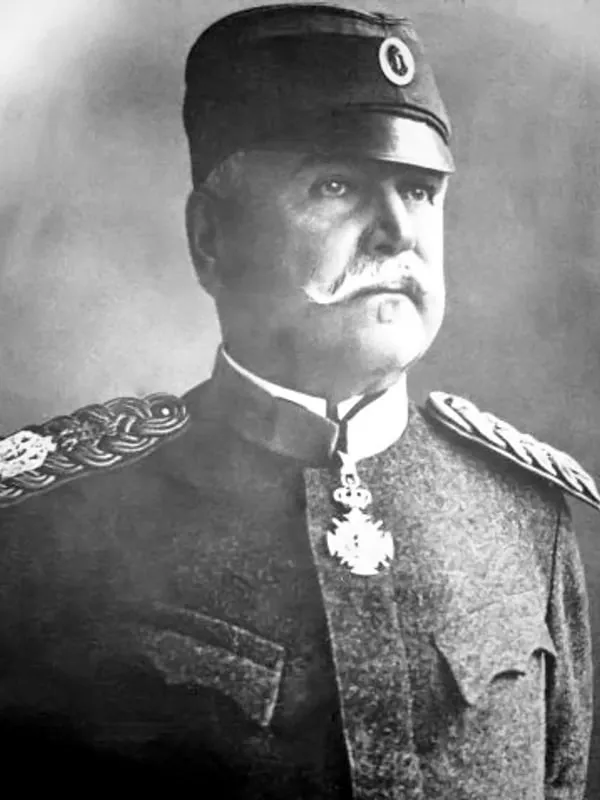
- Born:
- 11 March 1856, Kumodraž near Belgrade (Serbia)
- Died:
- 27 April 1929, Čačak (Kingdom of Serbs, Croats and Slovenes)
- Author:
- Łukasz Skowroń
- Photo:
- autor nieznany, domena publiczna, Wikimedia Commons

Stepa Stepanović went through the whole of the Great War at the head of the same Serbian Second Army. In August 1914 his Second Army won on Mount Cer the first Allied victory of the war; in December of the same year it advanced in the front line on Belgrade; in the autumn of 1915 it held back the Bulgarians for several weeks; and in September 1918 it broke the front at Dobro Pole, which within two weeks knocked Bulgaria out of the war. The son of a peasant from near Belgrade, strict with his officers and close to his soldiers, shunning journalists and politics, he remains to this day one of the most popular national heroes in Serbia.
Before the war
He was born on 11 March 1856 (28 February in the Julian calendar) in the village of Kumodraž near Belgrade, into a peasant family. In 1874 he entered the artillery school in Belgrade and, while still a cadet, went to war against Turkey. In 1876–1878 he fought at Pirot and Vranje, among other places, and in 1885, as a company and then a battalion commander, in the lost war with Bulgaria. He passed through the General Staff and lectured on military history, but he felt most at home with the troops. “The office kills the spirit,” he is said to have remarked.
The coup of 1903, which gave the throne to Peter I Karađorđević, did him no harm, although Stepanović had kept his distance from the conspirators. He took command of the Šumadija Division in Kragujevac, where he became known for Prussian-style drill. In 1907 he became a general, and in April 1908 minister of war. During the Bosnian crisis, when crowds were demanding war with Austria-Hungary, he warned publicly that neither the country nor the army was ready for it, and for this he had to leave the ministry. He headed it again in 1911–1912, when together with Radomir Putnik and Živojin Mišić he prepared the war against Turkey. In the First Balkan War he commanded the Second Army, which also included a Bulgarian division, and then led the Serbian troops at Adrianople. In March 1913 his Timok Division took the northern sector of the fortress and, according to Serbian sources, also captured its commandant.
July 1914: Putnik’s deputy
In the spring of 1914 Stepanović was working on the commission demarcating the border with Bulgaria. According to his Serbian biographers, the news of the Sarajevo assassination reached him on 29 June as he sat outside a café in Babušnica. He is said to have remarked: “God grant that Austria does not put the blame on us. If that happens, we shall have a terrible war, perhaps a European one, and we have not even rested.” On the night of 23–24 July he was ordered to go to Kragujevac and stand in for the chief of staff of the Supreme Command, because Putnik was taking a cure in Austria. For the first two weeks of the war he directed the mobilisation and concentration of an army short of ammunition, uniforms and boots. When Putnik returned on 5 August, Stepanović took command of the Second Army, the strongest in the Serbian forces.
1914: Cer and Kolubara
On 12 August the troops of Austria-Hungary crossed the Drina and the Sava. Putnik sent the Second Army on a forced march into the Jadar valley to strike the flank of the Austro-Hungarian Fifth Army advancing on Valjevo. Stepanović did not know that an entire enemy corps was moving along the ridge of Mount Cer at that very moment, but he saw that this massif would decide the battle. On 15 August he ordered the Combined Division to take the highest summit of Cer that same night. This led to the night clash with which the Battle of Cer began. On 16 August the Combined Division wavered, but Stepanović reinforced it with the Morava Division, and on 19 August both divisions attacked across the ridges of Cer and Iverak and broke the enemy’s resistance. The Fifth Army fell back in disorder across the Drina. For this victory Stepanović received the rank of vojvoda, the second in Serbia’s history after Putnik. He himself was in fact dissatisfied with some of his subordinates, who in his view had missed the chance to destroy the enemy completely.
The following weeks brought less glory. In September, during the Syrmia offensive, the Timok Division of his army crossed the Sava near Sremska Mitrovica, but the late and badly organised crossing ended in defeat and the loss of some 6,000 men. Then for two months the Second Army defended the lowland Mačva under ever heavier artillery fire to which it had nothing to reply with. On 27 October Stepanović asked the Supreme Command to relieve him: he wrote that the daily worry over ammunition had broken his strength and that his soldiers were dying in buried trenches. In a sharp telephone conversation Putnik talked him out of it, and on the night of 30–31 October the Second Army abandoned Mačva.
In the Battle of Kolubara the Second Army was the pivot of the whole front. In the second half of November it defended itself around Lazarevac, on the hills of Vrače Brdo and Čovka, where the Austro-Hungarians repeatedly tried to break its line. When the Serbian counter-offensive began on 3 December, Stepanović did not at once believe in success: on 6 December the Austro-Hungarian staff intercepted a report of his which showed that he saw no possibility of holding his positions. A few days later, however, his army broke through the front of the Austro-Hungarian Fifth Army south of Belgrade. According to Serbian studies, on 13 December it stood on a line from Mount Avala to Kumodraž, the village where he had been born, and the next day it stormed Torlak hill. On 15 December the Serbs returned to Belgrade.
1915: holding off the Bulgarians and the retreat
Stepanović spent the winter and spring of 1915, when typhus was ravaging the country, with his staff at Mladenovac. Despite the doctors’ warnings he toured the hospitals and kept his soldiers drilling so that their spirits would not sink. On 1 September the Second Army was moved east, to Pirot, against Bulgaria. When Mackensen’s armies struck Serbia in October, the Supreme Command took some of his divisions and batteries for the northern front, counting on the French arriving quickly from Salonika. Stepanović warned that the Nišava valley would then be left undefended. Nevertheless, after Bulgaria’s declaration of war his army held the Bulgarian First Army in the mountains for nearly two weeks, while the second Bulgarian army quickly entered Macedonia and cut Serbia off from Salonika. On the night of 26–27 October Stepanović withdrew from Pirot, and at the beginning of November he gave up Niš.
He briefly turned the tide once more. On 8 November the Bulgarians took Leskovac and the divisions of the Second Army began to fall apart, but on 11 and 12 November a counter-attack at Leskovac threw them back a dozen or so kilometres and opened the way to Kosovo Polje for the armies from the north. After that the Second Army covered the retreat of the whole army from the east. When at the end of November the Supreme Command ordered a march across the mountains to the Adriatic, some officers would rather have died in their own country. According to Serbian studies, at the council of army commanders in Peć, which Stepanović chaired as the senior vojvoda, only Mišić spoke in favour of a counter-offensive, while the others decided that the order had to be carried out. The Second Army crossed Montenegro to Scutari, and at the beginning of February 1916 its commander sailed with the first units to Corfu.
The Salonika front
After the army was rebuilt, the Second Army arrived on the Macedonian front in the summer of 1916 and occupied the mountains above the Moglena basin, from Kožuf to Dobro Pole and Sokol. It was to remain there for more than two years. In the autumn offensive of 1916, when the Serbs took Kaymakchalan and fought on the Crna, it played a supporting role. In May 1917, in Sarrail’s unsuccessful offensive, it took Hill 1824 above Moglena, but got no further.
The year 1917 was a difficult one for Stepanović for another reason as well. At that time the trial of Colonel Dragutin Dimitrijević “Apis” and officers of the secret organisation the Black Hand was held in Salonika, ending in June 1917 with the execution of Apis. Several senior officers suspected of links with the conspirators were removed from the Second Army, and the vojvoda himself, according to his biographers, was given to understand that if he was tired he could retire for a rest. He replied curtly that he was perfectly healthy and fit to command an army.
When in the spring of 1918 Louis Franchet d’Espèrey took over the Allied command and Mišić became chief of the Serbian staff, the Second Army’s sector was chosen as the place to break the front. Stepanović was given two French divisions, the 17th Colonial and the 122nd Infantry Division, heavy artillery and the newly formed Yugoslav Division, made up largely of volunteers from the Habsburg lands. During the planning he argued with the Frenchman over the method of attack and, according to Serbian studies, had to rework his plan in August. On the morning of 15 September his troops moved against the Dobro Pole ridge. The Serbian Šumadija Division advanced quickly, but the French on the main axis were held up before Sokol. Stepanović did not wait for the summit to fall. In the evening he sent into the breach the Timok and Yugoslav Divisions, which crossed the ridge, the old border of Serbia, onto their own soil. Within a few days the Second Army reached the Vardar, which it crossed on 23 September, and by the end of the month it had reached the Bulgarian border. On 29 September Bulgaria signed an armistice.
The Second Army then turned west, through Kosovo towards Montenegro and Bosnia. At the beginning of November, as the Habsburg monarchy was falling apart, the Bosnian authorities asked the Serbs to come in, and on 6 November a detachment sent by Stepanović entered Sarajevo.
After the war
From December 1918 Stepanović commanded the 2nd Army District in Sarajevo. In an interview, the only one he ever gave, he said that Serbia was entering the new state without any claim to precedence. He was, however, exhausted, and in November 1919 he was relieved of his command at his own request, retiring in 1920. He settled in Čačak, where he tended his garden, kept away from politics and was active only in the patriotic society Narodna Odbrana, of which he became president for life. He died on 27 April 1929. King Alexander attended his funeral on 30 April.
Assessment
Serbian historians, led by his biographer Savo Skoko, see Stepanović as one of the three great commanders of the Serbian army, alongside Putnik and Mišić. They stress his eye for terrain, evident on Mount Cer, his methodical approach, his care for supplies and the fact that he never spared himself. The breakthrough at Dobro Pole, where he decided to commit his reserves to the battle before Sokol had fallen, is regarded as the crowning achievement of his career.
The assessment is not one-sided, however. The defeat of the Timok Division at Mitrovica also weighs on his army’s command, although Serbian authors place the blame chiefly on the divisional commander. The request to be relieved in October 1914 and the pessimistic report of December show a man who could break down under the weight of responsibility, although in the end he did not fail. Western historians of the war in the Balkans devote little space to him and credit the Serbian victories rather to Putnik and Mišić, and the 1918 breakthrough to the joint effort of the Serbs and the French. In Serbia, however, he has remained above all “Vojvoda Stepa”, the commander who was the first to beat the army of a great power and who four years later led his soldiers back home.
Sources
Spotted a mistake?Report an error
Commanded in battles
(08)- 12 August – 15 December 1914Serbian campaign of 1914Balkan Front
- 15–24 August 1914Battle of CerBalkan Front
- 6–14 September 1914Serbian offensive in SyrmiaBalkan Front
- 7 September – 4 October 1914Battle of the DrinaBalkan Front
- 16 November – 15 December 1914Battle of KolubaraBalkan Front
- 6 October – 4 December 1915Conquest of SerbiaBalkan Front
- 15–17 September 1918Battle of Dobro PoleBalkan Front
- 15–29 September 1918Vardar offensiveBalkan Front
Often appears with
People who appear in the same events.