Serbia · The Entente
Petar Bojović
Commander of the Serbian First Army (1914, 1918), chief of staff of the Supreme Command (1915/1916–1918), vojvoda
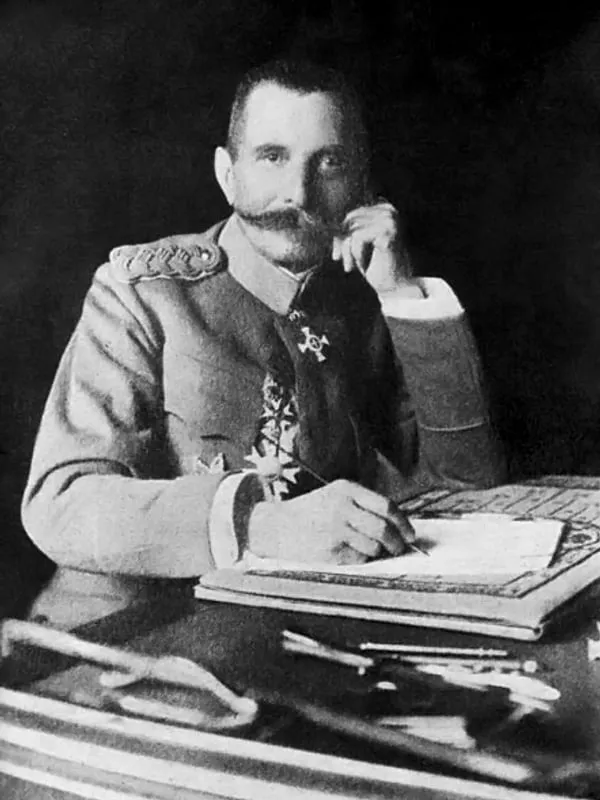
- Born:
- 16 July 1858, Miševići near Nova Varoš (Ottoman Empire, now Serbia)
- Died:
- 19 January 1945, Belgrade
- Author:
- Natalia
- Photo:
- autor nieznany, domena publiczna, Wikimedia Commons

Petar Bojović was the youngest of Serbia’s four vojvodas of the Great War and the only one who commanded both an army and the entire armed forces in it. In 1914 he led the First Army across the Sava into Syrmia and back to the Drina, until a wound put him out of action. In the autumn of 1915 he covered the line of retreat to Kosovo against the Bulgarians. For two and a half years, from the retreat through Albania to the summer of 1918, he was chief of staff of the Supreme Command, which rebuilt the army on Corfu and led it on the Salonika front. In the final offensive he again took command of the First Army and on 1 November 1918 entered Belgrade with it. He was a hard-working, stubborn soldier with no taste for politics, and the author of many military textbooks.
Before the war
He was born on 16 July 1858 (4 July by the Julian calendar) in the village of Miševići near Nova Varoš, into a poor peasant family, on land that still belonged to the Ottoman Empire. In 1867 the family secretly moved to Serbia and settled near Ivanjica. Thanks to his mother’s persistence and the help of benefactors the boy finished grammar school in Belgrade, and in 1875 he entered the artillery school. A year above him were Stepa Stepanović and Živojin Mišić, with whom he would later share the highest posts in the army. As a cadet he went to the wars with Turkey of 1876–1878, and in 1885, as a cavalry lieutenant, he fought in the lost war with Bulgaria.
He then made his career on the general staff. He trained in France, translated foreign military works and wrote several textbooks of his own. After the coup of 1903, which gave the throne to Peter I, he took over the operations department of the general staff, and then commanded the Morava Division in Niš. In 1906–1908, while Radomir Putnik was minister of war, he served as acting chief of the general staff, and from 1909 he commanded the cavalry division.
In the First Balkan War he became chief of staff of the First Army, formally commanded by Crown Prince Alexander. In practice it was he who directed the army in the victorious battles of Kumanovo and Bitola. After the first of them he was promoted to general. He was the military expert of the Serbian delegation at the peace talks in London, and then commanded the corps sent to besieged Shkodër. In the Second Balkan War, again as chief of staff of the First Army, he contributed to the victory over the Bulgarians on the Bregalnica. Later he took command of the troops in the territories conquered in Kosovo and Macedonia. According to Serbian biographers he opposed there the influence of officers from the secret organisation the Black Hand and demanded that the army serve the king and the state, not factions.
1914: Syrmia, the Drina and a wound
At the start of the war Bojović took command of the First Army. In August 1914, when the Serbs routed the Austro-Hungarian Fifth Army in the Battle of Cer, his troops took part in the final fighting for Šabac. According to Serbian biographers he was badly wounded in the leg there and his horse was killed under him. Even so he remained at his post. On 6 September, under pressure from Russia and France, his army crossed the Sava and entered Hungarian Syrmia. The Syrmia offensive lasted only a week, however. When the Austro-Hungarian forces struck across the Drina, Putnik ordered a return, and Bojović skilfully conducted the withdrawal behind the Sava. His divisions then made a forced march south and in the Battle of the Drina went straight into counter-attacks in the mountains, among others on Mačkov Kamen, where both sides suffered enormous losses.
For the following weeks the First Army held positions in the mountains above the Drina, under ever heavier artillery fire, to which it lacked the ammunition to reply. When at the beginning of November the Austro-Hungarians launched their third offensive, the army began to fall back, partly in disorder. His reopened wound prevented Bojović from commanding at close quarters. In mid-November, on the eve of the Battle of Kolubara, Regent Alexander handed the First Army to General Živojin Mišić, who led it to victory. Bojović remained without a posting for almost a year.
1915: Kosovo and the retreat
In the autumn of 1915, when Serbia was attacked simultaneously by Germany, Austria-Hungary and Bulgaria, he was remembered. The Bulgarian Second Army took Skopje and cut Serbia off from Salonika, and the weak Serbian units in Macedonia fell back towards Kosovo. According to some accounts, at the end of October Bojović took over command of these troops from General Damjan Popović. The Kačanik gorge and the roads to Kosovo had to be held so as not to close the army’s only line of retreat. At Kačanik the Serbs managed for a time to halt the Bulgarians, although an attempt to break through southwards towards the French failed. Bojović himself wrote years later that had the Bulgarians then broken through onto the Kosovo Field and cut off the retreat, there would have been neither Kajmakčalan nor Dobro Pole. In November his troops retreated through Prizren and Đakovica into Albania.
1916–1918: chief of staff
When in December the ailing Putnik, having reached Shkodër, asked to be relieved, Bojović became his successor, according to some sources at once, according to others in January 1916. On his shoulders rested the evacuation of the army, whose remnants marched on foot to the ports of Durrës and Vlorë, and then the rebuilding of the army on Corfu. In the spring the transport began of six divisions to Salonika. Bojović himself arrived there with part of the staff at the end of May. The question of command proved the hardest. The French wanted the Serbian army to be fully subordinate to the Allied commander-in-chief, General Maurice Sarrail, while the Serbs defended their independence, pointing out that they made up the largest part of his forces.
In the summer of 1916 the reconstituted army took over a sector in the mountains above the Moglena basin. In August the Bulgarians forestalled the Allies by striking at Florina, but the Serbs halted them at Lake Ostrovo, and in September went over to the attack. On 30 September they took Kajmakčalan, and in the Battle of the Crna won the heights which in November forced the Bulgarians and Germans to give up Bitola. This was bought with heavy losses that could not be made good. In the spring of 1917 Bojović had to disband one of the three armies. In May, during Sarrail’s failed offensive, he and the regent demanded that the attack be broken off when the Serbian Second Army had taken only a single hill. They judged that another bloody defeat could break an army in which many soldiers had been under arms for five years. Sarrail blamed the Serbs for the failure.
In June 1918 Bojović stepped down as chief of staff. According to Serbian biographers the reason was a dispute with the Allied commander-in-chief, General Adolphe Guillaumat, over whether the Serbs should take over a longer sector of the front, for which they lacked men. He swapped posts with Mišić: Mišić became chief of staff, and Bojović took over Mišić’s First Army. Mišić was to prepare the breakthrough of the front with the new Allied commander, General Louis Franchet d’Espèrey.
1918: with the First Army to Belgrade
On 15 September 1918, the day of the attack on Dobro Pole, the main blow was delivered by the Second Army of Stepa Stepanović together with two French divisions. Bojović’s First Army, with the Morava, Drina and Danube Divisions, stood on the left wing and was to move only once its neighbours had taken the summits. In the afternoon Bojović attempted an attack, although the Sokol ridge was still holding out, but he was repulsed. After dark he renewed the attack and this time met no strong resistance. By the morning of 16 September the Drina Division was already beyond the Gradešnica river. The breakthrough at Dobro Pole turned into the Vardar offensive, and on 26 September (13 September by the Julian calendar) Bojović received the rank of vojvoda. He was the fourth and last Serbian officer to receive it.
After the armistice with Bulgaria the leading role fell to his army. It advanced up the valley of the South Morava, retook Vranje, and on 12 October, despite exhaustion and warnings from the Allied command, took Niš from the German and Austro-Hungarian divisions that were meant to halt the pursuit. On 1 November 1918 Bojović’s soldiers entered Belgrade. The British official historian Cyril Falls wrote that the enemy’s last boats had barely reached the Hungarian bank when the vojvoda rode triumphantly into the capital.
After the war
After the war Bojović commanded the 1st Army District, and in March 1921, after Mišić’s death, he became chief of the general staff of the army of the Kingdom of Serbs, Croats and Slovenes. In December of the same year he was removed from the post and soon retired. Serbian historians link this to his proposal that the promotion of senior officers be reviewed by a military council, which would have limited the king’s power, and to the intrigues of court generals. In retirement he wrote his memoirs. In October 1934, as the only living vojvoda, he led the funeral procession of the assassinated King Alexander.
In April 1941, on the eve of the German invasion, the 82-year-old vojvoda was appointed deputy commander-in-chief of the Yugoslav army, but he played no part in the fighting. He refused to leave the country with the king and the government, and after the capitulation returned to Belgrade, where he spent the occupation in seclusion. According to Serbian biographers he refused to collaborate with the Reich’s envoy to the Balkans, Hermann Neubacher. He died in Belgrade on 19 January 1945, shortly after Partisans broke into his house, insulted him and took his sabre. In Serbia it was long repeated that he died as a result of a beating or torture, but according to a friend of the family he was not physically harmed, and the cause of death was pneumonia. He was buried quietly, without military honours, in the New Cemetery in Belgrade.
Assessment
Serbian historians place Bojović alongside Putnik, Stepanović and Mišić among the four great commanders of those wars. They stress his part in the victories of 1912, in covering the retreat in 1915, in the hard work of rebuilding the army after defeat, and in 1918 in the vigorous pursuit which in seven weeks took the First Army from the Greek border to Belgrade. Western historians of the war in the Balkans mention him less often, and attribute the breakthrough of 1918 above all to Mišić, Stepanović and Franchet d’Espèrey.
His time at the head of the staff is judged in different ways. Bojović firmly defended the independence of the Serbian army and husbanded its strength, which Sarrail and some French officers regarded as a lack of will to fight. His defenders reply that after the losses of 1914–1916 Serbia had nowhere left to find soldiers, and that caution preserved the army for the decisive year of 1918. With Mišić, with whom he had competed for years, he did not always agree. Mišić is said to have remarked, however, that although they quarrelled, Bojović was a great soldier and an even greater patriot.
Sources
Spotted a mistake?Report an error
Commanded in battles
(08)- 12 August – 15 December 1914Serbian campaign of 1914Balkan Front
- 6–14 September 1914Serbian offensive in SyrmiaBalkan Front
- 7 September – 4 October 1914Battle of the DrinaBalkan Front
- 5 October 1915 – 30 September 1918The Salonika FrontBalkan Front
- 17–19 August 1916Battle of FlorinaBalkan Front
- 5–22 May 1917Battle of the Vardar (1917)Balkan Front
- 15–17 September 1918Battle of Dobro PoleBalkan Front
- 15–29 September 1918Vardar offensiveBalkan Front
Mentioned in battles
(02)Often appears with
People who appear in the same events.