1918: The Salonika front
Battle of Dobro Pole
- Dates:
- 15–17 September 1918
- Front:
- Balkan Front
- Location:
- Mountain ridge between the peaks of Vetrenik and Sokol (including Dobro Pole, c. 1,870 m above sea level), in the range rising above the Meglena basin on the former Greek–Serbian border, and the Kozjak ridge to the north of it (today the border area of Greece and North Macedonia)On the battle map →
- Sides:
- Serbia and FranceLouis Franchet d'Espèrey, Živojin Mišić, Stepa Stepanović, Petar BojovićBulgaria and GermanyGeorgi Todorov, Friedrich von Scholtz, Kuno von Steuben, Ivan Rusev
- Result:
- Allied victory. In three days the Serbs and French took three successive Bulgarian defensive positions and opened a breach in the front through which the Serbian armies advanced towards the Vardar.
- Author:
- Natalia
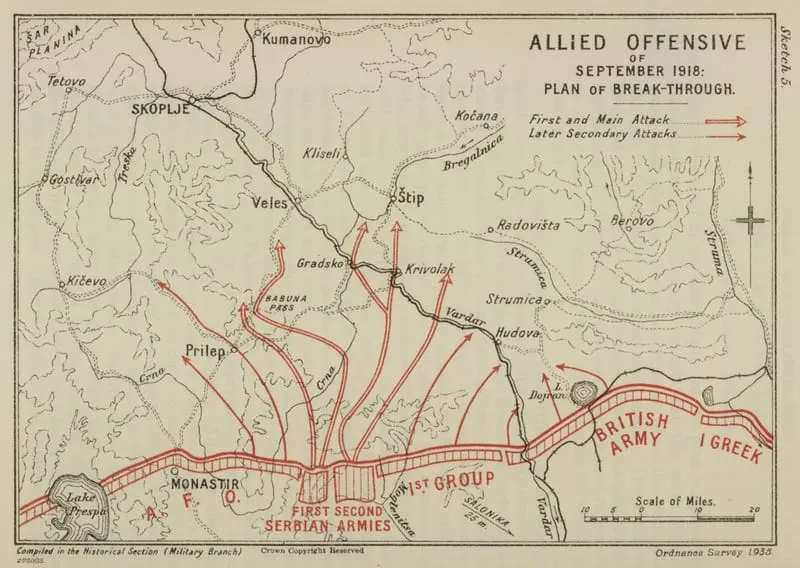
The Battle of Dobro Pole opened the last Allied offensive on the Salonika front. At 5.30 a.m. on 15 September 1918 two French divisions and the Serbian Šumadija Division went over the top against the Bulgarian trenches on a bare mountain ridge rising to almost two thousand metres above sea level over the Meglena (PL) basin. By evening they had taken the peaks of Vetrenik, Dobro Pole and Sokol, and during the night Serbian divisions passed through the breach, already marching on their own soil. By the evening of 17 September the second and third lines of defence had also fallen. The Bulgarians, convinced that no one would attack in such high mountains, lost the position on which the whole defence of Macedonia rested. Within two weeks the breakthrough at Dobro Pole had taken Bulgaria out of the war.
Name and dates
The name comes from the peak of Dobro Pole (Serbian Dobro polje, “good field”), which lay at the centre of the sector attacked. The French speak of the battle of Dobro Polje (bataille du Dobropolié), the Serbs of the battle of Dobro Pole or of the breakthrough of the Salonika front, and the Bulgarians of the breakthrough at Dobro Pole. According to the British official history by Cyril Falls, who adopted the French name, the Serbs also called the engagement the battle of the Moglenica, after the river flowing at the foot of the mountains. Polish literature has no established name, so we use the form “bitwa pod Dobrym Polem”, which corresponds to the Serbian one.
On this page we take the dates as 15–17 September 1918. The artillery preparation lasted the whole of 14 September, and the infantry attacked on 15 September. Following Falls, who cites French historians, we consider that the breakthrough battle ended on the evening of 17 September, when the Bulgarians lost their third position. From then on the Allies were merely pursuing the enemy. The English Wikipedia gives the dates 15–18 September, and Bulgarian studies often limit the battle to a single day, 15 September. Serbia was still using the Julian calendar at the time, so in Serbian documents of the period the assault falls on 2 September. Today 15 September is a state holiday in Serbia.
Background
Since the autumn of 1916, when the Serbs took Kajmakčalan, the front line here had run along a mountain ridge following the former Greek–Serbian border. In the spring of 1917 the Serbs had already attacked here once, during Sarrail’s May offensive, but took only a single hill. In the summer of 1918 the Serbian high command argued that this, in the highest mountains, was exactly where the blow should fall. General Adolphe Guillaumat began preparing a great offensive after the Greek victory at Skra di Legen, and his successor, General Louis Franchet d’Espèrey, adopted the Serbian plan as early as the end of June. Its co-author and most ardent advocate was the chief of staff of the Serbian army, Vojvoda Živojin Mišić.
The idea seemed insane. The ridge, known in various sections as the Moglena, rose to an average of over 1,350 metres, and on the Allied side it fell away so steeply that in the valley, two or three kilometres from the crest, the ground lay less than 200 metres above sea level. The Bulgarians sat on the peaks in shelters cut into the rock, from which they could observe the enemy’s entire rear. But the plan had its strengths. The Bulgarians did not expect an attack here, and their second and third positions were only partly fortified. Beyond the ridge the rivers and ridges ran parallel to the direction of the attack, towards the Vardar. The peaks to the west taken in 1916, such as Floka, were higher than the Bulgarian positions, so it was possible to look down and fire from above. Finally, six Serbian divisions were assigned to the attack, men used to the mountains who, after almost three years in exile, wanted to go home.
The objective was not the ridge itself. Behind it, about 55 kilometres from the front, lay Gradsko and Krivolak, where the Salonika–Niš railway, the narrow-gauge line to Prilep and the roads linking the two wings of the Bulgarian forces converged. Whoever held them would cut the enemy front in two. The British government agreed to the offensive only on 4 September.
Forces
The attack was led by the Serbian Second Army of Vojvoda Stepa Stepanović. Franchet d’Espèrey gave it two good French divisions, General Pruneau’s 17th Colonial and General Topart’s 122nd Infantry Division, on condition that they went in the first line, to break the front. In the first wave stood: on the right wing, facing Vetrenik, the Serbian Šumadija Division; in the centre, the 17th Colonial Division; and on the left wing, facing Dobro Pole and Sokol, the 122nd Division. Behind them waited the Timok Division and the Yugoslav Division, made up largely of volunteers from the South Slav lands of the Habsburg monarchy, which were to pass through the breach. To the left, the Serbian First Army of General Petar Bojović, with the Drina, Danube and Morava Divisions, was to move only once its neighbours had taken the peaks.
An unprecedented mass of artillery for these mountains was assembled for the attack: according to Serbian figures, about 580 guns and mortars. Heavy 105 and 155 mm batteries were hauled by tractors and on ropes to the summit of Floka, more than 2,300 metres above sea level, which sometimes took two weeks. The artillery of the whole operation was directed by the French General Bunoust. According to the official Serbian report, on the front of the two Serbian armies the Allies had a threefold superiority: 75 battalions against 26, 756 machine guns against 245 and 580 guns against 146. German historians, counting a wider sector, gave 56,000 Serbs and French against 33,000 Bulgarians and Germans. On the Salonika front as a whole the two sides’ forces were almost equal.
The sector under attack was held at the junction of two Bulgarian divisions: the 2nd Thracian under General Ivan Rusev (PL) and the 3rd Balkan. Between Sokol and Vetrenik stood four regiments, 12 battalions in all. Both divisions belonged to General Kuno von Steuben’s so-called German Eleventh Army, which was German only in name and staff, and which together with the Bulgarian First Army formed the army group of General Friedrich von Scholtz. The Bulgarian commander-in-chief, General Nikola Zhekov, was undergoing treatment in Vienna, and his duties were performed by General Georgi Todorov. Reserves were small and scattered, because the Bulgarians were in the habit of keeping almost all their forces in the front line.
Course of the battle
14 September. Franchet d’Espèrey left Mišić the choice of the day and hour for the bombardment to begin, stipulating that the artillery would open fire only in good visibility. In the morning the ridge was covered in mist, but it lifted, and Mišić, keeping watch with Prince Regent Alexander at an observation post, sent the armies the agreed signal. According to Falls it read “send fourteen officers and eight soldiers”, meaning fire on 14 September at eight o’clock. The bombardment lasted all day along the whole front from the Vardar to Bitola, so that the enemy would not discover where the blow would fall. In the evening patrols reported gaps in the wire and the first trenches destroyed in many places. Most of the Bulgarian batteries, however, survived the bombardment.
15 September. At 5.30 a.m., in the half-light before sunrise, the infantry went in. The Šumadija Division climbed the western slope of Vetrenik and took 300 prisoners and six guns, but secured the whole summit only in the afternoon. The French 17th Colonial Division took the Kravica plateau at eight o’clock and then beat off five Bulgarian counter-attacks. At one point the Bulgarians briefly retook Kravica, and according to Falls it seemed for a moment that the fate of the attack hung by a thread. At about 3.45 p.m. the French, together with the Serbs, took the summit of Kravički Kamen. The British liaison officer with the Serbian armies, General Plunkett, later wrote that without the help of the Šumadija men the attack would probably have collapsed.
On the left wing the 122nd Division advanced in two columns, because the gorge between Dobro Pole and Sokol was impassable. The Bulgarians stood up on the parapets of their trenches and pelted the attackers with grenades, and one machine-gun nest was destroyed only with a flamethrower. The summit of Dobro Pole, called the Pyramid by the French, fell after seven o’clock. The further fortifications behind it held out until two in the afternoon. Sokol held out longest: a French battalion was stopped 150 metres short of the summit, and a Serbian battalion from the First Army also failed to break through. Only after dark, when the Bulgarians began withdrawing their machine guns, was the summit stormed in the darkness.
Vojvoda Stepanović did not wait for Sokol to fall. At six in the evening the Yugoslav and Timok Divisions began passing through the French lines. The Serbian border ran exactly along the captured crest here, so Serbian soldiers entering the breach were standing on their own soil. According to Falls they ran out of the ranks to embrace French soldiers, and the columns went on singing the Marseillaise. Mišić ordered them to march all night so as not to lose contact with the enemy.
16 September. The Yugoslav Division attacked the second Bulgarian position on the Kozjak massif, a few kilometres north of Kravica. Accounts differ. According to French and Serbian sources the Serbs took the peaks of Kozjak in the morning and at noon, were driven off them in the afternoon and regained them before dusk. According to the German official history, which Falls considers more accurate, all the attacks were beaten off until the evening, and at about 7 p.m. the Bulgarians suddenly gave way, and disaster was averted only by the Saxon 13th Reserve Jäger Battalion. By nightfall the whole second position as far as the Crna Reka was in Serbian hands. On the left wing the First Army, which had tried unsuccessfully to move in the afternoon of 15 September, passed through the abandoned trenches after dark, and before noon on 16 September the Drina Division crossed the Gradešnica river.
17 September. The Bulgarians tried to make a stand on the third position. Their broken units in the breach were commanded by the German General von Reuter, who according to Falls stopped fleeing men pistol in hand. The position was undermined, however, by the commander of the 2nd Division himself, General Rusev. Bulgarian headquarters decided to recall him, but before his successor could arrive, Rusev, having learnt of a contingency plan for retreat, withdrew his troops behind the Crna Reka, without orders and without warning his neighbours. South of the villages of Polčište and Bešište a gap several kilometres wide opened up. Further east the Timok Division attacked Mount Blatec and the Bulgarians fled in disorder, and some battalions were already mutinying. By the evening of 17 September the third position had been lost, and the remnants of the Bulgarian divisions were falling back behind the Belašnica river.
Losses
According to the French official report cited by Falls, on 15 September the Šumadija Division lost about 500 men, the 17th Colonial Division 1,230 and the 122nd Division 790. Some of these losses fell on 14 September and the Bulgarian bombardment before the assault. The French General Revol gives 912 men for the 17th Colonial Division. Bulgarian studies, citing Allied data, speak of 3,300 killed and wounded on 15–16 September. On the first day the French took almost 3,000 prisoners and 33 guns.
Bulgarian losses were very heavy, because almost all their units stood in the front line. According to Bulgarian studies, of one of the regiments of the 3rd Division, the 29th Yambol, only 15 officers and 216 men withdrew to the rear. The English and Bulgarian Wikipedias give 2,689 killed and 3,000 prisoners, but these figures are hard to verify. By 22 September, as the Allies were reaching the Vardar, they had taken a little over 5,000 prisoners in all.
Significance
On 18 September, according to Falls, the breach in the Bulgarian front was about 50 kilometres wide and nearly 30 kilometres deep in the centre. Falls warns against the exaggeration of German authors, who explained the defeat by a complete collapse of morale in the Bulgarian army: at Dobro Pole the Bulgarians fought stubbornly and inflicted serious losses. Their weakness lay rather in the shallowness of their defences, the lack of reserves and poor relations with their German commanders. Once the front had broken, however, the shattered divisions were no longer fit to fight, and mutiny began to spread through one regiment after another.
The battle was the first step in Franchet d’Espèrey’s plan. Immediately afterwards the British and Greeks attacked at Doiran, while the Serbian divisions, at a fast pace and often without supplies, pushed north towards the Vardar, driving an ever wider wedge between the Bulgarian First Army and the Eleventh Army. Two weeks after the assault on Dobro Pole, Bulgaria signed an armistice. The battle went down in history as one of the boldest mountain offensives of the First World War and the greatest victory of the Serbian army, which, after its defeat in 1915 and the retreat through Albania, was returning home in these days.
Spotted a mistake?Report an error