Serbia · The Entente
Živojin Mišić
Commander of the Serbian First Army (1914–1915, 1916–1918), chief of staff of the Supreme Command (1918), vojvoda
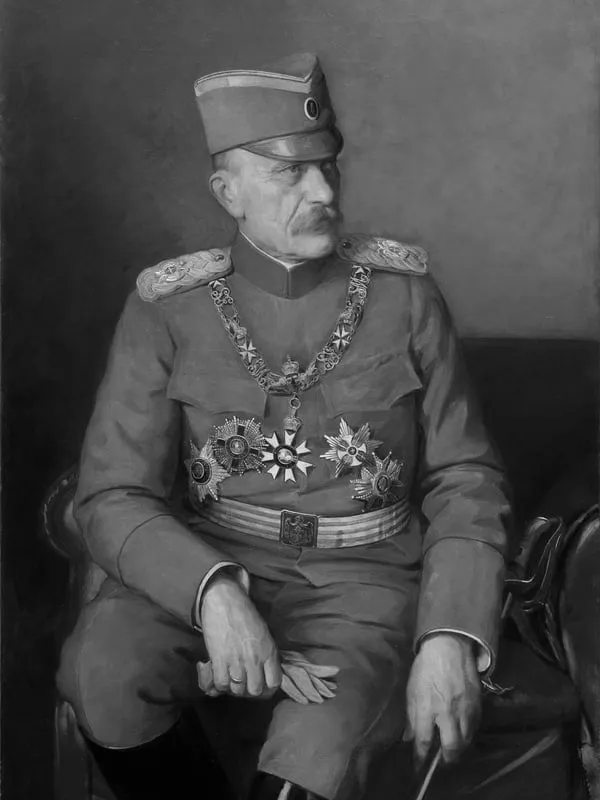
- Born:
- 19 July 1855, Struganik near Mionica (Serbia)
- Died:
- 20 January 1921, Belgrade
- Author:
- Łukasz Skowroń
- Photo:
- Uroš Predić, domena publiczna, Wikimedia Commons

Živojin Mišić was the most offensive-minded of the Serbian commanders of the Great War and the only one whose name is linked to both of Serbia’s great victories. In November 1914 he took over the shattered First Army, withdrew it deeper into the country against the wishes of the Supreme Command, and a few days later led the counter-attack that began the Austro-Hungarian defeat on the Kolubara. In 1918, as chief of staff of the Serbian army, he was co-author and the most ardent advocate of the plan for the breakthrough at Dobro Pole. Between those dates he was a commander who, in the worst moments of the retreat through Albania, preferred to keep fighting rather than give way, and who, after a quarrel over posts, found himself outside the army for several months.
Before the war
He was born on 19 July 1855 (7 July in the Julian calendar) in Struganik near Mionica, at the foot of the Suvobor mountains, the youngest of the thirteen children of a peasant family. As a child he herded cattle. He finished grammar school in Kragujevac and Belgrade, and in 1874 entered the artillery school, which was then the military academy. Petar Bojović studied there a year below him, and Stepa Stepanović in his own year; he was later to share the highest posts in the army with both. As a cadet and young officer he fought in the wars against Turkey in 1876–1878, and in 1885 he commanded a company in the lost war with Bulgaria. He then studied in Austria, joined the General Staff and for several years taught strategy at the academy.
His career was twice cut short. After the May Coup of 1903, in which conspiring officers murdered King Alexander Obrenović, he was regarded as too close to the overthrown dynasty, and in 1904 he was retired with the rank of colonel. In 1909, during the Bosnian crisis, the chief of staff Radomir Putnik brought him back into service and made him his deputy. Together they drew up the war plans. In the Balkan Wars Mišić was Putnik’s right hand at the Supreme Command; after the Battle of Kumanovo he was promoted to general, and in 1913, when the Bulgarians unexpectedly attacked on the Bregalnica, he persuaded Putnik to give battle on the front line instead of falling back. In the autumn of 1913, after a bloody clash with Albanian bands on the new border, he was again sent into retirement. Serbian biographers attribute this to the influence of officers of the Black Hand, who could not stand him.
He was living in Prokuplje when he was recalled in July 1914. Putnik was then taking a cure at an Austrian spa and was briefly detained in Hungary on his way home, so the preparation of the mobilisation fell to Stepanović, the acting chief of staff, and to Mišić as his deputy.
1914: the Kolubara
For the first months of the Serbian campaign Mišić worked at the Supreme Command in Kragujevac. In November Serbia’s position became desperate. The armies of General Oskar Potiorek had pushed the Serbs out of the mountains along the Drina and on 15 November took Valjevo, and the Serbian batteries were short of shells. Things were worst in the First Army, whose commander, General Petar Bojović, could no longer command because of a reopened wound. In mid-November Putnik handed this army to Mišić. According to Serbian biographers, Putnik told him on parting that the moment was critical and that only he could stop the army from falling apart.
Mišić found the army tired and demoralised, with three exhausted divisions. Under pressure from two corps of the Austro-Hungarian Sixth Army he fell back on the night of 21–22 November to the Suvobor ridge, near his home village, but on 28 November the enemy broke through this line as well. It was then that he took the decision that made him famous. He judged that defending every ridge would lead to the destruction of the army, and decided to fall back a dozen or so kilometres to positions in front of Gornji Milanovac, let the soldiers rest, replenish ammunition and only then strike. Putnik long objected, because this meant shortening the whole front and giving up Belgrade without a fight, but in the end he accepted the plan. The Austro-Hungarians took the withdrawal as a sign that the Serbian army was disintegrating, and they occupied the capital on 2 December.
On 1 December Mišić told his soldiers that the enemy’s difficult position must now be exploited and that he must be attacked everywhere, without a moment’s respite. He issued the orders for the attack on 2 December and only then informed the Supreme Command, asking that the other armies also join the attack. At dawn on 3 December the First Army struck the surprised Sixth Army, and on 5 December it retook Suvobor. Potiorek ordered a retreat, which turned into a rout, and on 15 December the Serbs returned to Belgrade. For this victory Mišić was given the rank of vojvoda, the highest in the Serbian army, in December 1914.
1915: defeat and dispute
Throughout 1915 the First Army stood in Mačva and on the Drina. When Mackensen’s offensive began in October, Mišić’s divisions held back the Austro-Hungarian bridgeheads on the Sava for several days and then fell back together with the rest of the army. Mišić proposed that, instead of patching holes all along the front, the whole First Army should strike the flank of the forces advancing up the Morava valley. Putnik agreed to this at the end of October, but the next day the Bulgarians linked up with the Germans on the Danube and the plan lost its point.
When the army had gathered in Kosovo and contact with the government and the Supreme Command had broken down, councils of the army commanders were held at Peć at the turn of November and December. Mišić was the only one there to favour a last counter-attack. According to Serbian accounts he said that they must move forward and see who they were running from, and that if this failed, envoys should be sent to the enemy. The other commanders decided that the order for the retreat through Albania had to be carried out. His words about negotiations were later held against him, although his defenders stress that he treated them as a last resort after a failed attack.
The First Army marched through Montenegro and at the beginning of January 1916 reached Scutari. Mišić was exhausted and ill there, but the dispute over posts mattered more. In place of the ailing Putnik, Bojović, who was younger than Mišić, became chief of staff. Mišić took sick leave, handed the army over to Colonel Miloš Vasić and on 14 January sailed for Italy. Serbian biographers consider this largely a protest. At the beginning of March 1916 he was formally removed from command of the army.
1916: Bitola
He spent several months in Italy and France. In April he was the guest of Joffre at headquarters in Chantilly, where he was received as the victor of the Kolubara, the “Serbian Marne”. He then returned to Corfu, where he waited several months for a posting. When the Serbian army returned to the front in Macedonia and in September 1916 the offensive of General Maurice Sarrail began, he was summoned to Salonika and again given the First Army, while Vasić took over the Third Army.
In the autumn his army fought in the mountainous bend of the Crna. In the Battle of the Crna and Bitola the Serbs pushed back the Bulgarians, and the German battalions sent to help them, step by step, in snow, mud and under constant fire. On 18 November the Serbian Danube Division took Hill 1378, the highest point of the bend, and the next day the Allies entered Bitola. It was the first piece of Serbia recovered after a year of exile.
Throughout 1917 the front stood still. The First Army held positions in the mountains east of the Crna, and its commander prepared plans for an offensive which Sarrail and his superiors kept putting off.
1918: Dobro Pole
In the spring of 1918 the new Allied commander-in-chief, Adolphe Guillaumat, demanded that the Serbs take over a longer sector of the front. The chief of staff, Bojović, protested and resigned. At the end of June 1918 the two vojvodas swapped posts: Mišić became chief of staff of the Supreme Command, and Bojović took over his First Army. Formally the army was commanded by the regent Alexander, but the actual direction of operations lay with the chief of staff.
Mišić inherited the Serbian plan for an attack in the highest mountains of the front, where the Bulgarians least expected it. He defended it against the sceptics and found an ally in the new Allied commander, General Louis Franchet d’Espèrey. At their first meeting he is said to have told him: “Just give us two divisions and guns, and our men will do the rest.” Franchet d’Espèrey shortened the Serbian sector, gave the Serbs two French divisions and heavy artillery, and left Mišić to choose the moment for the attack. On the eve of the offensive the chief of staff ordered his soldiers to “push boldly forward, without respite, to the last limits of the strength of men and horses”.
Mišić spent the night of 13–14 September with the regent at an observation post in the mountains. When the fog lifted in the morning, he sent the armies the agreed signal to open fire. On 15 September the Serbian Second Army of Stepa Stepanović, with two French divisions, took the ridges of Dobro Pole. In the following days Mišić pushed the armies forward without waiting for their neighbours, even when their flanks were exposed. According to Serbian accounts, when the regent asked what to do in view of the warnings from the Allied command, he replied: “Even if it means death, so long as we do not stand still.” The breakthrough turned into the Vardar offensive, and on 29 September Bulgaria signed an armistice.
After Bulgaria left the war, Mišić sent the First Army north up the Morava valley and left Bojović a great deal of freedom, smoothing over his disputes with the Allied command. On 1 November 1918 soldiers of the First Army entered Belgrade, seven weeks after the start of the offensive. On 13 November Mišić, on behalf of the Allies and together with the French general Paul Henrys, signed the Armistice of Belgrade with Hungary.
After the war
After unification in the Kingdom of Serbs, Croats and Slovenes he remained chief of staff of the Supreme Command, and in May 1920, after demobilisation, he became the first chief of the General Staff of the new state’s army. He was already seriously ill. He sought treatment in Paris, where he began writing his memoirs, which he took only as far as the Balkan Wars. He died in a Belgrade sanatorium on 20 January 1921 and was buried with state honours in the New Cemetery in Belgrade. He was succeeded by Bojović.
Assessment
Serbian historians place Mišić alongside Putnik and Stepanović, and often ahead of them, as the greatest commander of the wars of 1912–1918. They stress his courage in taking decisions against his superiors, his understanding of the Serbian soldier and his ability to raise his spirits at moments of collapse. In Serbia he has remained a national hero, and his family home is now a museum. Western historians of the war in the Balkans mention him less often. They usually credit the victory on the Kolubara above all to Putnik, although they appreciate the boldness of the withdrawal from Suvobor, and they regard the breakthrough of 1918 as the joint work of Serbs and French, with Franchet d’Espèrey at their head.
Other aspects of his career are less clear-cut. He was ambitious and touchy, and critics see his departure from the army in 1916, at its most difficult moment, as a sign of wounded pride. The proposal made at Peć to open talks with the enemy after a failed attack weighed on his reputation. The dispute with Putnik over the authorship of the victory on the Kolubara and the rivalry with Bojović have, moreover, divided Serbian historians as well.
Sources
Spotted a mistake?Report an error
Commanded in battles
(07)- 12 August – 15 December 1914Serbian campaign of 1914Balkan Front
- 16 November – 15 December 1914Battle of KolubaraBalkan Front
- 5 October 1915 – 30 September 1918The Salonika FrontBalkan Front
- 6 October – 4 December 1915Conquest of SerbiaBalkan Front
- 5 October – 11 December 1916Battle of the Crna and BitolaBalkan Front
- 15–17 September 1918Battle of Dobro PoleBalkan Front
- 15–29 September 1918Vardar offensiveBalkan Front
Often appears with
People who appear in the same events.