1918: The Salonika front
Battle of Doiran (1918)
- Dates:
- 18–19 September 1918
- Front:
- Balkan Front
- Location:
- Hills west of Lake Doiran (the P Ridge, Grand Couronné, Petit Couronné) and the Blaga range north of the lake, at the foot of the Belasica, in Bulgarian-occupied Macedonia (part of the Kingdom of Serbia), close to the Greek borderOn the battle map →
- Sides:
- United Kingdom, Greece and FranceGeorge Milne, Henry Fuller Maitland Wilson, Charles Briggs, Emmanouil ZymvrakakisBulgariaStefan Nerezov, Vladimir Vazov
- Result:
- Bulgarian victory in the field. The Greeks took only the forward position by the lake, and the Allies lost over 7,000 men. The attack nevertheless pinned down the Bulgarian First Army, which on 21 September, after the front had been broken further west, abandoned its positions of its own accord.
- Author:
- Łukasz Skowroń
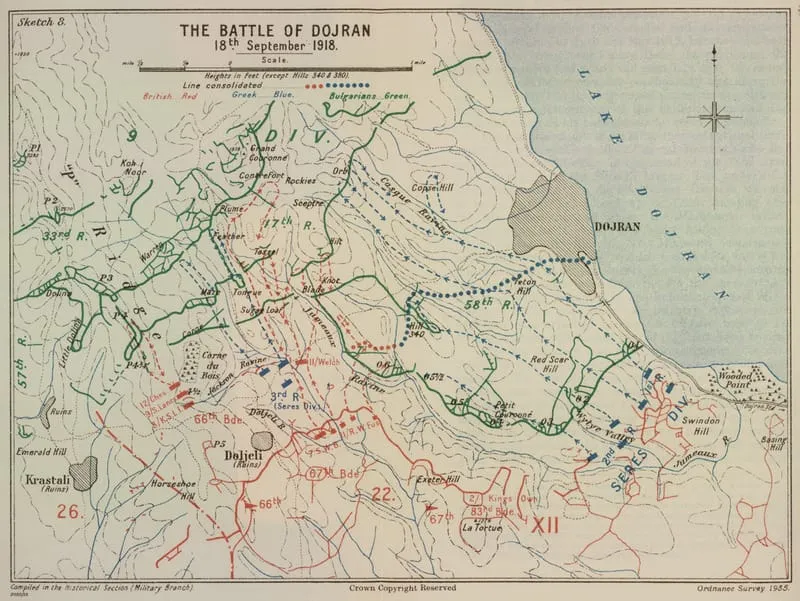
The Battle of Doiran was the British and Greek part of the great Allied offensive on the Salonika front in September 1918. Three days after the Serbs and French broke the front at Dobro Pole, General George Milne’s British Salonika Army and two Greek divisions attacked the most strongly fortified sector of the Bulgarian front: the hills west of Lake Doiran, for which the British had already fought in vain in the spring of 1917, and the Blaga range north of the lake. For two days, 18 and 19 September, the attackers forced their way into the Bulgarian trenches and were thrown out of them. They lost over 7,000 men and took only the forward position right by the lake. The strategic aim was nevertheless achieved: the Bulgarian First Army could not send reinforcements to the threatened sector west of the Vardar, and two days later, as the breach in Macedonia kept widening, it abandoned of its own accord the positions that no one had managed to take from it.
Name and dates
The British Battles Nomenclature Committee called this fighting the “Battle of Doiran 1918” and limited it to 18 and 19 September. This is also how it is described in the British official history of operations in Macedonia (Falls). At the same time the British chronology of the war includes it in the wider “Battles of Monastir and Doiran”, dated 18–24 September; this is the name for the whole British and French part in the offensive outside the main Serbian axis of advance. In Bulgaria the defence of this sector went down in history as the “Doiran epic”, and the fighting of September 1918 is its third and last battle, after the engagements of August 1916 and spring 1917. Bulgarian studies count the battle from 16 September, when the artillery bombardment began. Greece was still using the Julian calendar at the time, so in Greek documents the days of the assault are 5 and 6 September.
Background
The plan of the offensive was prepared by the new Allied commander-in-chief in Macedonia, General Louis Franchet d’Espèrey, who had taken command in June. The main blow was to be struck by the Serbs and French in the Moglena mountains. On 24 July the British received their instructions: once the main attack had begun, they were to push the Bulgarians off their positions east of the Vardar and cut their roads to Strumica. First, however, the P Ridge and the hills between it and the lake had to be taken. Franchet d’Espèrey recommended a strong frontal attack west of the lake, preceded by a bombardment, and a simultaneous surprise attack on the Blaga range, a spur of the Belasica running down to the northern shore of the lake. He placed at Milne’s disposal the two best Greek divisions of the National Defence Corps, the Serres Division and the Cretan Division, which had recently distinguished themselves at Skra di Legen, as well as three batteries of Greek howitzers, a French armoured train with two 190 mm guns and a regiment of Zouaves. The British government agreed to the offensive only on 4 September, but Milne had been preparing it since August. Two brigades of the 22nd Division, which was to bear the brunt of the attack, trained in the rear for three weeks.
The Salonika Army was in poor condition. Battalions went into battle at an average of about 450 men. Malaria had plagued them for years, and at the beginning of September an epidemic of Spanish flu broke out in the 65th Brigade, so severe that the brigade had to be replaced by the 77th Brigade from the 26th Division. Staff officers of XII Corps also fell ill: during the preparations the chief of staff changed four times.
On the other side stood General Vladimir Vazov’s 9th Pleven Infantry Division, the best unit of the Bulgarian army, which had repulsed the British in 1917. Its positions had been further strengthened since then. British airmen said that even from the air one could see that this sector was far stronger than the rest of the front and resembled the German fortifications in France. The Bulgarians built dugouts, machine-gun nests and battery shelters of reinforced concrete. The division had four regiments in the line and a fifth in reserve, and according to Falls 122 guns, including 11 German batteries, and 164 machine guns. Its soldiers, well supplied thanks to the nearby railway, believed the position could not be taken. North of the lake, in the Blaga range, stood the 1st Macedonian Brigade with six battalions and 24 guns. The whole sector was commanded by General Stefan Nerezov, who after the defeat at Skra di Legen had replaced Dimitar Geshov at the head of the First Army.
For the attack west of the lake, General Henry Fuller Maitland Wilson’s XII Corps assembled 231 guns, stripping the rest of its front. Against the defenders’ 122 guns this was a smaller superiority than was thought necessary for such an assault, and above all there was a shortage of heavy howitzers capable of smashing concrete shelters. After two days of cutting the wire, on the night before the attack the artillery shelled the Bulgarian batteries with gas shells. The Bulgarians, equipped with new masks, fought in them without serious losses. According to Bulgarian sources the bombardment lasted from 16 September.
Course of the battle
18 September west of the lake
The attack began at 5.08 a.m. on 18 September. On the right wing, right by the lake, General Emmanouil Zymvrakakis’s Serres Division attacked with great dash. Within two hours it took the first line between Petit Couronné hill and the lake, the Doiran and Teton hills and the strongly fortified Hill 340, capturing several hundred prisoners. Its 1st Regiment went further and broke on to Orb hill, a spur of Grand Couronné already belonging to the main line of defence. In view of the failure on the left wing and Bulgarian counter-attacks, however, it had to return to the line of the Doiran and 340 hills, which the Greeks held.
To the left General Duncan’s 22nd Division attacked in three columns: the 67th Brigade, the Greek 3rd Regiment from the Serres Division and the 66th Brigade on the P Ridge. The Welsh battalions of the 67th Brigade took the O 6 work, but further on they ran into the remnants of their own gas and machine-gun fire. A battalion of the Welch Regiment reached its objectives and was driven off them. Lieutenant-Colonel Daniel Burges’s battalion of the South Wales Borderers advanced through clouds of smoke and dust to just below the summit of Grand Couronné, where, under fire from three sides, it was almost wiped out. Burges, wounded three times, was briefly taken prisoner by the Bulgarians and was later awarded the Victoria Cross. The Greek 3rd Regiment took two lines of trenches, but at about 10 a.m. a Bulgarian counter-attack took its gains back. On the narrow P Ridge the Cheshire battalion was held up at the first work, P 4½, lost its covering fire and was massacred together with its commander. The South Lancashire battalion following it lost almost two-thirds of its men and its commander too. The third battalion, the Shropshires, could not even get through the soldiers crowded on the ridge and withdrew.
The day’s balance was grim: the Greeks of the Serres Division held the forward position by the lake, and the 22nd Division had taken only O 6. All three battalions of the 67th Brigade had practically ceased to exist, the 66th Brigade had lost 857 men and the Greek 3rd Regiment over 1,200. According to Falls the Bulgarians lost 777 prisoners, 683 of them taken by the Greeks. General Nerezov, who had been in the front line in the morning, considered the attack repulsed and even proposed to the Bulgarian command a general counter-offensive towards Salonika. The German army group command rejected the idea.
18 September north of the lake
At the same time General Charles Briggs’s XVI Corps attacked the Blaga range. General Spiliadis’s Cretan Division first had to cross several kilometres of flat plain. At dawn its two regiments occupied the Bulgarian outposts without much resistance, but the British field artillery that was to support them had to come down from the mountains by a single narrow road and cross the plain in daylight under fire. The first Greek attack, made between 7.30 and 8 a.m., before the artillery preparation had ended, briefly broke into the Bulgarian line. In the afternoon, just before the second attack, Bulgarian shells set fire to the tall dry grass in front of one of the regiments and the flames drove its soldiers back. The other regiment again got into the trenches but was driven out of them, and after 4 p.m. the whole division withdrew. Communications between the Greeks and the British barely worked: the British brigade covering the Greek flank learnt of the retreat only shortly before midnight. The Cretans lost nearly 800 men.
19 September
Milne, urged by Franchet d’Espèrey to exploit the Serbian success, ordered the attack west of the lake to be renewed. The shattered 66th and 67th Brigades could now only hold the line. The assault was to be made by the 77th Brigade with its Scottish battalions, the sickness-weakened 65th Brigade, the French 2nd bis Zouave Regiment and two regiments of the Serres Division. The attack went wrong even before zero hour, set for 5.15 a.m. The Zouaves, moving up to their start positions in the dark, came under fire in a ravine, went to ground and took no part in the attack, although they were the ones who were to take the central part of the position.
In this situation General Duncan tried to halt the attack on the P Ridge, but none of the six runners he sent arrived in time. The King’s Own battalion, which was to take P 4½ and P 4, waited two minutes for the barrage to lift, then went forward through its own artillery barrage, took P 4½ and tried to push on, until salvoes from its own 203 mm howitzers and Bulgarian machine guns forced it back. It lost 233 men. The Scots of the 77th Brigade took the Sugar Loaf and Tongue hills and beat off three counter-attacks, in the last of them throwing captured grenades and stones at the Bulgarians, but with both flanks exposed and out of ammunition they withdrew at about 10.30 a.m. Their commander, Lieutenant-Colonel Falconar Stewart, was killed. The Greeks of the Serres Division again took Hilt hill and again lost it in hand-to-hand fighting. Shortly after 11 a.m. General Wilson reported to Milne that further attacks were not worth the losses, and Milne ordered the attack to be called off.
Losses
According to the British official history, the British units of XII Corps lost 3,489 killed, wounded and missing in the two days, of which the 22nd Division alone, with its attached units, lost 3,320. Some battalions lost over 70 per cent of the men who went into the attack. The Serres Division lost 2,751 men, the Cretan Division 777 and the British units of XVI Corps 86. In all, excluding the unknown losses of the Zouaves, this comes to over 7,100 men; more than 500 of them were taken prisoner by the Bulgarians, who soon afterwards had to release them. Official Greek figures give somewhat lower losses of their own, about 3,400 men, and in various studies British losses range from about 3,200 to 3,900. According to the Bulgarian historian Colonel Nedev, cited by Falls, the Bulgarians lost 83 officers and 2,643 men on the sector from the lake to the P Ridge on 16–19 September, including prisoners. Falls estimates that their total losses did not exceed 3,000. In the two days the Allies took nearly a thousand prisoners, almost all of them by the Greeks.
Three British battalions, the 12th Argyll and Sutherland Highlanders, the 12th Cheshire and the 7th South Wales Borderers, received the French Croix de Guerre for this fighting, a very rare distinction for British units.
Significance
For the third time the Bulgarians had held their positions at Doiran. Falls attributes the defeat above all to the machine guns, which the too thin barrage failed to silence, the lack of heavy guns to smash the shelters, the exhaustion of the sick British soldiers and the haste with which the Greek divisions, which knew neither the ground nor British methods, were thrown into battle. He also judged that the British had underestimated the Greeks, whose dash surprised them, and that a heavier blow along the lake shore might have had a better chance than an assault on the almost impregnable P Ridge. The commander of the French Army of the Orient, General Paul Henrys, who saw this battlefield a few months later, called the position the most terrible he had ever seen.
The battle was not in vain, however. The attack pinned down a strong concentration of Bulgarian infantry and artillery between the Vardar and the lake and drew reserves there. According to Falls only one regiment from this sector was later sent to fight the Serbs. Meanwhile the breach west of the Vardar was growing. On 20 September Nerezov received orders to prepare a retreat, and on the morning of 21 September the British heard the explosions of dumps being blown up. The Bulgarian columns fell back along the road through Kosturino towards Strumica, bombed incessantly by aircraft of the Royal Air Force, and on 22 September the Allies occupied the abandoned positions for which they had been fighting for three years. For the Bulgarians the defence of Doiran remained the symbol of an army undefeated in the field, whose fate was decided elsewhere. Vazov became a national hero. A few days later Bulgaria asked for an armistice.
Spotted a mistake?Report an error