1917: The Salonika front
Battle of Doiran (1917)
- Dates:
- 24 April – 9 May 1917
- Front:
- Balkan Front
- Location:
- Hills west of Lake Doiran, between the lake and the Vardar (Petit Couronné, Grand Couronné, the P Ridge), in Bulgarian-occupied Macedonia (part of the Kingdom of Serbia), close to the Greek borderOn the battle map →
- Sides:
- United KingdomGeorge Milne, Henry Fuller Maitland WilsonBulgaria and GermanyDimitar Geshov, Vladimir Vazov
- Result:
- Bulgarian victory. The British took only the first line of trenches on a narrow sector by the P Ridge, and in two night attacks lost about 5,000 men, several times more than the defenders.
- Author:
- Natalia
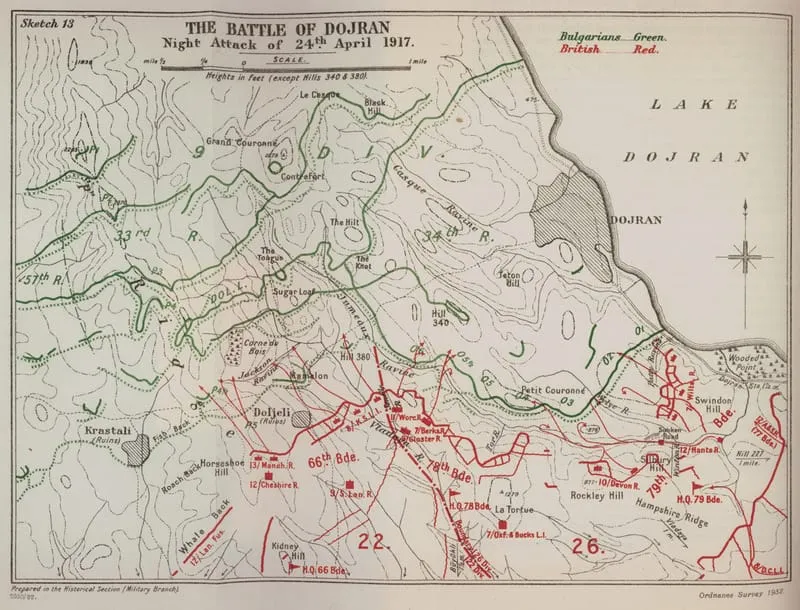
The Battle of Doiran was the British part of the spring offensive that the Allied commander-in-chief in the Balkans, General Maurice Sarrail, planned along the whole Macedonian front. General George Milne’s British Salonika Army was to attack west of Lake Doiran, at the most strongly fortified point of the Bulgarian front, and pin down enemy forces there ahead of the main attack by the French, Serbs, Italians and Russians further west. The British attacked twice, on the night of 24/25 April and on the night of 8/9 May 1917. Each time the Bulgarian artillery shattered their battalions in the deep ravines in front of the positions. Only a few advanced trenches on the P Ridge were taken, and the rest of Sarrail’s offensive also failed.
Name and dates
The British Battles Nomenclature Committee named this fighting the “Battle of Doiran 1917” and confined it to two attacks: 24–25 April and 8–9 May. These are the dates used by the British official history of the operations in Macedonia (Falls), and these are the dates used on this page. In Bulgaria the defence of this sector went down in history as part of the “Doiran epic”, and the 1917 fighting is usually called the Second Battle of Doiran: the first was the fighting of August 1916, the third the defence of September 1918. Bulgarian accounts date the battle from 22 April, the start of the British bombardment. Falls states that wire-cutting began on 21 April and that the shelling continued for several days after 9 May. The British chronology of the war, on the other hand, calls the parallel attacks west of the Vardar the “Battle of the Vardar”.
Background
Sarrail had been planning a great offensive since the winter. When his plan reached London, the Chief of the Imperial General Staff, General William Robertson, asked Milne whether it had been agreed with him. It turned out that it had not, but Milne had no intention of objecting. On a front some 145 kilometres long he could carry out only one serious attack, and he preferred to make it at Doiran rather than in the valley of the Struma. There the ground flooded in winter, and from June malaria threatened. At Doiran the enemy was dug in even better, but the artillery could support the infantry more effectively, and a success would make a greater impression on the Bulgarians. At the Calais conference in February the Allies decided that defeating the Bulgarian army was not a realistic aim for the time being, and that the troops at Salonika were to pin down the enemy and seize any opportunity. The French government nevertheless approved Sarrail’s plan, and Milne began preparations. West of the Vardar the French won a little ground around Bitola in March, and from 17 March the Bulgarians deluged the British lines at Doiran with shells, for the first time on this front including gas shells.
The ground west of the lake was among the most difficult in all Macedonia. A few kilometres from the shore ran a steep ridge rising to over 600 metres. The French, who had held this sector earlier, had marked its summits as Piton 1, Piton 2 and so on. On maps this was shortened to P 1, P 2, and the whole ridge was called the “P Ridge”. Between it and the lake lay a chaos of hills cut by deep ravines. The largest, called the Jumeaux by the British, was about 120 metres deep and ran in front of the Bulgarian trenches for over two kilometres. Everything was dominated by the summit of P 2 and the hill of Grand Couronné. From them the Bulgarians could see British trenches, batteries and roads as far as the horizon. The soldiers felt that their whole lives were spent under the eye of the enemy.
The positions were built first by two German divisions, and from 1916 by the Bulgarians. Trenches were cut into the rock, and in some places the dugouts were covered with a metre and a half of concrete. The sector from the Vardar to the lake was defended by the 9th Pleven Infantry Division, whose command had been taken over in March 1917 by Colonel Vladimir Vazov, an artilleryman. It was part of the Bulgarian 1st Army of General Dimitar Geshov, subordinate to a German army group which at the end of April General Otto von Below handed over to General Friedrich von Scholtz. On the division’s right wing, by the Vardar, stood the German 9th Jäger Regiment. According to the Bulgarian historian Colonel Nedev, cited by Falls, the front from the Vardar to the lake was covered by 147 German and Bulgarian guns, including 50 heavy ones, and at night it was lit by 33 searchlights. The Bulgarians knew what was coming. In April they received reinforcements: a regiment from the Crna front and an infantry battalion.
Preparations
Milne assigned the attack to General Henry Fuller Maitland Wilson’s XII Corps. Wilson wanted to take three successive Bulgarian lines as far as Grand Couronné, but Milne ordered that for the time being only the first be taken: the works between the lake and the hill of Petit Couronné, Hill 380, the hill called the Mamelon and the most advanced work on the P Ridge, marked P 4½. The 26th Division was to attack on the sector from the lake to the Jumeaux ravine and the 22nd Division further west, while the 60th Division by the Vardar was to carry out a raid. The attack was planned for night-time, because by day the Bulgarians saw every movement. Milne warned against a short, violent bombardment immediately before the attack, which would give away the hour of the assault, and stressed the importance of counter-battery fire.
The date kept slipping. Milne was ready in the first week of April, but blizzards, avalanches and landslides in the mountains west of the Vardar forced the French to delay. The main attack was put back from 8 to 15 and then to 26 April. The British were to go in two days earlier. On 19 April, at the Saint-Jean-de-Maurienne conference, Prime Minister David Lloyd George told the French that if there was no clear success this time, Britain would have to reduce its forces in Macedonia. On 21 April the British artillery began cutting the wire.
Course of the battle
The attack of 24–25 April
On the morning of 24 April a Bulgarian deserter came over to the British. He said that his battalion had been told to expect an attack that evening at about 8 p.m. Milne decided not to change the plan. At 9.45 p.m. the infantry went over to the assault.
On the right wing the 79th Brigade of the 26th Division suffered a complete defeat. The Bulgarians, forewarned, laid down a barrage before the British reached their jumping-off positions. Heavy shells, including those of a German battery of 150 mm naval guns, fell on the floor of the Jumeaux ravine with extraordinary accuracy. The Wiltshire battalion by the lake ran into uncut wire and machine-gun fire. The Devon battalion took a work on the eastern slope of Petit Couronné, but fire cut it in two and only two companies reached the objective. The Hampshire battalion was held up in the ravine, and its wounded commanding officer could not lead his men forward. To their left the 78th Brigade took some of the trenches, and the Worcestershire battalion beat off counter-attacks until dawn. Reports reached the headquarters late and were contradictory, and reinforcements were fed into the fight “in driblets”. At about 4 a.m. the divisional commander, General Gay, called off the planned renewed attack, and the units that had held on in the Bulgarian trenches withdrew before dawn.
On the left wing the 66th Brigade of the 22nd Division, with the Shropshire and Manchester battalions, succeeded. Its men deployed out of reach of the Bulgarian barrage, crossed the parapet at 9.45 p.m. against little resistance and took Hill 380, the Mamelon and P 4½. They dug in not on the captured positions but behind them, which the Bulgarians did not expect. Counter-attacks on 25, 26 and 28 April were beaten off. The 60th Division’s raid by the Vardar achieved nothing, because the Bulgarians had withdrawn to their second line.
The pause
The British attack was meant as a prelude to the main blow west of the Vardar, but on 26 April Sarrail informed Milne that the bombardment would not begin until 28 April, and the attack would follow when the preparation was sufficient. The War Office in London was alarmed by the failure, the losses and yet another delay. On 4 and 5 May, at a conference in Paris, Lloyd George pushed through a decision to reduce the forces at Salonika: from 1 June one division and two cavalry brigades were to begin withdrawing, unless the offensive brought exceptional success. The French government at the same time agreed to order Sarrail to attack as soon as possible. Milne decided to carry on. He believed that the difficult task had a reasonable chance if the mistakes of April were avoided.
The attack of 8–9 May
The second assault was set for 9.50 p.m. on 8 May, under a bright moon. This time the 26th Division was to straighten the line between the lake and Petit Couronné, while the 22nd Division was only to feint. The first wave of the 77th Brigade was made up of Scottish battalions: the Scottish Rifles, the Argyll and Sutherland Highlanders and the Black Watch. They crossed no man’s land without heavy losses, but in the Bulgarian trenches they met bombs, machine guns and uncut wire. The Argylls fought their way through to the final objective but were cut off and withdrew after half an hour. All the officers who had gone with them were killed or wounded. At 12.20 a.m. on 9 May the Oxford and Bucks battalion attacked Petit Couronné, followed by companies of the Berkshires. Some of the men broke into the Bulgarian work and held on in it until morning, but both neighbouring positions remained in Bulgarian hands. Before noon on 9 May the divisional commander ordered the withdrawal of about 250 men still clinging to the summit. That night the 22nd Division took the Roach Back ridge, and the 60th Division several undefended hills in front of its line.
West of the Vardar the main attack began at dawn on 9 May. In the bend of the Crna the French 16th Colonial Division, a Russian brigade and the Italians took some positions but had been driven out of them by evening. The Serbs took Hill 1824 in the Moglena range. Further attempts on the Crna and at Bitola also failed, the Serbs demanded that the offensive be halted, and on 21 May Sarrail issued such an order. Milne cancelled the minor operations still planned, because in line with the decisions of the conference the 60th Division was to leave Macedonia.
Losses
According to the XII Corps return for the week ending 29 April, which covers the bombardment, the attack and the counter-attacks, the British lost 3,163 killed, wounded and missing, of whom the 22nd Division lost only 766. Most of the missing had been killed. On the night of 8/9 May losses came to 1,861 men, including 1,743 in the 26th Division, which in the two attacks lost 3,888 men in all. Together this makes about 5,000, and in the following days there were further casualties from shelling. The British took only 22 prisoners. Bulgarian sources give much higher figures, as many as 12,000 killed, wounded and captured, and according to them the defenders buried over 2,000 enemy bodies. Bulgarian losses were much smaller. Colonel Nedev gives 835 killed, wounded and missing on 24–25 April and 489 in the second attack. Vazov wrote of about 2,000 men lost by the division in the whole battle, including the sick. Sarrail’s entire spring offensive cost the Allies about 14,000 men.
Significance
The Battle of Doiran was the costliest British engagement in Macedonia up to that time. The British official history attributes the outcome above all to the Bulgarian artillery, which could not be neutralised. To this were added the lack of communication with the units in the enemy trenches, the slow commitment of reserves, a night attack over difficult ground, and too few guns and too little ammunition. Heavy howitzers that could have smashed the concrete shelters were especially lacking. Milne later admitted in a letter to Robertson that in mountain fighting the advantage lay with the Bulgarians. The Bulgarian soldier, capable, tough and well trained, proved a better opponent than the Allies had thought.
For the Bulgarians the defence of Doiran became a source of pride. Vazov, whose division bore the name “Pleven”, was soon promoted to general and became a hero in Bulgaria. The failure of the whole offensive strengthened the conviction in London that the Salonika expedition was pointless. As early as June part of the British force began to be withdrawn to Egypt and Palestine. The front at Doiran fell quiet for sixteen months. The British and Greeks attacked the same hills again in September 1918 and again suffered heavy losses, but a few days later Bulgaria, broken through further west, asked for an armistice.
Spotted a mistake?Report an error