1918: The Salonika front
Battle of Skra-di-Legen
- Dates:
- 30 May 1918
- Front:
- Balkan Front
- Location:
- The rocky Skra-di-Legen massif (Bulgarian Yarebichna) above the village of Lyumnitsa (now Skra), between the two arms of the river Lyumnitsa, west of the Vardar and east of the Kožuf range, on the Greek–Macedonian border (now northern Greece)On the battle map →
- Sides:
- Greece, France and United KingdomAdolphe Guillaumat, Emmanouil Zymvrakakis, Dimitrios IoannouBulgariaDimitar Geshov, Ivan Bonchev
- Result:
- Allied victory. The Greeks took the Bulgarian positions on a front about 12 km long and up to 2 km deep, destroyed the 49th Infantry Regiment and captured between 1,800 and over 2,000 prisoners.
- Author:
- Natalia
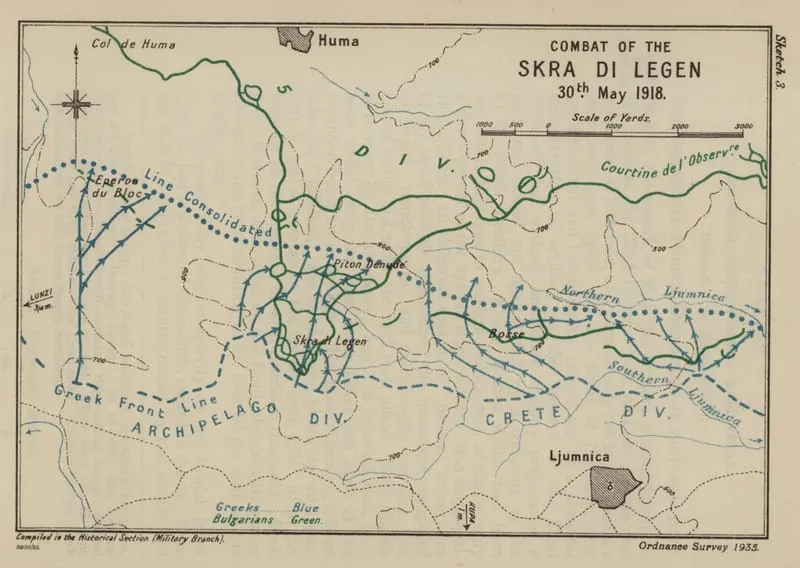
The Battle of Skra-di-Legen was the first large attack by the Greek army on the Salonika front and the last major engagement in Macedonia before the great Allied offensive of September 1918. At dawn on 30 May 1918 two regiments of the Archipelago Division and a regiment of the Serres Division, with units of the Crete Division on the right wing, attacked a strongly fortified Bulgarian salient on the rocky Skra-di-Legen massif. After two days of artillery preparation, in which the British took part alongside the French, they took the main heights in under an hour and a half, and the whole allotted sector by the afternoon. Bulgarian counter-attacks in the afternoon and during the night were repulsed. The success was of little military but enormous political significance: it proved that the Greek army, divided for years by the quarrel between the King and Venizelos, could fight, and it raised the morale of the whole of Greece.
Name and dates
The name “Skra-di-Legen” comes from the Austrian 1:200,000 staff map, on which the hill was written in this strange, half-Italian form, as the Italian historian Luigi Villari observed. Under this name the battle entered the British official history and the chronology of the war, and in France the list of victories. The Greeks speak simply of the Battle of Skra (Μάχη του Σκρα), the Bulgarians of the Battle of Yarebichna, after the Bulgarian name of the peak. The nearby village of Lyumnitsa was later renamed Skra. There is no established name in Polish literature, so we adopt the form “bitwa pod Skra di Legen”.
On this page we adopt a single date, 30 May 1918. On that day the infantry attack went in at 4.55 a.m., and on that day all the objectives were taken. The British official history of the Macedonian campaign (Falls) calls the whole operation “the fight for the Skra di Legen, 30th May”. The artillery preparation, however, had been going on since 28 and 29 May, and the Bulgarian counter-attacks until the night of 30/31 May, so Greek accounts give the dates 29–30 May, and the English and Bulgarian Wikipedias 29–31 May. The British chronology of the war recorded the battle under 31 May. Greece was then still using the Julian calendar, so in Greek sources the day of the attack is 17 May.
Background
Greece entered the war as a whole in June 1917, when, after the removal of King Constantine, Eleftherios Venizelos took power in Athens. Before that only the troops of his provisional government in Salonika had fought at the front; from them the National Defence Corps had been formed, with three divisions: Serres, Crete and Archipelago. It was commanded by General Emmanouil Zymvrakakis, who in August 1916 had led the Venizelist coup in Salonika. The old royal army still had to be purged of officers loyal to Constantine, mobilised and trained. Many districts, especially the royalist Peloponnese, accepted conscription reluctantly. The British doubted whether the Greeks would make good soldiers, and the Greeks themselves, as Villari wrote, believed in their hearts that Bulgarians trained by Germans were worth more than Greeks trained by Frenchmen.
General Adolphe Guillaumat, who in December 1917 had replaced Sarrail as commander-in-chief of the Allied armies in Macedonia, rated the Greek army much more highly. He had long been thinking of an operation that would be a dress rehearsal for the future offensive, test the worth of the Greeks and the enemy’s power of resistance, and at the same time improve the front line. He chose the Bulgarian front line on a sector about 13 km long, from near the village of Lyumnitsa to the village of Lunzi at the foot of the Kožuf range, a dozen or so kilometres west of the Vardar and south-west of Gevgelija. The centre and key of this position was the rocky summit of Skra-di-Legen, which formed a salient jutting southwards. On the Greek side it fell away in an almost vertical wall, and the Bulgarian trenches there were very close to the Greek ones. The defenders had shelters cut into the rock that were proof against artillery fire, and numerous machine-gun posts rising in tiers up the slope. In the west, in front of the Bulgarian position on the ridge the French called the Éperon du Bloc, stretched a no man’s land more than three kilometres wide, which could not be crossed as long as the Bulgarians held Skra-di-Legen. According to Greek and Bulgarian accounts, the French had already fought for this salient in the spring of 1917, without lasting success.
Forces
The sector was held by the 49th Infantry Regiment of the 3rd Brigade of the Bulgarian 5th Danubian Infantry Division (PL), with the brigade’s 50th and 2nd Regiments on its flanks. The division belonged to the First Army of General Dimitar Geshov. According to Bulgarian sources the division was commanded by Colonel Ivan Bonchev. In the Bulgarian ranks there were also German specialists, mainly signallers.
For the attack Guillaumat chose soldiers of the National Defence Corps, withdrawn from the front at the beginning of April for training under French officers. The main blow was to be struck by the Archipelago Division of General Dimitrios Ioannou, made up of islanders from the Aegean. One of its regiments was then doing garrison duty in Athens, so it was replaced by the 1st Regiment of the Serres Division. On the right wing units of the Crete Division were to attack: according to Falls one regiment, according to Greek accounts the 7th and 8th Regiments. Greek and Bulgarian accounts state that about 14,500 infantrymen in all went into the attack. The French 1st African Marching Regiment stood in reserve, and the French also supplied flamethrower teams. The Greeks operated in the sector of the French General Gérôme, who according to Greek accounts directed the operation on the French side.
The artillery support was very strong. A mass of French guns was assembled here, to which the British added two 8-inch howitzers of the 424th Siege Battery, while six of their 60-pounder guns crossed to the right bank of the Vardar. According to some Greek accounts the attack was supported by 287 guns of various calibres in all. To conceal the objective of the attack, in the preceding days the artillery and raiding parties also harassed the Bulgarians in other sectors: on the right of the Greeks the French 122nd Division and the British beyond the Vardar, who on 28 May began a heavy bombardment on their front, and on the left the Serbian armies. On the evening of 28 May the French and Serbs carried out raids, and on the morning of 29 May the British 7th Battalion of the South Wales Borderers.
Course of the battle
On 29 May the Allied heavy artillery began destroying the Bulgarian fortifications. According to Greek accounts the bombardment began at five in the morning and lasted all day. At 4.55 a.m. on 30 May the Greek soldiers leapt out of their trenches, keeping close behind the creeping barrage that moved ahead of them. The attack was so fast that, according to Villari, the Bulgarian artillery opened its barrage only when the attackers were already well in front of their own trenches. The islanders of the Archipelago Division climbed the slopes of Skra-di-Legen and took the summit, and in two further bounds reached the final objective, a hill the French called Piton Dénudé. In the west they took the Éperon ridge, which was in their hands by 6.15 a.m. Greek accounts state that the whole massif had been taken by 6.30. Hundreds of Bulgarian soldiers were captured in their shelters, surprised and unwounded, because the first wave of attackers followed close behind the fire of its own guns.
East of Skra-di-Legen the Cretans crossed the southern arm of the river Lyumnitsa and took the high ridge between its two arms. Here the fighting was harder and, according to Falls, ended only in the afternoon. In all the Greeks took a labyrinth of trenches and shelters on a front about 12 km long and up to 2 km deep. The Bulgarian 49th Regiment was surrounded and almost completely destroyed. According to a Bulgarian account, only two of its twelve companies survived, and they saved the regimental colour.
The Bulgarians replied with heavy artillery fire, and in the afternoon and during the night they counter-attacked several times, especially against the positions taken by the Cretans. All the counter-attacks were repulsed. A stronger blow was expected in the following days, because the Bulgarians despised the Greeks and it was not believed that they would accept defeat at their hands. Defences were prepared, the Greek regiments were relieved by the French, and the Greeks went back to rest in the second line. The counter-attack, however, never came. Villari cites the memoirs of Paul von Hindenburg and other sources, according to which the soldiers detailed for the counter-attack refused to march.
Losses
According to Guillaumat’s brief report of 3 June, cited by Falls, 1,812 men were taken prisoner, including 33 officers and a number of German signallers. The French historian Colonel Bujac states that this figure does not include wounded prisoners and that about 2,500 were taken in all. According to him, 50 machine guns and 60 trench mortars were also captured, and 800 dead were found on the battlefield. Greek accounts speak of 2,063 prisoners, 12 guns and 32 machine guns, Bulgarian ones of 600 killed and 1,712 prisoners.
Falls puts Allied losses at 2,795 men, all but 136 of them Greeks. Greek tallies speak of 441 killed, about 2,200 wounded and 164 missing, the heaviest share of which, 338 killed and 1,777 wounded, fell on the Archipelago Division. Among the dead was Major Vasilios Papagiannis. Villari wrote in 1922 of Greek losses of some 500–600 killed and wounded, but Greek and British figures indicate that they were several times higher.
Significance
Falls called Guillaumat’s plan as bold as it was well thought out, because failure could have had a bad effect on a Greek army whose parts distrusted one another. The general had counted on the National Defence Corps and was not disappointed. He then advertised the victory with a showman’s skill. He sent Venizelos a telegram saying that this victory would fill the whole of Greece with justified pride. Greece did indeed ring with the news. The Venizelist soldiers were proud, and the old royal army, which was just then being mobilised in the royalist Peloponnese as well, took heart. Venizelos’s prestige rose markedly, and conscription, which had met resistance until then, went more smoothly from then on. “Though it was a fine feat of arms, few such small actions have caused so much stir,” wrote Falls. According to Villari, the Athenian cafés saw no difference between the Marne, the Somme, the Brusilov offensive and Skra-di-Legen.
The battle also had military significance. With part of the German troops leaving Macedonia and more and more signs of disintegration in the Bulgarian ranks, the Greek success convinced Guillaumat that he could abandon his former caution and prepare a real offensive. After the defeat Geshov lost command of the Bulgarian First Army and was replaced by General Nerezov, and Tsar Ferdinand I blamed the Germans for not helping to defend the Macedonian front.
Guillaumat had no time to exploit the victory. At the same time the Germans broke through the front on the Aisne and were approaching Paris, and Clemenceau wanted a general in the capital who would inspire confidence. On 9 June Guillaumat left for France in haste and secrecy to take command of the defence of Paris. His successor, General Louis Franchet d’Espèrey, received instructions from Paris to continue the series of operations “begun so successfully at Skra-di-Legen and in Albania”. The Greek success helped Venizelos persuade the new commander to give the Greek army a larger role in the offensive. When in September 1918 the Allies broke through the front at Dobro Pole and forced Bulgaria to capitulate, Greek divisions fought on several sectors of the front. The name of the battle also passed into history in France: as Falls bitterly noted, on the boards bearing the names of victories, displayed during the Paris victory parade on the Champs-Élysées on 14 July 1919, the only Macedonian names were Pogradec and Skra-di-Legen.
Spotted a mistake?Report an error