Serbia · The Entente
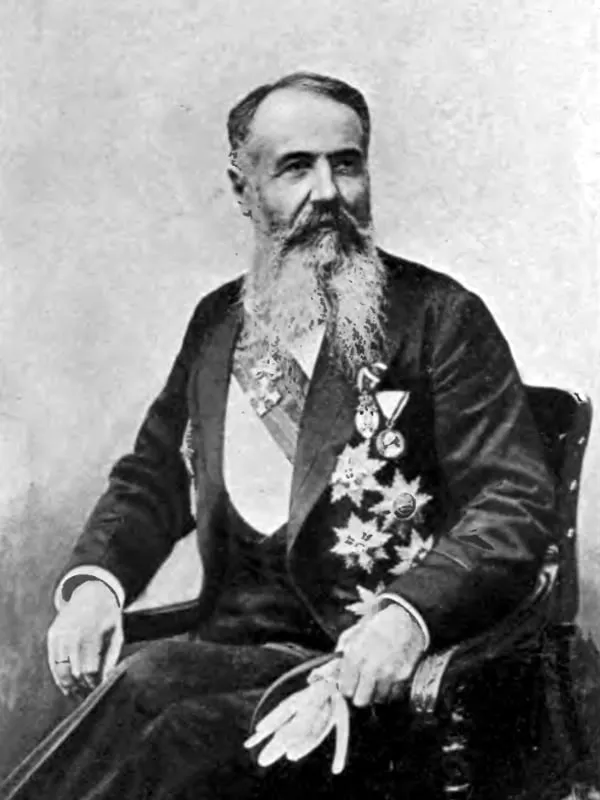
Nikola Pašić
Prime Minister of Serbia (1912–1918), leader of the People's Radical Party
- Born:
- 18 December 1845, Zaječar (Serbia)
- Died:
- 10 December 1926, Belgrade
- Author:
- Natalia
- Photo:
- Petrovic, Vojislav Maksim, 1885?-1934, domena publiczna, Wikimedia Commons

Nikola Pašić headed the Serbian government throughout the Great War, from the assassination in Sarajevo to the union with the South Slav lands of the Habsburg monarchy. Taciturn, cautious and distrustful, with a long grey beard that became his trademark, he had been the country’s most important politician since the 1880s and the undisputed leader of the Radical Party. It was he who answered the Austro-Hungarian ultimatum in July 1914, he who bargained with the Allies over the borders of a future Serbia, and he who in 1917 signed the declaration on Corfu on a common state of Serbs, Croats and Slovenes. To some he was the creator of Yugoslavia, to others a politician who from the start saw it above all as an enlarged Serbia.
Before the war
He was born in Zaječar in eastern Serbia, into a modest merchant family. His date of birth is uncertain: 18 December 1845 is most often given, but 19 and 31 December are also found. He studied in Belgrade and then, on a state scholarship, railway engineering in Zurich, where he came into contact with socialists and Russian Narodniks. He was an engineer only briefly. In 1878 he entered parliament, and in 1881 he co-founded the Radical Party, the first modern party in Serbia, which drew its support from the peasants and the petty bourgeoisie.
Under the Obrenović dynasty he was an enemy of the court. After the Timok Rebellion of 1883 he was sentenced to death in absentia, and he spent several years in exile in Bulgaria. After his return he was speaker of parliament, mayor of Belgrade and briefly prime minister. In 1899, after the attempt on the life of the former king Milan, he was again put on trial and reportedly survived thanks to the intervention of Russia and Austria-Hungary, but the forced testimony he gave against his own party was held against him for a long time. He took no part in the May Coup of 1903, but it was the Radicals who gained most from it. Under Peter I Pašić headed the government several times, weathered the customs war with Austria-Hungary and the Bosnian crisis, and from the autumn of 1912 led Serbia through the Balkan Wars, which almost doubled its territory.
The victories brought a new conflict, this time with the army. Officers of the secret organisation Black Hand, grouped around Colonel Dragutin Dimitrijević “Apis”, refused to leave the administration of conquered Macedonia to the civil authorities. In the spring of 1914 the dispute turned into a government crisis. Pašić stayed in power thanks to Russian support, parliament was dissolved and new elections were called for August. On 24 June the ailing king handed his powers to his son Alexander, who became regent.
July 1914
What Pašić knew of the preparations for the assassination in Sarajevo is disputed to this day. What is certain is that the assassins received weapons and help in crossing the border from men linked to the Black Hand and Serbian military intelligence. The education minister Ljubomir Jovanović claimed in 1924 that at the turn of May and June the prime minister had already told ministers about people who were setting off for Sarajevo. In the second half of June the Serbian minister in Vienna warned the joint finance minister Leon Biliński that the archduke’s visit might provoke some mad act. The warning, however, was so vague that nobody in Vienna took it seriously. Some historians see in this proof that Pašić knew and tried to prevent disaster without crossing Apis. Others believe his knowledge was hazy, and that the government did not control the officers in any case.
When on 23 July Austria-Hungary delivered its ultimatum, Pašić was away from the capital on an election tour and returned to Belgrade the next morning. The reply was prepared in under two days. Belgrade accepted most of the demands, some with reservations, but refused to allow Austro-Hungarian officials to take part in the investigation on Serbian territory and proposed submitting the dispute to arbitration. On 25 July, a few minutes before the deadline expired, Pašić personally handed the note to the minister Giesl, who broke off relations and left the same evening. The government had already ordered mobilisation and moved to Niš. Even Wilhelm II, reading the reply, concluded that every reason for war had fallen away.
1914–1915: war and war aims
In the first months of the war Pašić had above all to obtain ammunition for the army and keep the support of the Allies. Under Russian pressure he agreed to the offensive in Syrmia, which the chief of staff Radomir Putnik opposed. In September 1914 he concluded a secret agreement in Niš with the Albanian leader Essad Pasha Toptani, who with Serbian money and weapons formed a government in Durrës. In December, in the hardest days of the campaign, he brought the opposition into the government, and on 7 December he announced in parliament the so-called Niš Declaration: the aim of the war was henceforth the liberation and unification of all Serbs, Croats and Slovenes.
The year 1915 was spent in difficult talks with the Allies, who were trying to win Italy and Bulgaria over to their side at Serbia’s expense. As early as April Pašić asked the Entente capitals not to let the South Slav lands become an object of bargaining with Rome, but the Treaty of London promised Italy a large part of Dalmatia. In May Edward Grey assured him of Bosnia and Herzegovina, and in August the Allies listed Serbia’s future gains in return for ceding part of Macedonia to Bulgaria. Pašić, usually composed, is said to have lost patience at that point. In his reply of 1 September he agreed to some of the concessions but hedged them with conditions. When Bulgaria began to mobilise, he wanted to strike at it before it finished, and promised the Greeks Dojran and Gevgelija to persuade them to help. London and Petrograd, however, forbade an attack, and Athens refused to honour the alliance.
In the autumn the forces of August von Mackensen and the Bulgarians conquered Serbia. The government wandered from Niš to Kraljevo, Raška, Mitrovica and Prizren, and at the end of November crossed the mountains to Shkodër, where on 7 December Putnik reported to Pašić on the state of the shattered army. In mid-January 1916 the prime minister and ministers sailed to Brindisi, and from there to Corfu, which remained the seat of government until the end of the war.
In exile
A government without a state could act only through diplomacy. In the spring of 1916 Pašić accompanied the regent on a journey to Rome, Paris and London, and in May he went to Petrograd for talks with Nicholas II and the foreign minister Sergey Sazonov. He worked to ensure that the promises to Romania did not include the Serbian part of the Banat, and secured the creation in Odessa of a volunteer division of prisoners of war from Austria-Hungary. He forced through a Serbian rather than Yugoslav name for it, which alienated the émigrés of the Yugoslav Committee.
The darkest episode of these years was the Salonika trial. In the spring of 1917 Apis and a group of Black Hand officers were accused of plotting against the regent. A military court in Salonika sentenced several of them to death, and on 26 June Dimitrijević and two other condemned men were shot. Historians agree that the charges were largely fabricated. They disagree, however, over whether the main role was played by Alexander, who wanted to get rid of inconvenient officers, or also by Pašić, for whom Apis had been a rival since 1914 and a dangerous witness in the Sarajevo affair. Most writers believe that the prime minister at the very least did nothing to stop the trial. In 1953 a court in Belgrade rehabilitated the condemned men.
After the fall of tsarism Serbia lost its chief protector, and Pašić had to come to terms with the Yugoslav Committee. On 20 July 1917 he signed with its chairman Ante Trumbić the Corfu Declaration, which announced a common kingdom under the Karađorđević dynasty. The question of the constitution was, however, deferred to a constituent assembly, and Pašić consistently defended a centralised state. The views of Montenegro and its king, Nicholas I, were ignored. In the autumn of 1917 Pašić was among the Allies who complained about the commander-in-chief in Macedonia, General Maurice Sarrail. In December the French recalled him. In 1918 he sought the support of the United States, which after Russia’s exit from the war became an important partner for Serbia.
1918: unification
When in the autumn of 1918 the Salonika front collapsed and the Habsburg monarchy disintegrated, Pašić fought above all to ensure that unification took place around Serbia and not as a union of equals. At the Geneva conference on 6–9 November, under French pressure, he agreed to a joint government of Serbia and the National Council in Zagreb, but the agreement collapsed after a few days when the government in Belgrade resigned. On 16 November Pašić formed a new coalition cabinet. The Kingdom of Serbs, Croats and Slovenes was proclaimed on 1 December by the regent, while Pašić was abroad. On 20 December Alexander, who disliked him, entrusted the task of forming the first joint government to Stojan Protić.
After the war
Pašić headed the new state’s delegation at the Paris Peace Conference. He failed to obtain Rijeka or most of Carinthia, but he negotiated the borders with Bulgaria and Hungary. In 1921 he again became prime minister and steered through parliament the centralist Vidovdan Constitution, adopted on 28 June amid a boycott by the Croatian peasant republicans of Stjepan Radić. He governed, with a short break, until April 1926. In December, after an audience at which King Alexander declined to entrust him with power again and reproached him with his son’s scandals, Pašić died suddenly on 10 December 1926 in Belgrade.
Assessment
In Serbia Pašić is regarded as one of the greatest politicians in its history: the man who led a small country through two Balkan wars and a world war and brought about a state many times larger than the one he had inherited. His supporters stress his patience, his skill in dealing with the great powers, and the fact that in 1915, when the Allies were ready to give part of Serbia to Bulgaria and Italy, he was able to bargain without breaking with them. The Serbian historian Dalibor Denda points out that Pašić deliberately chose the Yugoslav programme because he believed that Serbs and Croats could not be separated by a border.
Critics see it differently. According to many historians, especially Croatian ones, Pašić thought above all of a Greater Serbia, and Yugoslavia was for him merely a broader version of it. His insistence on a centralised state is considered one of the sources of the Serbo-Croat conflict that undermined the kingdom throughout the interwar years. His unclear role in July 1914 and in the Salonika trial also weighs on his record. Contemporaries accused him of vacillation and of delaying decisions, and Archibald Reiss, a Swiss friend of the Serbs, reproached him with his wealth and his indulgence towards his son. Yet even his opponents admitted that in Serbian politics of those years there was no one of comparable authority.
Sources
Spotted a mistake?Report an error
Mentioned in battles
(03)Often appears with
People who appear in the same events.
On the timeline
(36)1913
1914
July
- 25
- Austria-Hungary breaks off diplomatic relations with SerbiaOn 25 July 1914 the Austro-Hungarian minister, Baron Giesl, judged Serbia's reply inadequate, broke off diplomatic relations and left Belgrade.
- Serbian government orders mobilisationOn 25 July 1914, before replying to the ultimatum, Serbia announced general mobilisation, and the authorities began to leave Belgrade.
- Serbian government moves from Belgrade to NišOn 25 July 1914 Regent Alexander decided to move Serbia's government, parliament and administration to Niš, which became the country's wartime capital.
August
October
December
1915
1916
January
- 15
- Serbian government moves to BrindisiIn mid-January 1916 Pašić's government left threatened Scutari and sailed to Brindisi in Italy. A few days later it moved on from there to Corfu.
- King Peter leaves SalonikaOn 15 January 1916 King Peter I of Serbia sailed from Salonika on a French warship. He went to take a cure at the spa of Edipsos on the Greek island of Euboea.