France · The Entente
Alexandre Millerand
French Minister of War (1914–1915), President of the French Republic (1920–1924)
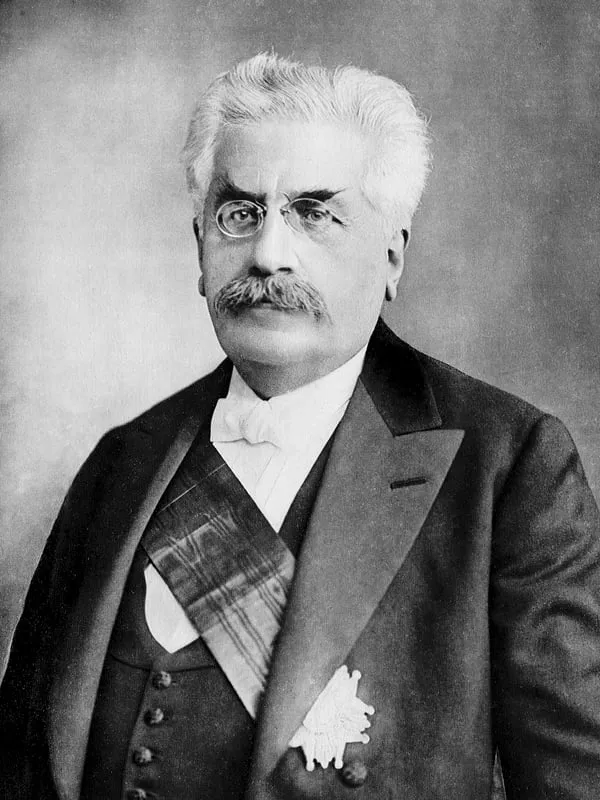
- Born:
- 10 February 1859, Paris
- Died:
- 6 April 1943, Versailles
- Author:
- Natalia
- Photo:
- autor nieznany, domena publiczna, Wikimedia Commons

Alexandre Millerand was France’s Minister of War in the first and hardest year of the war. He took office in August 1914, when the French armies were retreating after the lost Battle of the Frontiers, and held it until October 1915. He saw the minister’s role as service to the commander-in-chief: he shielded General Joffre from parliament, supported censorship and accepted sweeping powers for the army. At the same time he had to organise the production of ammunition and weapons for a war for which France was not prepared. He paid with his post for the shortages of armament, the failed offensives and the Sarrail affair. A few years later he was prime minister and then President of France, and as head of government in 1920 he sent a military mission to Poland during the war with the Bolsheviks.
Before the war
Étienne Alexandre Millerand was born on 10 February 1859 in Paris, into the family of a small cloth merchant. His mother came from an Alsatian Jewish family and converted to Catholicism. He studied law and made a career as a lawyer, defending among others striking miners. In 1885 he became a deputy for Paris, first as a Radical, then as leader of the independent socialists. In 1899 he accepted the portfolio of Minister of Commerce in Pierre Waldeck-Rousseau’s government, the first socialist in a French government. This caused a storm in the labour movement, and the dispute over “Millerandism”, that is, socialist participation in bourgeois governments, engaged the whole Second International. As minister he carried out labour reforms, including the shortening of the working day.
Over time he moved to the right. In January 1912 Raymond Poincaré made him Minister of War. Millerand strengthened the position of the Chief of the General Staff, Joseph Joffre, increased spending on the army, supported the development of military aviation and took a harder line against anti-militarists. He was regarded as an advocate of a strong army and a close associate of Poincaré. In January 1913 he had to resign when he reinstated an officer compromised in the Dreyfus affair.
The commander-in-chief’s minister
On 26 August 1914, when Prime Minister René Viviani was reshaping his government into a cabinet of the Sacred Union, Millerand replaced Adolphe Messimy, who was blamed for the defeats. On the same day General Gallieni became Military Governor of Paris. A few days later the government left for Bordeaux, and the War Ministry worked in the building of the city’s faculty of letters until January 1915.
From the start Millerand took Joffre’s side. At his demand, in September 1914 he agreed to special courts martial, judging without investigation and without right of appeal, and to tighter censorship, which affected even the newspaper of Georges Clemenceau. President Poincaré spoke privately of a “military dictatorship”. The minister rarely went to the front and rarely questioned the decisions of General Headquarters. He did, however, occasionally reprimand the commander-in-chief, for example in January 1915, after the costly defeat at Soissons. In February 1915 he ordered a new division to be organised for the expedition to the Dardanelles, stipulating that it would not take troops away from the Western Front. On 6 July 1915 he took part in the first Calais conference, and the next day he presided at Chantilly over the first inter-Allied military conference.
His greatest problem was armament. France entered the war with a good 75 mm field gun, but without enough ammunition or heavy artillery. In September 1914 Millerand and the industrialists decided to raise shell production to 100,000 a day, and skilled workers were recalled from the front to the factories. The target long remained out of reach, and hastily produced shells often burst the barrels. Before the Senate the minister admitted that it had been necessary to “sacrifice quality for quantity”, and he refused to punish the industrialists. Orders for heavy guns were considered belated, and aviation and the medical service were also criticised. From May 1915 the government imposed under-secretaries on him, among them the socialist Albert Thomas, who took over artillery and munitions.
The Sarrail affair and resignation
From January 1915 parliament sat continuously, and its committees demanded insight into army affairs. Millerand restricted this oversight, which multiplied his enemies. What damaged him most was Joffre’s dismissal on 22 July 1915 of General Maurice Sarrail, commander of the 3rd Army and a favourite of the left. The minister sided with the commander-in-chief, and the left regarded the dismissal as a political purge. The crisis was defused only when Sarrail was given command of the expedition to the East.
In the autumn of 1915 the bloody losses in Champagne and the defeat of Serbia were added to the old charges. On 19 October Millerand signed in London a protocol on Salonika in which the British left themselves a loophole for withdrawing their promises. Prime Minister Viviani regarded this as almost a contradiction of his assurances to parliament. When he tried to reshape the government, he offered Millerand the Ministry of Justice, but Millerand refused. On 29 October the Viviani government fell, and in the cabinet of Aristide Briand the War Ministry was taken over by Gallieni. Poincaré believed that Millerand had become the scapegoat for all the mistakes of the military administration, but that with his haughtiness he had alienated even his friends. The right-wing and centrist press bade him farewell with praise.
After the war
For the rest of the war Millerand remained a deputy, returned to the bar and gave lectures in defence of the Sacred Union. At the end of 1917 he supported Clemenceau. In March 1919 the prime minister appointed him Commissioner-General in Strasbourg with the task of integrating the recovered Alsace and Lorraine into France. Millerand preserved the region’s particularities, including the Concordat and the social insurance system.
In January 1920, after Clemenceau’s departure, he became prime minister and foreign minister. In the summer, when the Red Army was marching on Warsaw, his government sent to Poland, together with the British, a mission that included General Maxime Weygand, and in August, alone in Europe, it recognised the government of General Pyotr Wrangel in southern Russia. In September 1920, after the resignation of the ailing Paul Deschanel, the National Assembly elected Millerand president. In February 1921 he received Józef Piłsudski in Paris when the Franco-Polish alliance was concluded. He tried to strengthen the powers of the presidency and openly supported the right before the 1924 elections. When the left won, it refused to work with him, and in June 1924 he was forced to resign. He was later a senator. He died on 6 April 1943 in Versailles.
Assessment
Millerand is not one of the best-known figures of France’s war, but his tenure was of great importance. It was during his time that the arrangement took shape in which the commander-in-chief ran the war almost without control. Critics, both contemporaries and historians, reproach him for giving up the role of minister for that of spokesman for General Headquarters, and say his aversion to parliamentary oversight intensified the conflict that broke out in full force in 1915–1916. His defenders stress that in the chaos of 1914 backing Joffre was sensible, and that the production of armament, though belated, got going on a large scale under his administration. André Tardieu’s report of 1917 emphasised Millerand’s efforts on heavy artillery. His later path, from socialist to leader of the right, makes his one of the most surprising careers of the Third Republic.
Sources
Spotted a mistake?Report an error
Mentioned in battles
(01)Often appears with
People who appear in the same events.