France · The Entente
Maxime Weygand
Chief of staff to General Ferdinand Foch (1914–1918), chief of staff to the commander-in-chief of the Allied armies (1918), général de division
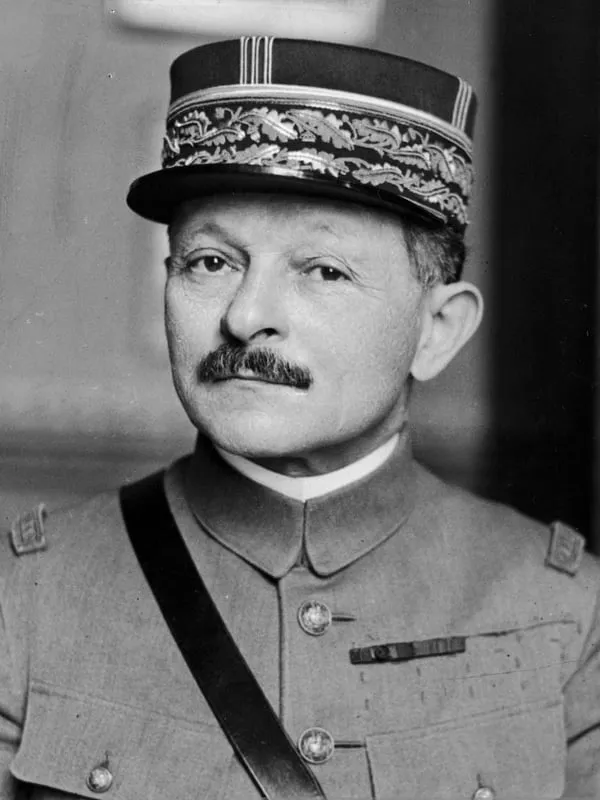
- Born:
- 21 January 1867, Brussels (Belgium)
- Died:
- 28 January 1965, Paris
- Author:
- Natalia
- Photo:
- autor nieznany, domena publiczna, Wikimedia Commons

Maxime Weygand spent the whole war at the side of Ferdinand Foch. From the end of August 1914 he was his chief of staff in the Ninth Army, then in the Northern Army Group and in the commands that followed, and in the spring of 1918, when Foch became commander of the Allied armies, he took charge of his staff. For four years he turned his chief’s ideas and instructions into clear orders, spoke on his behalf with the British and the Americans, and smoothed over the quarrels that Foch’s impetuosity provoked. He himself never once commanded troops in the field. In November 1918 it was he who, in the railway carriage in the Forest of Compiègne, read the armistice terms to the Germans and discussed the details with them. After the war he became one of the most important generals in France, and in 1940 he was given the supreme command in a hopeless situation and came out in favour of an armistice with Germany. That later role has overshadowed, in French memory, the years in which he was the closest collaborator of the victor of 1918.
Before the war
He was born on 21 January 1867, according to his birth certificate in Brussels, of unknown parents. The mystery of his origins was never solved. Biographers name several possible pairs of parents, most often the Belgian officer Alfred van der Smissen and Empress Charlotte of Mexico, daughter of the King of the Belgians, but none of these hypotheses has been proven. Weygand himself claimed not to know who his parents were, and in his memoirs he devoted only a few pages to his childhood. He grew up in Marseille, first with a widow whom he regarded as his mother, then in the house of the merchant David Cohen. Someone wealthy, according to some authors the Belgian court, paid for his education at good schools.
As Maxime de Nimal he entered the military school of Saint-Cyr in 1885, admitted as a foreigner, a Belgian. He then completed the cavalry school at Saumur. In October 1888 François-Joseph Weygand, an accountant in Cohen’s firm, recognised him as his son. The young officer received the name under which he went down in history, and soon afterwards French citizenship. He was a cavalry officer, a devout Catholic and a conservative. During the Dreyfus affair in 1898 he contributed to a subscription for the widow of Colonel Henry, the author of forged evidence against Dreyfus, for which he received four days’ arrest. It was the only punishment of his career.
He did not sit the entrance examination for the École de Guerre, which trained staff officers, explaining that he wanted to stay with the soldiers. For several years he was an instructor at Saumur. In 1912 he was promoted to lieutenant-colonel, and in 1913 he took the course at the new Centre des Hautes Études Militaires, where future commanders of higher formations were trained. There he caught the attention of Generals Joseph Joffre and Foch. In July 1914 he was second-in-command of the 5th Hussars at Nancy.
1914: at Foch’s side
With his regiment he took part in the failed French offensive in Lorraine and in the defeat at Morhange. At the end of August Joffre detached from the neighbouring armies a group of forces which he entrusted to Foch and which at the beginning of September was renamed the Ninth Army. Weygand became its chief of staff. Biographers give different dates for his appointment. French sources link it to his promotion to colonel in September, but accounts of the Battle of the Marne show that he was already with Foch by then. The two did not know each other well, and nothing suggested that their partnership would last the whole war.
In the Battle of the Marne the Ninth Army held the centre of the front on the edge of the Saint-Gond marshes. Weygand drafted the orders for its attacks and, according to his biographer Anthony Clayton, was one of the first staff officers of such seniority to view the battlefield from an aeroplane. Already then he and Foch worked out a way of working that lasted until 1918. Foch thought quickly and spoke in shorthand, while Weygand turned his ideas into orderly instructions, gathered reports and kept an eye on the details. Foch used to say that their views were almost identical and would refer visitors to his chief of staff: “Ask Weygand, it is the same thing.” In the autumn, during the Race to the Sea and the First Battle of Ypres, Foch, as Joffre’s deputy, coordinated the operations of the French, British and Belgian forces in the north, and Weygand ran his staff.
Artois, the Somme and disfavour
In 1915 Foch’s staff, now transformed into the headquarters of the Northern Army Group, planned the great and bloody offensives in Artois. Weygand’s notes from that year are full of anxiety about the mounting losses. Talks with the British took up more and more of his time. He did not speak English well, but he had a gift for winning people over and quickly gained the trust of a number of British officers. In August 1916 he was promoted to général de brigade.
He later remembered the Battle of the Somme as a series of constant misunderstandings with an ally that was only just learning to conduct large operations. When at the beginning of July Joffre and Douglas Haig quarrelled so badly that they stopped speaking to each other, Weygand, together with Foch and the British General Henry Wilson, helped to restore cooperation between the two armies. When Foch was ill, he ran the army group in his place, and in Foch’s disputes with his subordinates he often acted as peacemaker.
In December 1916, when Robert Nivelle became commander-in-chief, Foch lost his command. Weygand considered this an injustice. He could have had an infantry brigade and at last commanded in the field, but when Foch was given the task of preparing a plan in case the Germans tried to outflank the front through Switzerland, he decided to stay with him. At the beginning of 1917 he went on a confidential mission to Bern to agree with the Swiss on French assistance in the event of a German invasion. He also accompanied the Chief of the British Imperial General Staff, General William Robertson, on a journey to the Italian front. According to Clayton, Foch and Weygand doubted from the start that the Nivelle offensive would succeed. After its failure, in May 1917, Foch became Chief of the General Staff and Weygand one of his deputies. He then wrote to his wife that he was giving up seeking a command in the field.
Versailles
After the Italian defeat at Caporetto Weygand went with Foch to Italy and accompanied him at Rapallo, where the prime ministers set up the Supreme War Council with its seat at Versailles. Permanent military representatives of the individual states were to sit on the council. France was to be represented by Foch, but the British Prime Minister David Lloyd George argued that the Chief of the General Staff could not at the same time be an independent adviser to the council. The new French Prime Minister, Georges Clemenceau, therefore kept Foch in Paris and at the end of November sent Weygand to Versailles. Clemenceau is said to have told President Wilson’s envoy, Colonel Edward House, that he would send a second- or third-rate man there and see what came of it.
Weygand was the most junior in rank of the permanent representatives, who included Henry Wilson, General Luigi Cadorna and the American General Tasker Bliss. The new post brought promotion to général de division. Wilson regarded him as a mere mouthpiece for Foch and was not far wrong: at Versailles Weygand defended his chief’s views, and Clemenceau agreed to the creation of an Allied general reserve only on condition that Foch, not Weygand, would control it. In February 1918 Foch took the French representative’s seat on the council’s executive committee. The reserve was never formed anyway, because Haig and Philippe Pétain refused to give up divisions for it.
1918: chief of staff to the Allied commander-in-chief
On 21 March 1918 the Germans launched their offensive on the Somme. On 25 March Weygand was the only French general to come to a meeting with Haig at Abbeville. The next day at Doullens the governments entrusted Foch with coordinating the operations of the Allied armies, on 3 April at Beauvais with the strategic direction of operations, and on 14 April with the title of commander-in-chief. Weygand left Versailles and took charge of his staff. It was a very small staff, at first 25–30 officers, with General Pierre Desticker as deputy. Foch did not want a large apparatus. He preferred to issue general directives to the commanders-in-chief and leave the execution to them.
In the spring Weygand often had to say no. When at the beginning of April on the Avre British generals asked him for the French to counter-attack or to take over part of the front, he could only refer them to the directive Foch had already issued, since Foch was saving his reserves for a future counter-offensive. Not all of his staff’s assessments proved right. On 3 May he assured the British that the sector on the Aisne, where British divisions bled white in March were being sent to rest, was quiet. Three weeks later the Germans broke through the front there and reached the Marne.
From June, under pressure from the British, who wanted Foch to have real instruments of command, Weygand’s staff took over officers from Pétain, and in August the officer responsible for supply and transport, Colonel Payot, and the military missions of the other armies were transferred to it. The historian Elizabeth Greenhalgh writes that only then did Foch’s authority become real rather than merely nominal. Weygand drew up the memorandum that Foch presented to the commanders-in-chief at Bombon on 24 July, during the Second Battle of the Marne. It announced a shift to the offensive along the whole front. Weygand personally took Haig the directive for the attack at Amiens. In the autumn he doubted, together with Foch, whether the offensive in Lorraine planned by Pétain could be supplied across the belt of destruction left by the retreating Germans. These doubts were one of the reasons why Foch considered an armistice on harsh terms better than continuing the war.
The armistice
On 8 November 1918, in the Forest of Compiègne, Weygand accompanied Foch and Admiral Rosslyn Wemyss at the first meeting with the German plenipotentiaries. It was he who read out the main points of the terms agreed at Versailles. Foch appeared before the Germans only at the first and last sessions, and they discussed the details with Weygand and Admiral George Hope. On 9 November Matthias Erzberger and his companions handed him written observations on the terms, and when they argued that their army was falling apart, Weygand replied that the disintegration was the result of the victorious Allied offensive, and the Allies would not give up what they had won. During the night of 10–11 November he read out the text of the armistice article by article, and immediately after the signing he sent the commanders-in-chief Foch’s order to cease hostilities at 11 a.m. In the paintings and photographs of the carriage he stands or sits right beside the marshal.
At the peace conference he shared Foch’s conviction that France’s security required a military frontier on the Rhine, and he looked with growing dislike at the politicians, whom he called the “four old men” in his diary. Since Foch himself was hard to attack, President Woodrow Wilson and Lloyd George accused Weygand of feeding the marshal his extreme views.
After the war
In the summer of 1920, as the Red Army advanced on Warsaw, the government of Alexandre Millerand sent Weygand to Poland with an Allied mission. He expected to take command, but at their first meeting Józef Piłsudski asked him how many divisions he had brought, and Weygand had none. He became adviser to the Chief of the General Staff, General Tadeusz Rozwadowski, and proposed a defence on the Bug and then on the Vistula, but his plans were rejected. After the Battle of Warsaw he was welcomed in France as the victor, although as early as 21 August he had told a French journalist that the victory was Polish, the plan was Polish and the army was Polish. The legend of the “victor of Warsaw” nevertheless survived for decades.
He was later French High Commissioner in the Levant, from 1930 Chief of the General Staff, and in 1931–1935 vice-president of the Supreme War Council, that is, the designated commander-in-chief in the event of war. In 1931 he was elected to the Académie française. In May 1940, during the fall of France, he replaced Maurice Gamelin as commander-in-chief. He failed to halt the Germans and became one of the leading advocates of an armistice. In Marshal Pétain’s government he was minister of defence, then the government’s delegate in North Africa, from where he was recalled under German pressure in November 1941. From 1942 to 1945 the Germans held him prisoner in the Tyrol. After the war he was charged with collaboration with the enemy, but in 1948 the court dismissed the case. To the end of his life he quarrelled with Charles de Gaulle. He died in Paris on 28 January 1965, aged 98.
Assessment
Historians of the First World War agree that Weygand was an outstanding staff officer and that it is hard to separate his part in Foch’s victories from the marshal’s own merits. Clayton and Greenhalgh stress that it was he who brought order to his chief’s improvisations, and that his tact and patience helped to maintain cooperation with the British and Americans at a time when Foch had no formal authority over their commanders. The British, who at first saw him as merely Foch’s shadow, came in time to appreciate his reliability. Doubts remain as to whether his staff was large enough and well enough informed. Some scholars point out that in the spring of 1918 Foch and Weygand underestimated the threat on the Aisne, and that the modest staff received the tools needed to direct a great coalition campaign only in the summer.
The harshest verdict came from de Gaulle, who wrote that Weygand was by nature an excellent second-in-command but had never held a command in his whole career. Many historians believe this partly explains his helplessness in 1940, when for the first time he had to make decisions on his own, and in a hopeless situation at that. Others point out that in 1918 no one understood the mechanics of coalition victory better than he did, and that his defeats in the Second World War should not overshadow what he achieved in the First.
Sources
Spotted a mistake?Report an error
Mentioned in battles
(01)Often appears with
People who appear in the same events.