France · The Entente
René Viviani
Prime Minister of France (13 June 1914 – 29 October 1915), Minister of Justice (1915–1917)
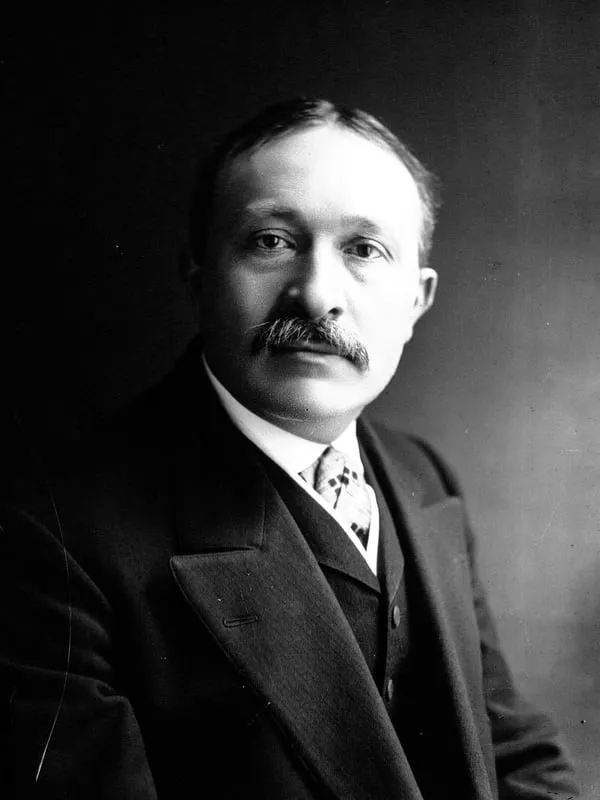
- Born:
- 8 November 1863, Sidi Bel Abbès (French Algeria)
- Died:
- 6 September 1925, Le Plessis-Robinson
- Author:
- Natalia
- Photo:
- Agence de presse Meurisse, domena publiczna, Wikimedia Commons

René Viviani was Prime Minister of France when the Great War broke out. He had taken office barely two weeks before the assassination in Sarajevo, lived through the July crisis aboard the warship carrying him home from Russia, and on 1 August ordered mobilisation. It was he who on 4 August announced France’s entry into the war in the Chamber of Deputies, and he who at the end of that month rebuilt the government as a “sacred union” (union sacrée) cabinet, in which politicians of every party sat, from the socialists to the right. A brilliant orator and lawyer, an independent socialist, he nevertheless deferred to President Raymond Poincaré in foreign policy and to the commander-in-chief, Joseph Joffre, in military matters. In the autumn of 1915, after the defeat in the Balkans and bloody offensives, his government fell. Until 1917 he remained in successive cabinets as Minister of Justice, and he was one of the men who in the spring of 1917 urged the Americans to help France.
Before the war
He was born in Sidi Bel Abbès (PL) in French Algeria, into a family of Corsican origin. Most sources give the date as 8 November 1863, but the French Senate’s biography gives the year 1862, and the National Assembly’s database, in its heading, 11 November 1863. His father was a lawyer and a member of the departmental council of Oran. René went to lycées in Oran and Algiers, studied law in Paris, and then practised as a lawyer in Algeria and in the capital, where among others he defended socialists and trade unionists.
In 1893 he was elected to the Chamber of Deputies for the 5th arrondissement of Paris. He quickly became known as one of the best orators of the left. In 1902 he lost the election to a nationalist candidate, but in 1906 he returned to the Chamber, and from 1910 he represented the department of Creuse (PL). Together with Jean Jaurès he co-founded the daily L’Humanité in 1904. When in 1906 he joined the government of Georges Clemenceau, he found himself, like Aristide Briand, outside the unified socialist party, and called himself an independent socialist.
From October 1906 to November 1910 he was France’s first ever Minister of Labour and Social Welfare, in the governments of Clemenceau and Briand. In that time the 1910 law on workers’ and peasants’ pensions was passed, to which Viviani later devoted a separate book. A declared anticlerical, he went down in history for a line from a speech in the Chamber in November 1906, that the republicans had “extinguished stars in the sky that no one will light again”. In December 1913 he became Minister of Public Instruction in the cabinet of Gaston Doumergue. On 13 June 1914 President Poincaré entrusted him with the premiership together with the foreign ministry. Viviani won a vote of confidence by 370 votes to 137, coming out in favour of keeping three-year military service and of a large loan for armaments.
The July crisis
In mid-July 1914 Viviani and Poincaré sailed on a visit to Russia. From 20 to 23 July they held talks in St Petersburg with Tsar Nicholas II and his ministers. Austria-Hungary deliberately delivered its ultimatum to Serbia only once the French guests were already at sea. For the following days the man who was both prime minister and foreign minister had poor communications with Paris, where affairs were run by the acting minister, Jean-Baptiste Bienvenu-Martin. They did not get home until 29 July.
According to the Senate’s biography, Viviani, “seconding Poincaré’s efforts”, did everything to avert the danger and sought mediation. On 30 July the government decided to pull the covering troops back 10 kilometres from the German border, so as to give the Germans no pretext and to convince the British that France was not the aggressor. When Russia proclaimed general mobilisation, Viviani presented it to the allies as a response to Austro-Hungarian mobilisation. On the evening of 31 July the German ambassador, Wilhelm von Schoen, asked him what position France would take in a German-Russian war. Viviani replied only that France would be guided by her own interests, and on 1 August the government ordered general mobilisation. On 3 August at 6.45 p.m. Schoen handed him the declaration of war. That same day Doumergue took over the foreign affairs portfolio, and Viviani became prime minister without a department.
On 4 August Viviani announced France’s entry into the war in the Chamber of Deputies and asked for war credits. His biographers at the Senate called it the most moving speech of his life, in which he was “the interpreter of his country”. He had with him the text of the military convention with Russia, but no one demanded that it be read out. A few days later, on 7 August, he called on France’s rural women to finish the harvest in place of the men who had gone to the front.
Prime minister of France at war
The first weeks of the war brought defeats in the Battle of the Frontiers. On 26 August Viviani and Poincaré rebuilt the government: Alexandre Millerand became war minister in place of Adolphe Messimy, Théophile Delcassé took foreign affairs, Briand became Minister of Justice, and Alexandre Ribot took charge of finance. Two socialists also joined the government. This was the first “sacred union” cabinet. On 1 September Viviani took part in the talks with Lord Kitchener, who had come to Paris to stop the British retreat, and on the night of 2–3 September, as the Germans drew near the capital, the government moved to Bordeaux. After the victory on the Marne the authorities gradually returned to Paris, and the government moved back at the beginning of December.
Viviani essentially left the conduct of the war to Joffre, who kept politicians out of the zone of the armies. When in 1915 the government and parliament tried to exercise control over him, for instance through inspections at the front, the attempt failed. Millerand, too, was criticised ever more sharply for the shell shortage, and in May 1915 the government imposed deputies on him, among them Albert Thomas as under-secretary of state for artillery. On 6 July 1915 Viviani met the British Prime Minister, Herbert Henry Asquith, for the first time at the Calais conference.
In the autumn of 1915 everything went wrong. The Second Battle of Champagne and the offensive in Artois cost enormous losses and brought no breakthrough, Bulgaria entered the war on the side of the Central Powers, and Serbia came under attack. On 13 October Delcassé resigned and Viviani took over his department himself. In stormy debates in the Chamber he defended the expedition to Salonika and gave assurances that France would not act there alone, and on 16 October France declared war on Bulgaria. The government won a vote of confidence by 372 votes to 9, but with very many abstentions. An attempt to reshape the cabinet failed, and on 29 October Viviani resigned. According to Poincaré, in his last days in office he was “like a hunted animal”.
Minister of Justice
In Briand’s new government Viviani became deputy prime minister and Minister of Justice, and from December 1916 to March 1917 he was also in charge of education. By now, however, he had little influence on government policy. In the spring of 1916 he went to Russia with Albert Thomas to discuss supplies and Russian help for France. He remained Minister of Justice in Ribot’s government, formed in March 1917.
When the United States entered the war in April 1917, Viviani led the French mission to America, in which Marshal Joffre also travelled. In American eyes the popular “victor of the Marne” overshadowed the former prime minister, but it was this very mission that persuaded Washington to send a division to France as soon as possible. The Senate’s biography even credits Viviani with a decisive role in bringing America in. In June he was at the station in Paris to welcome General John Pershing. Ribot’s government fell in September 1917; Viviani left with it and never held ministerial office again. Clemenceau, who took power in November, sidelined him.
After the war
In 1920–1921 Viviani represented France on the Council of the League of Nations, and in 1921 he went with Briand to the Washington Conference. On 15 October 1922 he became senator for the department of Creuse. He was deeply affected by the death of his stepson, killed in the war, and then by the death of his wife in February 1923. On 8 June 1923, while addressing the Court of Cassation (PL), he suddenly lost the power of speech. He spent his last years paralysed in a nursing home at Le Plessis-Robinson (PL) near Paris. He died there on 6 September 1925 according to the Senate and the National Assembly, a day later according to some other sources.
Assessment
Historians see in Viviani above all an orator rather than a leader. In the July crisis, as his biographers write, he was largely dominated by President Poincaré, and later the prime minister almost always deferred to his judgement. Nor could he impose his will on Joffre, so that the first year of the war was a period in which the high command acted almost without government control. Clemenceau mocked him as an orator who gave “kilometre-long harangues”. Yet Viviani has his place in French history as the prime minister who in August 1914 united every party behind the government, and the “sacred union” that he built together with Poincaré lasted in France until 1917.
Sources
Spotted a mistake?Report an error
Mentioned in battles
(01)Often appears with
People who appear in the same events.
On the timeline
(22)1914
July
- 31
- Russia begins general mobilisation31 July 1914 was the first day of general mobilisation in Russia. The news of it provoked an immediate reaction from Berlin.
- Germany sends an ultimatum to RussiaOn 31 July 1914 Germany demanded that Russia halt its mobilisation within 12 hours. At the same time it asked France whether it would remain neutral.
August
- 26
- Dismissal of war minister Adolphe MessimyOn 26 August 1914 the French war minister Adolphe Messimy lost his post in Viviani's reshuffled government and soon went to the front.
- Delcassé becomes French foreign ministerOn 26 August 1914 Théophile Delcassé, architect of the Entente Cordiale, replaced Gaston Doumergue as French Minister of Foreign Affairs.
September
November
1915
July
October
- 29
- Fall of the Viviani governmentOn 29 October 1915 René Viviani's government fell. After Balkan setbacks and failed offensives he could not reshape his cabinet and gave way to Briand.
- Millerand leaves the Ministry of WarOn 29 October 1915 War Minister Alexandre Millerand, criticised for munitions shortages and deference to Joffre, left office with Viviani's government.
- 30
- Aristide Briand becomes prime minister of FranceOn 30 October 1915 France had a new government. Aristide Briand became prime minister and foreign minister and brought veteran politicians into his cabinet.
- Joseph Gallieni becomes minister of warOn 30 October 1915 General Joseph Gallieni, defender of Paris in 1914, became minister of war in Briand's government. He accepted the post very reluctantly.