1915: The Dardanelles
Third Battle of Krithia
- Dates:
- 4 June 1915
- Front:
- Middle East
- Location:
- Southern part of the Gallipoli peninsula, the whole Helles front from the Aegean Sea to the Dardanelles strait, south-west of the village of Krithia (today Alçıtepe) and the hill of Achi Baba, Ottoman Empire (today Turkey)On the battle map →
- Sides:
- United Kingdom, France and British IndiaIan Hamilton, Aylmer Hunter-Weston, Henri GouraudOttoman EmpireOtto Liman von Sanders, Erich Weber
- Result:
- Ottoman defensive victory. The Allies gained about 250 to 500 yards (230–460 metres) on a front a mile long, but did not take Krithia.
- Author:
- Łukasz Skowroń
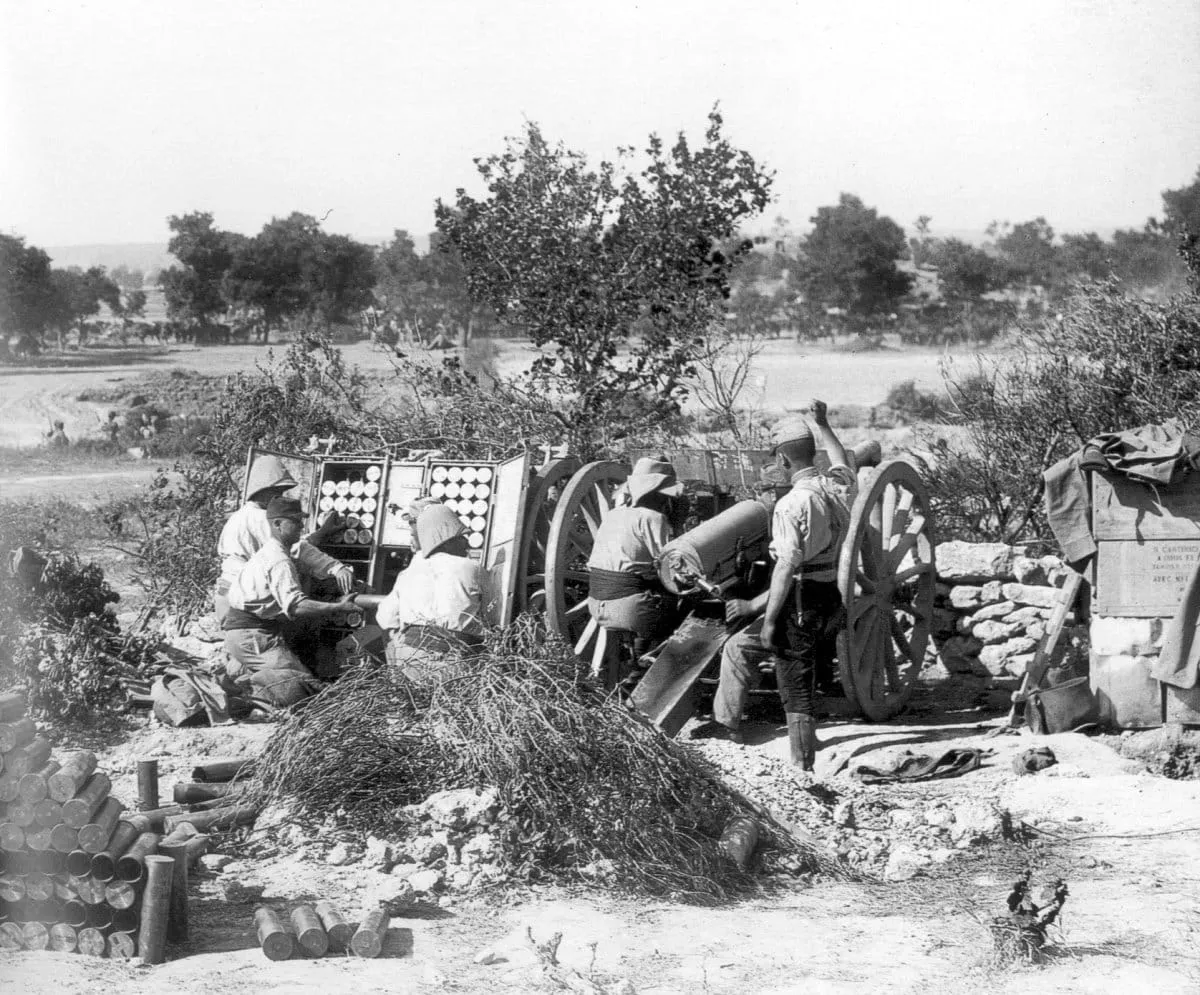
The Third Battle of Krithia was the last great attack in which the Allies tried to break out of the bridgehead at Helles, at the southern tip of the Gallipoli peninsula, by a frontal assault across the whole width of the peninsula. On 4 June 1915 the British VIII Corps and the French expeditionary corps, about 30,000 men in all, attacked what was by now a continuous line of Turkish trenches. This time the objective was more modest than in April and May: not Achi Baba, but the capture of the first lines of trenches, at most 800 yards forward. In the centre Lancashire Territorials broke through the Turkish defences almost to Krithia itself. On both flanks, however, the attack collapsed, the reserves were thrown in where the attack had failed rather than where it had succeeded, and by the evening most of the ground won had to be given up.
Name and dates
In British historiography the battle is called the Third Battle of Krithia, in Turkish Üçüncü Kirte Muharebesi. The village of Krithia, Kirte in Turkish, is today called Alçıtepe. The British official history speaks simply of the battle of 4 June, and that is how we date it on this page. The Turks counter-attacked on 5 and 6 June as well, which is why some studies, especially Turkish ones, extend the battle to 6 June. We describe these counter-attacks below as its aftermath.
Background
After the Second Battle of Krithia in early May the front at Helles came to a standstill. For the following weeks both sides dug in. At night the British pushed their trenches ever closer to the Turkish ones, until in this way they had gained about half a mile of ground almost without loss and were within assaulting distance of the enemy’s front line. By the end of May two continuous lines of trenches ran from the sea to the strait, in places protected by barbed wire, with strongpoints capable of all-round defence. It was the first battle on the peninsula fought under conditions of true trench warfare.
The Allied forces at Helles had grown. On 24 May three British divisions, namely the 29th Division, worn down in the earlier fighting, the Royal Naval Division, brought back up to twelve battalions, and the Territorial 42nd (East Lancashire) Division, formed VIII Corps under General Aylmer Hunter-Weston. To these was added the 29th Indian Brigade. On 15 May General Henri Gouraud, an energetic commander, took over the French corps from Albert d’Amade and at once began to push the French line forward. Facing his men, on the ridge above the Kereves Dere ravine, the Turks had built four redoubts. The French took one of them on 31 May, but the redoubt known as the Haricot they took twice and lost twice.
At the same time the Allies lost some of their support from the sea. After the sinking by U-21 of the battleships Triumph and Majestic the heavy ships were withdrawn to sheltered harbours. Those that were to support the attack could fire only while under way, at 12 knots, changing course every ten minutes. On land the British had 78 guns and howitzers, and mostly shrapnel at that, because high-explosive shells were in short supply.
General Ian Hamilton would have preferred to wait for reinforcements from England. To his request of 17 May for four new divisions the government in London, busy forming a coalition cabinet, replied only with the promise of one division. Both corps commanders at Helles, however, were confident that they would take Achi Baba with the forces they already had, and every day the Turks were strengthening their positions and receiving reinforcements. On 31 May Hamilton agreed to a new battle. When on 3 June Lord Kitchener asked him by telegram whether, with the reinforcements he had requested, he could take the Kilid Bahr position and finish the operation, Hamilton replied briefly that he was fighting a battle the next day and preferred to answer when he had seen its result.
Plan
The lessons of April and May had been taken to heart. Every stage of the attack was set out in detailed orders, and for the first time a sketch of the Turkish trenches, drawn from aerial photographs taken by the Royal Naval Air Service, was attached to the VIII Corps orders. The first wave was to take the Turkish front line, and the second to pass through it and seize the second objective, 400–500 yards further on. Behind them came parties of sappers and detachments that were to clear the captured trenches of hidden riflemen. Hand bombs, as grenades were then called, were however very scarce, mostly home-made from jam tins, and few soldiers had ever held one.
The bombardment was to last from 8 a.m. At 11.20 a.m. the guns were to fall silent for a quarter of an hour, while the infantry cheered and showed their bayonets above the parapet to lure the Turks to their fire positions. At 11.30 a.m. the artillery was to open up again, and at noon the first wave was to go over. For the first time an attempt was also made to use a few armoured cars crewed by the Royal Naval Air Service, which were to drive along the Krithia road.
From west to east the front was held by: the 29th Indian Brigade on Gully Spur and in Gully Ravine above the Aegean Sea, the 88th Brigade of the 29th Division on Fir Tree Spur, the 42nd Division on both sides of the Krithia road, the Royal Naval Division opposite the Kanli Dere ravine, and two French divisions on the ridge above Kereves Dere, on the strait side. About 20,000 men were assigned to the first assault, and 10,000 were held in the reserves of the two corps.
On the Turkish side the Southern Group was commanded by the German general Erich Weber, known as Weber Pasha, who was subordinate to Otto Liman von Sanders. In the front line stood the 9th and 12th Divisions, with three more in reserve, among them the 7th and 15th. After the May fighting the divisions were intermingled and made up of battalions from many units. The British official history estimates the strength of the defenders at 25,000–28,000 rifles and 86 guns. Turkish studies give somewhat lower figures.
Course of the battle
4 June was a fine summer day with a strong north-easterly wind. The bombardment was the heaviest yet seen on the peninsula, but in many sectors it hardly damaged the Turkish trenches, which, as it later turned out, had strong loopholes protecting them against shrapnel. When the artillery fell silent at 11.20 a.m. and the infantry showed their bayonets, rifle and machine-gun fire did indeed burst from the Turkish trenches, and the Turkish batteries, silent until then, also opened up. The dust and smoke of the renewed bombardment, however, drifted back over the British trenches, and it was difficult to judge its effect.
The flanks
On the right flank the French attack collapsed almost at once. The trenches of the two sides were here little more than 100 yards apart, so the French gunners, afraid of hitting their own men, fired well beyond the Turkish front line. Its garrison survived untouched and its machine guns swept away the attackers, who returned to their trenches after a few minutes. A small party reached the Haricot redoubt, but was quickly driven out of it.
In the neighbouring sector the attack was led by Commodore Oliver Backhouse’s 2nd Naval Brigade, with the Anson, Howe and Hood Battalions. Here the French 75 mm guns had smashed the Turkish trench well, and the first wave took it. A quarter of an hour later the newly arrived Collingwood Battalion went forward in a long line, “as if on parade”. Just short of the Turkish trenches it came under murderous fire from the right flank, from the ridge from which the Turks had just repulsed the French, and was almost completely destroyed. A handful of survivors, with the remnants of other battalions, even took the second objective, but the flanking fire made it impossible to hold, and before 1 p.m. the brigade was back in its starting positions. In three quarters of an hour it had lost 60 of its 70 officers and more than a thousand of its roughly 1,900 men. The Collingwood Battalion was never re-formed.
On the left flank, by the sea, the 29th Indian Brigade attacked Gully Spur and along the floor of Gully Ravine. Howitzers were lacking, and some of the guns allotted to support the Indians were switched to another target at the last minute, so the Turkish trenches on the spur were almost untouched. The 14th Sikhs, advancing up the ravine, lost according to the British official history 12 of 15 British officers, 11 of 14 Indian officers and 380 of 514 men. A company of Gurkhas of the 1/6th Battalion, slipping along under the coastal cliffs, reached one of the Turkish works, but without support had to withdraw.
Breakthrough in the centre
In the centre things went differently. The 88th Brigade, reinforced to six battalions but with few veterans of the April landing left in it, ran into Turkish strongpoints that the artillery had not destroyed. In one of them were German sailors with machine guns from the cruiser Breslau. The first wave of the King’s Own Scottish Borderers was almost entirely wiped out. On the brigade’s left, however, the Worcestershire battalion took the Turkish trenches and carried its neighbours forward with it. By 1 p.m. the brigade had taken most of the first objective and 250 prisoners, among them a German officer in charge of machine guns.
The greatest success was achieved by the 42nd Division. French high-explosive shells had destroyed the Turkish trenches in front of it, and General Noel Lee’s 127th (Manchester) Brigade took the whole of its objective almost without loss. Its units went at least a thousand yards, more than 900 metres, deep into the Turkish positions and took 217 prisoners, and individual parties got to within 1.2 km of Krithia. According to the British official history there was by then almost no Turkish trench between them and the summit of Achi Baba. Turkish studies state that the breach was stopped by the battery of Lieutenant Arif, who, instead of obeying an order to destroy his guns and retreat, defended the hill in front of Krithia with 150 men until reinforcements arrived.
The reserves
At about 2 p.m. both corps commanders knew that the flanks had been repulsed and that the centre had broken through. They had eighteen battalions in reserve. Instead of sending them into the breach made by the 42nd Division, they decided to renew the attack where it had failed. The French and the Royal Naval Division were to attack the trenches above Kereves Dere once more at 4 p.m., and the Gurkhas of the 1/5th Battalion were to support a renewed Indian attack on Gully Spur. At 5 p.m. Gouraud informed Hunter-Weston that his troops were unable to attack again that day, so the Royal Naval Division’s attack was cancelled. On the left flank the Indians and Gurkhas once again, with great courage, went forward against Gully Spur and were again repulsed. The 1/5th Gurkhas lost all their British officers. By 5 p.m. seven of the twelve battalions of the VIII Corps reserve had been dispersed.
Meanwhile Turkish reserves were converging on the breach. The first struck at about 4 p.m., covered by the Kanli Dere and Kirte Dere ravines. From 5.15 p.m. the reports from the 127th Brigade grew steadily worse; at 6 p.m. the brigade was being attacked from three sides, and half an hour later the divisional commander ordered the forward units to withdraw. General Lee had been mortally wounded at about noon, and his successor was killed. By nightfall the 42nd Division had given up most of the ground it had won.
Losses
According to the British official history, on 4 June VIII Corps lost about 4,500 killed, wounded and missing out of some 16,000 men who took part in the fighting, and the French about 2,000 in the morning attack. Turkish losses, according to the Turkish official history, were even higher, at about 9,000 men. One Turkish account even gives 10,000.
Aftermath
On the evening of 4 June General Henry de Lisle, sent from France to take command of the 29th Division, came ashore on the beach at Helles, crowded with wounded and shelled by the Turkish artillery. The night and the following day were spent carrying the wounded down to the beaches and consolidating the new line. On 5 June the Turks counter-attacked several times without success, and on the morning of 6 June, after further reinforcements had arrived, they struck in greater strength. In the 42nd Division’s sector they recovered some of the trenches, and in the 88th Brigade’s sector the whole forward part of the captured line. Second Lieutenant George Moor of the Hampshire Regiment, who stopped the fleeing soldiers of a neighbouring unit and with them retook the lost trench, received the Victoria Cross for it. The Turkish afternoon attack was repulsed. Hunter-Weston later wrote that holding the position by the exhausted Territorials was an even greater feat than taking it.
Significance
The battle gained the Allies from 250 to 500 yards of ground on a front about a mile long, at the cost of 6,500 killed and wounded. The British official history points out that the Turkish command considered the situation critical that night. The German colonel Hans Kannengiesser, attached to the Turkish 9th Division, later wrote that another vigorous British attack would have had the gravest consequences. Neither the British nor the French, however, had the strength to renew it. The official historian formulated the main lesson clearly: reserves should be thrown in where an attack has succeeded, not where it has failed.
On the evening of 6 June Hamilton replied to Kitchener that after this battle he was convinced that with his present forces he would advance only very slowly, but that the reinforcements he had requested would allow him in the end to take Kilid Bahr. The commanders at Helles also drew another conclusion from the battle: with so few howitzers it was impossible to attack along the whole front at once. The next attacks, the French one above Kereves Dere and the British one in Gully Ravine at the end of June, were made on narrow sectors, with the concentrated fire of all the available artillery. The Allies did not take Krithia or Achi Baba before the end of the campaign.
Spotted a mistake?Report an error