Key event
Battle of Polygon Wood begins
- Category:
- Military operations
- Front:
- Western Front
- Date:
- 26 September 1917
- Author:
- Łukasz Skowroń
- Battle:
- Battle of Polygon Wood
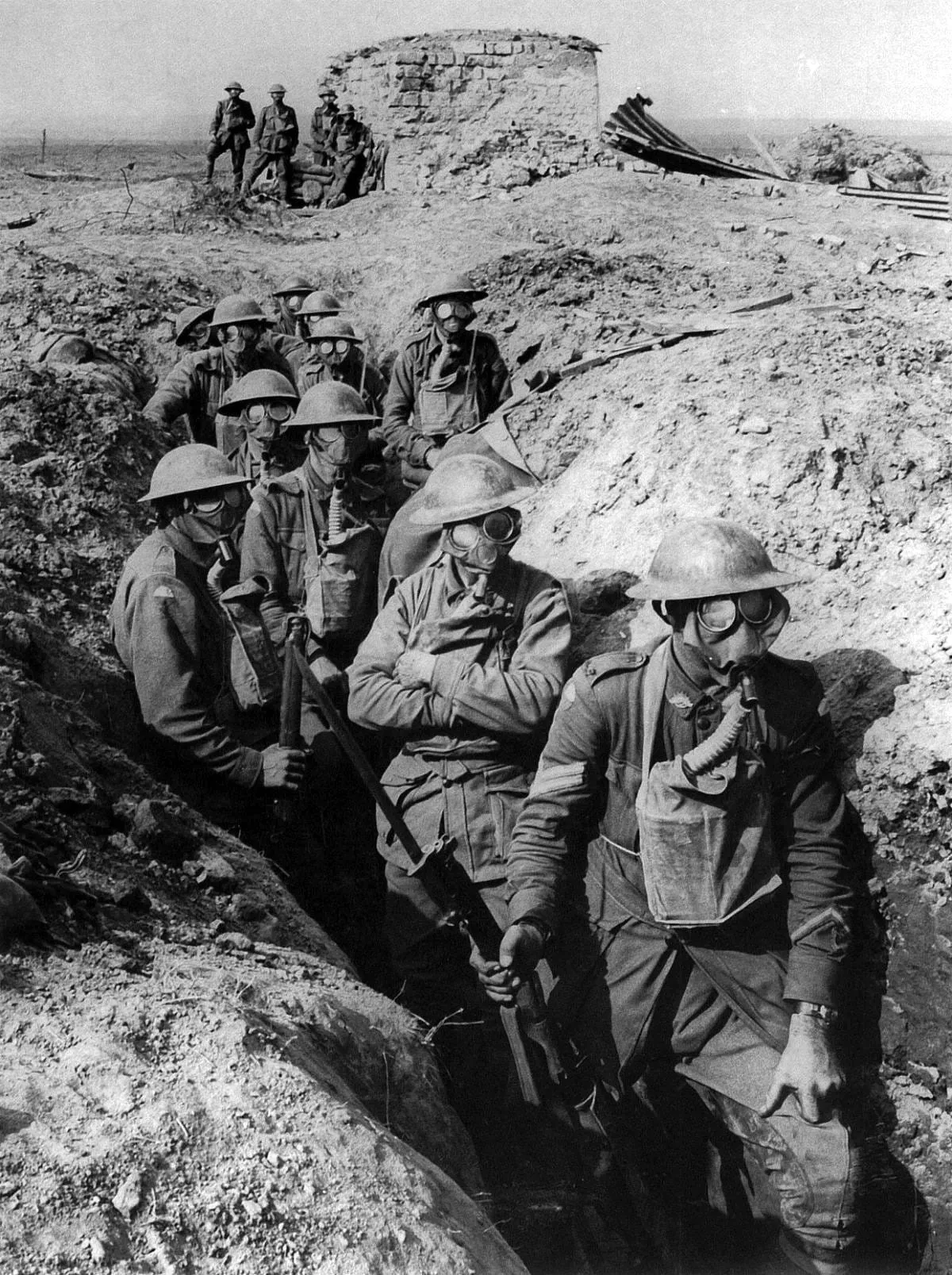
On 26 September 1917 at 5.50 a.m., as the plateau east of Ypres was beginning to emerge from the darkness, a mass of British guns opened fire simultaneously, “with one crash”, as almost every report recorded. Behind a wall of dust and smoke seven divisions moved off: five British and two Australian. It was General Herbert Plumer’s second step in the Third Battle of Ypres, six days after the attack along the Menin Road. By midday the Australians had taken the rest of Polygon Wood with the Butte mound and a stretch of the German Flandern I line, and the British had entered Zonnebeke. In the afternoon the German counter-attack divisions, coming down from the Broodseinde ridge in full sunlight, were shattered by artillery fire before they could reach the new line.
A night after a hard day
The attack very nearly did not take place. On the morning of 25 September the German 50th Reserve Division, supported by exceptionally strong artillery, struck the southern edge of Polygon Wood, a sector just taken over by the British 33rd Division, and recaptured several hundred metres of ground from which the Australians’ right wing was to advance the next day. All day German shelling swept the Menin Road and the rear of General Harold Elliott’s 15th Australian Brigade. The forward ammunition dump for the attack blew up, wrecked lorries burned on the road, and the commander of the 5th Australian Division, General Talbot Hobbs, had to turn back 200 metres short of Elliott’s headquarters. The Australian war photographers Frank Hurley and Hubert Wilkins photographed this inferno, exposing themselves to fire. Elliott, who had sent his assault battalions to help, reported in the evening that an attack by his brigade was out of the question. Plumer and the commander of I Anzac Corps, General William Birdwood, nevertheless decided that the attack would go ahead. Elliott was to attack with one intact battalion, and the 8th Brigade lent him two more.
At 8.15 p.m. the German artillery suddenly fell silent. The night was bright, with low cloud. Intelligence officers laid out the jumping-off lines with tapes on a field that had almost no landmarks left apart from tree stumps and concrete pillboxes. A battalion of Queenslanders and Victorians from the 8th Brigade reached its tapes ten minutes before the attack. On the German side all was quiet: the Crown Prince of Bavaria, Rupprecht, the army group commander, had concluded after the previous day’s attack that the British would not attack for several days, and had left for Munich on personal business.
The Butte
In the morning mist lay over the plateau. In the 14th Australian Brigade from New South Wales, General Hobkirk crammed twelve waves of infantry into a strip about 55 metres deep, right next to the line on which the barrage was to fall. The German barrage, fired as a precaution at four o’clock, came down behind them. At 5.50 the British wall of fire moved forward, and the infantry behind it. The Australian official historian Charles Bean called this barrage the most perfect cover that had ever led Australian soldiers: the dry earth threw clouds of dust into the air, and the fire rolled ahead of the attackers “like a Gippsland bushfire”. Officers kept direction with compasses in hand.
Captain Cotterell of the 55th Battalion reportedly walked calmly ahead of his men, map in hand and cigarette in mouth. Pillboxes were bypassed on both sides, and from some of them terrified boys emerged, holding out hands full of souvenirs. After about 450 metres the silhouette of the Butte loomed out of the mist: a tall earth mound, before the war the butt of a Belgian rifle range and now part of the German third position. The German machine-gunners on top fled, and men of the 53rd Battalion stormed the mound and bombed the entrances to the dugouts on its rear slope. After a few shots up the stairs, about 60 Germans, mostly stretcher-bearers, surrendered there. At 7.30 the 55th and 56th Battalions passed through the captured ground to the second objective, a stretch of the Flandern I line almost a kilometre long. Only shreds remained of its wire, and the pillboxes were taken without difficulty. The brigade took about 200 prisoners and 34 machine guns. An artillery observer and machine-gunners took up position on top of the Butte, from where they could see the rest of the plateau.
The victory had its price. Early in the morning a German shell mortally wounded the commander of the 53rd Battalion, Lieutenant-Colonel Croshaw, who before the attack had taken leave of his officers with the words: “Gentlemen, your men first, then yourselves. Watch your flanks.” Even before the attack a shell killed the medical officer of the 56th Battalion, Captain Elliott, the brother of the 15th Brigade’s commander.
An exposed flank
On the right wing, at the southern edge of the wood, nothing went according to plan. The battalions of the 8th Brigade, trained to keep close behind the barrage, passed through the ranks of the 59th Battalion, which had waited three minutes as instructed, and the two units merged into one dense line. The ground, empty only the previous morning, was swarming with German machine guns covering the flank of the 229th Reserve Regiment. The British 98th Brigade on the Australians’ right had failed to retake the lost line during the night: some of its battalions had lost their way in the dark. From the ruins of Jerk House and Cameron House German machine guns fired into the Australians’ flank and back. Captain Hibbs’s company of the 31st Battalion turned straight towards this fire and went to ground in front of Jerk House, its officers falling one after another. The Germans came out in a counter-attack and took twenty-odd Australians prisoner. Their commander, Major Hethey, was killed directing the defence, however, and other officers after him.
At 7.30 the commander of the 31st Battalion, Lieutenant-Colonel Toll, decided that he could not go on with an exposed flank and halted his men and the 29th Battalion on the first objective. Elliott replied with an order to go forward or hand over command. Meanwhile the soldiers settled the matter themselves. Captain Neale of the 59th Battalion, who found his battalion digging in 200 metres short, on the old racecourse in the wood, led it across the little valley of the Polygonebeek stream. Lieutenant Pentreath worked round a group of pillboxes above the stream and captured them, taking prisoner Captain Fischer, the commander of the German sector in the wood, with his staff and about 60 men. Before ten o’clock the Australians stood almost on the second objective. When the barrage stopped at 11.17 they were setting up small posts in shell holes, and in some of them they were already brewing tea. “They won’t get through here,” they told an officer who came to check their position. Private Patrick Bugden of the 31st Battalion led attacks on pillboxes during these days and rescued a captured corporal from the Germans. He was killed on 28 September carrying wounded men out from under fire and was posthumously awarded the Victoria Cross.
At noon the British 2nd Battalion Royal Welch Fusiliers, sent to the exposed flank through the Australians’ rear, attacked Jerk House almost without artillery cover. Once the mist had cleared, the German machine-gunners on the Polderhoek spur had the attackers in full view. One of their companies fired more than 20,000 rounds in a short time. The Fusiliers reached Jerk House but not Cameron House, and after four o’clock, when their ammunition ran out, they withdrew. Cameron House was taken only during the night by men of Lieutenant-Colonel Norman Marshall’s 60th Battalion.
Zonnebeke
In the north, where General Ewen Sinclair-MacLagan’s 4th Australian Division attacked, the advance went almost unhindered. Facing it was the German 3rd Reserve Division, which according to Bean contained many Poles, some of whom actually wanted to be taken prisoner. The Australians smothered pillbox after pillbox and were consolidating on the Tokio spur before the barrage ended. Sergeant John Dwyer of the 4th Machine Gun Company knocked out a German machine-gun nest with his fire, brought back the captured gun and went on firing it, for which he received the Victoria Cross. Among the dead was Captain Harold Wanliss of the 14th Battalion, in whom friends, among them General John Monash, had seen a future leader of Australia. The division’s left battalion reached the brickworks at Zonnebeke.
The British 3rd Division entered Zonnebeke but failed to take the railway station, and on Hill 40 it was stopped by fire from the ridge. The German 34th Fusilier Regiment, counter-attacking from Broodseinde in mist and smoke, managed to reinforce the defence at the level crossing north of the village. Further north the 59th Division took a series of fortified farms, while a brigade of the 58th Division was held up on the Gravenstafel spur a few hundred metres short of its objective.
Counter-attacks
When the mist lifted before noon, airmen of the Royal Flying Corps began warning by wireless of German columns approaching the front. Australian airmen circled low over the infantry, which showed them its positions with red flares. At about 2.30 p.m. the lines of the German 236th Division came out onto the Broodseinde ridge and at once ran into artillery fire. At 3.25 p.m. Captain Albert Jacka of the 14th Battalion, the first Australian to be awarded the Victoria Cross in this war, fired the flares calling for a barrage. The artillery responded immediately and the Germans did not reach the Australian trenches. From the south the 17th Division advanced on Polygon Wood through Holle Bosch wood and over Reutel hill, straight into British shellfire, and further north the 4th Bavarian Division lost more than 1,300 men struggling through the mud along the Paddebeek stream. At about five o’clock observers on the Butte watched German troops gathering by a road and trying to get through gaps in the hedges, but machine guns and two 6-inch howitzers dispersed them every time. The only success of the German counter-attacks was the repulse of the British 3rd Division’s evening attack on Hill 40. After 8.15 p.m. the front fell quiet.
Evening
By the end of the day the attackers had taken almost all their objectives except Hill 40 and a few pillboxes on the right wing. They gave up not a single piece of the captured ground. According to the British official history the seven divisions lost more than 15,000 men in the battle, mainly on that day, including about 5,300 in the two Australian divisions. The heaviest losses, more than 4,000, were suffered by the British 3rd Division at Zonnebeke. Bean attributed the victory above all to the excellent artillery cover, but also to the tenacity with which Elliott’s 15th Brigade and the battalions supporting it wrested complete success from an almost desperate situation. For the 5th Australian Division, which had bled itself white at Fromelles in July 1916, it was its first great victory.
On the German side the day was a defeat for the new tactics. This time each of the three front-line divisions had a counter-attack division behind it, twice as many as on 20 September, but none broke through the British barrages. According to German accounts their units needed up to two hours to cover a kilometre and arrived exhausted. Within the next few days Erich Ludendorff and the command in Flanders began looking for another method of defence. Plumer was already preparing the next step, onto the Broodseinde ridge.
Remember the articles you have read? Only in this browser; nothing is sent anywhere.How it works
Read ·
Spotted a mistake?Report an error
Related events
(04)The same battle, people or subject.
- 9 October 1917 · Western FrontBattle of PoelcappelleOn 9 October 1917, after a night march through mud, the British attacked at Ypres towards Passchendaele and were repulsed. Guards and French reached Houthulst.
- 3 October 1917 · Western FrontEnd of the Battle of Polygon WoodOn 3 October 1917 near Ypres the last German attempt to retake ground at Polygon Wood failed. Plumer was finishing preparations for the attack on Broodseinde.
- 25 September 1917 · Western FrontEnd of the Battle of the Menin Road RidgeOn 25 September 1917 the Germans attacked at Ypres south of Polygon Wood and pushed back the 33rd Division. Plumer still kept the attack set for the morning.
- 12 October 1917 · Western FrontFirst Battle of PasschendaeleOn 12 October 1917 Anzacs advanced in the rain on Passchendaele. By evening they were back on their old lines, and 845 New Zealanders were dead.