1916: The Western Front beyond Verdun
Battle of Mount Sorrel
- Dates:
- 2–13 June 1916
- Front:
- Western Front
- Location:
- The ridge south-east of Ypres between Hill 60 and Hooge, with the knoll of Mount Sorrel, Hills 61 and 62 (Tor Top), Observatory Ridge and Armagh Wood and Sanctuary Wood, West Flanders (Belgium)On the battle map →
- Sides:
- United Kingdom and CanadaDouglas Haig, Herbert Plumer, Julian Byng, Malcolm Mercer, Arthur CurrieGerman EmpireAlbrecht, Duke of Württemberg, Theodor von Watter
- Result:
- Canadian victory. On 2 June the Germans took Mount Sorrel and Hill 62, but on 13 June the Canadians regained almost the whole of the lost line. The Germans held only the trenches at Hooge.
- Author:
- Natalia
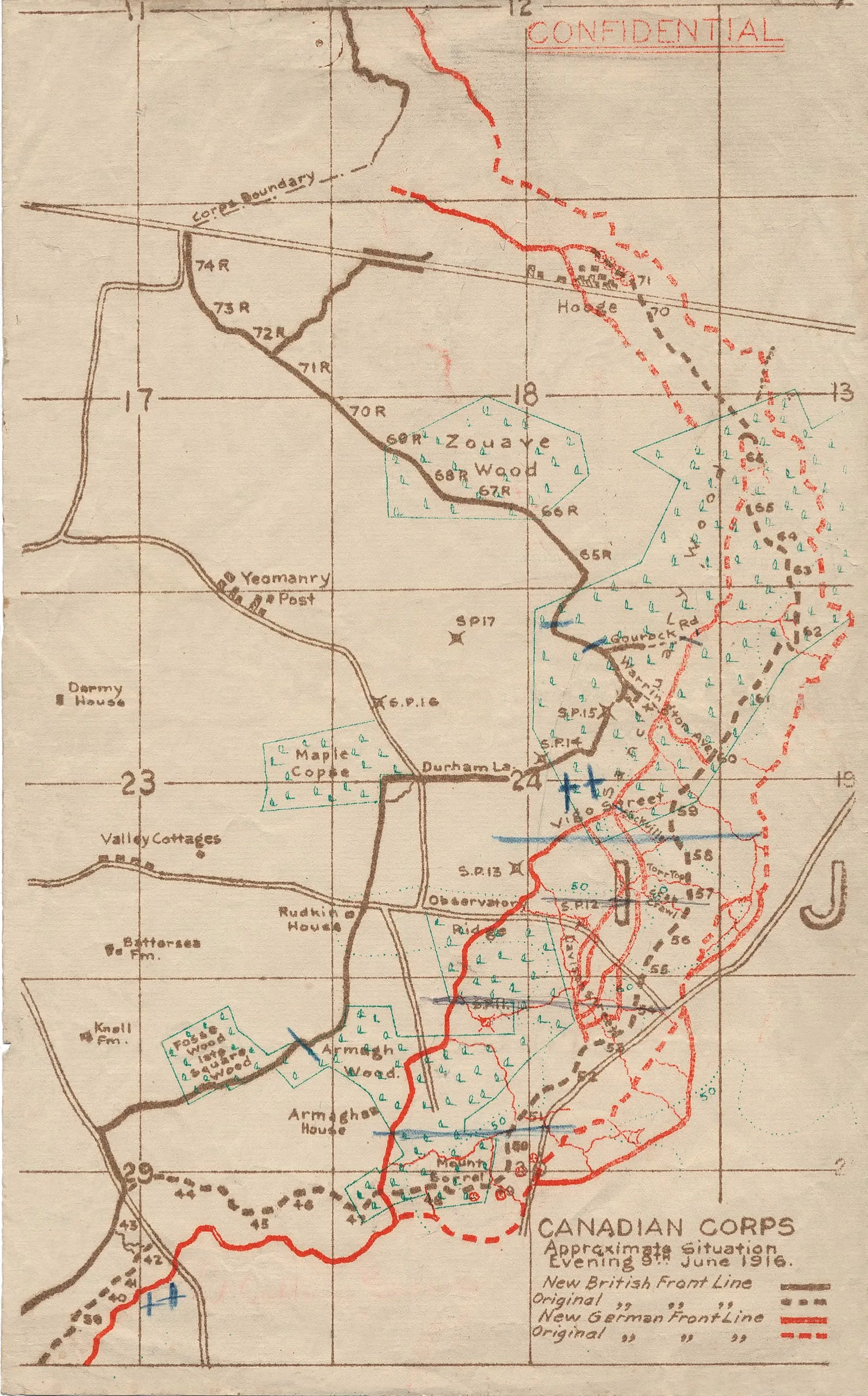
The Battle of Mount Sorrel was the largest engagement on the British sector of the Western Front in the months before the Battle of the Somme. It was fought on the eastern edge of the salient around Ypres, where the Canadians held the last piece of ridge from which the German rear could be seen. On 2 June 1916, after several hours of devastating bombardment, the Württemberg XIII Corps took the knoll of Mount Sorrel and the neighbouring Hills 61 and 62, killed the commander of the 3rd Canadian Division and broke several hundred metres into the Canadian positions. A hasty counter-attack the next morning failed. Only on 13 June, after a carefully prepared bombardment by more than two hundred guns, did the Canadian infantry in a night attack regain almost the whole of the lost line. It was the first battle won by the Canadian Corps and the first trial of the method that its commander, Lieutenant-General Julian Byng, was later to develop at Vimy.
Name and dates
The name comes from a small, flat knoll with farm buildings on the ridge near Ypres which the British called Mount Sorrel. The British Battles Nomenclature Committee classed the engagement as a “battle” (as distinct from the smaller “actions” of that spring, such as the fighting for the craters at St. Eloi), and the British official history (Edmonds, Military Operations France and Belgium 1916) describes it as the fighting of “Mount Sorrel and Hooge, 2–13 June 1916”.
We use the dates 2–13 June 1916, following the official histories and the British chronology of the war: from the German attack to the Canadian recapture of the hills. The last, unsuccessful German counter-attacks came on the morning of 14 June, which is why the Canadian official history (Nicholson) counts casualties up to and including 14 June.
Background
Since the Second Battle of Ypres in the spring of 1915 the Germans had held almost the whole of the ridge enclosing the town on the east, and from its slopes they looked down into the British trenches and rear areas. The exception was a stretch about a kilometre long between Hill 60 near Zillebeke and Sanctuary Wood. There the front line climbed onto the ridge, ran across Mount Sorrel and reached two slightly higher summits which the Canadians called Hills 61 and 62. The second of these, 62 metres high, was known as Tor Top. From it a broad, mostly open spur, Observatory Ridge, ran west towards Ypres between Armagh Wood and Sanctuary Wood. Whoever took it could look into the rear of the British positions. From here it was little more than three kilometres to the gates of Ypres.
Since 4 April 1916 this sector had been held by the Canadian Corps, part of the Second Army of General Herbert Plumer. In the spring its 2nd Division had lost the costly fighting for the craters at St. Eloi, and the dispute over responsibility for that defeat led to the removal of the corps commander, General Edwin Alderson. On 28 May he was replaced by Byng, a cavalryman who had previously commanded a corps at Gallipoli. On the ridge stood the 3rd Canadian Division of Major-General Malcolm Mercer, with the 8th Brigade, made up of four battalions of dismounted Canadian Mounted Rifles, and the 7th Brigade, which included among others the battalion of Princess Patricia’s Canadian Light Infantry. To its right stood the 1st Canadian Division of Major-General Arthur Currie.
Opposite lay the 26th and 27th Infantry Divisions of the Württemberg XIII Corps of General Theodor von Watter, part of the Fourth Army of Duke Albrecht of Württemberg. On 20 May Watter issued an order “to wrest from the enemy his last commanding observation points”. According to German accounts quoted by Edmonds, the attack was also meant to pin down as many British troops as possible at Ypres and reduce the forces earmarked for the expected offensive. Preparations took six weeks. No fresh infantry was brought in; instead a great deal of heavy artillery and trench mortars was borrowed from neighbouring corps. The soldiers were told that they would soon be going to another front. In the rear, by the road to Menin, the assault was rehearsed on a model of the Canadian trenches. Canadian patrols and airmen saw German saps being pushed out towards Tor Top and a fresh trench dug less than 150 metres from the Canadian lines, but poor flying weather and the absence of troop movements meant that nobody expected an attack so soon.
Course of the battle
2 June. In the morning General Mercer and the commander of the 8th Brigade, Brigadier-General Victor Williams, went up to the front line to inspect the positions near Tor Top. Shortly after 8.30 the German fire suddenly intensified, and from 9.00 it fell with full force on the sector from Sanctuary Wood to Mount Sorrel. It was the heaviest bombardment British troops had yet experienced. The worst hit was the 4th Battalion, Canadian Mounted Rifles, at Armagh Wood, which had taken over the position only the day before. The trenches were levelled, and the men who had sheltered in a tunnel dug by Canadian engineers on the reverse slope of Mount Sorrel were buried in it and later taken prisoner. Of about 700 men of the battalion, 76 came out unscathed. Williams, wounded, was taken prisoner. Mercer, stunned by a blast and with a leg shattered by a bullet, was killed by shell fragments during the night of 2–3 June. He was the highest-ranking Canadian officer to fall in the war.
At 1.07 p.m. the Germans fired mines just in front of the Canadian trenches on Mount Sorrel and in full sunlight went over to the assault: battalions of the 121st and 125th Regiments of the 26th Division against Tor Top and Observatory Ridge, the 120th Regiment of the 27th Division against Mount Sorrel. Handfuls of survivors of the 1st and 4th Battalions of the Mounted Rifles defended themselves with grenades and bayonets, and the Germans used flamethrowers. The attackers took the whole of the first zone from Mount Sorrel to Tor Top, most of Armagh Wood and three strongpoints on Observatory Ridge, where they captured two guns of the 5th Battery of Canadian field artillery, which fought to the last man. To the north, in Sanctuary Wood, the companies of Princess Patricia’s held up the German flank for many hours. The battalion lost more than 400 men, including its commander, Lieutenant-Colonel Herbert Buller. The fire of their machine guns, and from the south that of the 5th Battalion, together with the resistance of the 5th Battalion of the Mounted Rifles at Maple Copse, meant that the Germans, in accordance with their limited-objective orders, halted and dug in about 550–650 metres beyond the old front line.
3 June. Byng ordered the lost ground to be regained that same night. An attack by two brigades of the 1st Division and units of the 3rd Division was planned for 2.00, but the battalions could not reach their positions in time under fire, and the 3rd Brigade arrived from Poperinge only after 1.45. The attack went in at 7.10, in full daylight, over open ground. The signal was to be six green rockets fired at once. Some proved faulty, fourteen had to be fired, and they went up one after another, so the battalions set off at different times. The Germans could concentrate their fire on each of them in turn. A few groups broke into the German trenches but were wiped out or captured, and by 1 p.m. the survivors had returned to their starting positions. The counter-attack did, however, close a dangerous gap between Square Wood and Maple Copse and made it possible to build a new, continuous line as far as Hooge.
4–12 June. Douglas Haig agreed with Plumer that a position so close to Ypres had to be regained, but he did not want to draw troops away from the preparations on the Somme, just as after the German attack on Vimy Ridge in May. He therefore provided heavy artillery and one infantry brigade in reserve and advised that the next attack be made with a small number of infantry supported by many guns. The corps artillery commander, Brigadier-General Henry Burstall, assembled, according to the Canadian official history, 218 guns, from 18-pounders to two 12-inch howitzers. Rain and the lack of aerial photographs several times forced the attack, first set for 6 June, to be postponed. On that day at 3 p.m. the Germans fired four large mines under the Canadian trenches on the eastern edge of the ruins of Hooge, by the Menin road, and took the front line of the 28th Battalion. Byng judged that retaking these ever-costly trenches would divert forces from the main task, and ordered the reserve line to be made the new front line. Haig approved. Between 9 and 12 June the Canadian artillery fired four short, violent bombardments so that the Germans would stop taking them as the prelude to an assault. On 12 June it shelled all the German positions from Hill 60 to Sanctuary Wood for ten hours.
13 June. At 1.30 a.m., in pouring rain and under cover of a smoke screen, two composite brigades of the 1st Division, formed from the least depleted battalions, attacked: that of Brigadier-General Louis Lipsett against Mount Sorrel and that of Brigadier-General George Tuxford against Tor Top, with the 58th Battalion of the 9th Brigade on the left flank. The fire was so accurate that the leading waves could wait in no man’s land inside the German barrage. Dazed by the bombardment, most of the Württembergers offered no resistance. Between 2.00 and 2.30 all three attacks reached their objectives: the 3rd Battalion regained Mount Sorrel, the 16th Battalion the northern part of Armagh Wood, the 13th Battalion Observatory Ridge and Tor Top, and the 58th Battalion a large part of the old line in Sanctuary Wood. Five German officers and 186 men were taken prisoner. The British official history called this first carefully planned attack by the Canadians in larger strength an “unqualified success”. In the mud and water-filled shell holes the old line could not be found, and on Mount Sorrel the new position was dug a few dozen metres in front of it. Two German counter-attacks on the morning of 14 June were broken up by the artillery, and then the fighting died down.
Casualties
According to the British official history the Canadian Corps lost more than 8,400 killed, wounded and missing between 2 and 14 June (the Canadian official history gives about 8,000). The 8th Brigade alone lost almost 1,900 men. German losses on this sector, according to figures supplied by the Reichsarchiv, were 5,765 men. Edmonds observes that, given the different ways of counting the wounded, the losses of the two sides were probably similar.
Significance
The Württembergers succeeded in disrupting the British preparations only to a small extent: Haig sent only heavy artillery and two brigades, one of infantry and one of dismounted cavalry, to Ypres, and just three weeks later the offensive on the Somme began. In the end the Germans kept only the trenches at Hooge, having lost thousands of men. According to German accounts they could not hold their gains because the enemy had command of the air and more ammunition, and the borrowed heavy artillery soon had to be returned.
For the Canadians the battle was at once a first-day defeat and their first clear victory. The hasty counter-attack of 3 June repeated the mistakes of the Second Battle of Ypres, whereas the attack of 13 June showed what a limited objective, patient preparation and powerful, precisely directed artillery could achieve. Byng and Currie put this lesson to use at Vimy in April 1917. Mercer was succeeded in command of the 3rd Division by Lipsett. The Canadian part in the battle is commemorated by a memorial on Hill 62, by Sanctuary Wood.
Spotted a mistake?Report an error