1914: The fighting in Flanders
Battle of the Yser
- Dates:
- 16 October – 10 November 1914
- Front:
- Western Front
- Location:
- The Yser river between Nieuport and Diksmuide, West Flanders, BelgiumOn the battle map →
- Sides:
- Belgium, France and United KingdomAlbert I, Émile Dossin, Pierre Ronarc'h, Paul Grossetti, Horace HoodGerman EmpireAlbrecht, Duke of Württemberg, Hans von Beseler
- Result:
- Allied defensive victory. The Germans crossed the Yser and took Diksmuide, but the flooding of the plain stopped them. Belgium kept a strip of territory, held until 1918.
- Author:
- Natalia
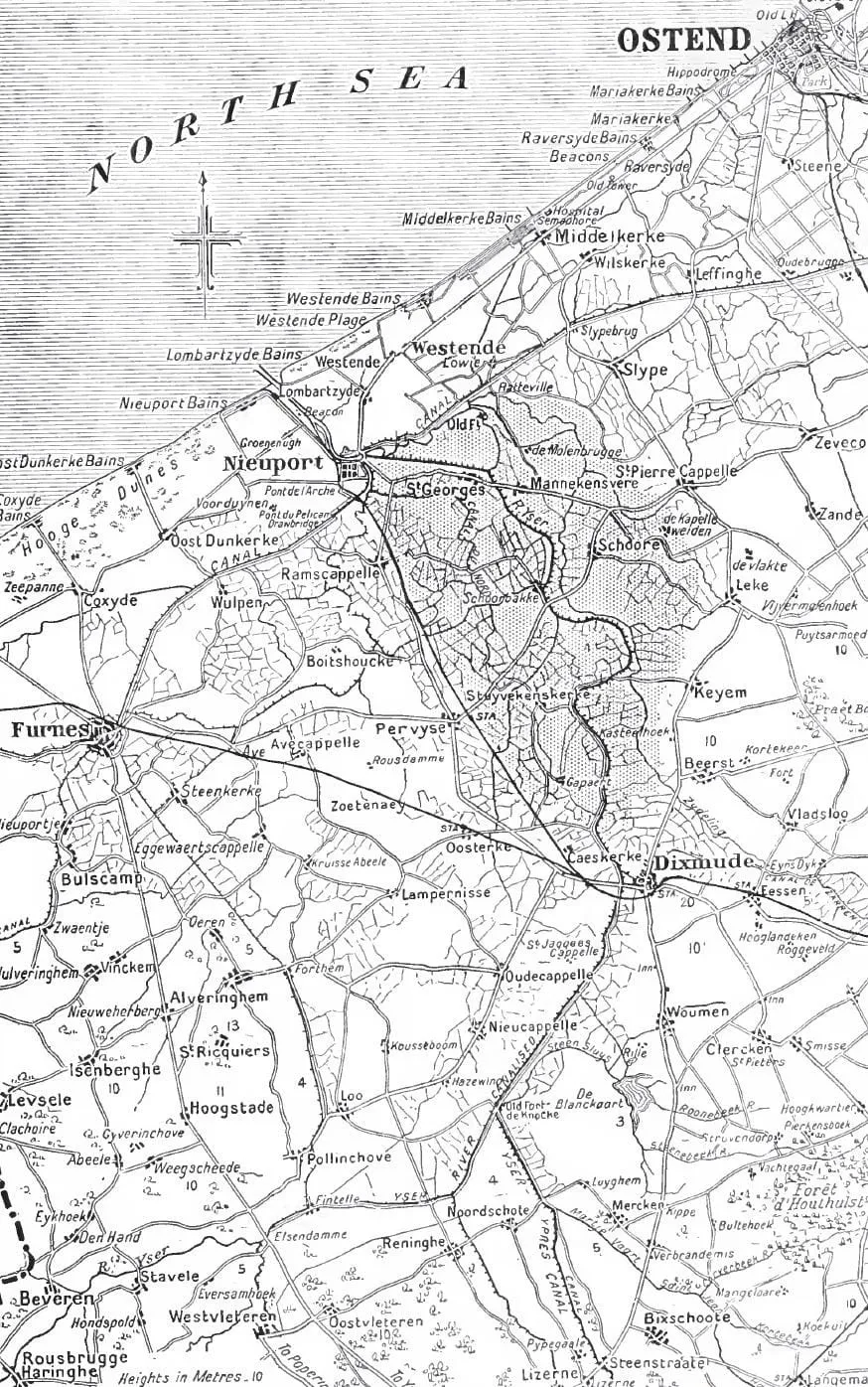
The Battle of the Yser was the final act of the race to the sea. In the second half of October 1914 the exhausted Belgian army, which had slipped out of Antwerp a few days earlier, held the line of the small river Yser between Nieuport and Diksmuide against the new German Fourth Army. It was supported by French naval fusiliers and, from the sea, by British warships. After two weeks of fighting, with the Germans already across the river, the Belgians opened the sluices at Nieuport and let the sea onto the low-lying plain. The flooded strip of land halted the advance. On 10 November the Germans still took Diksmuide, the last Allied bridgehead on the eastern bank, but they got no further. The last strip of free Belgium survived until the end of the war.
Name and dates
The start of the battle is marked by the first clash at Diksmuide on 16 October. This is how Belgian tradition dates the battle, and the British history of the war notes that this is the date adopted by the Belgians. The main German assault began on 18 October, and some studies count the battle from that day.
The dates for the end of the battle vary more. The Polish and English Wikipedias give 16–31 October 1914 and close the battle with the German withdrawal from the flooded ground on the night of 30–31 October and the following days. The end is, however, often taken to be 10 November, when the Germans captured Diksmuide, the last Allied bridgehead on the eastern bank of the Yser. The British history of the war gives this date as the French one, and the dates 16 (or 18) October – 10 November are also adopted by many French and Belgian studies and by the British website greatwar.co.uk. We adopt this broader date, because the defence of Diksmuide was an inseparable part of the defence of the Yser line. Studies that treat the Battle of the Yser as the northern sector of the wider fighting in Flanders extend it as far as 30 November. South of Diksmuide, the November fighting already merged with the First Battle of Ypres.
Background: the last line
After the fall of Antwerp the Belgian army retreated westwards along the coast. Sending it to rest behind the French border, around Saint-Omer and Calais, was considered, but King Albert I, under French pressure, decided to stand on the Yser. On 14 October the Belgians began to dig in, and the next day, when the Germans reached the coast and took Ostend, they manned the line from Diksmuide to the sea. The King’s headquarters was set up at Veurne. In an order of the day Albert called on his soldiers to regard as a traitor anyone who spoke of retreat without a formal order.
The army numbered six infantry divisions and a cavalry division, but these were the remnants of its former strength. Estimates of its numbers range from about 50,000 to 65,000–70,000 men, worn out by two and a half months of fighting and short of ammunition and officers. At Diksmuide stood the French brigade of naval fusiliers under Rear Admiral Pierre Ronarc’h, some 6,500 men, together with the Belgian brigade of Colonel Alphonse Jacques. South of the town the line was extended by French Territorial divisions, and beyond them by the British at Ypres. Allied operations in the north as a whole were directed by General Ferdinand Foch, who had, however, no authority over the Belgian army.
The terrain favoured the defenders only in appearance. The Yser flowed between embankments across a flat plain of polders, partly below sea level and cut by drainage ditches. A few kilometres behind the river ran the embankment of the Nieuport–Diksmuide railway, about two metres high. Several Belgian outposts had been pushed forward onto the eastern bank, to the villages of Mannekensvere, Schoore, Keiem and Beerst, and at Nieuport a bridgehead was held that included Lombardsijde and Westende.
Facing them stood the new German Fourth Army of Duke Albrecht of Württemberg. On the sector from the sea to Diksmuide the attack was made by the III Reserve Corps of General Hans von Beseler, the conqueror of Antwerp, reinforced by the 4th Ersatz Division, while further south new reserve corps brought from Germany were entering the fight. Estimates of the German strength on the Yser range from 60,000 to 85,000 men. The Germans also had a considerable superiority in heavy artillery. Their aim was to break through the front and march along the coast to Dunkirk and Calais.
Course of the battle
16–17 October. The first German units approached Diksmuide and attacked the town. The fusiliers and the Belgians repulsed the attack. In front of the rest of the line German patrols and reconnaissance units appeared.
18–20 October. On 18 October the main assault began. German artillery shelled the Belgian outposts on the eastern bank, and the infantry of the III Reserve Corps struck at Keiem, Schoore and Mannekensvere. That same morning the flotilla of Rear Admiral Horace Hood appeared off Nieuport, made up of cruisers, three shallow-draught monitors and destroyers, later joined by French destroyers. The ships shelled German columns and batteries along the coast as far as Middelkerke, and their fire deterred the Germans from trying to force the Yser at Nieuport itself. Within a few days, however, the Belgians lost all their forward outposts, and the bridgehead at Lombardsijde was pushed back to Nieuport itself. By 20 October the Germans stood on the river along the whole length of the front. Diksmuide was shelled and attacked without respite.
21–24 October. On the night of 21–22 October a German reserve infantry regiment crossed the Yser by a footbridge in the bend at Tervate, roughly halfway between Nieuport and Diksmuide, and occupied the whole bend. Belgian counter-attacks, in which the grenadiers suffered heavy losses, failed to throw the Germans back across the river. Around 22–23 October (sources give different dates) the French 42nd Division of General Paul Grossetti reached Nieuport, the first substantial support for the exhausted Belgians. On 24 October the Germans crossed the river at further points and took Stuivekenskerke. That day the Germans also attacked Diksmuide repeatedly, without success.
25–28 October. The Belgians, at the end of their strength, withdrew behind the Nieuport–Diksmuide railway embankment, their last line of defence. A plan to flood the ground between the river and the embankment had been prepared earlier, and on 25 October, under mounting German pressure, the King agreed to carry it out. The culverts under the embankment were blocked with sandbags so that the water would not reach the defenders’ rear. The work was overseen by Karel Cogge, a supervisor of the local water board at Veurne and an expert on the canal system. On 27 and 28 October the Belgians repulsed attacks at Pervijze, supported from the sea by the ships, which themselves suffered losses from the fire of German batteries.
Opening the sluices. The key was the complex of sluices at Nieuport known as the Ganzepoot, or goose’s foot, where several canals and the Yser itself converged. By opening the gates at high tide and closing them before the ebb, seawater could be let onto the polders. The sluices, however, lay on the front line, under German artillery fire. The first attempts, on the nights of 26–27 and 27–28 October at the old sluice on the canal to Veurne, had only partial effect. The decisive opening came on the night of 29–30 October. At Cogge’s suggestion Captain Fernand Umé with a group of soldiers and the bargeman Hendrik Geeraert opened the spillway of the Noordvaart canal. Sources differ in detail as to which sluices were opened on successive nights. Repeating this manoeuvre at every high tide, the Belgians gradually flooded a strip of land between the river and the embankment, from about one and a half to several kilometres wide, reaching south as far as Diksmuide.
30–31 October. On 30 October the Germans launched their last great assault. They broke the Belgian line on the embankment and forced their way into Ramskapelle (PL), and at Pervijze they came up to the village itself. A Belgian-French counter-attack retook Ramskapelle on 31 October. Meanwhile the water behind the Germans was rising hour by hour. The German command cancelled the attack planned for the next day and on the night of 30–31 October began to withdraw. Over the following days the German units, wading through flooded meadows and abandoning some of their equipment, fell back to the eastern bank of the Yser.
1–10 November. On 31 October and 1 November the Germans still tried to push south along the eastern bank of the river to cut off the bridgehead at Diksmuide, but there too the water stopped them. On the night of 1–2 November they withdrew behind the Yser. From then on the flooded sector from the sea to Tervate was guarded only by the 4th Ersatz Division, and the III Reserve Corps was moved south, towards Ypres. Diksmuide remained an advanced Allied bastion on the eastern bank. Under constant shelling it was defended by Ronarc’h’s battalions of naval fusiliers, Belgian units and Senegalese tirailleurs, who had arrived on 26 October. On 10 November, after a night bombardment, two German divisions attacked the town from three sides. After fierce street fighting the defenders withdrew to the western bank in the afternoon, and the Belgians blew up the bridges behind them. That same day, further south, the Germans pushed the French from Bikschote back to the Yser canal. The capture of Diksmuide closed the fighting for the river line. The exhausted fusiliers were relieved on 16 November.
After the battle
After the fall of Diksmuide the front on the Yser froze. On the sector from the sea to Diksmuide the flooded ground separated the two armies for almost the entire war. At the beginning of November Hood’s flotilla sailed away, as the arrival of reinforcements and the flooding had made its presence unnecessary. King Albert moved his headquarters to De Panne, where he remained until 1918.
Losses
The losses of both sides are not known precisely. According to the historian Sophie de Schaepdrijver, the Belgian army lost about 3,500 killed and 15,000 wounded on the Yser. Jack Sheldon puts Belgian losses between 18 and 30 October at about 20,000 men, a third of the army’s strength. Ronarc’h’s fusiliers at Diksmuide also suffered heavily. The British official history estimates German losses between Gheluvelt and the sea from 18 October to 30 November at over 76,000 men. This figure, however, also covers the fighting at Ypres, so only part of it relates to the Battle of the Yser itself.
Significance
The Battle of the Yser ended the race to the sea. The Germans did not break through along the coast to Dunkirk and Calais, the ports through which supplies and reinforcements flowed to the British army. The Western Front reached the North Sea and, from Nieuport to the Swiss border, turned into a continuous line of trenches.
For the Belgians the victory had enormous symbolic significance. The Germans occupied about 95 per cent of the country, but a small strip at its western end, with Veurne, De Panne and Poperinge, remained free. King Albert, who did not abandon his soldiers, became a national hero and a symbol of resistance. The Belgian army held the Yser front for four years, until the offensive in the autumn of 1918. The experience of Flemish soldiers, commanded by French-speaking officers, also gave rise to the Front Movement, from which the post-war Flemish nationalist movement grew.
Spotted a mistake?Report an error
On the timeline
(04)1914
October
November
- 10
- Battle of the Yser endsOn 10 November 1914 the fall of Diksmuide ended the Battle of the Yser. Belgium kept a scrap of its land, held for four years behind a flooded plain.
- Germans take DiksmuideOn 10 November 1914 the Germans took Diksmuide on the Yser, held since mid-October by French marines and Belgians. The defenders fell back across the Yser.