1915: The Great Retreat of the Russian army
Siege of Novogeorgievsk
- Dates:
- 9–20 August 1915
- Front:
- Eastern Front
- Location:
- Novogeorgievsk fortress (Modlin) at the confluence of the Vistula, Narew and Wkra, with forts on both banks of the Vistula from Zakroczym and Pomiechówek to Zegrze and Jabłonna, Kingdom of Poland (now Nowy Dwór Mazowiecki)On the battle map →
- Sides:
- German Empire (with Austro-Hungarian siege artillery)Hans Hartwig von BeselerRussian EmpireNikolai Bobyr
- Result:
- German victory. On 20 August 1915 the commandant, Bobyr, capitulated. The Germans captured the entire garrison, more than 85,000 men according to the German communiqué, and seized huge stocks of guns and ammunition.
- Author:
- Natalia
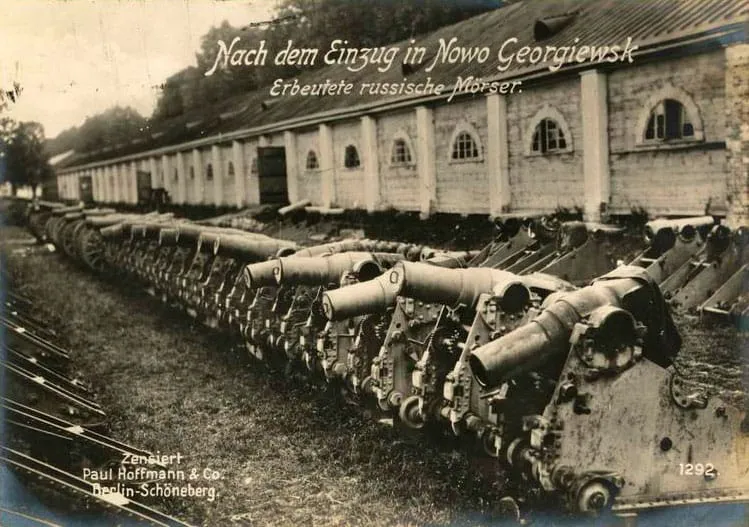
Novogeorgievsk, today’s Modlin, was the largest fortress of the Russian Empire. It lay about 30 kilometres north-west of Warsaw, where the Narew and the Wkra flow into the Vistula. When at the beginning of August 1915 the Russian armies withdrew eastwards from Warsaw, the Russian high command decided not to abandon the fortress. The garrison shut up inside it, numbering by various accounts from 80,000 to more than 100,000 men, was left alone behind a front that quickly moved away to the east. The German siege group of General Hans von Beseler, made up mainly of Landwehr and Landsturm units, surrounded the fortress, smashed the north-eastern forts with heavy mortars and within a week of fighting forced the defenders to capitulate. On 20 August 1915 the commandant of the fortress, General of Cavalry Nikolai Bobyr, signed the act of surrender. The entire garrison went into captivity.
Name and dates
From 1834 the Russians called the fortress at the mouth of the Narew Novogeorgievsk, and in 1915 the Germans called it Nowo-Georgiewsk.
This page uses the dates 9–20 August 1915. On 9 August, according to the German communiqué and the memoirs of General Erich Ludendorff, the Germans closed the ring of encirclement on the east as well, between the Narew and the Vistula. Some works date the siege from 10 August, when the Russians gave up their last outpost in the south-east, and some German works from 4 August, when the heavy artillery reached the fortress. The German command and the Austrian official history regarded the fortress as taken on the evening of 19 August, when the Germans entered the citadel. The act of capitulation was, however, signed on 20 August, and that day the last fighting died down.
Background
The fortress, founded in Napoleonic times, was rebuilt by the Russians after the November Uprising, and at the turn of the 19th and 20th centuries they surrounded it with two rings of forts, partly with French money. Before the war the Russian war ministry even considered abolishing it, but in the end it was decided to modernise it. The new forts were designed to the latest patterns, such as the “Tsarsky Dar” fort group in the north-east, but in 1915 many of them were unfinished, and some had not been equipped with armoured turrets and observation posts.
In July 1915 the German attack across the Narew brought the front closer to the fortress from the north. On 20 July Beseler, the conqueror of Antwerp, arrived before the fortress and took command of the troops that were to capture it. In mid-July a German Landwehr patrol fired on a Russian staff car. The fortress’s chief engineer, Colonel Korotkevich-Nochevny, was killed in it, and the Germans found on him a briefcase with plans of the fortifications and of the positions of the heavy batteries. Rumours of treason quickly spread among the garrison, which, Russian historians write, undermined its morale.
When at the end of July the Russian command decided to withdraw its armies from the Kingdom of Poland, it did not order the evacuation of Novogeorgievsk. According to the Austrian official history the fortress was to prepare for encirclement and an independent defence. Ludendorff later wrote in disbelief that Grand Duke Nicholas Nikolaevich had allowed this, although he afterwards ordered Brest and Grodno to be abandoned.
Forces
According to Russian returns, at the moment the fortress was cut off it held about 1,000 officers and more than 90,000 soldiers; Polish works give as many as 105,000. The core of the garrison was four infantry divisions, the 58th, 63rd, 114th and 119th, largely made up of inexperienced opolchenie militia, along with fortress artillery, sappers and labour units. There were rifles for only some of the men. The fortress had more than a thousand guns, only some of them modern, and large stocks of ammunition. The commandant was General of Cavalry Nikolai Bobyr.
By various accounts Beseler had about 80,000 men, most of them from the Landwehr and Landsturm. Among them were General Dickhuth’s corps, the 14th Landwehr Division, Colonel Traugott von Pfeil’s brigade and the 169th Landwehr Brigade, while from the south the fortress was sealed off by General Westernhagen’s detachment of the Ninth Army. The Germans’ advantage lay in their siege artillery. According to some Russian works Beseler’s group had about 390 guns, including six 42 cm mortars, the Big Berthas, and ten 30.5 cm mortars. An Austro-Hungarian communiqué stressed that Austro-Hungarian heavy mortars also took part in the bombardment of the fortress. Ludendorff wrote that the heavy guns provided by the high command at the end of July went to Novogeorgievsk, not to Kovno.
Course
Encirclement (5–10 August). The heavy artillery and ammunition arrived at the beginning of August, once the Germans had rebuilt the railway from Mława to Nasielsk. Beseler decided to attack the north-eastern forts, which that line reached, without a long siege by the old rules. First the German brigades struck at the advanced bridgeheads on the Narew. On the night of 6–7 August the Russians withdrew from them behind the river, destroying the bridges, and on 8 August the Germans occupied the fortifications of Zegrze. On 9 August they closed off the fortress from the east, and from the south, after the capture of Warsaw, Westernhagen’s detachment came up. On 10 August the Russians gave up their last outpost in the south-east and the ring was closed.
Attack on the north-eastern forts (13–17 August). On 13 August, after a bombardment lasting several hours, the German infantry attacked the field positions in front of the forts in the area of Pomiechówek. According to the German communiqué it took 1,800 prisoners. From 14 to 16 August the heavy mortars shelled the forts of the Pomiechówek sector. On the evening of 15 August the Germans took the right-hand work of the “Tsarsky Dar” group, and on 16 August Pfeil’s brigade occupied the group’s main fort, Fort XV. Russian counter-attacks failed, although some of the defenders still held out in the left-hand work. On 17 August the Germans took more forts. In the evening Bobyr ordered the outer ring in the Pomiechówek sector to be abandoned and a withdrawal behind the Wkra. According to Russian works the forts were to have been blown up, but there were not enough explosives and they fell into German hands intact. That same night several aircraft took off from the fortress airfield, carrying away secret documents, the fortress’s colours and a stock of St George’s Crosses.
Fall (18–20 August). On 18 August the Germans moved their heavy batteries closer, crossed the Wkra and took more forts of the northern front, while the decision to abandon the outer ring deepened the disintegration of the garrison. The fortress chief of staff, General Nikolai Globachev, telegraphed to front headquarters that the defence of the inner ring would not last more than a day. At dawn on 19 August the assault on the inner ring of forts began. At Forts II and III the Russian 249th Infantry Regiment counter-attacked Pfeil’s brigade, but by noon the forts had fallen. In the evening whole groups of defenders began hanging out white flags, and at about 7 p.m. the Germans entered the citadel. According to the German communiqué more than 20,000 Russians were taken prisoner that day alone.
On the night of 19–20 August Bobyr went to negotiate with Beseler. The capitulation was signed on 20 August at Zegrzynek. The garrison was to go into captivity, and the fortress was to be handed over with all its guns and stores without destruction. Even so, some soldiers in the citadel and several forts on the left bank of the Vistula, which had not received word of the capitulation, held out for a few more hours. By the evening of 20 August the whole fortress was in German hands. That same day Kaiser Wilhelm II came to thank Beseler and his soldiers.
Losses
The German communiqué of 20 August spoke of 6 generals, more than 85,000 prisoners and more than 700 guns. Later tallies give more: Russian works speak of about 1,500 officers, including 23 generals, and up to 90,000 soldiers, as well as more than 1,600 guns and huge stocks of ammunition and food. German losses were small, but reliable complete figures are lacking. Russian historians stress that never before had the Russian army lost so many prisoners and generals at once.
Significance
The fall of Novogeorgievsk was the final chord of the fighting for the Kingdom of Poland. The German communiqué called the fortress “the enemy’s last bulwark in Poland”. The Germans gained free navigation on the Vistula and the Narew and the railway line from Mława to Warsaw, and Beseler’s troops, released from the siege, were sent east. A few days later Beseler became German Governor-General in Warsaw.
For Russia the capitulation was one of the most humiliating defeats of the war, all the more painful because Kovno had fallen three days earlier. Russian historians blamed Bobyr and the fortress command for passivity and panic, and the high command for leaving tens of thousands of soldiers in a cut-off fortress. Ludendorff concluded that the era of ring fortresses had come to an end: they could not withstand modern heavy artillery.
Spotted a mistake?Report an error