Key event
Battle of Cambrai
- Category:
- Military operations
- Front:
- Western Front
- Date:
- 20 November 1917
- Author:
- Łukasz Skowroń
- Battle:
- Battle of Cambrai
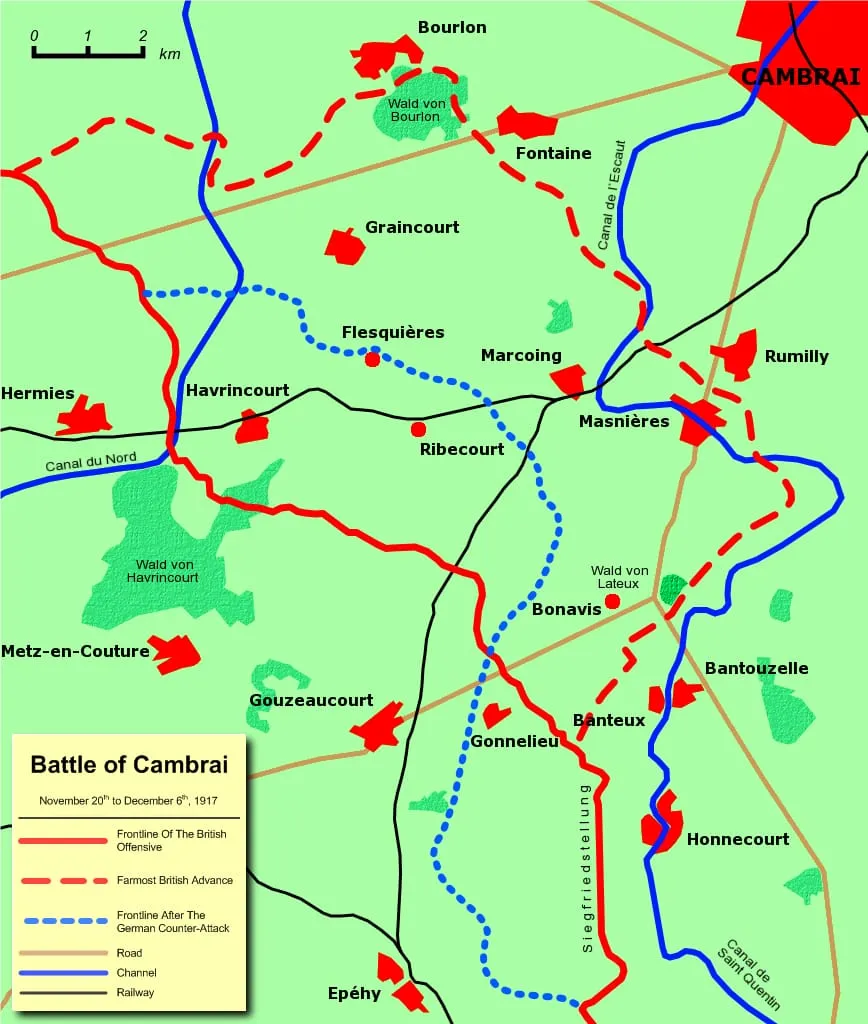
On Tuesday 20 November 1917, at 6.20 a.m., on a front some ten kilometres long south-west of Cambrai, an attack began such as the Western Front had never seen. The British Third Army of General Julian Byng assaulted the Hindenburg Line without a single shot of artillery preparation. Several hundred tanks drove ahead of the infantry to crush the wire, and more than a thousand guns opened fire only at the moment of the attack, aiming by maps and calculation. Surprise was complete. Within four hours the British had passed through the whole system of German defences, advanced five or six kilometres and by evening taken more than four thousand prisoners, at a cost many times lower than in the attacks in Flanders. Even so, the day’s plan was not fulfilled: the attack stalled at Flesquières, the cavalry did not get across the canal, and Bourlon ridge remained in German hands.
Before dawn
Preparations had gone on in the greatest secrecy for several weeks. By night batteries were brought into Havrincourt Wood and the surrounding villages, unable to fire a single ranging shot, together with 476 Mark IV tanks, 378 of them fighting tanks. Each fighting tank carried on its roof a fascine, a huge bundle of brushwood, which it dropped into the Hindenburg Line’s trenches, more than three metres wide, in order to cross over it. The new method of fighting was the work of a few men: the commander of the British Tank Corps, General Hugh Elles, and his chief of staff J. F. C. Fuller, who had long wanted to use tanks in mass on dry ground, and the artillery commander of the 9th Division, General Henry Hugh Tudor, who devised the attack without registration of the guns. The tanks, which more than a year earlier had gone into action on the Somme a few dozen strong and in the summer of 1917 had sunk into the mud of Flanders, were finally given their chance.
The Germans, who did not regard this sector as threatened, nevertheless sensed something. From 18 November, when prisoners taken from the British 36th Division revealed that an attack was being prepared around Havrincourt, the troops of the 54th Division had been on alert. On the night of 19–20 November German headquarters warned that the British might strike with tanks, but expected the attack to be preceded by a bombardment lasting several hours. The front between the canals was held in practice by two divisions, the 54th Division and the 20th Landwehr Division, with little artillery. On the evening of 19 November the first units of the 107th Division, transferred from Russia, began by chance to arrive in Cambrai.
The morning was cloudy and misty, with a light south-westerly wind. Elles, who in his order on the eve of the battle had announced that he would lead the tanks himself, rode in the tank “Hilda” at the head of the machines leading the 6th Division, under the largest Tank Corps flag that could be found. At 6.10, still in darkness, the machines moved off, their noise drowned by British aircraft circling low over the lines.
The breakthrough
At 6.20, as the tanks and the infantry following them crossed the British line, more than a thousand guns suddenly opened up. Fire fell on German batteries, strongpoints and villages in the rear, while a curtain of shells and smoke moved ahead of the attackers. The British official history writes that the defenders, stunned by the sudden storm, saw the tanks emerging from the mist, and that even where an attack had been expected nobody had imagined an assault like this. The German barrage was late, scattered and inaccurate. Most of the soldiers in the outpost zone surrendered or fled.
On the right of III Corps the 12th Division broke through the German lines along the Péronne–Cambrai road, took Lateau Wood and Bonavis Farm and advanced almost four and a half kilometres. Beside it the 20th Division took the village of La Vacquerie and reached the second line of defences. The 6th Division within a few hours captured both lines and the village of Ribécourt, where it took several hundred prisoners. Its losses were little more than 450 men, which the division attributed to close co-operation between infantry and tanks. On the left of IV Corps the 62nd Division, made up of Yorkshiremen, after sharp fighting took the village and château park of Havrincourt, while west of the Canal du Nord the Irishmen of the 36th Division stormed the great spoil heap from the canal excavations and pushed north along the German trenches. By about 11.30 the British held the Hindenburg Line along almost the whole front of attack and had begun to overrun the German artillery positions. In most battalions losses did not exceed eighty men.
British aviation, the Royal Flying Corps, supported the attack despite mist that made observation impossible. Fighters dropped out of the clouds to bomb and machine-gun German troops, batteries and columns from low altitude. According to the history of British aviation they heightened the panic caused by the tanks, but paid a high price: about a third of the aircraft used in this way failed to return, crashed or were badly damaged.
Flesquières
The only place where the attack broke down was the Flesquières ridge in the centre of the front. The Scots of General George Harper’s 51st (Highland) Division took the first line without great difficulty, but when their tanks drove onto the ridge and showed themselves against the skyline, they came under direct fire from German field guns placed behind the village. The batteries of the 54th Division, which in the spring on the Aisne had learned to fire at French tanks, ran their guns out from cover and hit the machines one after another. In the two tank battalions working with the 51st Division the artillery hit 28 machines. The infantry, following rather far behind them, ran into uncut wire and machine-gun fire from the houses and the château park. Some historians blame Harper, who had ordered his battalions to keep further back from the tanks than the instructions laid down; others consider the charge exaggerated.
A legend was born from the fighting at Flesquières. Haig’s dispatch mentioned a German artillery officer who served a gun alone and destroyed many tanks until he was killed beside it. The British official history holds that such losses could not have been inflicted by one gun or even one battery. According to the German author Zindler, the only reliable testimony on the matter, guns of several batteries took part in firing at the tanks, and one NCO, Krüger, served one of them alone and hit several machines.
In the afternoon the Scots tried several times to take the village, but a combined attack of infantry and tanks could not be organised. News of the failure took a long time to reach headquarters, and in the morning IV Corps even received a report of “many prisoners from Flesquières”, which was taken to mean the village had been captured. Nor was the chance taken to outflank Flesquières from the east through the 6th Division’s positions. The village remained in German hands until nightfall.
Masnières and the cavalry
At about 10.15 the 29th Division moved forward; it was to seize the crossings of the St Quentin Canal and open the way for the cavalry. On the left its units, with tanks, took Marcoing before the Germans could blow up the railway bridge, as well as Nine Wood and the village of Noyelles. The most important crossing, however, was at Masnières. At about 12.40 a tank with a group of infantrymen clinging to its armour tried to cross the main bridge, previously damaged by the Germans. The structure gave way and the machine was stuck between its broken ends. There was no other bridge that would bear a tank. The infantry crossed to the far bank one by one, over a lock and footbridges, and a battalion from Newfoundland crossed the canal on the western edge of the town. Beyond the canal, however, the soldiers met manned trenches and heavy fire, and without artillery and tank support they failed to take the Masnières–Beaurevoir line.
Meanwhile there was chaos on the German side. From Masnières to Crèvecœur that line was entirely unmanned for several hours, and the crossings between Marcoing and Masnières were defended by the 54th Division’s headquarters commandant with a handful of men. The British cavalry, however, could not exploit the opportunity. In the afternoon, as a drizzle began, a Canadian cavalry brigade reached Masnières. Only one squadron of the Canadian Fort Garry Horse crossed by the lock and galloped towards Rumilly. When the squadron commander was killed, Lieutenant Harcus Strachan led the horsemen in a charge on a German battery. After dark the survivors turned their horses loose and came back on foot, bringing prisoners with them. Strachan received the Victoria Cross for this. The commanders on the spot decided that larger cavalry forces could not get across the canal, and nobody knew of a wooden bridge a kilometre and a half further on that reconnaissance had not discovered. The cavalry division that was to go round Flesquières and move on Bourlon reached Marcoing only in the afternoon and halted.
On the left the 62nd Division made the deepest penetration of the day. In the afternoon, after tanks destroyed two field guns that had earlier hit six machines, the West Riding infantry took Graincourt, and after dark one company reached the sugar factory on the Bapaume–Cambrai road, at the foot of Bourlon ridge. With darkness falling and no support, no attack was made on Bourlon itself.
The day’s balance
By 6 p.m. the British had counted 102 officers and 4,109 men taken prisoner, and the number of prisoners was still rising. About a hundred guns had been captured or destroyed. Their own losses, according to the British official history, were little more than four thousand men. Breaking two strong trench lines with a belt of outposts in front of them in just over four hours was without precedent on the Western Front. It cost the tank crews dearly, however: of the 378 fighting tanks, 179 were out of action by evening, 65 of them hit by artillery, 71 broken down and 43 ditched or disabled by other failures. The surviving machines had to be gathered, refuelled and repaired, and the exhausted crews needed rest.
On the German side the 54th Division and its artillery had been almost destroyed, and the 20th Landwehr Division was in a similar state. First Quartermaster General Erich Ludendorff, who had rather expected further attacks in Flanders, learned of the attack by telephone soon after eight and at once sent reinforcements to Cambrai from north and south, and the headquarters agreed that the Second Army of General Georg von der Marwitz must restore the situation by counter-attack. In the evening the arriving battalions of the 107th Division filled the gaps in front of Cantaing, Noyelles and Masnières, while more divisions were on their way by rail from Flanders, the Aisne and Douai.
At 4.30 p.m. Douglas Haig met Byng at Albert. The French divisions waiting near Péronne for the signal to pursue were to stay where they were. Haig agreed that the Third Army should attack again the next day, before the Germans gathered their strength. The main objective was to be Bourlon ridge, whose capture the orders for 21 November called a matter of “paramount importance”. During the night, in rain and darkness, the Germans quietly abandoned Flesquières.
A few days later church bells were rung in Britain to celebrate the victory at Cambrai. The rejoicing proved premature: the fighting for Bourlon ridge lasted more than a week, and on 30 November the Germans counter-attacked, taking back from the British most of what they had won on 20 November.
Remember the articles you have read? Only in this browser; nothing is sent anywhere.How it works
Read ·
A voice from the front
“1. To-morrow the Tank Corps will have the chance for which it has been waiting for many months, to operate on good going in the van of the battle. […] 4. In the light of past experience I leave the good name of the Corps with great confidence in your hands. 5. I propose leading the attack of the Centre Division.”
Spotted a mistake?Report an error
Meanwhile
(04)Elsewhere in the same days.
- 21 November 1917 · Eastern FrontBolsheviks propose an armisticeOn 21 November 1917 Lenin's government told the high command to offer the enemy an armistice, and the Allied embassies got Trotsky's note. Dukhonin refused.
- 21 November 1917 · AfricaFlight of the airship L 59On 21 November 1917 the airship L 59 left Bulgaria with supplies for Lettow-Vorbeck. Recalled over Sudan, it returned after a 95-hour flight.
- 18 November 1917 · Middle EastDeath of General MaudeOn 18 November 1917 General Stanley Maude, the conqueror of Baghdad, died of cholera in the city. Command in Mesopotamia passed to General William Marshall.
- 17 November 1917 · War at seaSecond Battle of Heligoland BightOn 17 November 1917 British cruisers surprised German minesweepers in the Heligoland Bight. The chase was ended by minefields and two German battleships.
Related events
(04)The same battle, people or subject.
- 23 November 1917 · Western FrontFighting for Bourlon WoodOn 23 November 1917 the British 40th Division with tanks broke into Bourlon Wood near Cambrai and took the ridge. Bourlon and Fontaine villages were not taken.
- 30 November 1917 · Western FrontGerman counter-attack at CambraiOn 30 November 1917 the German Second Army struck the British salient at Cambrai. In the south it took Gouzeaucourt and 158 guns; at Bourlon it was repulsed.
- 3 December 1917 · Western FrontEnd of the Battle of CambraiOn 3 December 1917 the Germans took La Vacquerie and the Marcoing canal bend, and Haig ordered the Bourlon Wood salient abandoned for Flesquières Ridge.
- 21 March 1918 · Western FrontOperation Michael beginsOn 21 March 1918, after a five-hour bombardment and in thick fog, three German armies broke the British front on the Somme. The British lost over 38,000 men.