1916: The war in Africa
Battle of Ngomano
- Dates:
- 25 November 1917
- Front:
- Africa
- Location:
- Ngomano (Negomano), a Portuguese post on the south bank of the Rovuma at the mouth of the Lugenda, on the border of German East Africa and Portuguese East Africa (now northern Mozambique)On the battle map →
- Sides:
- German EmpirePaul von Lettow-VorbeckPortugalJoão Teixeira Pinto
- Result:
- German victory. The Portuguese garrison was destroyed and its commander killed, and the Germans captured weapons, ammunition, food and medicine that allowed them to carry on the war in Mozambique.
- Author:
- Natalia
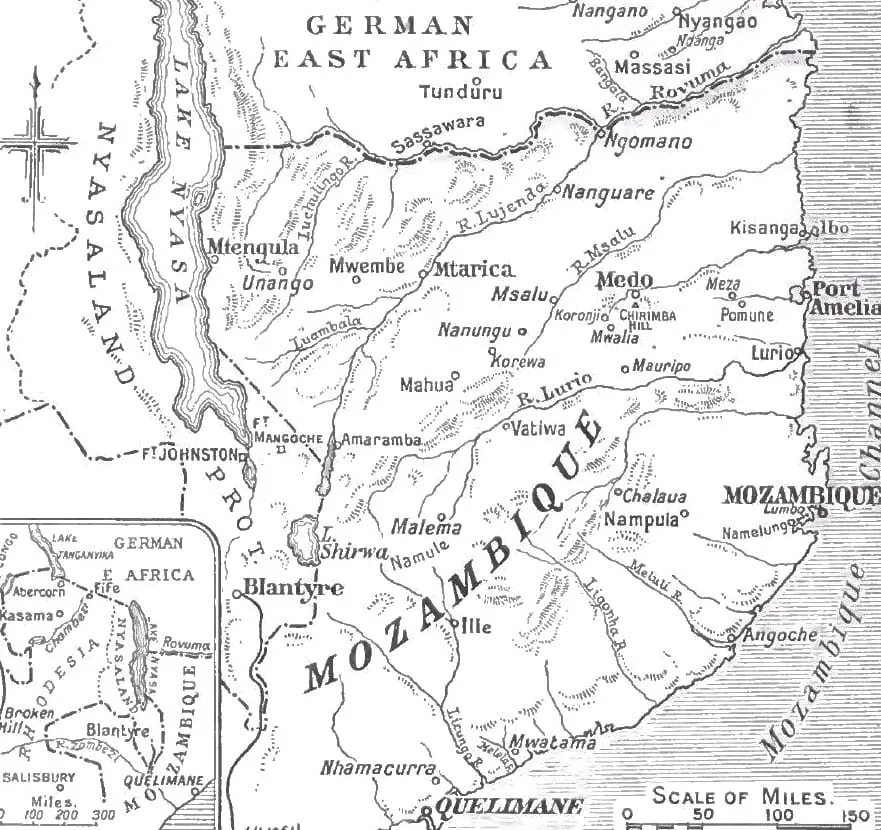
The Battle of Ngomano opened the last chapter of the war in East Africa. On 25 November 1917 the main force of Paul von Lettow-Vorbeck, driven out of German East Africa, forded the border river Rovuma and the same day attacked a newly established Portuguese camp at Ngomano, at the mouth of the Lugenda. After several hours of fighting the garrison, commanded by Major João Teixeira Pinto, ceased to exist. For the Germans, who were running out of ammunition, food and medicine, it was salvation: the booty from Ngomano rearmed them and allowed them to wage war on Portuguese territory until the end of 1918.
Name and dates
The place appears in the sources in two forms. The British and Germans usually wrote Ngomano; the Portuguese speak of the battle or “combat of Negomano” (combate de Negomano). The British official chronology of the war records under 25 November 1917 that Lettow-Vorbeck’s forces crossed the Rovuma and defeated the Portuguese at Ngomano, and that German operations in Portuguese East Africa began. The crossing and the battle fitted into a single day, so we take 25 November as both the start and end date. The German rearguard, which crossed the river two days later, and the small company later left at Ngomano did not fight any further significant actions.
Background
After the bloody Battle of Mahiwa in October 1917 Lettow-Vorbeck had nothing with which to replace his losses. British columns from Kilwa and Lindi were pushing his units onto the Makonde plateau, and so little ammunition was left that most of the askaris were still firing 1871-pattern black-powder rifles. In a conversation with Governor Heinrich Schnee on 24 October Lettow-Vorbeck declared that he was ready to leave the colony and move into Portuguese East Africa. Portugal had been at war with Germany since March 1916, and its troops in Mozambique, as earlier fighting on the Rovuma had shown, were weak and poorly supplied.
On 20 November Lettow-Vorbeck reached Newala. He left there the sick, the wounded and those unfit to march, and the next day set off south with about 300 Europeans, 1,700 askaris and about 3,000 porters and other Africans. That is the figure Lettow-Vorbeck himself gives. Other sources give lower numbers: according to General C. P. Fendall, who served with the British forces in East Africa, about 200 Europeans and 1,500 askaris crossed the river. Governor Schnee and General Kurt Wahle went with them too. Lettow-Vorbeck chose the route up the Rovuma because he knew from people familiar with the area that before the war there had been a Portuguese station at the mouth of the Lugenda, and he hoped to find supplies there. Locals told him of a garrison of as many as 2,000 men. The second large German detachment, under Captain Tafel, was meanwhile fighting its way from the Mahenge area, and Lettow-Vorbeck had no news of it.
The Portuguese knew the Germans might cross the border. The British commander in East Africa, General Jacob van Deventer, asked the commander of the troops in Mozambique, Colonel Sousa Rosa, to occupy the Rovuma line, while himself passing on information about German movements. According to a Portuguese study based on the work of General Gomes da Costa, Major Teixeira Pinto’s column had been at Ngomano since October, but in November a series of contradictory orders shifted companies between posts, so that nobody had time to prepare proper trenches and fields of fire. On 20 November van Deventer warned the Portuguese that the Germans were heading south, but named a different stretch of the river as the crossing point. Captain W. D. Downes, author of the history of the Nigerian brigade, wrote that on that day about 900 Portuguese African soldiers arrived at Ngomano from the south and that instead of fortifying the position they set about pitching a large camp beside the old fort. According to some accounts a more senior officer, Quaresma, also arrived in those days to replace Teixeira Pinto, but Portuguese sources present Teixeira Pinto as the commander in the battle.
João Teixeira Pinto, born in 1876 in Moçâmedes in Angola, was one of the best-known Portuguese colonial officers. He made his name in 1913–1915 with the campaigns of conquest in Portuguese Guinea, for which he received the Order of the Tower and Sword.
Course of the battle
Early on the morning of 25 November the German advance guard forded the Rovuma a little above the mouth of the Lugenda. During the morning the main body, nine companies, crossed, while the rearguard was about two days’ march behind. Three companies under Captain Göring crossed the river much further downstream to surprise another Portuguese camp. Lettow-Vorbeck recalled that his troops were then in a state of “allgemeine Wurschtigkeit”, the indifference of men cut off from all help: the hunters went on hunting, and many soldiers bathed in the river in full view of the enemy. On the south bank the advance guard ran into Portuguese scouts.
Lettow-Vorbeck reconnoitred the camp in person. He saw men in white clothes building fortifications, and a transport column. When roughly a company of askaris in khaki came out of the camp, he thought the Portuguese meant to attack his men during the crossing, and ordered them onto the defensive. The attack did not come. Lettow-Vorbeck considered bypassing the camp and continuing up the Lugenda, but a belt of dense forest on the other side of that river made it possible to approach the position itself unseen. On the advice of Captain Müller he decided to attack, although part of his force was still crossing the river.
A light mountain gun shelled the Portuguese trenches from the west, and according to Downes a few shells also fell on the camp from the north bank of the Rovuma. Several companies pinned the defenders from the west and north, while Captain Koehl’s detachment crossed the Lugenda about a kilometre above Ngomano, pushed through the forest and struck the camp from the south. The Portuguese, who expected a frontal attack, dug in hastily in shallow rifle pits which, according to Downes, mostly did not protect even against bullets. Their machine guns, as Lettow-Vorbeck admitted, fired quite well. The Portuguese study states that the Germans gave the order to attack at 12.45, fighting began before 2 p.m., and at about 4 p.m., after two more companies came up, the defensive line broke in the sector of the 25th and 27th Native Companies. Other Portuguese accounts speak of an attack before noon and a cease-fire signal at about 3 p.m. All sources agree that the fighting lasted several hours.
The Germans saved ammunition. According to Downes they used only four machine guns, and at very close range, while the Portuguese fired at least 30,000–40,000 rounds from about 350 rifle pits. Lettow-Vorbeck’s askaris shouted that “today is the day of the old rifles”: the smoke from their black-powder weapons did not this time draw mortar fire on them, because the Portuguese had no mortars. When Koehl’s line rushed into the trenches, the attack went in from all sides. Teixeira Pinto was killed. Downes wrote that he fell at the very start of the fighting together with eight other Europeans. Portuguese accounts say that the major, wounded in the arm, was carried to a tent and found dead only after the battle. Deprived of their commander, the defenders surrendered.
Immediately afterwards the camp became a battlefield of another kind. Askaris, porters and servants threw themselves on the Portuguese stores. Lettow-Vorbeck described how cases of jam were opened and abandoned as soon as someone found something better, and how even the captured Portuguese askaris joined in the looting. It took him a good while to restore order.
Losses
Lettow-Vorbeck wrote that of about 1,000 defenders little more than 200 escaped, that the Germans buried about 200 enemy dead, released about 150 Europeans on parole not to fight against Germany again, and took several hundred askaris prisoner. Portuguese figures are lower, but also very high. The study based on Gomes da Costa’s work gives 5 officers, 21 European NCOs and men and 162 African soldiers killed, and 30 officers, 75 Europeans and 550 Africans taken prisoner. Another tally speaks of 208 African soldiers killed and more than 550 prisoners, including 31 officers. According to Downes about 700 askaris surrendered. The Germans used the prisoners as porters and later released them.
German losses were very small. Downes, who saw the battlefield a few days later, judged from the graves that the Germans had lost only one European, Sergeant Bachmann. Later studies speak of one European and three askaris killed.
Booty
For Lettow-Vorbeck what mattered most was what he captured. Six machine guns fell into his hands, several hundred rifles, about 250,000 rounds, about 30 horses, several tons of European food and stocks of medicine, which he remembered as excellent, because the Portuguese had centuries of experience of colonial wars. Almost half his soldiers were armed with Portuguese rifles, and weapons for which there were no more cartridges were destroyed. According to Downes the Germans also took British machine guns with which the Portuguese unit had been armed. The ragged soldiers changed into captured uniforms. Lettow-Vorbeck called the arrival of the Portuguese at Ngomano just before his own “a real miracle”: at one stroke he was rid of a great part of his troubles. In December, after further raids on Portuguese posts, his stock of ammunition grew to almost a million rounds.
Only food for the Africans was lacking, as there were no stocks of local grain in the camp. Nor could Lettow-Vorbeck stay at Ngomano, as he feared the arrival of the British. He left Captain Klinkhardt’s company on the river as a rearguard and set off up the Lugenda, into the interior.
Significance
The British received the news of Ngomano with bitterness. Downes considered comment superfluous and left readers to draw their own conclusions, and Fendall wrote that the Portuguese had given assurances they would stop the Germans on the Rovuma, whereas a few shots had been enough to make their post capitulate. In Portugal the “Negomano affair” still provokes disputes about the commanders’ responsibility for dispersing the troops and failing to fortify. The battle did not change the fate of German East Africa, which the British within the following days declared entirely occupied. It did, however, save Lettow-Vorbeck’s army. Without the booty from Ngomano his troops, lacking ammunition and food, would probably soon have had to capitulate, just as Tafel’s cut-off detachment capitulated that same week.
Instead, Lettow-Vorbeck spent ten months crossing Mozambique, living on supplies seized from Portuguese posts and tying down much larger British and Portuguese forces. In September 1918 he returned to the territory of German East Africa and then entered Northern Rhodesia. He laid down his arms only on 25 November 1918 at Abercorn, two weeks after the armistice in Europe, exactly a year after the Battle of Ngomano.
Spotted a mistake?Report an error