1915: The war at sea
Battle of the Rufiji Delta
- Dates:
- 6–11 July 1915
- Front:
- War at sea
- Location:
- The northern Kikunja channel of the Rufiji River delta, coast of German East Africa opposite Mafia Island (now Tanzania)On the battle map →
- Sides:
- United KingdomHerbert King-Hall, Eric FullertonGerman EmpireMax Looff
- Result:
- British victory. The cruiser Königsberg was wrecked and scuttled by her own crew, but the Germans salvaged her guns and used them in the fighting on land.
- Author:
- Natalia
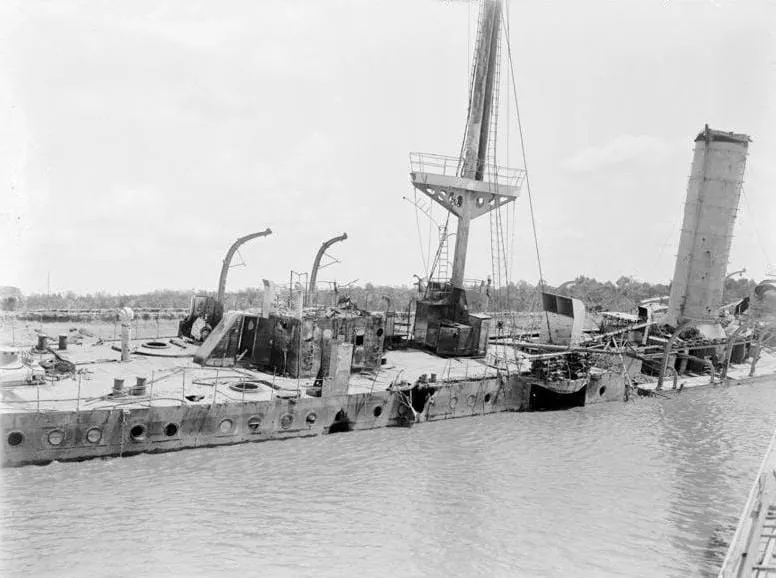
The battle of the Rufiji Delta ended the Royal Navy’s hunt, lasting more than eight months, for the German light cruiser Königsberg, hidden in the backwaters of the Rufiji River on the coast of German East Africa. Large ships could not reach her across the shallows, so the Admiralty sent two shallow-draught monitors, Severn and Mersey, to Africa. On 6 and 11 July 1915 they went deep into the delta and shelled the cruiser from a range of about 10 km, their fire directed by airmen in aircraft circling over the jungle. The second time Königsberg was wrecked, and Commander Max Looff ordered her blown up. It was one of the first actions in which ships fired at an unseen target solely on the basis of corrections passed from the air.
Name and dates
In English-language literature the name Battle of the Rufiji Delta is often applied to the whole blockade and siege of Königsberg, from her discovery at the end of October 1914 to her sinking. This page adopts the narrower meaning: the two attacks by the monitors on 6 and 11 July 1915, described in the British official history (Julian Corbett, Naval Operations, vol. III). Between them the monitors returned for a few days to their base on Mafia Island for repairs. The earlier history of the blockade is covered by articles on the timeline.
Background
Königsberg, commanded by Commander Max Looff, sank the cruiser Pegasus off Zanzibar in September 1914, but then had to hide in the Rufiji delta with defective engines. On 30 October the British found her and blockaded the river mouths. The cruiser lay a dozen or so kilometres upriver, among mangroves and jungle, out of range of the guns of ships that could not cross the bars at the mouth. The banks were guarded by German observation posts linked by telephone, light guns, machine guns and torpedo tubes. The defence of the delta was directed by Kapitänleutnant Werner Schönfeld. Part of the crew went ashore: according to the British official history of operations in East Africa, in May 1915 118 sailors joined the field units of Lieutenant-Colonel Paul von Lettow-Vorbeck.
The British tried various methods. They sank an old collier in one of the river channels to block the way to the sea. In January 1915 they occupied Mafia Island opposite the delta, and from March they maintained a formal blockade of the whole coast. First a civilian aviator and then seaplanes of the Royal Naval Air Service reconnoitred the cruiser’s position. Bombing from the air proved impossible, however, because in the heat the underpowered machines could not climb higher than a few hundred metres, and the wood and glue in their construction could not withstand the tropical climate. Meanwhile the Admiralty could not keep cruisers indefinitely watching one hidden ship when they were needed elsewhere, not least at the Dardanelles.
Monitors and aircraft
The answer turned out to be monitors. Severn, Mersey and their sister Humber had been built in Britain as river gunboats for Brazil, intended for service on the Amazon. In August 1914 the Royal Navy took them over. They displaced about 1,260 tons, drew less than two metres and carried two 152 mm (6-inch) guns each. They were not fit for the open sea. Severn under Commander Eric Fullerton and Mersey under Commander R. A. Wilson set out from Malta in the spring of 1915 with tugs, a supply ship and a collier, through the Suez Canal and the Red Sea. On 15 May they reached Aden, and from there, against wind and currents, they made their way along the African coast, often under tow. Corbett called the voyage one of the hardest of the whole war. On 3 June the monitors anchored off Mafia Island.
Over the next month the ships were prepared for battle. Their decks and sides were protected with extra plates and sandbags. On Mafia an airfield was laid out for a few Henry Farman and Caudron landplanes, which under Squadron Commander R. Gordon replaced the unreliable seaplanes, and directing fire from the air was practised. The South African hunter and scout Pieter Pretorius reconnoitred the channels of the delta and the depth of the water by night. Vice-Admiral Herbert King-Hall, commander of the Cape of Good Hope Station, assembled for the operation the cruisers Hyacinth, Weymouth, Pioneer and Pyramus, the armed merchant cruisers Laconia and Laurentic and several trawlers and auxiliary vessels. On 5 July, to divert the Germans’ attention, Laurentic and transports feigned a landing near Dar es Salaam.
Course
6 July
At 5.20 a.m. both monitors entered the northern channel of the delta, the Kikunja. From the banks they were fired on by small guns, machine guns and riflemen hidden in the thickets, but without much effect. Behind them Weymouth with King-Hall approached the mouth, while Hyacinth and Pioneer occupied the defenders’ attention at another mouth, the Simba Uranga. At about 6.30 a.m. Severn and Mersey anchored at a spot estimated at about 11,000 yards (10 km) from the target and opened fire. Corrections were sent from an aircraft by the naval airman J. T. Cull (with the rank of Flight Commander).
The Germans had expected the monitors at exactly this spot and knew the range to them. Königsberg fired salvoes from four, and sometimes five, guns, which fell a dozen or so metres from the monitors’ sides. At 7.40 a.m. a shell hit Mersey’s forward turret, put the gun out of action and killed several gunners; another pierced the hull at the waterline. Mersey had to pull back. Severn went on firing alone for more than an hour, until the aircraft had to return to the airfield. In the afternoon, with a fresh aircraft, the monitors resumed fire, but at 3.45 p.m. the commander ordered a withdrawal. The crews were exhausted and dejected. Of the 635 shells fired, the airmen had corrected only 78, and according to Corbett only six hit the cruiser (according to some sources four). On Mersey, according to the British official history, three sailors were killed, according to other tallies four, and two more later died of wounds.
11 July
For four days the strained hulls and guns were repaired at Mafia. It was decided that this time only one ship at a time would direct its fire, while the other drew the enemy’s fire on itself. On the morning of 11 July the monitors again entered the Kikunja. Mersey anchored at her position of 6 July, while Severn went further upriver under a hail of salvoes. At about 12.30 p.m., unhit, she anchored and opened fire, directed again by Cull and his observer, Flight Sub-Lieutenant Arnold.
The first seven salvoes missed, but the eighth hit, and then the aircraft signalled hit after hit. After ten minutes Königsberg was firing from only three guns. Then German fire reached the aircraft and Cull reported that he had to come down on the water. He kept the machine flying as long as he could, and Arnold passed corrections to the end. The aircraft fell into the river between the monitors, and both airmen were picked up by a boat from Mersey. At about 12.52 p.m. there was a great explosion on the cruiser and she was wrapped in clouds of smoke. By 1.40 p.m. the observers had counted seven more explosions. Then Mersey came closer and continued shelling the target, and by about 2.20 p.m. the wreck was burning from bow to stern.
Looff, wounded, ordered the ship abandoned, the breech-blocks of the guns removed or destroyed and the cruiser blown up with charges made from torpedo warheads. According to German data the explosions took place at about 1.40–2 p.m. and Königsberg settled on the bottom of the shallow river. King-Hall recalled the monitors. According to the German official history, 19 members of the crew were killed and 45 wounded in the last fight.
Significance
Corbett wrote that this was the end of the last German cruiser on the open seas. The threat to British shipping in the Indian Ocean disappeared, and the ships watching the delta could return to other tasks or turn to blockading the coast and supporting the land forces. The operation was also one of the first examples of co-operation between ships and aircraft: the monitors fired at a target they could not see, solely on the basis of corrections passed from the air by wireless.
For the Germans in East Africa, however, Königsberg did not cease to be useful. From the next day her crew, under Schönfeld’s direction, salvaged guns, ammunition and equipment from the wreck. Ten 105 mm guns and two smaller ones were taken to the workshops in Dar es Salaam, mounted on carriages and used for years afterwards as heavy field artillery in Lettow-Vorbeck’s campaign. One of them went to the steamer Götzen on Lake Tanganyika. The surviving sailors were drafted into the land forces, and Looff himself later commanded the defence of the southern part of the colony.
Spotted a mistake?Report an error