Bulgaria · The Central Powers
Boris III
Heir to the throne of Bulgaria (1894–1918), officer at Bulgarian General Headquarters, Tsar of Bulgaria (1918–1943)
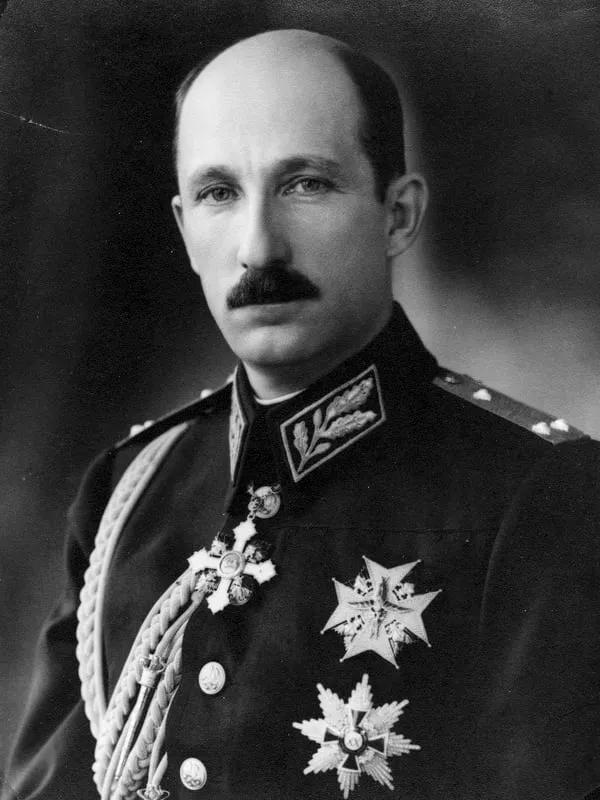
- Born:
- 30 January 1894, Sofia
- Died:
- 28 August 1943, Sofia
- Author:
- Natalia
- Photo:
- Dimitar Karastoyanov, domena publiczna, Wikimedia Commons

Boris, Prince of Tarnovo, was during the Great War the heir to the Bulgarian throne and a young officer who took no great decisions. It was his father, Tsar Ferdinand I, who in 1915 brought the country into the war on Germany’s side. Boris served at headquarters as a liaison officer, travelling between staffs, fronts and allies, and during the Romanian campaign he smoothed over disputes between Bulgarian and German commanders. His hour came in September 1918. When the Macedonian front collapsed, the heir to the throne went from regiment to regiment trying to stop the retreat, and won a popularity his father had never had. On 3 October 1918, after Ferdinand’s abdication, he became tsar. Thanks to him Bulgaria was the only one of the defeated states to keep its monarchy.
Childhood and youth
He was born on 30 January 1894 (18 January in the Julian calendar, which Bulgaria then used) in Sofia, the first son of Prince Ferdinand of the house of Saxe-Coburg and Gotha and Princess Marie Louise of Bourbon-Parma. He was christened Boris Clement Robert Maria Pius Louis Stanislaus Xavier. His birth was a political asset for Ferdinand. The Catholic prince, whom Russia still did not recognise, had the heir to the throne received into the Orthodox Church in February 1896, and Tsar Nicholas II became the boy’s godfather. Pope Leo XIII excommunicated Ferdinand, and Boris’s mother, a devout Catholic, took this very hard. She died in 1899. The reward, however, was Ferdinand’s recognition by the Great Powers and reconciliation with Russia. The fact that the heir to the throne had been born in Bulgaria and professed the Orthodox faith was to help him greatly in the future.
His father was demanding and cold, and the sons, Boris and the younger Kiril, grew up apart from their peers. They were taught at a palace school that Ferdinand had founded especially for them. Boris graduated from the military school in Sofia, and during the Balkan Wars of 1912–1913 he served at headquarters. He grew into a shy, modest and hard-working young man, passionate about nature and technology, especially railways. He liked to drive locomotives himself.
At war on Germany’s side
The decision to enter the war was taken by the tsar and Prime Minister Vasil Radoslavov. In the autumn of 1915 Bulgaria declared war on Serbia and, together with the armies of Field Marshal August von Mackensen, took part in the conquest of Serbia. Boris served as a liaison officer of the headquarters of the Bulgarian army, commanded by General Nikola Zhekov, with the troops on the Macedonian front. In January 1916 he became a major, and later the same year a lieutenant-colonel.
When Romania entered the war in August 1916, Bulgaria declared war on it. Boris was attached as a liaison officer to Mackensen’s army group and to the Bulgarian Third Army of General Stefan Toshev, which took Tutrakan and the whole of Dobruja. Relations between the proud Bulgarian general and the German field marshal were difficult, and according to his biographers the heir to the throne skilfully smoothed them. In doing so he won the esteem of the German commanders. Surviving photographs from those years show him accompanying Mackensen and Zhekov at reviews of troops.
In 1917–1918 the Macedonian front stood still. Boris visited the positions, called on units and got to know the soldiers, who increasingly felt the shortages of food and clothing and their exhaustion from the war. He had no influence on politics. When in June 1918 his father dismissed Radoslavov and appointed the government of Aleksandar Malinov, who was regarded as an advocate of an understanding with the Entente, the heir to the throne remained a soldier.
September 1918
On 15 September 1918 the Allies attacked at Dobro Pole and broke through the front. Within a few days the Vardar Offensive shattered the Bulgarian divisions. The British official history by Cyril Falls describes how the heir to the throne intervened in person in a disintegrating Bulgarian division and then, driving a light lorry himself, went from point to point wherever a breakthrough threatened and put heart into the soldiers. According to Falls he showed energy, courage and coolness that won him the nation. It was at his request that the German army group commander, General Friedrich von Scholtz, delayed the order to retreat for several hours, but the news from the front grew ever worse and the retreat began.
The army was falling apart. Mutinous soldiers seized the headquarters at Kyustendil, and on 27 September at Radomir they proclaimed a republic and marched on Sofia. Meanwhile Malinov’s government asked for an armistice, and on 29 September its delegates signed the Armistice of Salonica. The rebellion was crushed outside the capital on 30 September, but the tsar’s authority was destroyed. The Allies made it clear that they expected him to go.
Tsar
On 3 October 1918 Ferdinand signed the act of abdication and called on his subjects to rally round Tsar Boris. He himself left the country at once. Boris took the name Boris III, harking back to the medieval rulers of Bulgaria, and on the same day was promoted to major-general. He dispensed with a coronation and a military parade. In a manifesto to the nation he recalled that he had been born in Bulgaria and professed the Orthodox faith, and promised to respect the constitution. According to the press of the time Sofia welcomed him with enthusiasm, and the bells rang in all the churches.
Falls wrote that in the first days Bulgaria escaped an anti-dynastic revolution thanks to the German troops present in Sofia, and later thanks to the popularity that the heir to the throne’s conduct had won him among the soldiers returning from the front and in the whole nation. In October and November foreign agencies several times reported a revolution and the abdication of the young tsar, but these were rumours. Of all the defeated states, Russia, Austria-Hungary, Germany, Turkey and Bulgaria, only in Bulgaria did the monarchy survive for long: the Ottoman sultanate was abolished in 1922.
The first months of the reign were very difficult. Allied troops were stationed in the country, the army was being demobilised, and in November Malinov’s government resigned in protest against the Romanian occupation of southern Dobruja. The young tsar reigned in the shadow of strong politicians. In 1919 the leader of the Agrarians, Aleksandar Stamboliyski, a recent rebel, became prime minister, and Boris managed to establish correct relations with him. On 27 November 1919 Bulgaria signed the Treaty of Neuilly-sur-Seine, which took away its access to the Aegean Sea and lands in the west, imposed heavy reparations and limited the army to 20,000 men.
After the war
In 1923 Stamboliyski was overthrown and murdered by army officers. The 1920s brought terrorist attacks, including the bombing of St Nedelya Cathedral in Sofia in April 1925, and bloody repression. In 1930 Boris married the Italian princess Giovanna of Savoy, daughter of King Victor Emmanuel III. After the military coup of 1934 the tsar took effective power in 1935 and ruled personally until his death. During the Second World War, hoping for a revision of the Neuilly settlement, he tied Bulgaria to Germany. In 1940 it regained southern Dobruja, and in 1941 it joined the Tripartite Pact and occupied Macedonia and part of Greek Thrace. The Bulgarian authorities handed over the Jews of the occupied territories to the Germans to be killed, but under pressure from public opinion the deportation of the Jews of Bulgaria proper was halted. Boris also sent no troops against the Soviet Union. He died suddenly on 28 August 1943 in Sofia, shortly after returning from a meeting with Hitler. The throne passed to his six-year-old son Simeon II.
Assessment
Boris’s role in 1914–1918 was modest and limited to service as a staff officer, but in September and October 1918 it proved important for Bulgaria. Falls and later historians generally agree that his conduct during the retreat, and the fact that he bore no responsibility for the decision of 1915, saved the dynasty. The father became the symbol of two national catastrophes, the son the symbol of hope for recovery.
The assessment of the whole reign is much harder and still disputed. In Bulgaria Boris is sometimes called “the Unifier” and praised for saving the Bulgarian Jews and avoiding war with Russia. Critics point out that it was he who brought the country into alliance with the Third Reich, approved the anti-Jewish laws and bears responsibility for the deportation of Jews from the occupied Macedonian and Thracian lands to the Treblinka extermination camp. For the historian of the Great War, however, he remains above all the heir to the throne who at the moment of defeat managed to win over the soldiers returning from the front.
Sources
Spotted a mistake?Report an error
Mentioned in battles
(01)Often appears with
People who appear in the same events.