Bulgaria · The Central Powers
Stefan Toshev
Commander of the Bulgarian 3rd Army (1915–1916) and 4th Army (1918), general of infantry
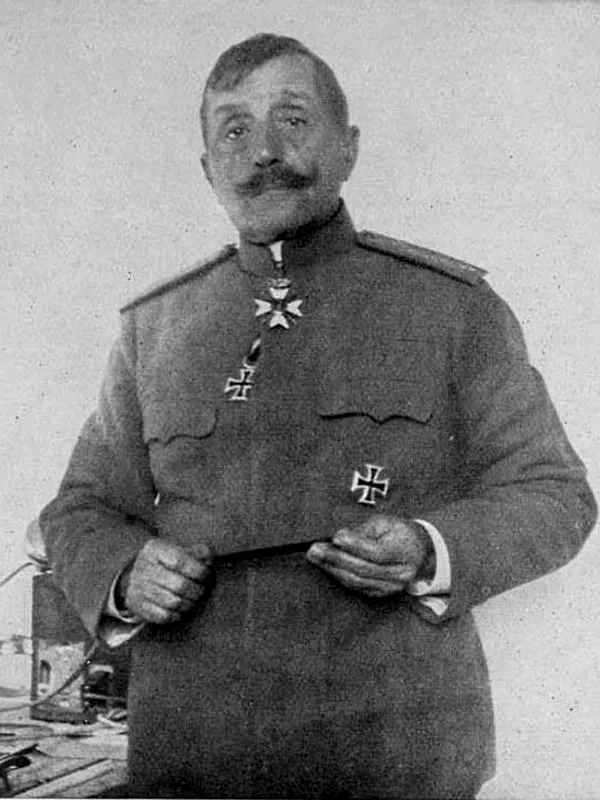
- Born:
- 18 December 1859, Stara Zagora (Ottoman Empire, now Bulgaria)
- Died:
- 27 November 1924, Plovdiv
- Author:
- Natalia
- Photo:
- M. F. u. F, domena publiczna, Wikimedia Commons

Stefan Toshev was the commander who gave Bulgaria its most celebrated victory of the Great War. In September 1916 his 3rd Army took the Romanian fortress of Turtucaia on the Danube in a few days, captured nearly 30,000 soldiers and within a few weeks wrested southern Dobruja from Romania, land that Bulgaria had lost in 1913. He was also a stubborn and proud officer who did not want to be a mere executor of a German field marshal’s orders. His disputes with August von Mackensen cost him his command before the Dobruja campaign was over. After the war he defended with his pen the honour of the Bulgarian army against what German generals wrote about it.
Before the war
He was born on 18 December 1859 in Stara Zagora, then still within the Ottoman Empire. His mother, Anastasia Tosheva, was a teacher and a well-known figure of the Bulgarian National Revival; his father was a merchant. He spent his youth in Gabrovo, where his mother taught at a girls’ school. During the Russo-Turkish War the seventeen-year-old Stefan volunteered for the Bulgarian militia, where, because he knew Russian, he served as an interpreter. In May 1879 he graduated in the first class of the military school in Sofia and began service in the militia of Eastern Rumelia, the autonomous province in which his home town lay.
In the Serbo-Bulgarian War of 1885 he commanded a battalion as a captain. He covered the retreat from Tran and then took part in the counter-attack at Slivnitsa, where, according to a Russian biographer, he was wounded in both legs. For this war he received the order “For Bravery”. His “Letters from the War of 1885” are regarded as the first Bulgarian war memoirs in which the author wrote openly about his own mistakes. Over the next quarter of a century he commanded regiments, a brigade and divisions, and in 1904 he became a major general.
In the First Balkan War he led the 1st Sofia Infantry Division, known as the “iron” division. In October 1912 his division won the engagement at Gechkinli and Seliolu that opened the Battle of Kırk Kilise, and then fought at Lüleburgaz and on the Çatalca lines. Even then Toshev clashed with his superiors when he felt they were halting a pursuit or ordering attacks without preparation. In the Second Balkan War he commanded the 5th Army at Kyustendil, which stopped the Serbs advancing into the interior of Bulgaria. In August 1913 he was promoted to lieutenant general. He took his country’s defeat and the Peace of Bucharest very hard, and blamed them on the government and the high command, not the soldiers.
1915–1916: guard on the Danube
When in the autumn of 1915 Bulgaria mobilised its army, Toshev took command of the 3rd Army. Unlike the other two armies, which went against Serbia, it was to guard the long border with Romania, from the Danube to the Black Sea coast. For nearly a year it stood between Ruse and Varna, building roads and strengthening positions. Officers and men who wanted to fight bore this inactivity badly, but when in August 1916 Romania entered the war, it was Toshev’s army that was to play the main role. It was placed under Mackensen, with Toshev retaining operational command over the Bulgarian troops.
From the first days two views of the war collided. Mackensen wanted to strike simultaneously at both Romanian fortresses on the Danube, Turtucaia and Silistra, and quickly prepare a crossing towards Bucharest. Toshev considered dividing forces between two fortresses too risky, and for Bulgaria the aim was above all to recover Dobruja. At a conference at Gorna Oryahovitsa station on 31 August he persuaded the field marshal to concentrate all forces on Turtucaia, leaving only a screen before Silistra and Dobrich. He entrusted the main attack to General Panteley Kiselov’s 4th Preslav Division.
1916: Tutrakan and Dobruja
The day after Bulgaria declared war on Romania, on the night of 1–2 September, the 3rd Army crossed the Dobruja border along its whole length. At Tutrakan the Bulgarians closed on the fortress, and on 5 September they launched the assault. Mackensen was reckoning on a siege that might last weeks. Toshev argued that every day’s delay would allow Russian reinforcements to arrive. The fortress fell on 6 September, after two days of assault. According to the Austrian official history, about 28,500 soldiers were taken prisoner and more than a hundred guns captured. In the same days other units of the army, under General Todor Kantardzhiev, repulsed Russian and Romanian troops and Serbian volunteers at Dobrich, and the Romanians abandoned Silistra. In little more than a week almost the whole of southern Dobruja was in Bulgarian hands.
The Germans’ part in the assault was small, and for the rest of his life Toshev opposed attempts to diminish the Bulgarian character of this victory. The success, however, deepened his disputes with Mackensen. In September the allies halted before the fortified Cobadin–Rasova line, on which the Russians and Romanians had gathered reinforcements. The field marshal demanded further attacks, while Toshev replied that he would not send men to attack without heavy artillery, reconnaissance and reserves. According to Bulgarian biographers, he is said to have declared that the lives of Bulgarian soldiers must not be sacrificed merely to keep to a German timetable. When the first attacks on the Cobadin line broke down and the enemy went over to counter-attacks, he withdrew his troops to prepared positions.
For the second blow Mackensen divided his forces into two groups. The eastern one, with the Germans and most of the heavy guns, was to deliver the main blow at Topraisar. The western one, under Toshev, made up of Bulgarians and the Turkish VI Corps, was to pin the enemy on the Danube. Toshev was opposed to splitting up his army in this way. The offensive began on 19 October and after three days broke through the front. On 22 October the allies entered Constanța, and on 24 October Mackensen ordered Toshev to take the bridgehead at Cernavodă. The Romanians withdrew during the night, and on the morning of 25 October the Bulgarians entered. The railway from Bucharest to Constanța, Romania’s only land link with the sea, was cut.
Dismissal
The victory did not end the conflict. Mackensen took more and more units away from Toshev’s command and moved them to the Danube, where he was preparing a crossing towards Bucharest. The Bulgarian general regarded this as an infringement not only of his own authority but of the independence of the Bulgarian command. He wanted first to take the whole of Dobruja, as far as the Danube delta. According to Bulgarian sources he twice asked to be relieved, and the second request, made in mid-November, was accepted. At the end of November 1916, in the same days that Mackensen crossed the Danube, General Stefan Nerezov took over the 3rd Army. The fighting in northern Dobruja died down only in January 1917.
On 25 March 1917 Toshev was promoted to general of infantry, then the highest rank in the Bulgarian army. Sources differ on what he did in the following months. According to Bulgarian biographers he remained at the disposal of headquarters, and in January 1918 he took up the post of governor-general of Macedonia, that is, of the military-administrative district covering the part of that region occupied by the Bulgarians. German studies link this appointment directly to his departure from Dobruja. In June 1918 he took command of the 4th Army, which held the front on the lower Struma and the Aegean coast as far as the mouth of the Maritsa. According to the British official history, it was a new and weak army, made up of one division and a few smaller units. In the days of the breakthrough at Dobro Pole its sector was not the Allies’ main objective.
After the war
After the armistice of Salonika and demobilisation, Toshev commanded the 4th Military Inspection District at Komotini in Thrace, and on 24 June 1919 he was transferred to the reserve. He was active in the Union of Reserve Officers, and in the autumn of 1923 he headed a committee that helped the victims of the communist September Uprising. In 1921 he published a book on the operations of the 3rd Army in Dobruja, conceived as a reply to what Erich Ludendorff had written about the Bulgarians in his memoirs, and in 1924 “Defeated, but not Beaten”, a survey of the three wars of 1912–1918. He died suddenly in Plovdiv, according to most sources on 27 November 1924, although some Bulgarian studies give 27 October. He was buried in Sofia. His name is borne by the town of General Toshevo in Dobruja, named so in 1942, and by a village near Yambol.
Assessment
In Bulgaria Toshev is regarded as one of the finest commanders in the country’s history and as the victor of Tutrakan, whose judgement proved correct: concentrating forces on a single fortress brought a quick success and opened the way to Dobruja. Bulgarian authors also praise him as a commander who left the initiative to his subordinates, cared little for drill and formalities, rewarded his soldiers and did not squander their lives. They relate that he lived so modestly that for the fifth anniversary of the capture of Tutrakan he could not afford to buy a new suit.
The view from the other side is cooler. German commanders saw in him a general who slowed the pace of operations and too readily put Bulgarian interests above the common plan. They attribute the main role in the October breakthrough on the Cobadin line to the eastern group with the German artillery, not to his troops. The Romanian historian Constantin Kirițescu, for his part, accused him of presenting, in his report on the capture of Cernavodă, the weak remnants of two Romanian brigades as a strong division with dozens of guns. The dispute with Mackensen was, however, also a dispute about war aims: Toshev was fighting for Dobruja, which the Bulgarians regarded as their own, and the field marshal for the defeat of Romania. In this sense his dismissal foreshadowed the disappointments that awaited Bulgaria in 1918, when the Peace of Bucharest did not give it the whole of Dobruja.
Sources
Spotted a mistake?Report an error
Commanded in battles
(01)Often appears with
People who appear in the same events.