1916: The Romanian campaign
Battle of Tutrakan
- Dates:
- 2–6 September 1916
- Front:
- Balkan Front
- Location:
- The fortress of Turtucaia (now Tutrakan in Bulgaria) on the right bank of the Danube opposite Oltenița, in southern Dobruja, then part of RomaniaOn the battle map →
- Sides:
- Bulgaria and GermanyAugust von Mackensen, Stefan Toshev, Panteley KiselovRomaniaMihail Aslan, Constantin Teodorescu
- Result:
- Central Powers victory. The fortress fell on 6 September, and two Romanian divisions were almost entirely destroyed or taken prisoner.
- Author:
- Natalia
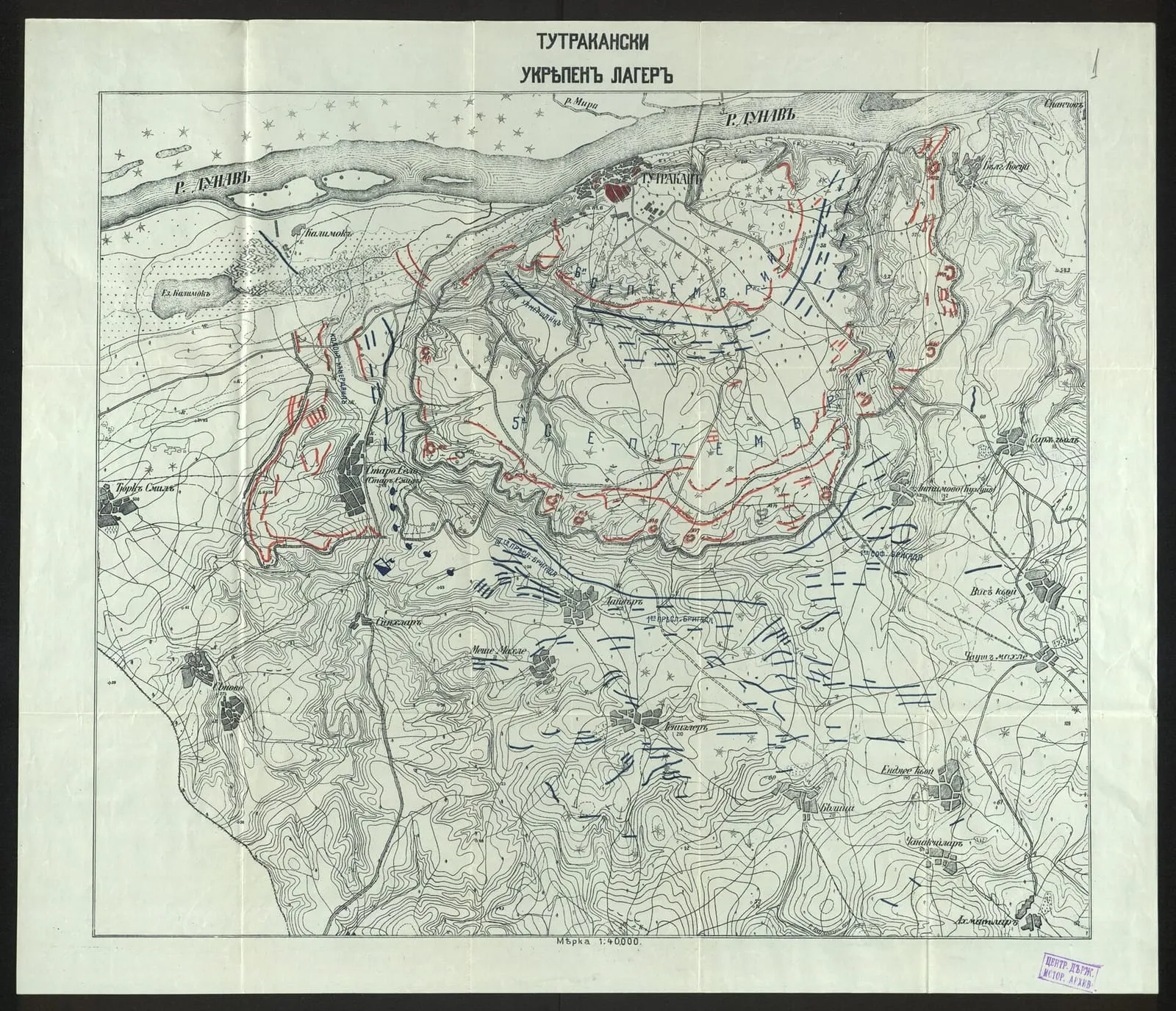
The Battle of Tutrakan was the first great battle of the Bulgarian–Romanian war and the first heavy defeat of the Romanian army in the First World War. Less than a week after Romania entered the war, the Bulgarian 3rd Army, supported by a small German detachment, surrounded the Danube fortress of Turtucaia and after two days of assault forced its garrison to capitulate. About 28,000 Romanian soldiers were taken prisoner. The defeat shook Romania and forced its command to move forces from Transylvania to the south, which to a large extent decided the fate of the whole 1916 campaign.
Name and dates
The town, which had belonged to Bulgaria until 1913, was called Turtucaia by the Romanians and Tutrakan by the Bulgarians. Today it lies in Bulgaria and bears the latter name. In Romania people speak of the Battle of Turtucaia (Bătălia de la Turtucaia), in Bulgaria of the “Tutrakan epic” (Тутраканска епопея). The Polish Wikipedia describes it under the entry Battle of Turtucaia.
The dates differ somewhat. Most studies, among them the American historian Glenn Torrey, count the battle from 2 to 6 September 1916: on the morning of 2 September the Bulgarian 3rd Army crossed the border along its whole length. The Austrian official history writes that the Bulgarians crossed the border as early as 1 September, the day of the declaration of war, and the Romanian Wikipedia begins the battle with the night attacks on Romanian outposts of 31 August – 1 September. Bulgaria was already using the Gregorian calendar, Romania still the Julian one, so in Romanian documents the fortress fell on 24 August. On this page we keep to the dates 2–6 September according to the Gregorian calendar.
Background
Under the Treaty of Bucharest of 1913 Romania took from Bulgaria the southern part of Dobruja with Tutrakan and Silistra. The Romanian general staff at once began rebuilding Turtucaia as a bridgehead from which, in a war with Bulgaria, the army could cross to the southern bank of the Danube. The site was a good one: the Danube narrows here opposite the mouth of the Argeș, and the town is surrounded by hills. The work went on for more than two years, with the help of Belgian military engineers. The main defensive line, about 25–30 kilometres long and resting on the river at both ends, was formed by 15 fortified “centres of resistance”, that is earthen forts with shelters and wire entanglements, linked by shallow trenches. In front of it lay a line of advanced outposts, and behind it, about three kilometres from the town, a weak and neglected second line. The most important thing was missing, however: a bridge to the northern bank. The garrison had a wide river at its back and only boats and a few pontoons. Even so, the Romanians were convinced of the strength of the fortress, which was sometimes called “a second Verdun” or “the Verdun of the East”.
Romania’s war plan assumed that three armies would strike at Transylvania, while the 3rd Army of General Mihail Aslan would only defend the line of the Danube and the border in Dobruja. Turtucaia was held by the 17th Infantry Division of General Constantin Teodorescu, composed mainly of reservists: according to Torrey, 19 battalions, more than 20,000 men and 66 machine guns. It also had about 150 guns, but most of them were old, not quick-firing and fixed in place, so that it was hard to concentrate their fire on one spot. From the west it was supported by monitors of the Romanian Danube flotilla. The nearest Romanian troops were far away: the 9th Division at Silistra, about 60 kilometres to the east, and the 19th Division further still, near Bazargic, that is Dobrich. The Romanians counted on help from the Russian corps of General Andrei Zayonchkovsky, which since 27 August had been crossing into Dobruja, but it was assembling slowly in the area of Medgidia and Cobadin.
On the other side of the border stood the Bulgarian 3rd Army of General Stefan Toshev, subordinate to Field Marshal August von Mackensen. The new German supreme command, in which Paul von Hindenburg had just replaced Falkenhayn, forbade Mackensen for the time being to force the Danube towards Bucharest. Instead he was to enter Dobruja and draw upon himself as many enemy forces as possible, before an army for the counter-offensive was assembled in Transylvania in the second half of September. Mackensen wanted to strike at Turtucaia and Silistra simultaneously. On 31 August, at the railway station in Gorna Oryahovitsa, Toshev persuaded him to concentrate all forces on a single fortress, Turtucaia, which threatened the flank of an army advancing deep into Dobruja. For the attack he assigned the 4th Preslav Infantry Division (PL) of General Panteley Kiselov, a brigade from the 1st Sofia Infantry Division (PL) and a mixed Bulgarian–German detachment under Colonel Kaufmann with a German infantry battalion, an uhlan regiment and heavy batteries. In all, according to Torrey, about 55,000 men and 132 guns, including modern quick-firing howitzers. The other two brigades of the 1st Division were to cover the attack from the direction of Silistra.
Course
The encirclement (2–4 September)
On the morning of 2 September the Bulgarians advanced on the fortress from three sides. The weak Romanian outposts fell back so quickly that by evening the garrison had given up almost the entire advanced line and taken cover behind the line of forts. In the west Kaufmann’s detachment came to a halt under the fire of the monitors and of batteries on the Danube islands; in the south the 4th Division came within less than three kilometres of the main line; and in the east the brigade from the 1st Division met no resistance at all.
On 3 September Kaufmann’s detachment attacked Hill 131 near Staro Selo without success, and the 4th Division moved up to the wire. The commander of the western sector, convinced that the Bulgarians had broken through his line, withdrew his men from strong positions in the evening, which according to the Romanian historian Constantin Kirițescu undermined the defenders’ morale. The first attempt at relief from the interior of Dobruja ended that day in defeat: the Bulgarian 1st Cavalry Division routed a brigade of the Romanian 19th Division near the villages of Kochmar and Karapelit; the brigade lost 654 killed and wounded and about 700 prisoners. Zayonchkovsky’s Russians did not go to the aid of the fortress, because they had orders to advance on Dobrich and then on Varna.
On 4 September the Bulgarians regrouped and brought up their artillery. Toshev entrusted Kiselov with command of all the troops before the fortress, and Major von Hammerstein took over the German–Bulgarian detachment. Teodorescu sent ever more desperate reports to Bucharest. The Romanian command finally sent its strategic reserve, originally intended for Transylvania, to Oltenița. The first battalions of the 15th Division crossed into the fortress on the evening of 4 September and during the night, but they were distributed piecemeal among the sectors, regardless of where the main blow would come from. According to the Austrian official history, with the reinforcements the defenders even had numerical superiority: 34 battalions and, together with the flotilla, 187 guns against the Bulgarians’ 28 battalions and 128 guns.
The assault (5 September)
On 5 September at 6.30 a.m. the Bulgarian artillery opened fire on the forts. On the key southern sector, near the village of Daidir, the Bulgarians had, according to Torrey, roughly a threefold superiority in men. After about an hour and a half of bombardment the infantry went into the attack. The Romanian 79th Infantry Regiment defended itself stubbornly and lost more than three-quarters of its strength, but by about noon Forts 5, 6 and 7 were in Bulgarian hands, and by evening the whole southern and eastern part of the main line had fallen. In the east the Bulgarians reached the bank of the Danube during the night, closing the encirclement. In the west Teodorescu himself ordered Forts 2 to 5 to be given up, and by nightfall the Romanians held only Fort 1 there, covered by the monitors. This day cost the Bulgarians the most: according to Torrey, about 82 per cent of their losses in the whole battle fell on it.
The fall of the fortress (6 September)
During the night the Romanians tried to man the weak second line, and on the morning of 6 September they counter-attacked, counting on relief from Silistra. The command of the 3rd Army had ordered the commander of the 9th Division, General Basarabescu, to go to the aid of the fortress, but he sent only part of his forces, which the Bulgarians routed on 6 September near the village of Sarsânlar, now Zafirovo (PL). The Romanian counter-attacks collapsed under the fire of the Bulgarian artillery, and when new Bulgarian columns appeared in the east instead of the expected relief, panic broke out among the defenders. Around noon or in the early afternoon, according to various accounts, General Teodorescu left by a flotilla boat for the northern bank. Thousands of soldiers crowded on the riverbank. Some threw themselves into the water to swim, some fought for the few boats, and hundreds drowned. In the afternoon Colonel Mărășescu, who had taken over command, decided together with the officers of the garrison to capitulate, and in the evening the Romanian soldiers laid down their arms on the plateau outside the town.
Casualties
The figures differ depending on the source. According to the Austrian official history, based on the Romanian general Radu Dabija, of the 39,000 defenders 28,500 were taken prisoner and 3,570 were killed or wounded. Kirițescu gives 480 officers and 28,000 men taken prisoner and 160 officers and 6,000 men killed and wounded. Some studies and communiqués of the time spoke of 20,000–25,000 prisoners. According to Kirițescu, about 2,000 men managed to escape across the Danube and about 3,500 in scattered groups to Silistra. The victors captured more than a hundred guns and 62 machine guns. Among the prisoners was the poet George Topîrceanu, who remained in Bulgarian captivity until 1918 and described the battle in his memoirs.
The attackers’ losses were also heavy. According to the Bulgarian official history, quoted by Torrey, from 2 to 6 September the Bulgarians lost 1,517 killed, 7,407 wounded and 247 missing. Kirițescu, citing Bulgarian data, gives 199 officers and 7,773 men killed or wounded, and the Austrian official history about 7,950 men. The Germans, according to Torrey, lost only a few killed and a few dozen wounded.
Significance
The rapid fall of a fortress regarded as impregnable caused shock in Romania. Two divisions had practically vanished from the army’s order of battle, and the Austrian official history notes that the Romanian command realised that its soldiers were tactically inferior to the enemy, easily gave way to panic and bore the fire of heavy artillery badly. On 6 September all troops south of the Danube were placed under Zayonchkovsky, and soon afterwards Aslan lost command of the 3rd Army, which was taken over by General Alexandru Averescu. Divisions began to be taken from the army in Transylvania and sent south, and on 9 September the offensive beyond the Carpathians was halted. On 15 September a council of war in Bucharest decided to shift the main effort to the Danube. For many Romanians Turtucaia became a symbol of the incompetence of their leaders. The politician Constantin Argetoianu later wrote that hatred of the political parties in Romania began with Turtucaia.
For the Central Powers the victory was very valuable. It strengthened the self-confidence of the Bulgarians, who showed that they could fight alongside the Germans against Russia’s allies as well, and it tightened the alliance. According to Torrey, the Emperor Wilhelm II, depressed by Romania’s entry into the war, gave a champagne reception for the Bulgarian representative at headquarters on hearing the news of the victory. A few days later the Romanians abandoned Silistra without a fight, and the Russian–Romanian forces fell back deep into Dobruja. The halting of the Romanian offensive in Transylvania, in turn, gave Erich von Falkenhayn time to gather forces for the counter-stroke, which began at the end of September.
Spotted a mistake?Report an error