Germany · The Central Powers
Wilhelm Solf
Governor of German Samoa (1900–1911), State Secretary of the Imperial Colonial Office (1911–1918) and of the Foreign Office (1918)
- Born:
- 5 October 1862, Berlin
- Died:
- 6 February 1936, Berlin
- Author:
- Natalia
- Photo:
- Bundesarchiv, Bild 137-31813, CC BY-SA 3.0 DE, Wikimedia Commons

Wilhelm Solf was one of the few liberals in the government of Imperial Germany. An Indologist by training, he governed Samoa for eleven years and from 1911 headed the Imperial Colonial Office. The war took his colonies from him within a few months, but not his post. For four years he was one of the most loyal supporters of Chancellor Theobald von Bethmann Hollweg, argued for a compromise peace and constitutional reform, and at the same time drew up plans for a great German empire in Central Africa. In October 1918 Chancellor Max von Baden entrusted him with the Foreign Office. Solf signed the notes in which Germany asked President Wilson for an armistice and, as the last foreign minister of the empire, steered German diplomacy through the revolution until his resignation in December 1918.
Before the war
He was born on 5 October 1862 in Berlin into the wealthy family of a liberal businessman. He studied oriental languages, above all Sanskrit, and in 1885 took a doctorate in Indology at Halle. He translated into German a Sanskrit grammar that was used at universities for years. In 1888 he entered the diplomatic service and was posted to the consulate-general in Calcutta. After three years he left to study law, since without legal training he could not be promoted. After his examinations he returned to the colonial department of the Foreign Office. In 1898 he was a judge in Dar es Salaam, and in 1899 he became president of the municipal council in Apia on Samoa, then still under the joint control of three powers.
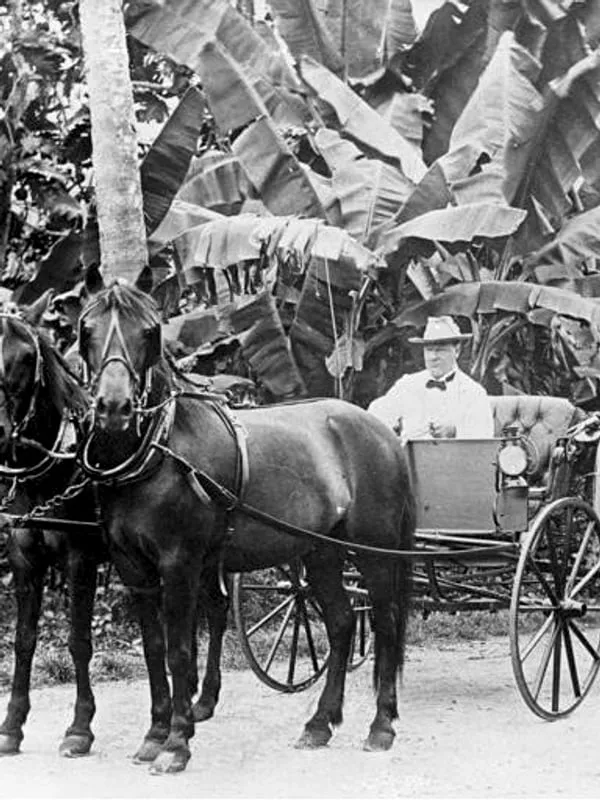
When in 1899 Germany and the United States divided the islands and Britain renounced its claim to them, Solf became, on 1 March 1900, the first governor of German Samoa. He ruled through Samoan chiefs, on the model of British “indirect rule”, refused to raise military units, supported schools teaching in the Samoan language and protected Samoan land from purchase by planters. In 1909 he ended the resistance movement of the chief Lauaki without bloodshed, although in the end, with the help of warships sent out to him, he exiled its leaders to Saipan. He was considered the best expert on indigenous cultures among German colonial officials, but his rule rested on strict separation of the races: he banned mixed marriages on Samoa, and Chinese labourers on the plantations worked in harsh conditions.
In December 1911 Solf became State Secretary, that is, head of the Imperial Colonial Office. He was the only head of that office to tour all four African colonies, in 1912–1913. He criticised abuses of forced labour and porterage, but approved the expropriation of the Duala people in Kamerun. He believed that colonial cooperation could soften the rivalry of the powers in Europe. In 1913 he negotiated with the British Colonial Secretary, Lewis Harcourt, a secret agreement on the future partition of the Portuguese colonies. His policy enjoyed the support of all parties in the Reichstag except the right.
Loss of the colonies
Solf refused to believe until the end that a European war would extend to the colonies. He counted on their being protected by the general act of the Berlin Conference of 1885, which provided for the possible neutralisation of the Congo basin, and cabled the colonies that they were in no danger. He miscalculated. In August 1914 the British and French took Togoland, and the New Zealanders occupied Samoa without a fight, the colony he had governed for eleven years. By the end of the year Germany had also lost New Guinea and Kiautschou, in 1915 South West Africa, and at the beginning of 1916 Kamerun. Only East Africa held out until the end of the war, under Governor Heinrich Schnee, Solf’s former deputy on Samoa, and Paul von Lettow-Vorbeck.
In the first days of the war a tragedy took place in Kamerun that some historians link to Solf’s office. On 8 August 1914 the colonial authorities hanged for high treason the Duala king Rudolf Manga Bell, who had peacefully protested against the expropriation of his people. According to Solf’s German biographer, the office in Berlin had refused the day before to forward to Kamerun a telegram from Bell’s lawyer asking for a stay of execution, although the connection was still working.
The office without colonies did not become a sinecure for Solf. In the autumn of 1914 he prepared the “Mittelafrika” plan, a great contiguous colonial empire in the middle of Africa made up of the former German possessions and of territories taken from France, Belgium and Portugal. Bethmann Hollweg included it in his September Programme of war aims, and from then on it remained a fixed item among German demands. According to historians, Solf also treated it tactically: expansion in Africa was to replace annexations in Europe, especially in Belgium, and make peace with Britain easier.
With Bethmann Hollweg
Solf was one of Bethmann Hollweg’s closest allies in the government. He warned against the demands of the annexationists, who in his words wanted to “paint half the world black, white and red”, and gave lectures at home in favour of a moderate peace. In 1916, in conversation with Edward House, the envoy of President Woodrow Wilson, he openly admitted that the chancellor wanted to avoid a break with America but was under heavy pressure from the army and navy over submarine warfare. The decision on unrestricted submarine warfare, taken in January 1917, was a defeat for him. He wrote to a friend that one could not hold an olive branch in one hand and fire a pistol with the other.
In domestic politics Solf demanded from the outset the abolition of the Prussian franchise, based on three classes of taxpayers, and the transformation of the empire into a parliamentary monarchy. At the Crown Council in July 1917 he supported Bethmann, who was urging Emperor Wilhelm II to promise equal suffrage. The emperor agreed, but a few days later, under pressure from the Supreme Army Command, the chancellor had to go. Under his successor, Georg Michaelis, Solf proposed in September 1917 that the government declare that Germany wanted the restoration of a free and independent Belgium. The government rejected the proposal. In the autumn, during the search for a new chancellor, the Social Democrats and the Progressives put forward his candidacy, but the National Liberals opposed it. Georg von Hertling became chancellor.
Solf was no pacifist. In his office’s war aims programme of 1917 he demanded not only the return of the colonies but also a German Central Africa made up of French, Belgian and Portuguese lands, and in the spring of 1918 he adopted the even more far-reaching demands of the German Colonial Society, although according to his biographers he himself did not believe they would be met.
The notes to Wilson
At the turn of September and October 1918, when the Supreme Army Command demanded an immediate request for an armistice and Hertling resigned, Prince Max von Baden became the new chancellor. State Secretary Paul von Hintze left with the old government, and the Foreign Office was taken over by Solf, who also kept the Colonial Office. The first note requesting an armistice, sent on the night of 3–4 October, was still signed by the chancellor himself. The following ones bore Solf’s signature.
In the note of 12 October Solf assured the president that Germany accepted the Fourteen Points as the basis for peace, was ready to evacuate the occupied territories, and that the government spoke for the majority of the Reichstag and of the nation. Wilson’s second note of 14 October, after the sinking of the Leinster, demanded an end to submarine warfare and a change of government in Germany. The Supreme Army Command then wanted to withdraw from the negotiations. Solf saw this as an attempt to shift responsibility for the defeat onto the government and the country. In its reply of 20 October the government agreed that the armistice terms should be set by military advisers, announced an end to attacks on passenger ships and described the constitutional reforms under way. When in his third note Wilson made it clear that he would not deal with the “masters of Germany”, Solf replied briefly on 27 October: the government took note of the note, recalled the profound changes in the constitution of the Reich and awaited armistice proposals. These came with the Lansing Note of 5 November, which referred the Germans to Marshal Foch.
On the same day the government demanded that the legation of Soviet Russia leave Berlin, as its head, Adolph Joffe, had been funding German revolutionaries. A few days later the revolution reached Berlin.
Revolution and resignation
After 9 November Solf remained in office as one of the experts whom the new authority, the Council of the People’s Deputies chaired by Friedrich Ebert, retained for the continuity of the state. During his time the Foreign Office conducted the first contacts with the victors after the Armistice of Compiègne, which Matthias Erzberger had signed on behalf of the government. The former dignitary of the empire fitted badly into a revolutionary government, however. He soon came into conflict with the Independent Social Democratic Party of Germany, especially its leader Hugo Haase. When it came out that Joffe, before his departure, had handed money for the revolution to the Independent deputy Oskar Cohn, Solf refused to work any further with its representatives in the government. On 13 December 1918 he resigned. He was succeeded by Count Ulrich von Brockdorff-Rantzau.
After the war
Solf joined the liberal German Democratic Party and in 1919 published a book on colonial policy in which he defended the German record in Africa against the victors’ accusations. From 1920 to 1928 he was ambassador in Tokyo, where he rebuilt relations with Japan, a former enemy, and promoted scientific and cultural cooperation. After his return he headed the Japan Institute in Berlin. He was an opponent of Nazism from the start. He died in Berlin on 6 February 1936. Later, opponents of Hitler, the so-called Solf Circle, met at the house of his widow, Johanna Solf. In 1943–1944 the Gestapo broke it up, and most of its members were executed. His widow and daughter survived the war in prison.
Assessment
His biographers present Solf as a “lost man” between eras, as Peter Hempenstall and Paula Tanaka Mochida titled their book. He was an enlightened, cosmopolitan official, an Anglophile and a reformer who in Imperial Germany never had a party of his own or real power, and who, when the Social Democrats took power, seemed to them a man of the old order. Older German literature, led by Eberhard von Vietsch’s biography, emphasised his efforts for a compromise peace and his resistance to the annexationists.
Newer research on German colonialism is more critical. It points out that his “enlightened colonialism” on Samoa went hand in hand with racial segregation, that as State Secretary he consented to the expropriation of the Duala, and that his “Mittelafrika” plans were imperialism on a grand scale, even if conceived as a substitute for annexations in Europe. Historians agree, however, that in October 1918 Solf played an honest part: convinced that the war could not be won, he conducted the correspondence with Wilson so as to bring about an armistice, despite the opposition of the Supreme Army Command.
Sources
Spotted a mistake?Report an error
Often appears with
People who appear in the same events.