1915: The Great Retreat of the Russian army
Second Battle of Przasnysz
- Dates:
- 13–17 July 1915
- Front:
- Eastern Front
- Location:
- Przasnysz and its surroundings, between Grudusk, Ciechanów and the Orzyc valley, south towards the Narew (Różan, Pułtusk, Serock), northern Masovia, Kingdom of PolandOn the battle map →
- Sides:
- German EmpirePaul von Hindenburg, Max von GallwitzRussian EmpireMikhail Alekseyev, Aleksandr Litvinov
- Result:
- German victory. The front of the Russian 1st Army was broken, Przasnysz fell on 14 July, and the Russians fell back about 30 km to the Narew bridgeheads.
- Author:
- Natalia
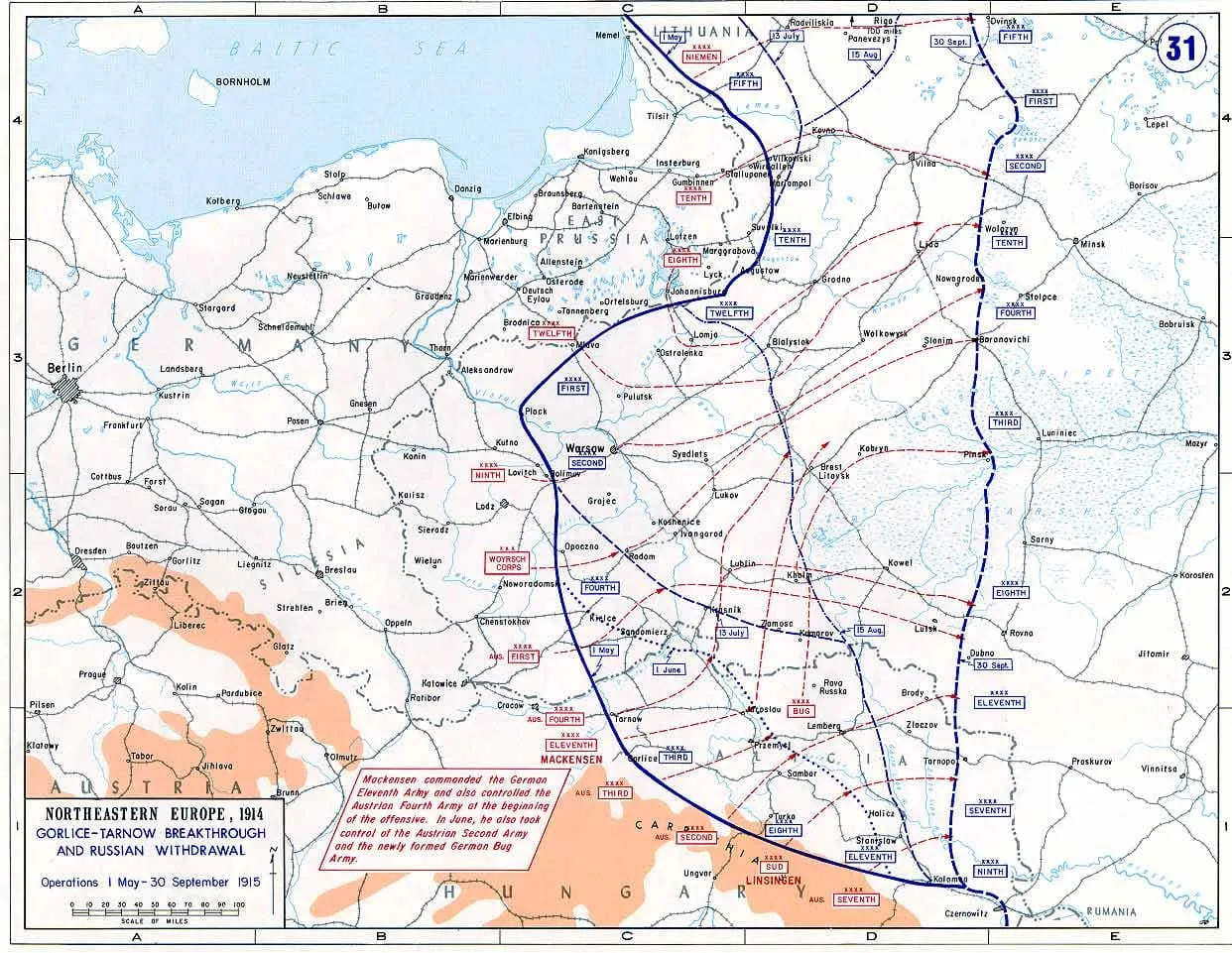
The Second Battle of Przasnysz opened the German summer offensive on the northern flank of the Eastern Front. On 13 July 1915 the army group of General Max von Gallwitz attacked the positions of the Russian 1st Army on both sides of Przasnysz, the same town that had been fought over in February. This time the Germans had a crushing superiority in artillery. On the first day they took the main line of defence, on 14 July they occupied Przasnysz, and by 17 July they had pushed the Russians back some 30 kilometres, to the fortified bridgeheads on the Narew. The breakthrough was the beginning of the wider Battle of the Narew and the Biebrza.
Name and dates
On this page we use the dates 13–17 July 1915, in line with the British chronology of the war and with the Soviet military encyclopaedia, which describes this defensive operation of the 1st Army as taking place on 30 June – 4 July by the Julian calendar, that is, 13–17 July by the Gregorian. Other works adopt other limits. The Polish Wikipedia restricts the “Second Battle of Przasnysz” to 13–14 July, that is, to the fight for the town itself, while the Russian and English Wikipedias extend it to 18 July, when the Germans halted their attack in front of the Narew line. In German historiography this fighting was called the “breakthrough battle of Przasnysz” (Durchbruchsschlacht von Przasnysz). The word “second” distinguishes it from the First Battle of Przasnysz of February 1915.
Background
After the breakthrough at Gorlice and the recovery of Galicia, the German command was looking for a way to decide the war in the east. On 2 July 1915 a conference was held in Posen in the presence of Emperor Wilhelm II. Field Marshal Paul von Hindenburg and his chief of staff Erich Ludendorff wanted to strike far to the north-east, towards Kovno and Vilna. The Emperor, however, backed the plan of the Chief of the General Staff, Erich von Falkenhayn: a powerful thrust southwards from the border of East Prussia across the Narew. It was to link up with the armies of August von Mackensen, advancing from Galicia on Lublin and Chełm, and trap the Russian forces in the westward-projecting Kingdom of Poland.
The main blow was entrusted to Gallwitz’s army group, which in July was reinforced with several corps brought in from other fronts. It was formally renamed the 12th Army only on 7 August 1915, which is why some works already use that name. Gallwitz decided to strike with the centre of his deployment at Przasnysz, on a sector about 30 kilometres long between Grudusk and the river Orzyc. The right flank was to watch the fortress of Novogeorgievsk (Modlin), and the left was to maintain contact with the German 8th Army advancing alongside.
Forces
According to Russian and German works, Gallwitz’s group numbered about 177,000 soldiers. Three corps (XIII, XVII and XI) with seven divisions were thrown into the attack, with more behind them. Estimates of the German artillery range from about 800 to over 1,200 guns. At least 800 of them took part in the artillery preparation, and each gun had a stock of several hundred shells.
The Russian 1st Army was commanded by General Aleksandr Litvinov. It comprised the I Turkestan Corps, the I Siberian Corps, the XXVII Army Corps and the I Cavalry Corps, and on its eastern side it bordered the IV Siberian Corps of the 12th Army. By various calculations the Russians had between about 107,000 and 141,000 men and between just under 400 and about 500 guns, with a severe shortage of ammunition. They were, however, defending positions that had been built up since the spring: several lines of trenches with dugouts and wire entanglements. The whole North-Western Front was commanded by General Mikhail Alekseyev.
Course
Breakthrough (13 July). During the night the German infantry advanced to within about a kilometre of the Russian trenches. Hindenburg came to Gallwitz’s headquarters at Willenberg, while Gallwitz himself watched the attack from an observation post at Dzierzgowo. At dawn, at about five o’clock, the artillery opened fire. The bombardment lasted several hours and ended with salvoes of mortars. Heavy shells destroyed the shelters, burying the soldiers inside, and the village of Osówka was razed to the ground. According to Russian accounts, the 2nd and 11th Siberian Rifle Divisions lost up to a third of their strength in the bombardment alone. Torrential rain delayed the infantry attack until about ten o’clock. By noon the Germans had taken Grudusk and the whole first line of defence, and by the evening also a large part of the second, penetrating the Russian deployment to a depth of between a few and ten kilometres. The XIII Corps got furthest, forcing the 2nd Siberian Division to retreat during the night towards Krasnosielc. According to Russian figures, the Germans took about 5,400 prisoners on the first day.
Fall of Przasnysz (14 July). During the night of 13/14 July units of the 1st Army withdrew to a rear position. On 14 July the Germans entered Przasnysz, which this time was not the main objective of the attack but a point on its path. They spent the rest of the day bringing up artillery before attacking the new Russian line.
Second position (15–16 July). On 15 July, after another hurricane bombardment, the Germans pressed on. According to Russian works, ten German divisions were then attacking four and a half Russian ones. The German 38th Division took Ciechanów after street fighting (according to local sources, the fighting for the town lasted until 16 July), the XVII Reserve Corps approached Nasielsk, and the 50th Reserve Division broke through the positions of the Russian 30th Infantry Division. The Russians counter-attacked. A brigade of the 14th Cavalry Division charged into the ranks of the German infantry but was stopped by fire. After heavy fighting the fortified Russian second position began to waver.
Retreat to the Narew (16–17 July). Alekseyev reinforced the 1st Army with units from the 2nd and 4th Armies and from the garrison of Novogeorgievsk, but he could no longer restore the front. Litvinov withdrew his corps in stages, fighting for every position. By 17 July the Russians had given up a belt 25–35 kilometres deep and occupied the bridgehead fortifications in front of the Narew, at Różan, Pułtusk and Serock. The German divisions, exhausted and delayed by rain and bad roads, halted their attack in front of this line and began preparing to storm it.
Losses
The casualty figures diverge. The Russian 1st Army lost about 40,000 men in these days, including many prisoners, which both German sources and some Russian ones confirm. The 11th Siberian Rifle Division suffered particularly badly, losing, according to Polish works, about three quarters of its strength. German losses are estimated very differently: according to German figures they amounted to about 10,000 men, according to the Polish Wikipedia about 16,000, according to the calculations of the Russian historian Sergei Nelipovich about 20,000, and some Russian authors give as many as 40,000.
The civilian population suffered heavily. According to Polish works, as a result of the fighting of 1914–1915 about 70 per cent of the buildings of Przasnysz were destroyed, and many villages in the area, among them Jednorożec, were almost completely ruined. For Przasnysz, 14 July 1915 marked the beginning of a German occupation that lasted until November 1918.
Significance
The breakthrough at Przasnysz showed how much the war in the east had changed since February. Then the Russians had managed to retake the town with a counter-offensive by fresh corps. In July, deprived of shells and reserves, they had nothing with which to answer the concentrated fire of several hundred guns. Here the Germans repeated the method used at Gorlice: a short, extremely powerful artillery preparation on a narrow sector, followed by an infantry attack behind which the artillery shifted its fire into the depth.
The victory did not, however, bring the decision Falkenhayn had hoped for. The Russians were not routed but fell back in good order to the Narew line, where further heavy fighting took place. In this way they gained time to withdraw their troops from the Vistula salient. The German pincers, closing from the north under Gallwitz and from the south under Mackensen, did not snap shut in time, and the Russian armies abandoned Warsaw in August and the whole Kingdom of Poland by the autumn.
Spotted a mistake?Report an error