1916: The Romanian campaign
Second Battle of the Jiu
- Dates:
- 11–17 November 1916
- Front:
- Balkan Front
- Location:
- The Jiu valley from the Vulcan and Surduc passes (Lainici gorge) in the Southern Carpathians to the foothills south of Târgu Jiu, Gorj county (Romania)On the battle map →
- Sides:
- Germany and Austria-HungaryErich von Falkenhayn, Viktor Kühne, Eberhard von SchmettowRomaniaParaschiv Vasilescu
- Result:
- Central Powers victory. The Romanian 1st Division and the 17th Division sent to its aid were routed, and the German 9th Army emerged from the mountains onto the Oltenian plain.
- Author:
- Łukasz Skowroń
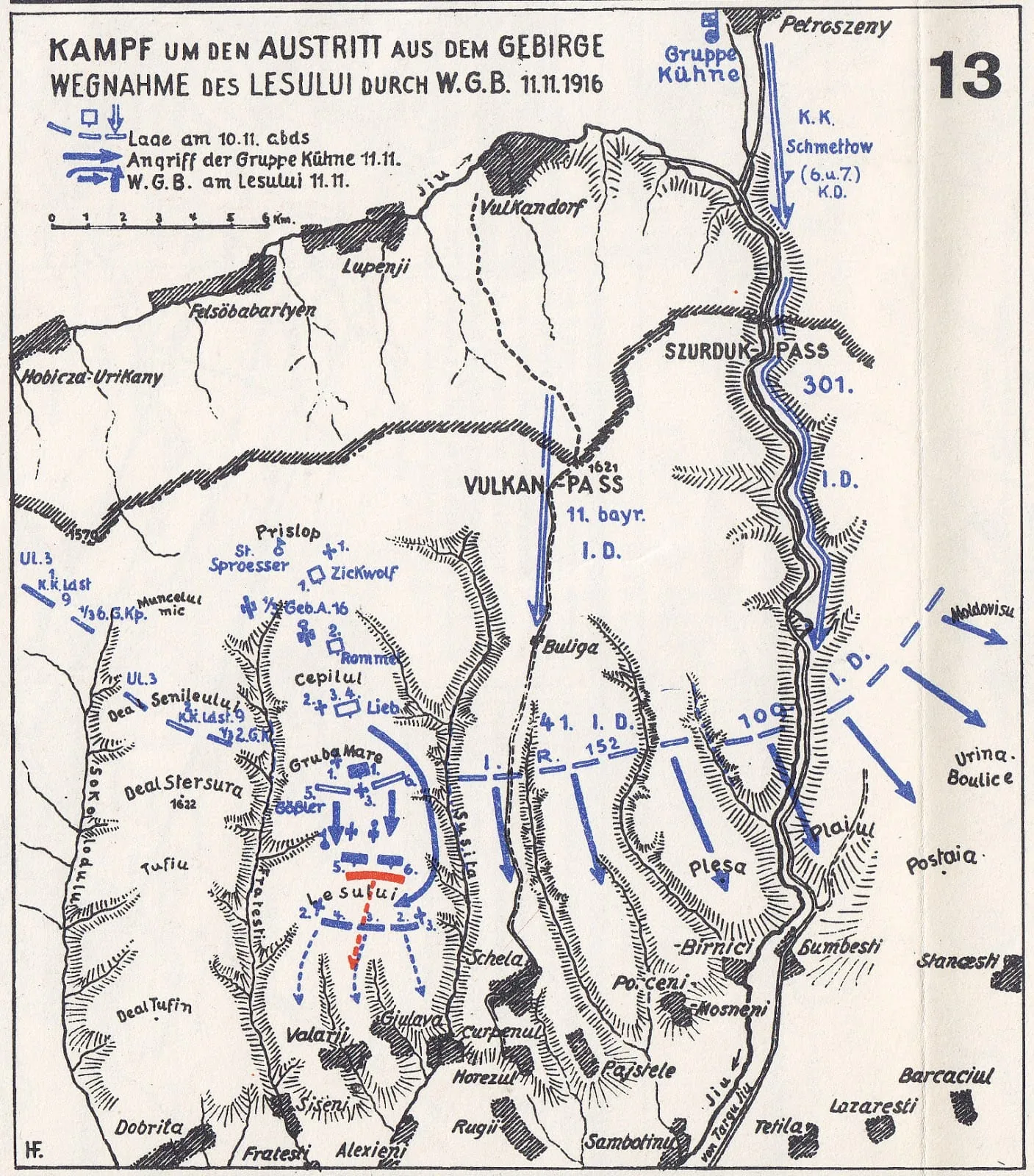
The Second Battle of the Jiu decided the fate of western Wallachia. Throughout October 1916 the German 9th Army of General Erich von Falkenhayn tried in vain to cross the passes of the Southern Carpathians. In November it therefore concentrated its forces on the westernmost sector of the front, in the valley of the river Jiu. From 11 November General Viktor Kühne’s German LIV Corps fought its way out of the mountains, on 15 November it entered Târgu Jiu, and on 17 November, in the foothills south of the town, it routed the last Romanian divisions barring its way. From there German cavalry and infantry moved out onto the plain of Oltenia, and the whole Romanian defence of the Carpathians began to crumble.
Name and dates
Romanian historians, among them Constantin Kirițescu, call this fighting the Second Battle of the Jiu, to distinguish it from the first, in October, which the Romanians won. In the Austrian official history (“Österreich-Ungarns letzter Krieg”) it is called the Battle of Târgu Jiu. The sketch map attached to that volume covers the days from 11 to 17 November 1916, and the text divides them into the fight to break out of the mountains (11–14 November) and the Battle of Târgu Jiu proper (15–17 November). We adopt this framework. The first date is the day Kühne’s corps launched its general attack, the second the day of the decision in the foothills. The English Wikipedia starts the battle as early as 7 November, with local fighting for the peaks west of the valley. Romania then kept time by the Julian calendar, so in Romanian documents the battle lasted from 29 October to 4 November.
Background
At the turn of September and October the Central Powers drove the Romanians out of almost all of Transylvania, ending the Battle of Transylvania. Falkenhayn hoped to cross the mountains on the heels of the retreating enemy and reach Bucharest directly. The plan failed. In mid-October the 9th Army crossed the Romanian border, but at the Predeal, Bran and Buzău passes and in the Olt valley Romanian resistance stiffened, and the narrow mountain valleys did not allow the Germans to exploit their superiority in artillery.
The first attempt to break through the Jiu valley was made by the group of General Paul von Kneußl, commander of the Bavarian 11th Infantry Division. On 23 October his units, among them the Austro-Hungarian 144th Infantry Brigade and the German 6th Cavalry Division fighting dismounted, attacked the Romanian 11th Division. Within a few days they pushed it off the border ridges, took about 2,200 prisoners and 28 guns, and on 26 October reached the Jiu at Porceni and Sâmbotin, a dozen or so kilometres from Târgu Jiu. The commander of the Romanian 1st Army, General Ioan Culcer, judged the situation critical and wanted to withdraw. The high command removed him and gave the army to General Ion Dragalina. Dragalina ordered a counter-attack against the attackers’ flank and rear, but on 25 October, while reconnoitring in the Jiu gorge, he was seriously wounded, and he died in Bucharest on 9 November. The counter-attack following his plan began on 27 October, in pouring rain turning to snow. The Romanians surrounded and almost destroyed a Bavarian battalion at Rasova, captured two Bavarian batteries and by early November had pushed the exhausted, poorly supplied attackers back into the forests below the border ridge. Both exits from the Petroșani basin, however, remained in the hands of the Central Powers, and with them a starting point for the next attack. General Paraschiv Vasilescu took over command of the 1st Army from Dragalina.
Forces and plans
On 29 October Falkenhayn decided to repeat the blow at the same spot, this time with much larger forces. The orders went to General Viktor Kühne, commander of LIV Corps, brought in from the Oituz Pass. At Petroșani he assembled the German 41st, 109th and Bavarian 11th Infantry Divisions, the 301st Division with the Austro-Hungarian 144th Brigade, and the Württemberg Mountain Battalion. According to the Austrian official history he had 40 battalions, 52 squadrons and 188 guns. Behind the infantry waited General Eberhard von Schmettow’s cavalry corps (6th and 7th Cavalry Divisions), which was to move out onto the plain once the road was open. Kühne’s task was to break through on both sides of the road through the Surduc Pass, the Jiu gorge more than 20 kilometres long, and to open the way out of the mountains at the level of Târgu Jiu. The corps was then to turn east, towards the Olt, and open the way onto the plain for General Krafft’s group, which was attacking in the Olt valley.
The preparations took almost two weeks and were carried out with great care. Falkenhayn left his headquarters in Brașov and showed himself at the front south of the town to divert the Romanians’ attention from the Surduc Pass. According to Glenn Torrey and the Austrian official history, the Romanian high command did not believe that after his October defeat the enemy would strike here again so soon. It withdrew some of the troops on the Jiu into reserve and from the remnants of the 11th Division and reinforcements formed a new 1st Division of eighteen and a half battalions and 16 batteries. Kühne’s forces outnumbered it more than two to one, and by far more in artillery.
Course of the battle
Breaking out of the mountains (11–14 November). The attack, originally set for 6 November, began on 11 November. The day before, units of the 144th Brigade and the 109th Division had taken the ridge from which the assault was to start, and for several days a company of the Württemberg Mountain Battalion under Lieutenant Erwin Rommel, later a field marshal, had been fighting for the peaks west of the valley. The 41st Division and the Württembergers attacked west of the road in the gorge, the 109th Division east of it. The Romanians defended themselves, as the Austrian official history admits, “with remarkable courage”, but by evening the German divisions had emerged from the forests. The 109th Division fought through the night and on the morning of 12 November took the village and railway station of Bumbești at the mouth of the gorge. General Vasilescu ordered the 1st Division to hold out for another two or three days, while the high command, failing to grasp the seriousness of the situation, even instructed it to throw the enemy back over the border. By 13 November Kühne already had a bridgehead in the foothills on the line Vălari–Sâmbotin–Mușetești. On 14 November the Romanians began to withdraw, and the cavalry corps passed through the whole gorge in a single march and bivouacked for the night at Bumbești. All of Kühne’s troops now stood south of the mountains.
Battle of Târgu Jiu (15–17 November). The Romanian command, on the advice of the head of the French military mission, General Henri Berthelot, wanted to stop the enemy as close to the mountains as possible until the planned Russian and Romanian counter-offensive in Moldavia got under way. The 1st Division was to dig in on the hills south of Târgu Jiu, while the 17th Division, arriving by rail and re-formed after its destruction at Turtucaia, was to strike the Germans’ eastern flank. 15 November passed almost without fighting. The Romanians retreated faster than the Germans could advance along the sodden roads, and the 41st Division entered Târgu Jiu, the capital of Gorj county, which according to Torrey was defended only by a weak militia detachment. A German uhlan regiment cut the railway east of the town. On 16 November, on ground softened by snow, the Bavarian 11th Division clashed with the Romanian 17th Division as it entered the fight, and in the evening took Petrești de Sus, where the Romanians were unloading their trains.
17 November brought the decision. The Romanian divisions were ordered to counter-attack, but the 41st and 109th Divisions broke through the 1st Division, stretched over a wide front, between the villages of Dragoeni and Florești. Its western wing was cut off, and about 2,500 soldiers with two guns were taken prisoner. The Bavarians had a hard time against the boldly attacking 17th Division, but German artillery broke its assaults, and in the evening the Bavarians reached Cărbunești. On the right wing the German cavalry advanced south along the road, and the Austro-Hungarian battalions of the 301st Division threw back a Romanian flank detachment in the east. A detachment sent by the Romanians from the Cerna through Baia de Aramă to cut the Germans’ line of retreat did not reach the battlefield in time. In the evening the Romanian high command ordered both shattered divisions to withdraw to a position north of Filiași.
Operations at Orsova. At the same time as Kühne, on 11 November, the Austro-Hungarian group of Colonel Szivó attacked in the far west. After street fighting the Romanians abandoned Orsova by 13 November, which they had taken at the beginning of September, and fell back to the eastern bank of the Cerna. There their so-called Cerna group repulsed further attacks. After the defeat at Târgu Jiu it was ordered to retreat, but under pressure from the representatives of the Allies, who did not want to hand the enemy the Danube waterway, the order was cancelled and the group was told to fight “to the last man”.
Losses
Complete figures for the losses are lacking. The Austrian official history mentions only the 2,500 prisoners taken on 17 November. According to Torrey, three-quarters of the men of one Romanian regiment were killed or wounded and the rest taken prisoner. The Romanian 1st Division shrank to about 1,800 men and the 17th Division to about 2,000. The Austrian official history, citing Romanian sources, states that on 19 November the two divisions together numbered about 3,800 men. German and Austro-Hungarian losses were much smaller than in October, but their totals have not been published.
Significance
The breakthrough on the Jiu was the decisive victory of the 1916 Romanian campaign. For the first time since the declaration of war in August, the troops of the Central Powers emerged from the Carpathians onto the plain of Wallachia, and at a point where the Romanian command no longer had any reserves. German cavalry and infantry set off in pursuit to the south and east. On 21 November they took Craiova, and on 23 November they reached the Olt. On the same day the army of Field Marshal August von Mackensen crossed the Danube at Svishtov. The Romanian Cerna group, cut off at Orsova, surrendered after two weeks of retreat on 6 December, the same day the Central Powers took Bucharest.
John Buchan, in his history of the war written as it unfolded, observed that the consequences of the breakthrough at the western end of the front were in any case less dangerous for the Romanians than if the Germans had broken through the passes south of Brașov and cut the country in two, separating Wallachia from Moldavia. Precisely because the Romanians had held the passes in the central part of the Carpathian arc throughout October, their army was later able to withdraw into Moldavia and survive. The Second Battle of the Jiu nevertheless gave the 9th Army what it had failed to win in six weeks of fighting in the mountains: an open road to Bucharest.
Spotted a mistake?Report an error